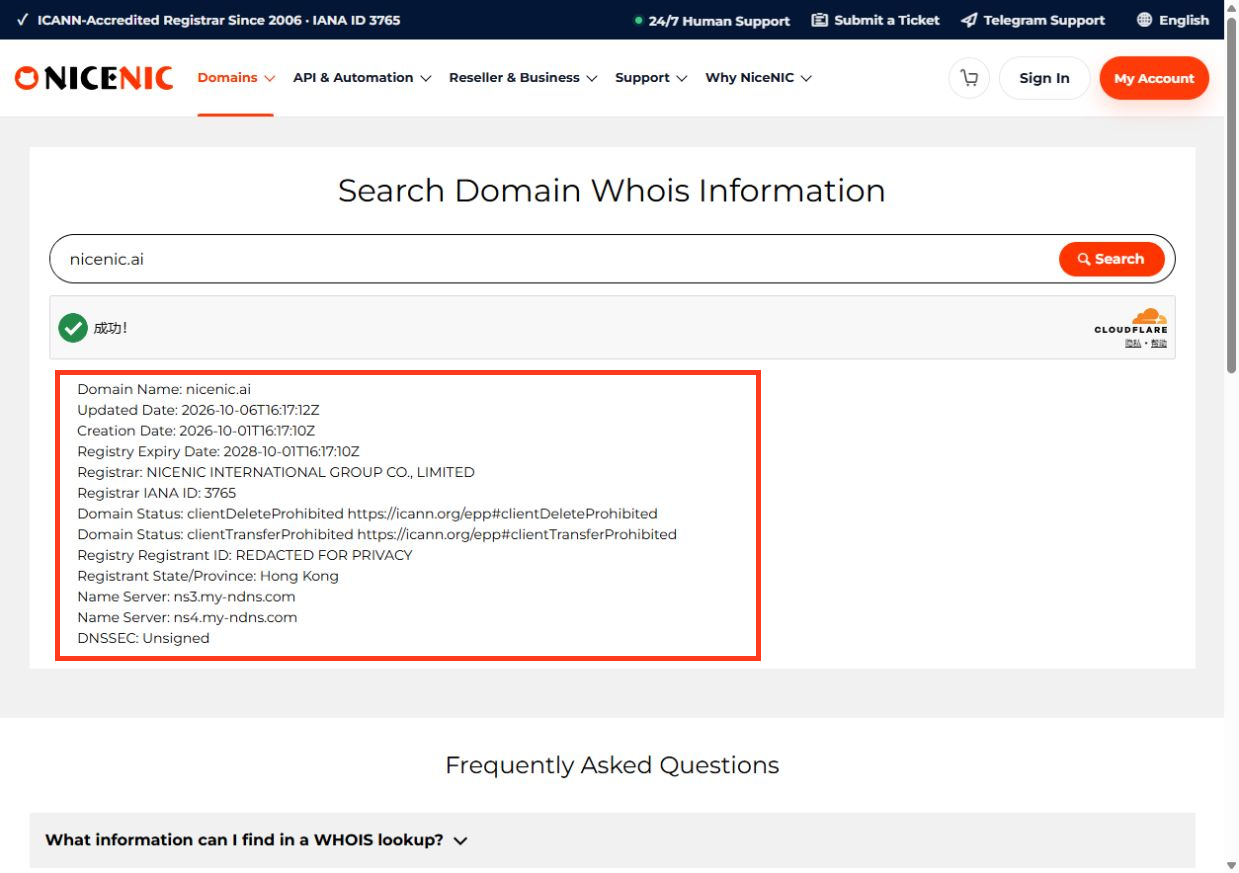
Does NiceNIC provide any domain privacy protection services?
NiceNIC supports domain privacy protection where the extension and its registry policies permit it. Privacy can reduce the amount of contact information displayed in public registration lookup services, but it does not remove the need to provide accurate details to the registrar and registry.
Is privacy available for my domain?
Availability depends on the exact TLD, registry requirements, the nature of the registrant and the type of public data service. Some extensions already redact personal data by registry policy; others support an additional privacy/proxy service; some restrict proxy or trustee arrangements.
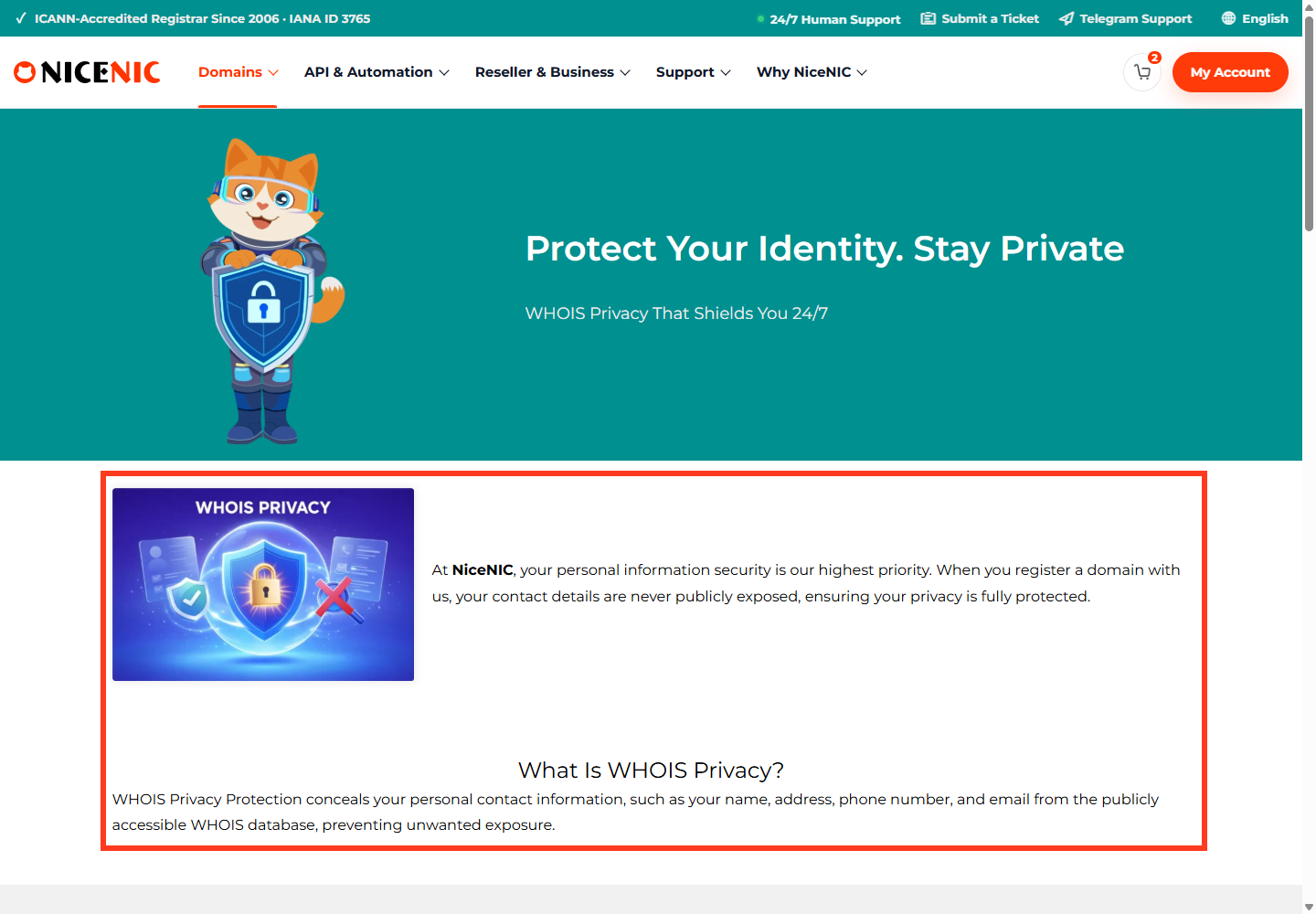
NiceNIC describes free privacy for most eligible generic TLDs on its WHOIS Privacy information page. That is not a promise of identical availability for every country-code extension.
To check your domain:
- Sign in to your NiceNIC account and open the domain's details.
- Look for the privacy option or privacy status shown for that extension.
- Confirm the name is eligible and review any product-specific service terms before enabling or changing a setting.
- Review the domain's current RDAP/WHOIS output after the update. Redaction may be due to registry or legal rules rather than a NiceNIC privacy service.
What privacy does not do
- It does not hide your details from the registrar, registry, lawfully authorized requests or required verification processes.
- It does not guarantee anonymous ownership or prevent all spam, phishing, or abusive contact.
- It does not replace domain account security, strong passwords or two-factor authentication.
- It does not imply that all ccTLDs offer the same level of public-data protection.
If an option is missing, do not assume it can be forced through a reseller API or by entering false contact information. Ask NiceNIC Support for the extension-specific privacy treatment and any supported alternatives.
Related: What Is Domain Privacy?.
Which extensions may behave differently?
Some ccTLDs or restricted TLDs require a separate privacy check instead of assuming standard gTLD privacy/proxy eligibility. Examples worth checking individually include .CA, .CH, .CN, .CO.UK, .COM.AU, .COM.SG, .DE, .ES, .EU, .FR, .GG, .IN, .IS, .LAW, .LI, .NL, .NU, .NYC, .ORG.AU, .SG, .TO, .UK and .US.
This is not a current exclusion list or a claim that every extension mentioned prohibits privacy. Three things must be checked separately:
- The registrar's offered service: whether NiceNIC currently displays and enables its free privacy/proxy feature for this individual domain.
- The registry's publication rule: whether the registry already redacts personal data (for example, certain individual-holder categories) without a separate proxy.
- The legal registrant requirement: whether an extension requires actual applicant details, local eligibility or documentary proof.
A customer owning .COM and .DE could see personal fields hidden on both public lookups, but for different reasons. The .COM may have registrar privacy/redaction treatment while an individual's .DE data may be withheld by DENIC policy. That distinction determines which setting the customer can actually change.
How to check without guessing
Compare the exact TLD's checkout/privacy indication, your NiceNIC account's privacy control, and the registry's current RDAP or WHOIS result. If the privacy button is missing, provide Support the extension and registrant category—not a public copy of sensitive contact data—and ask whether a different, compliant protection mechanism exists.