


Before trusting a company with a domain, verify more than the registration price.
A domain registrar can affect your renewal costs, transfer rights, account security, registration data, domain recovery options and what happens when a technical or compliance issue appears.
A useful verification process should answer a few basic questions:
- Is the company really an ICANN-accredited registrar?
- Which legal entity provides the registrar service?
- Are registration, transfer and expiration rules publicly available?
- Can you transfer your domain away when it is eligible?
- How is Registration Data handled?
- What security controls are available?
- Where do you go when something goes wrong?
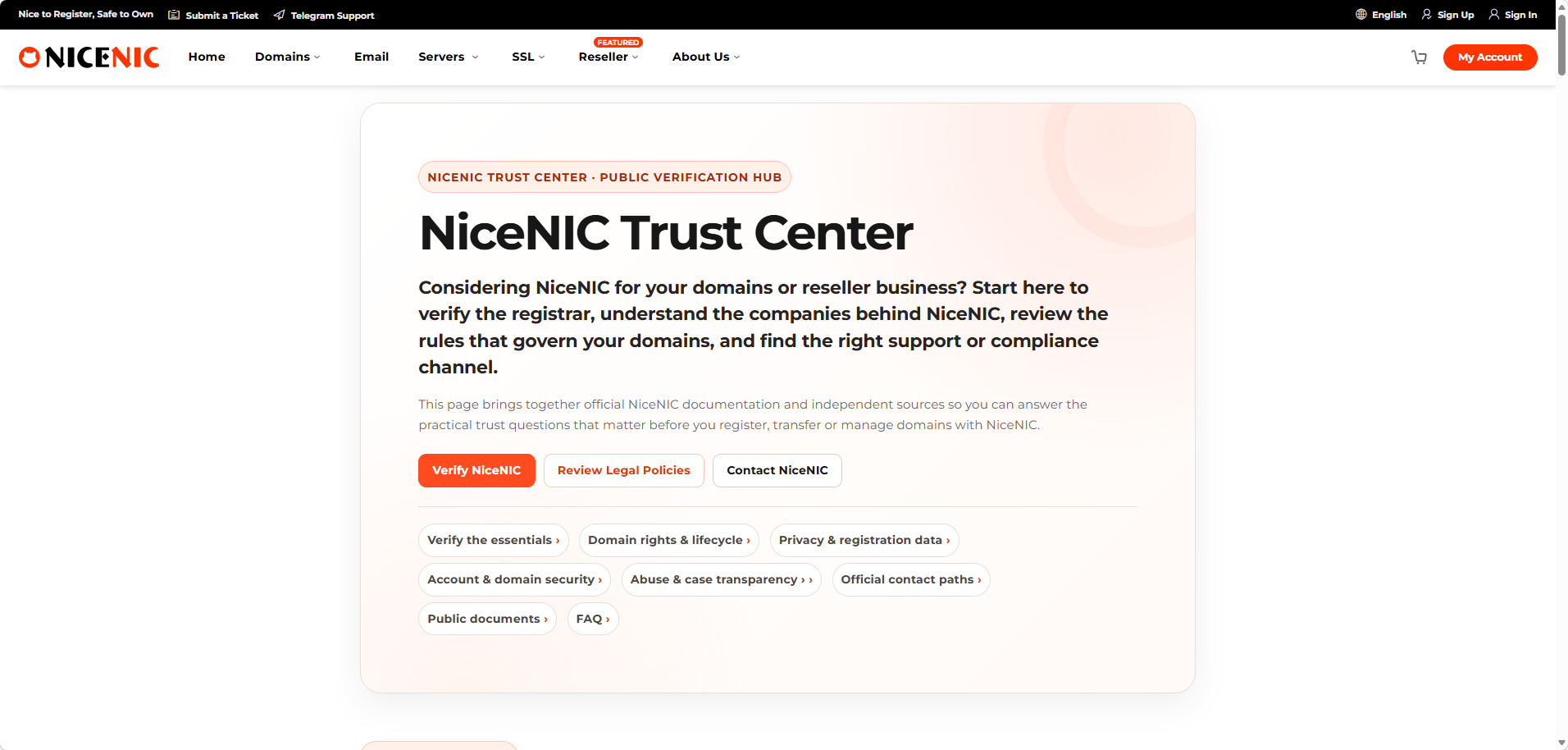
The NiceNIC Trust Center brings these questions into one public verification hub, with links to NiceNIC policies as well as independent ICANN and IANA sources.
Instead of relying only on a registrar saying it is trustworthy, users can check the underlying information themselves.
What Should You Verify Before Trusting a Domain Registrar?
Before registering, transferring or consolidating domains with a registrar, verify its identity, policies, security controls, domain lifecycle rules and support routes.
Price still matters, but it should not be the only check.
A practical registrar review should cover:
Registrar identity: Is the business itself accredited, or are you buying through a reseller?
Registration and renewal rules: What agreement governs the domain, and what will keeping it cost over time?
Transfer rights: Can an eligible domain be unlocked and transferred to another registrar?
Expiration and recovery: What happens if a renewal is missed?
Privacy and Registration Data: What information may be public, and how are nonpublic requests handled?
Security: Are 2FA, domain locks and DNSSEC-related controls available where applicable?
Support and escalation: Is there a clear path when self-service does not solve the problem?
These checks provide much stronger evidence than a homepage claim such as “trusted” or “secure.”
How Do You Check Whether a Domain Registrar Is Really ICANN-Accredited?
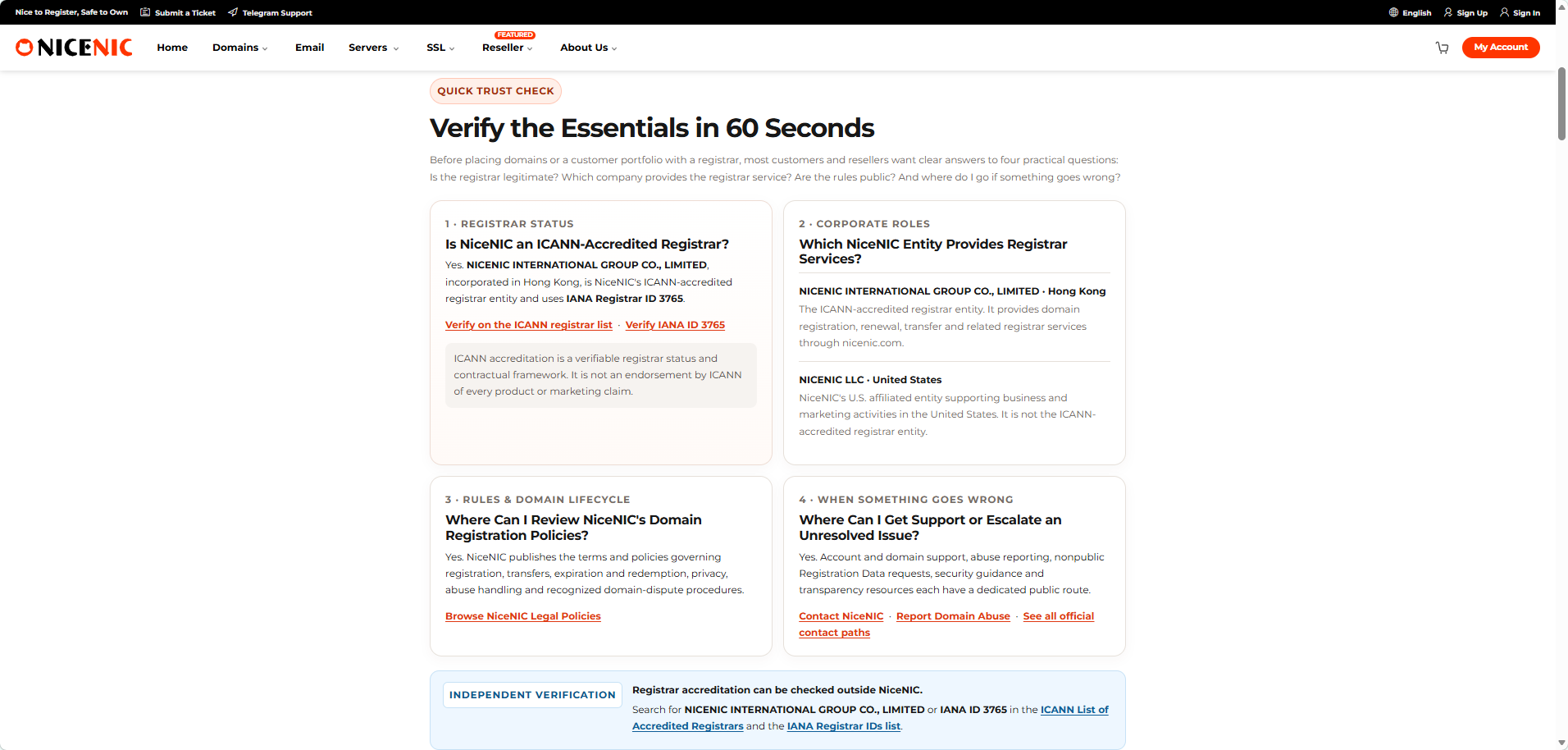
For a gTLD registrar, use ICANN’s official Accredited Registrar Directory and confirm the registrar name and IANA Registrar ID.
Do not rely only on a logo displayed on the registrar’s own website.
For NiceNIC, the current official record is:
Registrar: NICENIC INTERNATIONAL GROUP CO., LIMITED IANA Registrar ID: 3765 Status: Accredited
You can verify the record independently through the ICANN List of Accredited Registrars and the IANA Registrar IDs list.
NiceNIC also maintains a dedicated Registrar Accreditation page for customers who want to understand its registrar role.
ICANN accreditation is important because it confirms a contractual registrar relationship within the ICANN framework. It should not be interpreted as ICANN endorsing every product, price or marketing statement made by a registrar.
That is why independent verification should be the first check, not the last.
Why Should You Verify the Legal Company Behind a Domain Registrar?
A brand name and the legal registrar entity are not always the same thing.
Knowing the legal entity helps you understand who actually provides the registrar service and which company is responsible for the applicable registrar obligations.
For NiceNIC, NICENIC INTERNATIONAL GROUP CO., LIMITED, incorporated in Hong Kong, is the ICANN-accredited registrar entity that provides domain registration, renewal, transfer and related registrar services through nicenic.com.
NICENIC LLC is a U.S. affiliated entity supporting business and marketing activities in the United States. It is not the ICANN-accredited registrar entity.
Making this distinction public reduces ambiguity for customers, partners and domain resellers who need to know which company sits behind the registrar relationship.
What Domain Policies Should You Read Before Registering or Transferring?
At minimum, review the registration agreement, transfer policy, expiration and recovery rules, privacy policy, dispute procedures and abuse-handling policies.
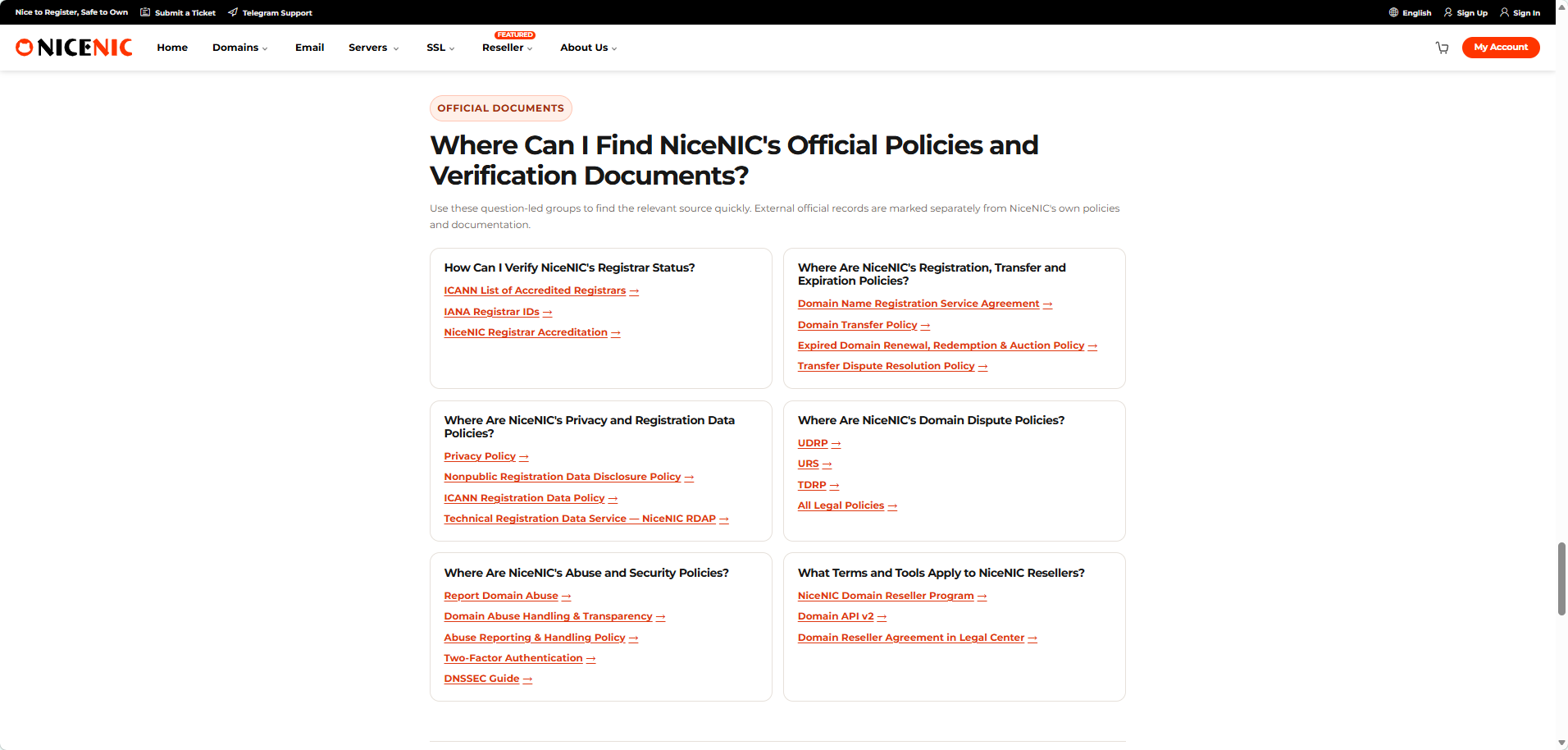
NiceNIC publishes these resources through its Legal Center and Trust Center.
Important documents include:
- Domain Name Registration Service Agreement
- Domain Transfer Policy
- Expired Domain Renewal, Redemption & Auction Policy
- Privacy Policy
- Domain Abuse Handling & Transparency
Reading these policies before a problem occurs is much easier than discovering the rules during an urgent transfer, expiration or domain dispute.
Can You Transfer Your Domain Away, and What Can Block a Transfer?
Eligible domains can generally be transferred between ICANN-accredited registrars, subject to the applicable ICANN Transfer Policy, registry rules, domain status and authorization requirements.
The important question when evaluating a registrar is whether its transfer process and restrictions are published clearly.
NiceNIC's Domain Transfer Policy explains its transfer requirements and applicable restrictions.
ICANN’s current Transfer Policy also requires registrar transfer processes to be clear and provides standardized requirements for eligible inter-registrar transfers.
A transfer can still be delayed or denied in permitted circumstances, so users should check domain status, transfer locks, authorization requirements and any applicable TLD-specific rules before starting a transfer.
Registrar trust includes being able to understand how you leave, not only how you register.
What Happens If Your Domain Expires?
An expired domain does not necessarily become immediately available for someone else to register.
Depending on the TLD and lifecycle stage, it may move through post-expiration renewal, redemption or restoration, auction, pending delete and eventual release.
These stages can also involve different recovery costs and deadlines.
Before choosing a registrar for an important domain, review its published expiration and recovery rules.
NiceNIC explains these stages in its Expired Domain Renewal, Redemption & Auction Policy.
For a business-critical domain, understanding expiration before it happens can be as important as knowing the original registration price.
Is Your Domain Registration Data Public, and How Is It Protected?
The amount of Registration Data shown publicly depends on the TLD, applicable ICANN requirements, registry rules and law.
A registrar should therefore explain both how it handles personal data and how requests for nonpublic Registration Data are reviewed.
NiceNIC publishes its Privacy Policy and guidance on Domain Privacy eligibility.
Domain Privacy is available for eligible TLDs, but eligibility and how privacy is applied can vary.
Privacy also does not remove a registrant’s responsibility to provide accurate Registration Data.
For gTLDs, ICANN’s Registration Data Policy establishes requirements covering the collection, processing, publication and disclosure of registration data.
What Security Features Should You Check Before Trusting a Registrar?
Look for account security, transfer protection and DNS security rather than relying on one generic “secure registrar” claim.
Important controls include:
Two-Factor Authentication: A second factor helps reduce the risk of an account being taken over with only a stolen password.
NiceNIC provides Two-Factor Authentication for supported account access and sensitive operations.
Transfer protection: Domain locks, authorization controls and secure handling of transfer credentials can help reduce unauthorized transfers.
DNSSEC: Where supported by the TLD and DNS configuration, DNSSEC can help validate DNS responses against certain forms of DNS manipulation. NiceNIC publishes a DNSSEC setup and troubleshooting guide.
Security should be evaluated as an operating process, not a badge.
How Should a Registrar Handle Abuse Reports and Domain Disputes?
A registrar should publish where abuse reports go, what information is useful and what affected customers can expect from the process.
It should also distinguish DNS Abuse from other domain disputes.
NiceNIC's Domain Abuse Handling & Transparency page explains report assessment, evidence review, case status, ClientHold and ServerHold, remediation and reseller workflows.
Suspected phishing, malware or other relevant abuse involving a NiceNIC-sponsored domain can be submitted through the official Domain Abuse Report page.
Domain disputes are different. Depending on the issue, UDRP, URS, TDRP, a ccTLD-specific procedure or a court process may apply.
Publishing these routes helps users understand which process applies instead of treating every domain complaint as the same type of case.
Where Should You Go If Registrar Support Does Not Resolve an Issue?
A trustworthy registrar should make its official support and escalation routes easy to find before an urgent problem occurs.
NiceNIC publishes its official Contact page for account, domain, renewal, transfer, billing and service questions.
For an existing unresolved issue, keeping the same ticket or reference number, affected domain and new relevant information together can help preserve the context of the case.
Separate public routes are also provided for abuse reporting, Registration Data requests and policy or dispute questions.
The key question is simple:
If something goes wrong with an important domain, can you quickly identify the correct official channel?
That should be checked before transferring an entire portfolio.
What Should Domain Resellers Verify About an Upstream Registrar?
Domain resellers should verify more than wholesale pricing.
Before placing customer domains with an upstream registrar, check:
- which accredited registrar actually sponsors the domains;
- the reseller agreement and commercial terms;
- which responsibilities remain at registrar level;
- how abuse and compliance cases are communicated;
- where support and escalation go;
- and whether API and portfolio-management documentation are available.
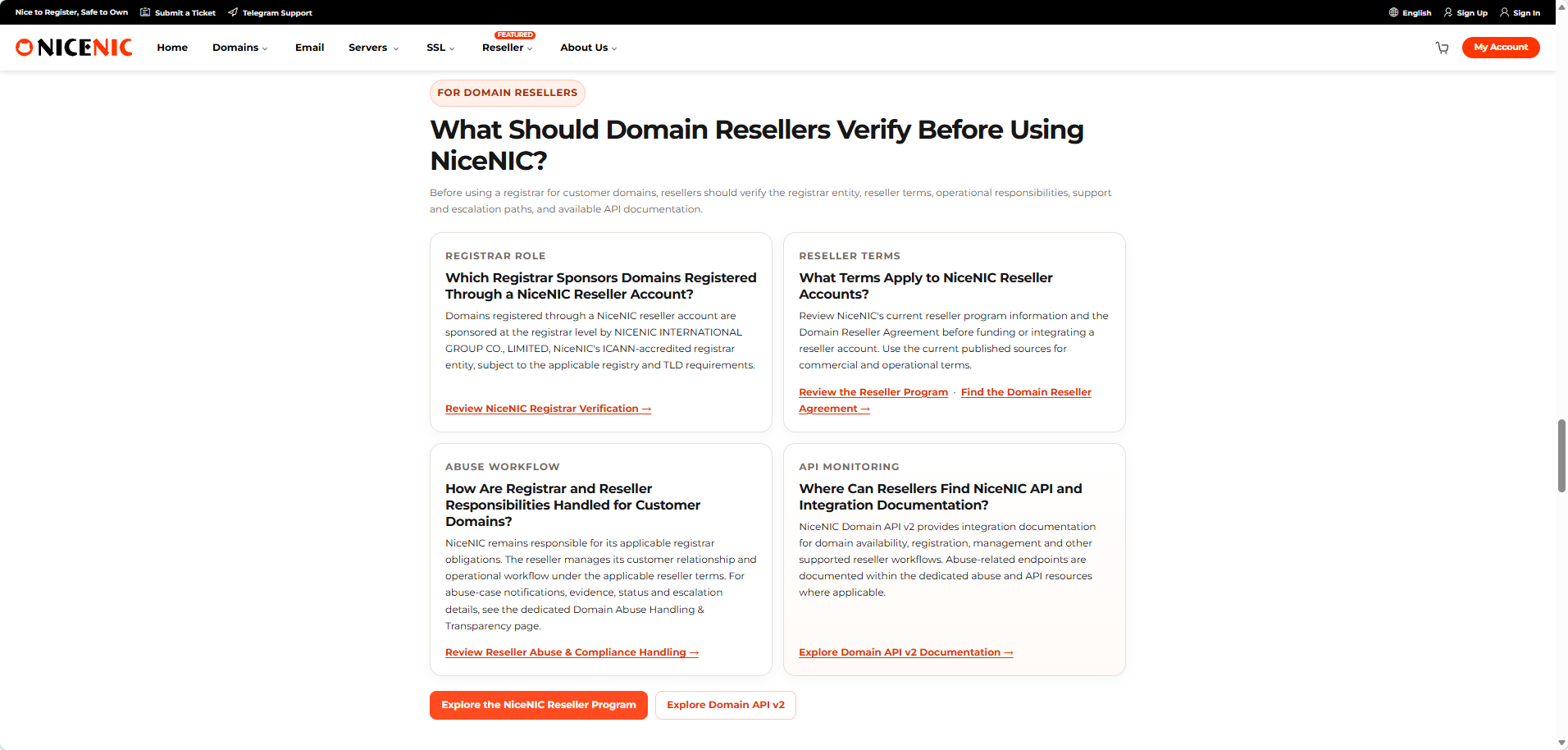
For domains registered through a NiceNIC reseller account, the sponsoring registrar is NICENIC INTERNATIONAL GROUP CO., LIMITED, subject to applicable registry and TLD requirements.
NiceNIC publishes its Domain Reseller Program, Domain API v2 documentation and abuse-handling resources publicly so businesses can review the operating model before integrating or increasing volume.
How Can You Verify NiceNIC in 60 Seconds?
Use four checks.
1. Verify the registrar. Search the ICANN Accredited Registrar Directory for NICENIC INTERNATIONAL GROUP CO., LIMITED or IANA ID 3765.
2. Verify the legal entity. Confirm which NiceNIC company provides the registrar service and which entities have other business roles.
3. Verify the rules. Review the registration, transfer, expiration, privacy, dispute and abuse policies that affect your domains.
4. Verify the support path. Know where to go for normal support, an unresolved case, an abuse report or another registrar-specific issue.
The NiceNIC Trust Center is designed to put those checks in one place.
Trust should be easier to evaluate when the evidence is public.
What Should You Do After You Verify a Registrar?
Verification should come before commitment.
If you are evaluating NiceNIC, start with the Trust Center and independently confirm the registrar record through ICANN or IANA.
Then review the policies that matter to your use case.
If you are registering a domain, you can search available domains.
If you manage customer portfolios, review the NiceNIC Domain Reseller Program and Domain API v2.
If you still have a question before moving a domain or portfolio, use the official NiceNIC Contact page.
A registrar should not ask you to trust first and verify later. The information needed to make that decision should be available before you place an important domain in its care.


