


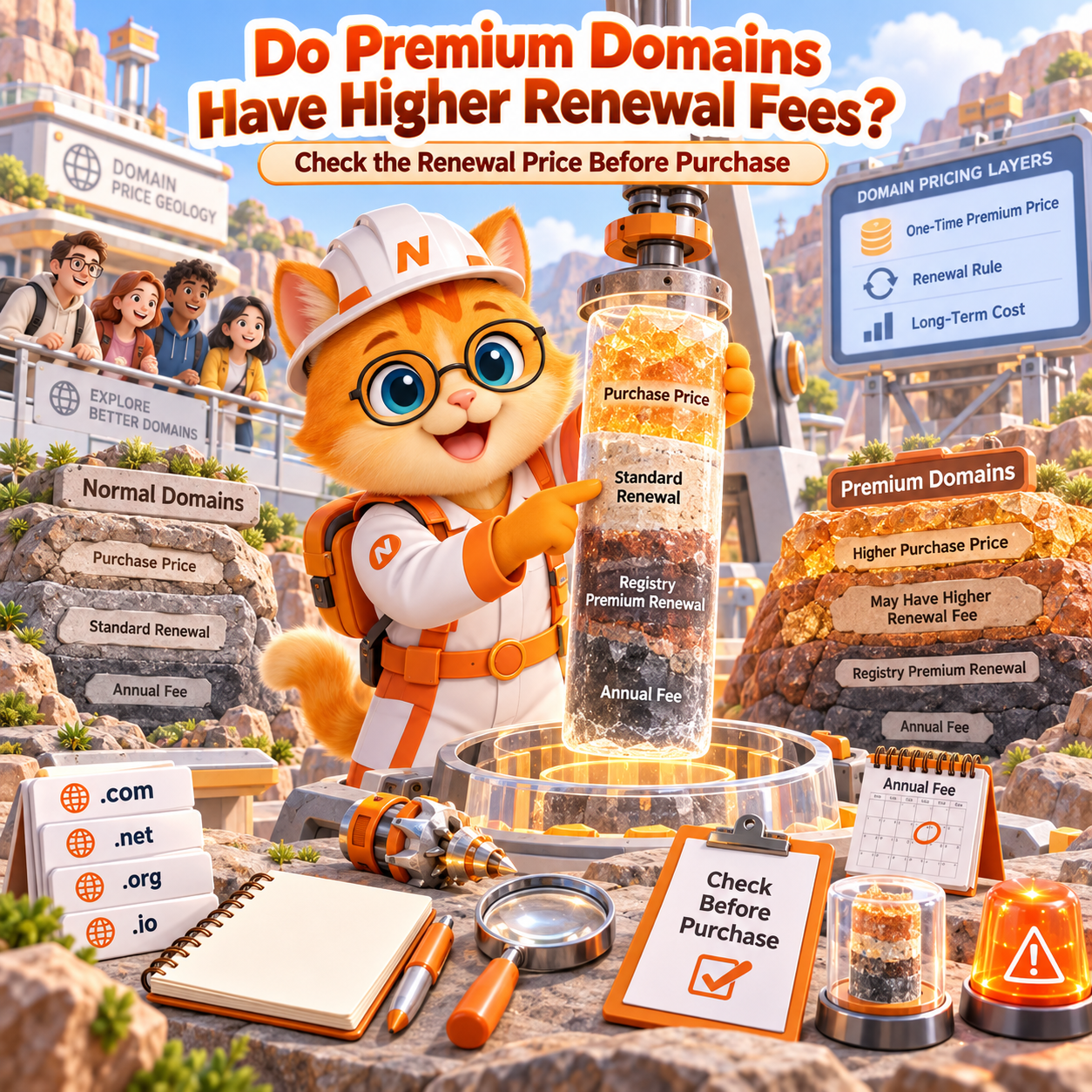
Before buying, one question matters immediately:
Will I have to pay that premium price again every year?
The answer depends on what type of premium domain you are buying.
For many Aftermarket Premium domains, the higher price is mainly a one-time acquisition cost. Future renewals may use the normal renewal price for that domain extension.
For a Registry Premium domain, the registry may continue charging a premium rate every year.
That difference can completely change the long-term cost of owning the domain.
Already considering a specific premium domain? Search fixed-price premium domains in the NiceNIC Buy Now Market, then check the applicable domain registration and renewal prices before making your decision.
Do Premium Domains Renew at the Premium Price Every Year?
Sometimes.
There is no single renewal rule for every premium domain.
The easiest way to understand it is to separate premium domains into two categories:
This distinction matters much more than the word “Premium” itself.
A domain listed for $5,000 could have a normal annual renewal afterward.
Another domain available for $500 could continue renewing for hundreds of dollars every year.
So the lower purchase price does not always mean the lower long-term cost.
Is a Premium Domain a One-Time Fee?
For many aftermarket domains, the large premium price is primarily a one-time acquisition cost.
Imagine that example.com is already registered.
The owner lists it for:
$5,000
You are paying $5,000 to acquire the domain from the current holder.
After the domain reaches your account, its future renewal may follow the normal .COM renewal rate rather than another $5,000 payment.
This is common with aftermarket premium domains.
However, you should still verify the exact renewal cost before purchase.
There are exceptions.
What Is a Registry Premium Domain?
A Registry Premium domain is a domain that the registry operating the extension has placed into a higher pricing tier.
The domain may still be completely unregistered.
For example, most domains under an extension may use the standard price, while a particularly short or commercially attractive name is classified as Premium.
The registry may apply special pricing to:
- registration;
- renewal;
- transfer;
- restoration.
Depending on the registry’s pricing model, that higher renewal rate may continue for as long as you keep the domain.
This is why Registry Premium pricing requires closer attention to long-term cost.
Why Do Registry Premium Domains Have Higher Renewal Fees?
The Premium classification exists at the registry level.
A registrar does not necessarily have the ability to convert the domain into standard pricing after the first year.
If the registry has assigned that exact name to a Premium pricing tier, future transactions may continue to use that tier.
That can include renewal.
So when a Registry Premium domain displays:
Registration: $300
you should never automatically assume:
Renewal: standard TLD price
The renewal may also be $300, another premium amount, or a different price specified by that registry.
Always check it separately.
What Is an Aftermarket Premium Domain?
An Aftermarket Premium domain is already registered and is being sold by its current holder.
Its high price reflects the acquisition of that particular domain.
The seller may value the name because it is:
- short;
- memorable;
- commercially useful;
- brandable;
- built around a desirable keyword;
- registered under a strong extension.
This is the type of premium domain commonly seen in fixed-price Buy Now marketplaces.
If the seller asks $5,000, that amount is usually the acquisition price for obtaining the domain.
It does not automatically mean the domain will cost $5,000 to renew each year.
Do Buy Now Premium Domains Have Normal Renewal Fees?
Many do.
A fixed-price Buy Now domain is usually an already registered domain being offered for sale at a stated price.
Once the acquisition is completed, many of these domains renew according to the normal pricing rules for their extension.
For example, if an existing .COM is purchased from its current owner, the buyer may pay a substantial acquisition price first and later renew the domain at the applicable .COM renewal rate.
But there is an important exception.
An aftermarket domain can itself also be a Registry Premium domain.
If that happens, Registry Premium renewal pricing may continue after the purchase.
That is why you should check the actual renewal fee instead of relying only on the type of marketplace listing.
Can an Aftermarket Domain Still Have a Premium Renewal Fee?
Yes.
This is one of the details buyers can easily miss.
Suppose someone originally registered a Registry Premium domain.
Later, that person decides to sell it on the aftermarket.
The domain now has two different pricing layers:
1. Aftermarket acquisition price
The amount the current owner wants for selling the domain.
2. Registry renewal price
The amount required to keep the domain registered in future years.
These are separate costs.
For example, a seller could theoretically list a domain for:
$2,500 acquisition price
while the underlying registry pricing still requires:
$200 annual renewal
The exact figures vary by domain and registry, but the principle is important.
Buying a domain from an existing owner does not automatically remove its Registry Premium status.
What Is the Difference Between Purchase Price and Renewal Price?
These numbers represent different things.
Purchase or Acquisition Price
This is what you pay to obtain the domain today.
For an aftermarket domain, it can include the seller’s asking price.
Renewal Price
This is what you pay later to keep the domain active for another registration term.
A domain can therefore have:
$5,000 purchase price + standard annual renewal
or:
$500 registration price + $500 Premium renewal
Those two domains have very different ownership economics.
The first has a larger upfront cost.
The second may create a much larger recurring expense over time.
Which Price Matters More: Purchase Price or Renewal Price?
Both matter.
The right way to evaluate a premium domain is to look at its total cost of ownership, especially if you expect to use it for many years.
Consider two simplified examples.
Domain A
Purchase:
$5,000
Annual renewal:
standard TLD rate
Domain B
Registration:
$500
Annual renewal:
$500
At first glance, Domain B looks much cheaper.
But if you keep it for 10 years, recurring Premium renewal charges become a significant part of the total cost.
A business planning to use a domain permanently should therefore look beyond the first checkout amount.
How Do I Check the Renewal Fee Before Buying a Premium Domain?
Before purchasing, check four things.
1. Identify the Type of Premium Domain
Find out whether the domain is:
- Registry Premium;
- Aftermarket Premium;
- or an aftermarket domain that also carries Registry Premium pricing.
2. Check the Acquisition Price
If it is listed as a Buy Now domain, review the current fixed purchase price.
You can search the NiceNIC Buy Now Market for eligible fixed-price premium domains.
3. Check the Renewal Price
Review the applicable NiceNIC Domain Prices.
If the exact domain uses special Premium pricing, verify the domain-specific renewal amount rather than relying only on the standard TLD price.
4. Look at the Long-Term Cost
If you expect to own the domain for five or ten years, include future renewals in your budget.
The first-year price is only part of the ownership cost.
Can Premium Domain Renewal Prices Change Later?
They can.
Domain prices are influenced by registry pricing and registrar pricing.
Registries may change wholesale prices over time, and registrars may update retail prices accordingly.
This also applies to standard domains.
So even when a domain currently renews at a normal rate, you should not assume that exact dollar amount will remain unchanged forever.
For Registry Premium domains, the same principle applies to Premium pricing.
The important thing is to understand the domain’s current pricing model before buying.
Why Is the Renewal Price Different From the Registration Price?
This happens with standard domains too.
A low first-year registration price may be promotional, while renewal uses the normal price.
Premium domains introduce another possibility because the registry may assign different prices to:
- registration;
- renewal;
- transfer;
- restoration.
That means you should avoid judging a domain only from the number shown beside “Register” or “Buy Now.”
For long-term ownership, renewal deserves its own check.
Does a $5,000 Premium Domain Cost $5,000 Every Year?
Usually not if the $5,000 is an aftermarket acquisition price.
For example, an existing owner may list a desirable domain for $5,000.
Once you purchase it, the seller does not normally receive another $5,000 from you every year.
You simply need to keep the domain renewed through your registrar.
If the domain uses standard registry pricing, future renewals may use the normal rate for its extension.
If the domain carries Registry Premium pricing, however, its renewal may remain higher.
That one distinction answers most confusion around Premium Domain renewal costs.
Should I Avoid a Domain With a Premium Renewal Fee?
Not automatically.
A high recurring cost should simply be part of the buying decision.
Ask:
- How important is this exact domain?
- How many years do I expect to keep it?
- What will the total renewal cost be?
- Is there a similar domain with standard renewal pricing?
- Does the domain support a serious long-term business?
- Is the recurring cost reasonable relative to the value of the project?
A $200 annual renewal may be insignificant for one business and completely unnecessary for another.
The decision depends on how much value the exact name creates.
For a broader buying decision, see Are Premium Domains Worth It? Costs, Renewals & Buying Guide.
What Should I Check Before Buying a Premium Domain?
Use this short checklist:
Purchase price How much will you pay today?
Renewal price How much will the next registration term cost?
Premium type Is it Registry Premium, aftermarket, or both?
Transfer price Will future transfers use standard or Premium pricing?
Registration term How many years can you register or renew at once?
Long-term use Will you still want this domain five or ten years from now?
These checks take only a few minutes and can prevent a much bigger surprise later.
Frequently Asked Questions About Premium Domain Renewal Fees
1. Do all premium domains have expensive renewal fees?
No.
Aftermarket premium domains often renew at the normal rate for their extension. Registry Premium domains may continue to renew at a higher Premium rate.
2. Is the premium domain price paid only once?
For many aftermarket domains, the high acquisition price is mainly paid once.
Registry Premium domains may continue to carry Premium registration and renewal pricing.
3. Why is my premium domain renewal so expensive?
The domain may be classified as Premium by its registry. Registry Premium pricing can apply to renewal as well as registration.
4. Does buying a premium domain remove its premium status?
Not necessarily.
If the domain has Registry Premium status, selling or transferring it to another owner does not automatically change the registry’s pricing classification.
5. Do Buy Now domains renew at normal prices?
Many aftermarket Buy Now domains do, but you should verify the exact domain. A Buy Now listing can still involve a domain with Registry Premium renewal pricing.
6. Can a premium domain renewal price change?
Yes. Registry and registrar pricing can change over time. Check current pricing when you register, buy, transfer or renew a domain.
7. Where can I check domain renewal prices?
You can review current standard registration, renewal, transfer and restore pricing on the NiceNIC Domain Prices page. Domain-specific Premium pricing should be checked separately where applicable.
8. Is a high renewal fee a reason not to buy a premium domain?
It is a cost to evaluate, not an automatic reason to reject the domain. Compare the long-term ownership cost with the business value of owning the exact name.
Before You Buy a Premium Domain, Check Two Prices
The biggest Premium Domain pricing mistake is looking only at the amount required today.
Before purchasing, check:
What does it cost to acquire the domain? and What will it cost to renew the domain later?
For many aftermarket premium domains, the expensive part is the one-time acquisition.
For Registry Premium domains, higher pricing may continue into future renewals.
Once you know which model applies, the decision becomes much easier.
If you already have a domain in mind, start by checking whether it has a fixed-price listing, then review the renewal cost before you buy.


