


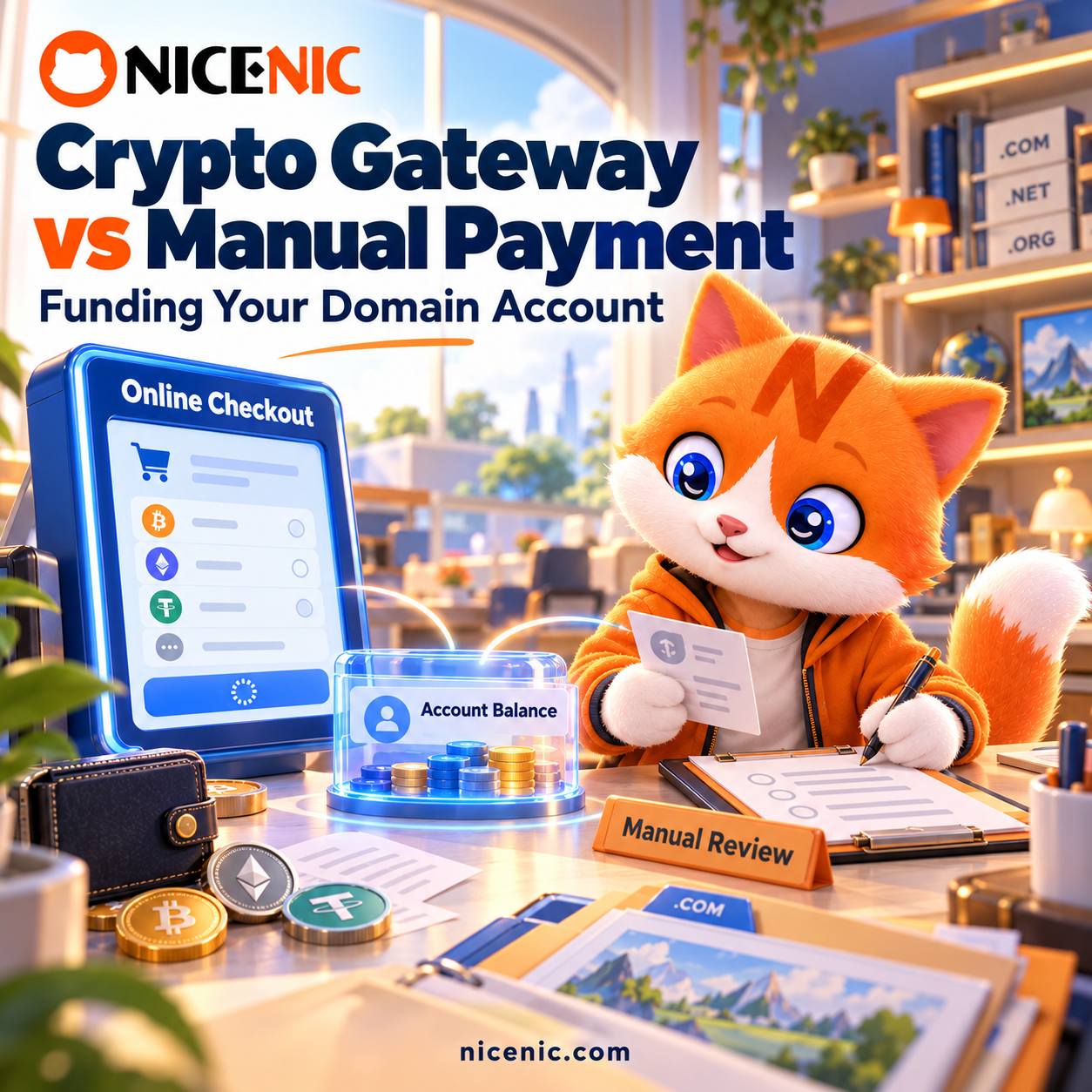
When you fund a NiceNIC account with cryptocurrency, the main difference between the Online Crypto Payment gateway and Manual Crypto Payment is how the payment instructions, verification, and account credit are handled. The online route uses a provider-hosted checkout through Triple-A and credits the NiceNIC balance automatically after successful payment confirmation and processing. The manual route uses wallet instructions issued by NiceNIC, with the first payment reviewed and later eligible payments handled through the verified workflow and transaction matching.
For most customers who want a guided checkout, the online route is simpler. For regular resellers who use a recurring wallet workflow, the manual route can be more suitable. Neither route should be treated as a direct domain purchase from a blockchain transaction: the crypto payment funds your NiceNIC account first, and the available balance is then used for eligible domain registration, renewal, transfer, and reseller operations.
Before sending funds, review the current NiceNIC Payment Options and follow the exact asset, network, destination, amount, and payment timing shown in your live payment instructions. If you have not checked your target domain yet, search for an available domain and compare registration and renewal rates on NiceNIC Domain Prices first.
Direct Answer Capsule
The practical difference is who manages the payment workflow. NiceNIC’s Online Crypto Payment is a gateway-based checkout processed by Triple-A. It provides transaction-specific payment instructions and automatically credits your NiceNIC balance after the payment is confirmed and successfully processed. Manual Crypto Payment is a separate NiceNIC wallet route for regular resellers. You request the current wallet instructions, the first payment is manually reviewed, and future eligible payments can be credited after verification when the transaction information matches the account.
Choose the online gateway when you want a guided checkout and automatic account credit after confirmation. Consider the manual route when you are a regular reseller with an established wallet funding workflow or need the manual route’s supported LTC option. The available assets and networks are not identical between the two routes, so the live NiceNIC payment instructions always take priority.
Quick Decision: Which Crypto Route Fits Your Domain Order?
For a broader list of current crypto funding options, see Buy a Domain With Crypto: USDT, USDC, Bitcoin, ETH and More.
How the Two Payment Routes Actually Differ
The terms “gateway” and “direct payment” can be misleading. At NiceNIC, the practical distinction is between the online provider-managed checkout and the manual wallet workflow.
The current NiceNIC Payment Options page is the authoritative source for which assets and networks are available in a particular payment flow. NiceNIC currently lists USDT and USDC across Ethereum, TRON, Polygon, Solana, Arbitrum One, and BNB Smart Chain, while the manual route separately lists BTC, USDT, ETH, and LTC. Availability can change, so do not infer support for one route from the other.
How the Online Crypto Payment Gateway Works
When you choose Online Crypto Payment in your NiceNIC account, the checkout is processed through Triple-A. The payment flow gives you the current payment instructions for the transaction, including the asset, network where applicable, amount, destination, and payment timing.
What the Gateway Handles
1. Payment instructions
The gateway presents the information needed to make the payment. Use the exact asset, network, destination, and amount shown in the active checkout.
2. Payment detection
Triple-A's payment confirmation guidance states that once a payment has been successfully settled, confirmation is normally completed within seconds. That does not mean every blockchain transaction reaches NiceNIC account credit instantly. Network conditions, payment details, provider processing, and other checks can affect when the balance becomes usable.
3. Account credit
NiceNIC states that online crypto payments are credited automatically after payment confirmation. You normally do not need to send a payment screenshot for ordinary online funding.
4. Multiple payment routes
NiceNIC’s online options currently include USDT, BTC, ETH, USDC, Bitcoin Lightning, PYUSD, and Binance Pay. The exact options available to you are determined by the current payment flow.
What the Gateway Does Not Mean
A payment gateway does not turn cryptocurrency into an irreversible domain order the moment you click “Send.”
The workflow is closer to:
Crypto payment -> provider confirmation and processing -> NiceNIC account credit -> domain order -> registry result
That separation matters. A successful crypto transfer does not by itself prove that a domain was registered, renewed, or transferred.
How Manual Crypto Payment Works
NiceNIC also provides Manual Crypto Payment for Regular Resellers. This is a separate funding workflow rather than another version of the Triple-A checkout.
The Manual Workflow
Step 1: Request the current wallet instructions
Sign in to the NiceNIC account you intend to fund and use the current manual payment workflow to obtain the wallet information. Do not reuse an address from an old ticket, screenshot, email, or previous payment without reconfirming it.
Step 2: Confirm the asset and network
The current manual route listed by NiceNIC supports BTC, USDT, ETH, and LTC. Follow the exact asset and network stated in the instructions issued for your payment.
Step 3: Send the funds
Send the required amount from your wallet or exchange. Check the amount that will actually reach the destination after any exchange withdrawal charge.
Step 4: Keep the transaction record
Save the TXID or transaction hash. This is important for reconciliation if the payment does not appear as expected.
Step 5: Complete the required verification
The first manual crypto payment is reviewed. Future eligible payments can be credited under the verified workflow when the transaction information matches the NiceNIC account.
When Manual Crypto Makes Sense
The manual route can be useful for a regular reseller who already has a stable wallet funding process and repeatedly adds registrar credit. It can also be relevant when you specifically need the manual route’s LTC option.
For businesses using automated domain operations, the funding method and the fulfillment method remain separate. Once the balance is available, NiceNIC credit can be used with supported domain operations and automation tools such as the NiceNIC Domain API and NiceNIC WHMCS Registrar Module.
For a detailed reseller funding workflow, see WHMCS Domain Registrar With USDT Funding: 2026 Guide.
Do Not Assume the Same Network Is Available in Both Routes
This is one of the easiest ways to make a crypto payment error.
NiceNIC’s current payment page lists online USDT and USDC options across several networks, while the manual route has its own supported asset and wallet instructions. Triple-A’s public documentation also maintains its own published list of supported assets and networks.
These sources should not be merged into one universal list.
For example, Triple-A's supported-currencies documentation and supported-networks guide list USDT on Ethereum, Tron, Polygon, Arbitrum, and Solana, and USDC on Ethereum, Polygon, Arbitrum, and Solana. NiceNIC's current Payment Options page separately lists additional online routes, including BNB Smart Chain for USDT and USDC.
The rule for a live NiceNIC transaction is simple: use the exact asset and network shown in the current NiceNIC payment instructions.
Do not switch from TRC20 to ERC20, from Polygon to Arbitrum, or from an online instruction to a manual wallet because the token symbol looks the same.
For a more focused comparison of USDT networks, see USDT TRC20 vs ERC20 for Domain Payments: Which Network Should You Use?.
A Gateway Invoice Is Not a Permanent Wallet Address
An online checkout and a manual wallet request are different payment objects.
If you open an online crypto checkout, use the payment details shown for that active transaction. Do not treat an old invoice address or QR code as a permanent NiceNIC deposit address.
For manual funding, use the current wallet instructions issued for your account and payment request.
This distinction becomes especially important when a customer:
- starts a payment but does not finish it;
- waits until an online payment request has expired;
- creates multiple funding requests;
- sends from an exchange that delays withdrawals;
- changes the blockchain network before sending;
- or sends a second payment before the first one has been reconciled.
If the first transfer is unresolved, do not send another payment simply to make the balance appear faster. Check the original payment status and contact support with the transaction record if necessary.
Why NiceNIC Credits the Account Balance Before Domain Fulfillment
Both crypto funding routes lead to the same operational point: usable NiceNIC account credit.
The balance can then be applied to eligible domain operations rather than tying one blockchain payment to one domain order.
That creates an important separation:
Funding status
Does NiceNIC have usable account credit?
Order status
Was the domain registration, renewal, or transfer submitted?
Registry status
Did the registry complete the requested operation?
These are not interchangeable.
For example, a crypto payment can be confirmed while a domain registration is still pending because the registry requires additional information. Conversely, a domain can become unavailable between a search and a registration attempt even though the account funding succeeded.
NiceNIC’s Domain API documentation also shows this separation. An API registration response with code: 201 means the order was submitted successfully but remains pending registry confirmation. If the domain cannot be activated, the documented registration fee is returned to the NiceNIC account balance within 24 hours.
For an order-level example, see Crypto Payment Confirmed but Domain Registration Failed: What Happens to Your Balance?.
Fees: Compare the Cost of Usable Account Credit
The right comparison is not simply:
gateway fee vs no gateway fee
You need to compare the total cost of the credit that reaches your NiceNIC account.
Online Crypto Payment
NiceNIC currently adds a 0% crypto processing fee. The online crypto provider currently charges a 1.5% service fee. Your wallet, exchange, or blockchain network may also charge a separate fee.
Review the final amount shown at checkout before confirming payment.
Manual Crypto Payment
NiceNIC currently charges 0% crypto processing fee for the manual crypto route. The Triple-A online service fee should not automatically be applied to a separate manual payment.
Your exchange, wallet, or blockchain network can still charge its own sending or withdrawal cost.
What You Should Compare
For a real funding decision, compare:
Total funding cost = NiceNIC fee + provider fee, if any + exchange or wallet cost + network cost
The exact result depends on the route, asset, network, and sending service you use.
Do not assume that the network with the lowest blockchain fee will always produce the lowest total cost. An exchange may impose a fixed withdrawal fee that changes the calculation.
For a stablecoin-specific comparison, see USDT vs USDC vs PYUSD for Domain Registration: Which Stablecoin Should You Use?.
Refunds and Payment Errors Are Separate From Domain Results
Crypto payments and domain orders have different failure points.
If the online invoice expires
Do not assume that the expiration of a short checkout countdown is the same thing as Triple-A’s general invoice validity rule.
Triple-A's expired-invoice documentation states that its invoices are valid for 30 days and that payments after that period are refunded. Triple-A separately documents payment-detection issues, including payments made 24 hours after payment-form creation.
For a NiceNIC transaction, the current payment instructions shown in the active checkout are the instructions to follow. If you have already sent funds and the status is unclear, check the payment record before paying again.
If you send the wrong network or amount
Do not assume that the transfer can be recovered automatically. Save the transaction details and contact support with the asset, network, amount, destination, timestamp, and TXID.
If the payment reaches NiceNIC but a domain order fails
That is a different event. Check the order status and account balance instead of treating the blockchain transfer as the failed domain transaction.
If you want a refund of cryptocurrency already credited to NiceNIC
NiceNIC’s current refund policy states that cryptocurrency payments received by NiceNIC are not refundable. This is separate from a provider-side return of a payment that was not accepted or credited.
Read the current NiceNIC Refund Policy before making a large account deposit.
Which Route Should You Choose?
Use the Online Crypto Payment gateway when:
- you want a guided checkout;
- you want automatic account credit after payment confirmation and processing;
- your preferred asset and network are available in the online flow;
- you are funding a NiceNIC account for a current domain operation.
Consider Manual Crypto Payment when:
- you are a regular reseller;
- you have a recurring wallet funding workflow;
- the manual route supports the asset you need;
- you can allow time for the required first-payment review;
- you prefer to reconcile recurring funding through the manual wallet process.
There is no universal winner. The better route depends on the payment asset, network, urgency, account type, and how often you fund the account.
For most first-time or time-sensitive online funding, the gateway is the simpler operational choice. For recurring reseller funding, the manual route can be practical once the payment workflow has been verified.
A Simple Checklist Before Sending Crypto
Before you click “Send”, verify all of the following:
- Account: You are funding the correct NiceNIC account.
- Route: You are using Online Crypto or Manual Crypto as intended.
- Asset: The cryptocurrency matches the current instruction.
- Network: The blockchain network matches exactly.
- Destination: The address or payment request comes from the current NiceNIC payment instructions.
- Amount: The expected received amount is sufficient after any exchange or wallet deduction.
- Timing: The online payment is being made within the active payment instructions and deadline.
- Record: You will keep the invoice reference, payment reference, TXID, or other transaction record.
- Balance: You will verify the NiceNIC account credit before submitting a time-sensitive domain order.
If anything is unclear, review the NiceNIC Payment FAQ before sending. If you still need help, submit a NiceNIC support ticket. Never provide your NiceNIC password, wallet private key, recovery phrase, one-time login code, or API secret.
Final Takeaway
The difference between a crypto payment gateway and a manual crypto payment is mainly the payment workflow, not the fact that both use cryptocurrency.
At NiceNIC, the online route provides a guided checkout through Triple-A and automatic account credit after confirmation and processing. The manual route provides a separate wallet workflow for regular resellers, with first-payment review and transaction matching for subsequent eligible payments.
Use the exact asset, network, destination, amount, and payment instructions shown for the payment route you are using.
Once the funds are credited, treat the NiceNIC balance, domain order, and registry result as separate checkpoints. That makes it easier to troubleshoot payment issues, avoid duplicate transfers, and manage domain registration or renewal with a clear record of what happened at each stage.
NiceNIC has provided domain services since 2006. Its registrar services are provided by NICENIC INTERNATIONAL GROUP CO., LIMITED, an ICANN-accredited registrar (IANA Registrar ID 3765). You can independently verify the registrar record in the ICANN Accredited Registrar Directory and review company verification, published policies, and official contact channels in the NiceNIC Trust Center.
Primary Sources
- NiceNIC Payment Options - Current online and manual crypto funding routes, fees, supported assets and networks, and account-credit workflow.
- NiceNIC Payment FAQ - Current payment verification, manual wallet workflow, network guidance, and reconciliation requirements.
- NiceNIC Refund Policy - Current refund restrictions and cryptocurrency payment treatment.
- NiceNIC Domain API Documentation - API registration status and account-balance handling for pending registrations.
- Triple-A: Supported Currencies for Invoice Payments - Provider documentation for supported invoice assets and published networks.
- Triple-A: What Networks Does Triple-A Support? - Provider documentation for supported blockchain and off-chain networks.
- Triple-A: How Long Does It Take for My Payment to Be Confirmed? - Provider guidance on confirmation after payment settlement.
- Triple-A: Why Was My Payment Not Detected? - Provider guidance on wrong-network payments and delayed payment-form submissions.
- Triple-A: Payment to an Expired Invoice - Provider guidance stating that invoices are valid for 30 days and payments after that period are refunded.
- ICANN Accredited Registrar Directory - Independent verification of NICENIC INTERNATIONAL GROUP CO., LIMITED and IANA Registrar ID 3765.
- NiceNIC Trust Center - Company verification, published policies, and official contact channels.


