


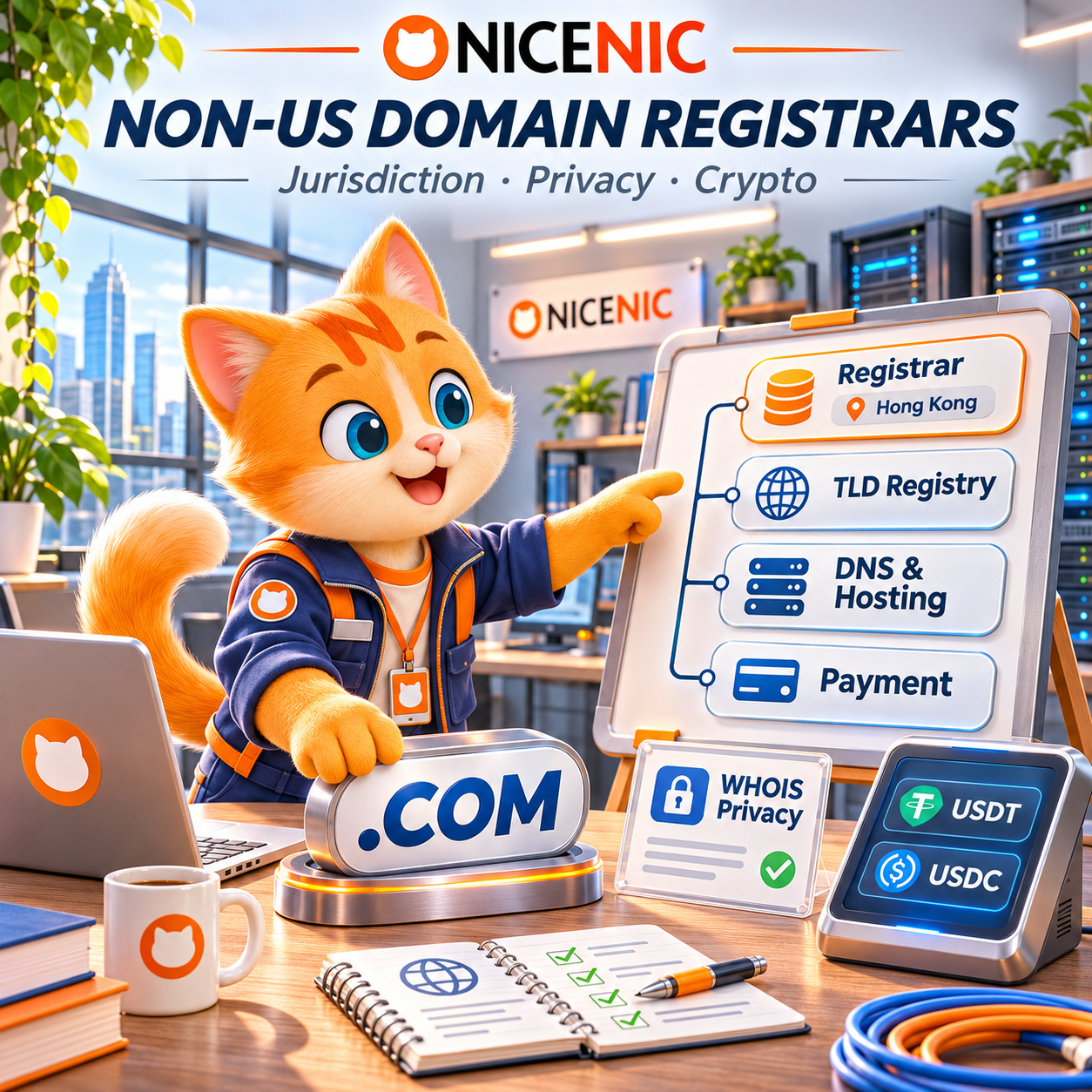
NiceNIC, operated by NICENIC INTERNATIONAL GROUP CO., LIMITED in Hong Kong, is an ICANN-accredited registrar operating since 2006, listed under IANA Registrar ID 3765. It offers access to more than 2,500 domain extensions, free WHOIS privacy for eligible domains, and account funding through supported cryptocurrencies including USDT and USDC. Before buying, check the exact TLD's eligibility rules, privacy treatment, registration and renewal costs, and the payment route shown at checkout. Start with NiceNIC Domain Prices and Payment Options.
By NiceNIC Content Team · Registrar identity, payment options and referenced registry rules checked November 17, 2026.
1. What Does a Non-US Domain Registrar Actually Change?
A registrar’s country of incorporation is an important fact, but it is only one part of a domain’s legal and technical structure. Consider four separate layers before drawing conclusions about jurisdiction.
.com registration remains subject to .com registry requirements regardless of the registrar used
For example, a company can register a .com domain through NiceNIC's Hong Kong-incorporated registrar entity while the .com registry is operated by US-based VeriSign, Inc. The website could use a DNS provider and hosting service in still other jurisdictions. ICANN lists VeriSign as the .com registry operator.
The practical advantage of selecting a non-US registrar can be a different contractual relationship, support operation, payment choice or product offering. It is not a guarantee that US legal processes, international agreements, registry policies or other applicable laws cannot affect the domain.
NiceNIC's corporate structure also includes a U.S. affiliate. NICENIC INTERNATIONAL GROUP CO., LIMITED is the Hong Kong-incorporated ICANN-accredited registrar responsible for the registrar services described here. NICENIC LLC is a separate U.S. affiliated entity supporting business and marketing activities; it is not the accredited registrar under IANA ID 3765. "Non-US registrar" describes the contracting registrar entity, not the absence of all U.S. business relationships. The roles are explained in NiceNIC's Registrar Verification Guide.
A terminology distinction matters: "Non-US" here describes NiceNIC's registrar entity, not a service designed to evade law. NiceNIC expressly rejects "offshore," "bulletproof" and "DMCA ignored" positioning in its official clarification. Customers must comply with the applicable registration and acceptable-use requirements.
2. How Should You Compare Non-US Domain Registrars?
Do not choose a registrar solely because it advertises a location, accepts Bitcoin, or promises privacy. Compare the services you will actually use under the same conditions.
A domain reseller is not inherently illegitimate because it is not itself ICANN-accredited. Many legitimate domain sellers operate through accredited upstream registrars. What matters is identifying the responsible registrar, understanding the reseller relationship, and confirming pricing, access to the domain, and support responsibilities. Avoid treating unsupported category-wide price ranges as evidence that one model is always cheaper or safer.
NiceNIC's legal entity and accreditation can be reviewed in the NiceNIC Trust Center. For a broader purchasing checklist, see How to Choose a Domain Registrar: 12 Things to Check Before You Buy.
3. Why the TLD Registry Still Matters: Four Examples
Changing registrars does not change the operator or eligibility rules of the extension you register. These examples show why exact TLD → exact registry → exact rule is a better decision method than a broad “non-US domain” label.
.COM
.com registry operator or the extension's applicable policies
.EU
.FR
.FR and .EU have identical rules
.SG
.sg applicant must appoint a local administrative contact; additional requirements apply to categories such as .com.sg
A country-code extension may be administered by a registry outside the United States, but that fact alone does not create immunity from laws that otherwise apply to the holder, the services or the transaction. Verify the actual registry operator and registration terms before treating a ccTLD as part of a jurisdictional strategy.
If an extension requires a local administrative contact or trustee arrangement, ask who will be recorded as the domain holder, who can approve changes, what documentation is needed, and how the arrangement ends. Trustee eligibility differs by extension. For example, DENIC confirms that .DE no longer uses an Admin-C contact; a local contact requirement must not be assumed for every ccTLD.
Use NiceNIC Domain Search to check available extensions, then confirm the specific registry requirements before paying. Registration availability and registrant eligibility are not the same thing.
4. WHOIS Privacy, RDAP and Real Domain Ownership
A privacy-friendly registrar should explain exactly what is public, what information it retains and who remains the registered domain holder.
NiceNIC offers Free Lifetime WHOIS Privacy for eligible domain extensions, subject to the relevant TLD and service rules. This can reduce the public exposure of contact information without an added privacy-service charge on eligible registrations and renewals. It does not promise that every field will be hidden for every domain or registrant type.
For gTLDs, RDAP is now the standard registration-data access protocol. ICANN distinguishes a privacy service, in which the customer remains the registrant and alternate contact details may be displayed, from a proxy service, in which the proxy provider is the registrant of record. These arrangements have different legal consequences. See ICANN's Privacy and Proxy Service Explanation and ICANN's RDAP Guide.
Privacy protection is not anonymous ownership or a promise of nondisclosure. NiceNIC may retain account, billing, transaction, domain-registration, support, security and compliance records even when eligible public WHOIS/RDAP fields are redacted. Information may be shared with registries, payment processors, ICANN-related providers or other recipients where authorized or required by applicable rules, valid legal process or the published privacy policy. See the NiceNIC Privacy Policy for categories of retained information, disclosure conditions and cross-border data handling. Domain holders should use accurate contact details, keep their account email accessible, and verify who is recorded as the holder when a third-party proxy or trustee service is involved.
5. Can You Fund a Non-US Registrar with USDT or USDC?
Yes, where the registrar offers those payment routes. At NiceNIC, supported cryptocurrency payments fund a USD account balance that can then be used for eligible domain registrations, renewals, transfers and other supported services. Paying for a domain and registering the domain are two separate operations.
NiceNIC currently publishes the following funding choices:
For supported stablecoins, NiceNIC’s payment page lists networks such as TRON (TRC20), Ethereum (ERC20), Polygon, Solana, Arbitrum One and BNB Smart Chain (BEP20), depending on the asset and route. Never assume that a network available for one payment route is available for another. Binance Pay is a payment option, while Bitcoin Lightning is a Bitcoin payment network; neither is a separate cryptocurrency.
The NiceNIC Payment Options page and the Crypto Registration Guide provide the current instructions. The live payment request is the final reference for supported routes, fees, destination, amount and deadline.
A safer six-step crypto-funded domain purchase
- Verify the domain: Check availability, registration eligibility, term, first-year price and renewal price before adding funds.
- Select the payment route: Confirm the exact cryptocurrency, blockchain network, provider fee and any withdrawal or network charges.
- Use the current payment instructions: Do not reuse an old deposit address. Keep the payment reference and transaction hash (TXID).
- Confirm the NiceNIC account balance: A successful blockchain transaction is not itself proof that NiceNIC has credited the account.
- Place the domain order: Recheck availability, registrant details, nameservers and price, then submit the authorized order using available credit.
- Verify the registry result: Confirm the domain status and expiration date. If the order is pending or the response is uncertain, reconcile the existing transaction before retrying.
Crypto is a payment choice, not an anonymity guarantee. Blockchain transfers can be traceable, payment providers may request verification, and accurate domain registration data is still required.
Important before pre-funding: NiceNIC's published policy states that unused crypto-funded account credit cannot be withdrawn as cash or cryptocurrency; this balance is intended for eligible NiceNIC services. Blockchain payments are generally irreversible, and successfully completed domain orders are ordinarily non-refundable, subject to applicable law and published terms. If a domain registration or renewal cannot be completed, any eligible order-related account credit or refund adjustment is handled according to the transaction status and applicable terms; it is not the same as reversing a blockchain payment or withdrawing unused account funds. Review the NiceNIC Refund Policy, Domain Registration Service Agreement and Crypto Funding Guide before committing a large balance.
6. What Else Should Businesses Check Before Moving Domains?
An attractive funding method does not solve domain-management problems by itself. Before adopting any registrar for a larger portfolio, test the entire lifecycle:
-
Ownership and access: Can the intended customer or business be listed correctly as the registrant? Who controls the account and transfer authorization?
-
Total cost: Compare first-year, renewal, transfer, premium and restoration pricing for the actual extensions you need. Free privacy and promotional registration prices may depend on eligibility or account tier.
-
Renewal reliability: Confirm renewal notices, auto-renew settings, available balance and the process for an unsuccessful renewal. Account credit does not automatically enable auto-renew.
-
Nameservers and security: Check the registrar's NS-change process, DNSSEC support, transfer locks and the effects of domain status restrictions. No registrar can promise every transfer will have zero downtime.
-
Abuse and support: Review published policies for reports, investigation, account verification, remediation and appeals. The NiceNIC Domain Abuse Transparency Center explains reporting, review, domain statuses and monthly metrics. No privacy option exempts a domain from legitimate abuse handling.
-
Bulk and API operations: If you run a hosting business or SaaS platform, test the operations your application actually requires before placing live customer orders.
Current .COM price example (November 17, 2026)
Price snapshot (November 17, 2026): For standard, non-premium .COM names, NiceNIC lists a $14.99 Market first-year registration price with a $17.99 current annual renewal price. The VIP promotional first-year registration price is $12.99, with a $16.99 current annual renewal price. The VIP first-year offer runs through December 31, 2026 (UTC); applicable ICANN fees are included. These are different account tiers, not interchangeable quotes for the same buyer. Confirm your current account price using NiceNIC .COM registration pricing.
NiceNIC provides Domain API access for eligible Market and Reseller accounts and a non-billable API Sandbox. Its Reseller Program offers optional prepaid-credit tiers; reseller pricing and API access are separate decisions. Hosting businesses can also review the WHMCS Registrar Module. Teams checking multiple names can use NiceNIC Bulk Domain Search, while compatible AI clients can access supported account and domain tools through the NiceNIC Remote MCP Server. Confirm each integration's actual permissions before production use.
For an existing portfolio, the lowest-risk evaluation is often to keep current registrations in place, compare a few relevant TLDs, test one authorized workflow and expand only after its billing, renewal and support processes work as expected. NiceNIC documents registrar identity and compliance resources in its Trust Center.
7. Which Setup Fits Your Needs?
A US-incorporated registrar may still be a perfectly reasonable choice for a user whose main priorities are price, support or particular integrations. A non-US registrar should win a customer’s business on verifiable fit, not on implying immunity from legal obligations.
8. Frequently Asked Questions
Is NiceNIC a non-US ICANN-accredited domain registrar?
Yes. NiceNIC’s registrar services are provided by NICENIC INTERNATIONAL GROUP CO., LIMITED, incorporated in Hong Kong, operating since 2006 and listed by IANA as an accredited registrar under ID 3765. Its incorporation does not remove ICANN, registry or otherwise applicable legal obligations.
Does registering a .COM domain through a Hong Kong registrar remove US jurisdiction?
No. The registrar’s incorporation and the TLD registry’s operator are different facts. The .com registry is operated by VeriSign, Inc., and other applicable legal relationships can exist regardless of the registrar selected.
Is a cryptocurrency-funded domain registration anonymous?
No. A supported crypto route may avoid entering card details into that payment flow, but blockchain activity, payment-provider checks, registrar records and registry requirements can still apply. WHOIS/RDAP privacy does not prevent the registrar from retaining necessary account and compliance records or responding to valid disclosure requests.
Can I withdraw unused NiceNIC credit funded with cryptocurrency?
No. NiceNIC's published crypto funding guidance states that unused crypto-funded account credit cannot be withdrawn as cash or cryptocurrency. Credit or refund adjustments for failed or incomplete service orders are handled separately under the published refund policy and registration agreement; do not assume they are reversals of the original blockchain payment.
Can a foreign company register .EU, .FR or .SG domains?
It depends on the extension and registrant. EURid, Afnic and SGNIC publish different eligibility requirements. For example, certain .eu applicants qualify through EU/EEA citizenship, residence or establishment, while a foreign .sg applicant must arrange the required local administrative contact. Check the specific registry rules before ordering.
Do I need to prepay for a reseller tier to use the NiceNIC Domain API?
No reseller-tier upgrade is required solely to access the Domain API for eligible active accounts. Reseller levels are optional commercial arrangements that use prepaid account credit; live domain orders still incur the applicable domain charges.
Make a Domain Decision You Can Verify
A useful registrar decision starts with the domain you actually need, not a broad promise about location, privacy or crypto. Identify the registrar, confirm the exact TLD rules, check the public-data policy, compare the full lifecycle cost, and choose a payment route you can verify.
NiceNIC combines a Hong Kong-incorporated ICANN-accredited registrar entity, more than 2,500 offered extensions, privacy options for eligible domains, cryptocurrency account funding and tools for both individual buyers and professional domain operators. The right next step is a small, informed test—not an immediate portfolio-wide migration.
Start with NiceNIC Domain Search, Domain Prices and Payment Options. If you already manage significant domain volume, share your target TLDs, estimated monthly registrations and integration requirements through a NiceNIC Support Ticket or Official NiceNIC Telegram to discuss an appropriate account setup.
Primary Sources
- IANA Registrar IDs — Accreditation status and NiceNIC's legal registrar name.
- NiceNIC Trust Center — Registrar entity, policies and verification resources.
- NiceNIC Registrar Verification Guide — Distinction between the Hong Kong registrar and U.S. affiliated entity.
- NiceNIC Privacy Policy — Account records, registration data, lawful disclosure and cross-border processing.
- NiceNIC Official Clarification — Clarification that NiceNIC does not provide offshore or bulletproof services.
- ICANN .COM Registry Agreement — Official registry operator information.
-
EURid .EU Eligibility Rules —
.EUeligibility criteria. -
Afnic .FR Eligibility FAQ — Actual residence and establishment requirements for
.FRapplicants. - SGNIC .SG Registration Guidance — Local administrative contact and category rules.
- ICANN Privacy and Proxy Services — Difference between privacy and proxy domain registrations.
- ICANN RDAP Information — Public registration-data access.
- NiceNIC WHOIS Privacy Eligibility — Eligibility and privacy-service limits.
- NiceNIC Payment Options — Current payment routes, fees and account-credit process.
- NiceNIC Crypto Registration Guide — Domain purchase workflow and payment verification.
- NiceNIC Refund Policy and Domain Registration Service Agreement — Refund conditions, non-refundable completed services and account adjustments.
- NiceNIC Crypto Funding Guide — Non-withdrawal of unused crypto-funded balance.
- NiceNIC Stablecoin Registrar Guide — Funding and account-credit considerations.
- NiceNIC Reseller Program and Domain API — Optional reseller tiers and automation access.
-
NiceNIC
.COMRegistration Pricing — Market/VIP first-year and renewal price snapshot, checked November 17, 2026. -
DENIC Official Domain Holder FAQs — Confirmation that the former
.DEAdmin-C contact role was discontinued in 2018.


