


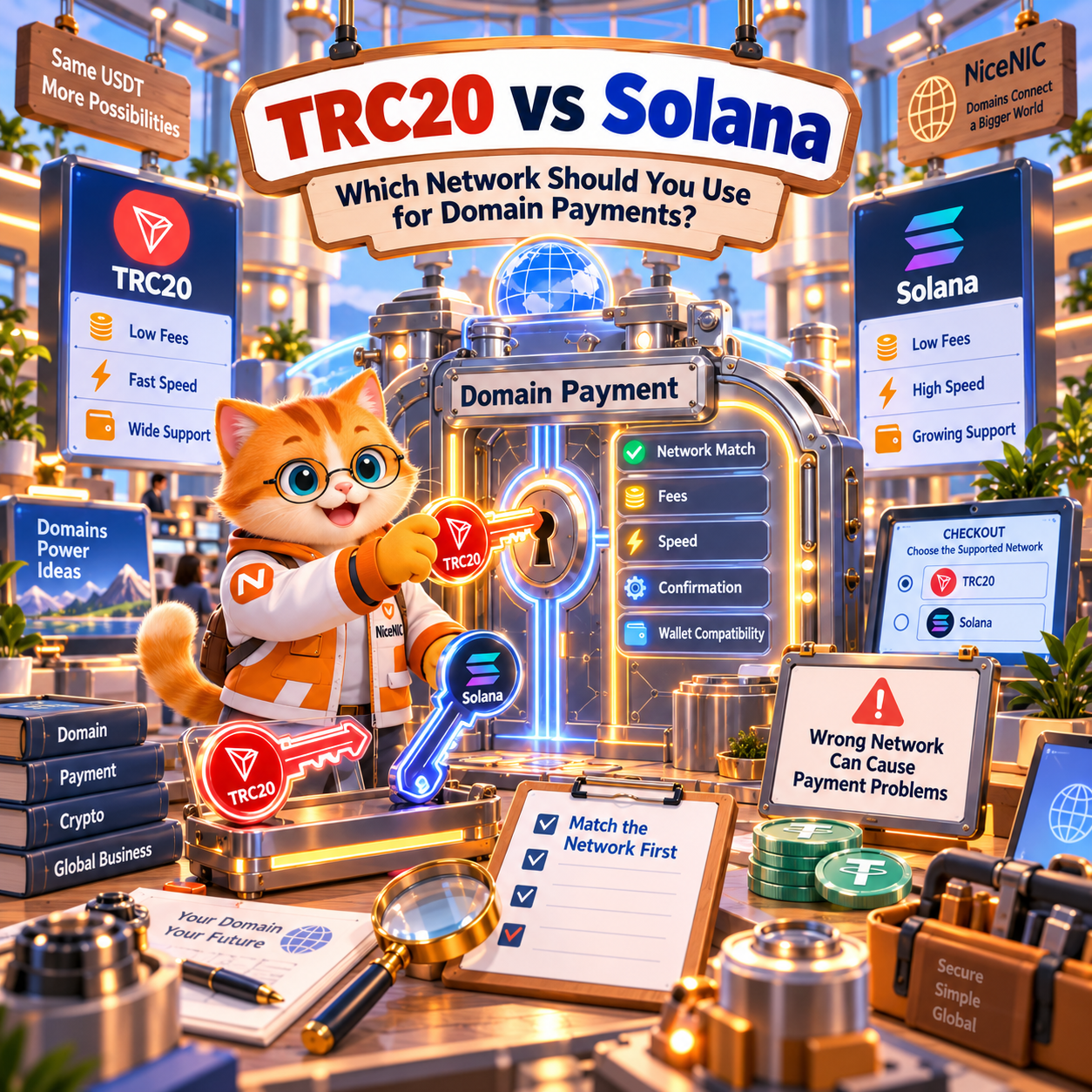
Direct Answer: TRC20 or Solana for USDT Payments?
USDT on TRON (TRC20) and USDT on Solana use different blockchain networks, fee models, address systems, and confirmation mechanisms.
Neither network is automatically better for every payment.
For NiceNIC specifically, both TRON and Solana are currently available as USDT networks through Online Crypto checkout.
NiceNIC currently adds a 0% crypto processing fee. Online Crypto is processed through Triple-A, which currently charges a 1.5% service fee. Your wallet, exchange, or blockchain network may also charge a separate fee.
The most important rule is:
Use the exact asset and network displayed in your current payment instructions. Do not move from TRC20 to Solana, or from Solana to TRC20, solely because one network appears cheaper.
If your USDT is already on TRON, TRC20 may be the simplest route.
If your USDT is already on Solana, using Solana may avoid an unnecessary conversion or withdrawal.
The live NiceNIC Payment Options and current checkout should always be treated as authoritative because supported networks and payment-provider options can change.
USDT TRC20 vs Solana: Quick Comparison
T
The main takeaway is:
Network compatibility comes first. Total payment cost comes second.
What Is USDT TRC20?
USDT TRC20 is USDT transferred over the TRON network using the TRC20 token standard.
TRON addresses normally begin with:
T
For example:
T...
TRON uses a resource model based primarily on:
- Bandwidth
- Energy
This is different from a simple fixed-dollar gas model.
Depending on the account and transaction, available network resources may reduce the amount of TRX consumed. When resources are insufficient, TRX can be consumed according to current network parameters.
That means statements such as:
"Every TRC20 transaction costs exactly $1"
are not technically reliable.
The amount you ultimately pay can depend on:
- Available Bandwidth and Energy
- Wallet configuration
- Exchange withdrawal policy
- Current network parameters
- Transaction conditions
If you send USDT from a centralized exchange, the exchange’s withdrawal fee may also differ from the underlying TRON network cost.
What Is USDT on Solana?
USDT on Solana uses the Solana network rather than TRON.
Solana addresses use Base58 public keys and do not have the same fixed T prefix used by TRON addresses.
Solana’s payment infrastructure is designed around very fast transaction processing and low blockchain-level fees.
However, three different concepts should not be confused:
- Block or slot production
- Transaction confirmation
- Finalized network state
A transaction can appear and confirm quickly without that meaning every merchant, payment gateway, or downstream service has completed its own processing at the same instant.
For NiceNIC payments, the important sequence remains:
Solana transaction → payment-provider confirmation → NiceNIC balance credit → domain or service order
So a fast blockchain does not mean the entire domain-registration workflow finishes in the same number of milliseconds.
Which Network Is Cheaper?
There is no universal answer.
Solana commonly has very low blockchain-level transaction fees.
TRON uses a different Bandwidth and Energy resource model.
But the raw blockchain fee is only one part of the total cost.
A real payment can include:
- Triple-A service fee
- Wallet fee
- Exchange withdrawal fee
- Blockchain fee
- Trading or conversion cost
- Bridging cost if you move between networks
For NiceNIC Online Crypto, a more useful formula is:
Total funding cost = Triple-A service fee + wallet/exchange cost + blockchain cost + any conversion cost
NiceNIC itself currently adds:
0% crypto processing fee
Triple-A currently charges:
1.5% service fee
That fee applies to the Online Crypto payment route regardless of whether you select TRON or Solana.
Why the Cheapest Blockchain Is Not Always the Cheapest Payment
Suppose you already hold USDT on TRON.
Moving to Solana simply to save on blockchain fees may require:
- Sending funds to an exchange or bridge.
- Changing the network.
- Paying a withdrawal, bridge, or trading cost.
- Sending the final payment from Solana.
Those additional steps can cost more than the network-fee difference you were trying to save.
The same applies in reverse.
If your funds are already on Solana, moving them to TRON simply because TRC20 is widely used may create unnecessary cost and risk.
A better decision rule is:
Use the supported network where your funds already reside, provided it matches the recipient's current payment instructions.
TRON Speed vs Solana Speed
TRON currently produces blocks roughly every 3 seconds, with typical solidification taking about 1 minute under healthy network conditions.
Solana is designed for much shorter slot times and very fast transaction confirmation.
However, comparing only those numbers can be misleading for a commercial payment.
For either network, the complete NiceNIC funding flow can include:
Blockchain transfer
→ Network confirmation
→ Triple-A confirmation
→ NiceNIC balance credit
→ Domain or infrastructure order
→ Registry or service provisioning
So:
Blockchain speed ≠ checkout completion speed ≠ domain provisioning speed
That distinction matters much more than quoting a single “seconds to payment” figure.
Can You Send TRC20 to a Solana Address?
No.
TRON and Solana are completely different blockchain networks.
A TRC20 address typically begins with T.
A Solana address is a Base58 public key and has no equivalent TRON prefix.
Sending through the wrong network can result in:
- The payment not being detected
- An unmatched transaction
- Manual reconciliation
- Difficult recovery
- No recovery in some circumstances
It is too absolute to say that every wrong-network transaction is always permanently lost.
Recovery can depend on:
- Who controls the receiving address
- Whether the receiving service supports the network
- Whether the necessary private keys are accessible
- Whether the payment provider has a recovery procedure
The safest approach is prevention.
Before every transfer, verify:
Asset + Network + Address + Amount
Real-World Example: Paying NiceNIC With TRON or Solana
NiceNIC provides a practical comparison because both networks are currently available for USDT in its Online Crypto payment flow.
NiceNIC is an ICANN-accredited registrar operating under IANA Registrar ID 3765 and has provided domain services since 2006.
Paying With USDT on TRON
If the live NiceNIC checkout shows:
USDT → TRON
select TRON in your wallet or exchange.
Do not substitute another USDT network merely because it appears cheaper.
Paying With USDT on Solana
If the current checkout shows:
USDT → Solana
select Solana in the sending wallet or exchange.
Again, follow the active payment instruction rather than relying on an old article or previous invoice.
Current NiceNIC Fee Structure
For Online Crypto:
- NiceNIC processing fee: 0%
- Triple-A service fee: currently 1.5%
- Wallet, exchange, or blockchain costs may also apply
After successful payment confirmation, the corresponding NiceNIC account balance is credited automatically.
That balance can then be used for eligible NiceNIC services.
Payment confirmation and domain registration are separate steps.
Review Current NiceNIC Payment Options
TRC20 or Solana for a Domain Purchase?
Use this simple decision process.
Choose TRC20 When:
- The current NiceNIC payment screen specifies USDT on TRON
- Your USDT is already held on TRON
- Your wallet or exchange supports the requested TRON withdrawal
- Moving to Solana would require another trade, bridge, or withdrawal
Choose Solana When:
- The current NiceNIC payment screen specifies USDT on Solana
- Your USDT is already held on Solana
- Your wallet or exchange supports the requested Solana route
- Moving to TRON would add unnecessary conversion steps
Do Not Choose Based Only on:
- A generic gas-fee chart
- A withdrawal-fee screenshot from another exchange
- An older NiceNIC invoice
- A blog claiming one network is always cheaper
- Raw blockchain speed alone
The current recipient instructions come first.
Putting the Payment Route Into Practice
Once your NiceNIC account balance has been credited, you can use it for eligible domain services.
For example:
The choice between TRON and Solana changes the payment route.
It does not change:
- The domain's registry rules
- Registration requirements
- Transfer rules
- Renewal requirements
- Privacy eligibility
Those are determined separately by the domain extension and registrar workflow.
Does Payment Network Affect WHOIS Privacy?
No.
TRON vs Solana has no effect on whether a domain qualifies for privacy protection.
NiceNIC provides free WHOIS privacy on eligible TLDs where registry policy permits it.
Some ccTLDs and restricted namespaces do not permit registrar privacy services.
Payment method and WHOIS privacy should therefore be evaluated separately.
Can the Same Account Fund Hosting and Server Services?
NiceNIC also provides infrastructure products beyond domains.
If your project needs infrastructure after registering the domain, you can separately review:
These products have their own pricing and service terms.
They are mentioned here only because the same account-funding workflow may be relevant to customers purchasing broader web infrastructure.
The main subject of this guide remains TRC20 vs Solana for USDT payments.
Security Checklist Before Sending USDT
Before confirming a payment:
- Verify the asset. Make sure the checkout requests USDT.
- Verify the network. TRON and Solana are not interchangeable.
- Verify the address. Use the destination generated for the current payment.
- Review the payment amount. Check what your wallet will actually send.
- Review all fees. Include Triple-A, exchange, wallet, and blockchain costs.
- Keep the required network asset. Self-custody wallets may require TRX or SOL for network execution depending on the transaction and wallet model.
- Save the TXID or transaction signature.
- Do not automatically reuse an old deposit address.
- Do not switch networks after generating an invoice unless you generate a new valid payment instruction.
The final check should always be:
Asset + Network + Address + Amount
Frequently Asked Questions
Does NiceNIC accept USDT TRC20?
Yes.
USDT on TRON is currently available through NiceNIC’s Online Crypto payment flow.
Always verify the live checkout before sending funds.
Does NiceNIC accept USDT on Solana?
Yes.
USDT on Solana is currently listed among NiceNIC’s Online Crypto network options.
Network availability can change, so the live payment screen remains authoritative.
Is Solana cheaper than TRC20 for USDT?
At the blockchain level, Solana can have very low transaction fees.
But the total payment cost can also include:
- Triple-A fee
- Exchange withdrawal fee
- Wallet fee
- Conversion or bridge cost
If your USDT is already on TRON, switching to Solana may not save money.
Is Solana faster than TRON?
Solana is designed for very fast block and payment confirmation.
TRON currently produces blocks roughly every 3 seconds and typically reaches solidification in about a minute.
However, merchant confirmation and NiceNIC account credit are separate from raw blockchain timing.
Is USDT on TRON the same as USDT on Solana?
They represent USDT transferred over different blockchain networks.
For payment purposes, treat them as separate network routes.
Always use the network requested by the recipient.
What happens if I send USDT over the wrong network?
The payment may not be detected automatically.
Recovery can be difficult or impossible depending on the network, destination, and payment provider.
Save the transaction information and contact NiceNIC Support if reconciliation is required.
Does NiceNIC charge extra for TRON or Solana payments?
NiceNIC currently adds a 0% crypto processing fee.
For Online Crypto payments, Triple-A currently charges a 1.5% service fee.
Wallet, exchange, and blockchain fees may also apply.
Does paying with crypto change my domain rights or obligations?
No special domain rights are created or removed simply because you use cryptocurrency.
The domain remains subject to the applicable registrar agreement, registry rules, transfer requirements, renewal policies, registration-data obligations, and applicable law.
Final Verdict: TRC20 or Solana?
There is no universal winner.
For a NiceNIC USDT payment:
Use TRC20 when the current payment screen requests TRON and your funds are already on TRON.
Use Solana when the current payment screen requests Solana and your funds are already on Solana.
Then compare the real cost of completing that supported route.
The most useful question is not:
"Which blockchain has the lowest gas fee?"
It is:
"Which supported network lets me complete the payment with the fewest unnecessary conversions, fees, and operational steps?"
NiceNIC currently combines both TRON and Solana USDT funding options with:
- ICANN accreditation under IANA Registrar ID 3765
- More than 2,500 supported domain extensions
- 0% NiceNIC crypto processing fee
- Multiple crypto funding networks
- Domain, reseller, and infrastructure services
Before sending any crypto payment, verify the live checkout.
Review Current Crypto Payment Options
Compare TRC20 vs ERC20 for Domain Payments
Verify NiceNIC Registrar Status
Verification Notes
Crypto networks, payment-provider fees, blockchain parameters, and exchange withdrawal costs can change.
This article was last checked on September 29, 2026 against current NiceNIC payment documentation and current TRON and Solana technical documentation.
For an actual payment, the live NiceNIC checkout and current payment instructions should always take priority over an older article, screenshot, exchange default, or third-party comparison.


