


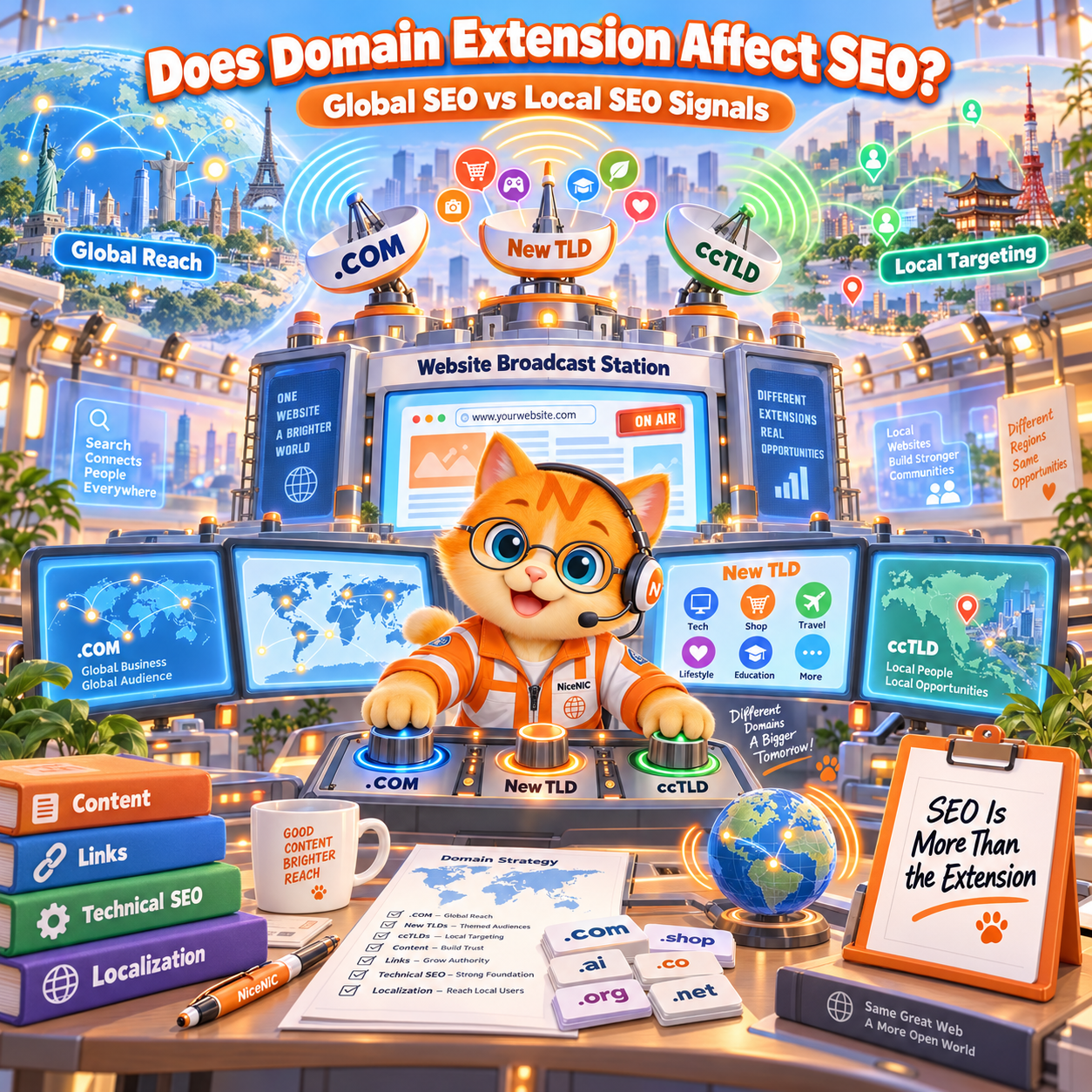
Does Domain Extension Affect SEO?
For most generic domain extensions, the TLD itself does not give a website an automatic Google ranking advantage.
Google treats .COM, .ORG, .NET and new generic TLDs as generic extensions. A site does not rank higher simply because it uses .COM, .SHOP, .TECH or another keyword-related extension.
The clearest SEO difference comes from geographic targeting.
Most country-code TLDs, such as .DE or .FR, provide Google with a strong signal that the website is intended for users in a particular country.
So the practical rule is:
Choose a domain extension for your audience, geography and brand—not because you expect the extension itself to boost rankings.
Still choosing a domain?
Is .COM Better for SEO?
No. .COM does not receive an automatic Google ranking boost simply because it is .COM.
Google’s own Search FAQ states that its goal is to return the most relevant result regardless of the top-level domain.
That means a strong website on:
example.net
or:
example.shop
can rank ahead of a weaker website on:
example.com
if the content and overall search relevance are better.
.COM can still be a good branding choice because it is widely used and familiar, but that is different from a direct SEO ranking advantage.
If you are choosing between extensions, read Which Domain Extension Should You Choose?.
Are New TLDs Bad for SEO?
No. New generic TLDs are not automatically worse for Google SEO.
Examples include:
-
.APP -
.SHOP -
.STORE -
.TECH -
.SITE -
.ONLINE -
.XYZ
Google says that if the best result for a search happens to use a new generic TLD, it can appear in Search just like a page on an older extension.
So you do not need to avoid a new TLD because you think Google will penalize it.
However, SEO neutrality does not mean every extension is equally good for your business.
Before choosing one, also check:
- whether customers will remember it
- whether the full domain sounds natural
- renewal pricing
- Premium status
- long-term brand fit
For more detail, see Are New gTLDs Safe for SEO and Branding?.
Do Keywords in a Domain Extension Help SEO?
Do not choose a TLD because you expect the keyword after the dot to create an automatic ranking advantage.
For example:
example.shop
does not automatically rank better for shopping searches.
example.ai
does not automatically rank better for AI-related searches.
example.tech
does not receive a technical SEO bonus because the word “tech” appears in the extension.
A relevant TLD can still make the brand meaning clearer to users, but that is not the same as Google assigning a keyword-ranking bonus.
Choose a keyword-related extension because it improves the domain name—not because you expect it to replace normal SEO work.
Are Country Domains Good for Local SEO?
They can be very useful when your website genuinely targets one country.
Google says that country-code top-level domains provide a strong signal to both users and search engines that the website is intended for a specific country.
Examples:
-
.DE→ Germany -
.FR→ France -
.JP→ Japan -
.CN→ China
A German business using:
example.de
therefore sends a much clearer country signal than a generic domain alone.
But a ccTLD does not automatically make weak content rank well.
You still need:
- useful local content
- the correct language
- local business information where relevant
- good technical SEO
- relevant links and authority
Think of the ccTLD as a geographic signal, not a ranking shortcut.
Is a Country Domain Good for International SEO?
It depends on how your international website is structured.
If you mainly serve one country
A country-code TLD can be a strong choice.
For example:
example.de
for a German-focused business.
If you operate separate country websites
You might use:
example.de
example.fr
example.jp
This creates very clear geographic separation.
But Google also notes some disadvantages: ccTLDs can require more infrastructure, may have registration restrictions and normally target only one country each.
If you operate one global brand
A generic TLD can be easier to manage.
For example:
example.com/de/
example.com/fr/
example.com/jp/
can keep multiple markets under one main domain.
For multilingual or multi-regional websites, domain structure is only part of the solution. You should also use clear localized URLs and hreflang where appropriate.
Google explains these options in its Managing Multi-Regional and Multilingual Sites guide.
Are .AI and .IO Country Domains for SEO?
Technically, yes: .AI and .IO are country-code TLDs.
But Google currently treats both as generic TLDs for search targeting because they are widely used internationally rather than mainly for their original geographic markets.
Google’s current generic-treated ccTLD list includes extensions such as:
-
.AI -
.CO -
.IO -
.ME -
.TV
So using:
example.ai
does not currently tell Google that the website is intended only for Anguilla.
Likewise:
example.io
is not treated as a country-targeted website simply because .IO is technically a ccTLD.
Google notes that this list can change, so international businesses should check the current policy when planning a long-term domain strategy.
Should You Change Your Domain Extension for SEO?
Usually, do not change a working domain purely because you think another generic TLD will rank better.
For example, moving:
example.net
to:
example.com
does not automatically improve Google rankings just because the new address uses .COM.
Changing domains can create migration work involving:
- redirects
- internal links
- canonical URLs
- XML sitemaps
- Search Console
- backlinks
- indexing changes
A domain change can make sense for other reasons, such as:
- rebranding
- serious brand confusion
- trademark problems
- a major international-market strategy change
But “`.COM ranks better” is not, by itself, a good SEO reason to migrate.
Which Domain Extension Should You Choose for SEO?
Use this simple framework.
.COM, .NET, .ORG or suitable new gTLD
.AI, .IO, .CO, .ME, .TV
Then choose based on:
Brand + Audience + Geography + Eligibility + Long-Term Cost
not:
“Which extension does Google like most?”
Frequently Asked Questions
Does .COM rank better than other domain extensions?
No. Google does not give .COM an automatic ranking advantage over other generic TLDs.
Are new domain extensions bad for SEO?
No. New generic TLDs can rank normally in Google Search. Their suitability depends more on brand fit, user expectations and long-term cost.
Does a country-code domain help local SEO?
A ccTLD provides a strong country-targeting signal, which can help Google understand the intended market. It does not automatically guarantee higher rankings.
Is a ccTLD bad for international SEO?
Not necessarily, but one ccTLD strongly targets one country. A global business serving many markets may find a generic TLD with localized subdirectories or subdomains easier to manage.
Does .AI help AI SEO?
No automatic ranking boost comes from .AI. Google currently treats .AI as a generic TLD for search targeting.
Does Domain Extension Matter for SEO?
Yes—but mostly for geography and user expectations, not direct ranking power.
For Google Search:
- generic TLDs do not receive an automatic ranking advantage
- new gTLDs are not automatically disadvantaged
- keyword TLDs do not create a ranking shortcut
- most ccTLDs provide a strong country signal
-
some ccTLDs such as
.AIand.IOare currently treated as generic
Choose the extension that fits the market you actually want to reach.


