


閲覧数:129
時間:2026-06-02 15:24:52 著者: windy 
Why This Issue Matters to Domain Owners and Resellers
For a domain owner, being reported for abuse can feel like being treated as guilty before the facts are clear. For a reseller, the situation can be even more difficult because the reseller may receive the notice, while the end customer controls the website, hosting, email, or CMS.
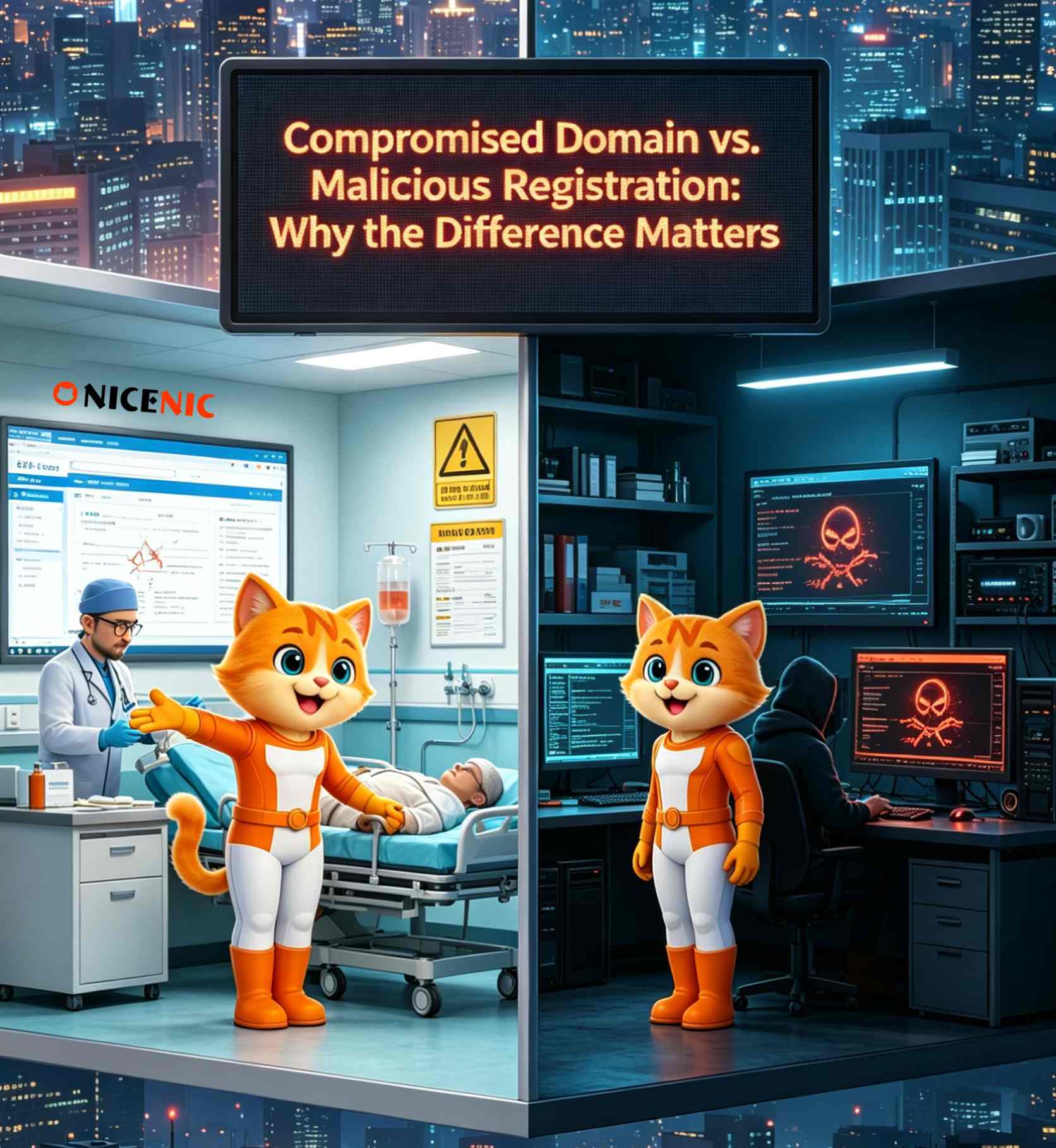
The distinction between a compromised domain and a malicious registration is one of the most important issues in abuse handling.
A compromised legitimate domain may belong to a real business, agency, nonprofit, developer, online store, or long-term customer. The domain may have been operating normally for months or years before a security incident occurred.
A malicious registration, by contrast, may show signs that the domain was created or acquired mainly for abuse. It may be newly registered, use deceptive naming patterns, host phishing pages, redirect users to harmful content, or appear in multiple security reports shortly after registration.
These two situations should not be treated as the same by default. NiceNIC's goal is to protect legitimate domain owners and resellers while responsibly addressing verified DNS Abuse. That means reviewing the facts, allowing customers to provide remediation evidence where appropriate, and avoiding unnecessary disruption when a less harmful response can address the risk.
What the Complaint or Abuse Signal Does and Does Not Mean
An abuse report is a signal that requires review. It is not automatically proof that the domain owner intentionally committed abuse.
A complaint or abuse signal may mean:
a phishing page was found on the domain;
a malware file was detected;
a suspicious redirect was observed;
a subdomain may be abused;
spam may have been sent using the domain or related infrastructure;
the domain appears on a third-party security list;
a reporter believes the domain is connected to harmful activity;
NiceNIC needs clarification, remediation evidence, or further review.
A complaint does not automatically mean:
the registrant intentionally registered the domain for abuse;
the whole domain is malicious;
the domain owner knew about the issue;
suspension is always the first or only appropriate step;
the complainant’s report is complete or final;
the domain cannot be reviewed after cleanup;
a reseller's entire account is responsible for one end customer's issue.
In ICANN-related abuse handling, DNS Abuse generally includes malware, botnets, phishing, pharming, and spam when spam is used as a delivery mechanism for those forms of DNS Abuse. Not every complaint about copyright, trademark, business conduct, website content, refund disputes, or customer disagreement is automatically DNS Abuse.
That is why classification matters. A hacked website, an outdated plugin, a stolen mailbox password, and an intentionally registered phishing domain require different review and response paths.
How NiceNIC Reviews the Issue Fairly
NiceNIC reviews abuse cases according to the NiceNIC Abuse Handling Manual, based on evidence, context, current risk, and proportional mitigation.
During review, NiceNIC may consider:
- whether the report includes actionable evidence;
- whether the exact reported URL is still active;
- whether the issue affects the entire domain or only a specific URL, file path, subdomain, redirect, or email flow;
- whether the domain is newly registered or long-standing;
- whether the domain has legitimate business use;
- whether the domain appears intentionally deceptive;
- whether the issue came from hosting, DNS, email, CMS, or third-party services;
- whether the domain owner or reseller has responded;
- whether cleanup evidence has been provided;
- whether urgent mitigation is needed to stop ongoing harm;
- whether a less disruptive action may be sufficient.
The practical review question is: Is this a legitimate domain that was compromised and can be remediated, or does the available evidence suggest the domain itself is being used as part of an abusive operation?
The answer affects the appropriate next step.
What a Compromised Domain Usually Looks Like
A compromised domain is usually a legitimate domain that has been misused without the owner's intention.
Common signs include:
- the domain has an established website or business purpose;
- the issue appears suddenly after normal operation;
- only a specific URL, folder, subdomain, or script is affected;
- the homepage may still look normal;
- the abuse may involve hidden files, injected pages, or redirects;
- the owner can identify and remove the compromise;
- the hosting provider can confirm cleanup;
- the customer can show remediation steps.
- a WordPress plugin vulnerability creates hidden phishing pages;
- an old CMS installation is used to host malware;
- an email password is stolen and used for spam;
- a redirect script is injected into website files;
- a subdomain points to a compromised third-party service;
- DNS records are changed after account credentials are exposed.
What Domain Owners or Resellers Should Do Immediately
If your domain is reported and you believe it is compromised rather than maliciously registered, act quickly.
First, log in to your NiceNIC account and review the domain status. Use How to Check Your Domain Abuse Status in NiceNIC to understand whether the domain is under review, restricted, or awaiting customer action. If available, review How to View the Abuse Complaint Summary for Your Domain to identify the reported issue.
Second, inspect the exact reported item. Do not check only the homepage. Review the reported URL, subdomain, file path, redirect, email behavior, or third-party listing.
Third, secure the affected environment. Check website files, CMS users, plugins, themes, DNS records, nameservers, MX records, email logs, hosting access logs, and third-party services. Remove unknown users, reset passwords, update software, delete malicious files, and disable suspicious scripts.
Fourth, contact your hosting provider if hosting is involved. Ask for malware scanning, cleanup confirmation, and written notes showing what was found and removed.
Fifth, respond through the official NiceNIC support or abuse channel with facts and evidence. Do not send only a general denial.
For resellers, contact the end customer immediately. Ask for technical evidence, not just a verbal statement. Then reply to NiceNIC with a clear summary and attachments.
What Evidence or Remediation Materials Are Useful
Useful evidence may include:
- screenshots showing the reported URL is removed or clean;
- malware scan results;
- hosting provider cleanup confirmation;
- server logs showing the issue is no longer active;
- CMS cleanup records;
- DNS before-and-after screenshots;
- password reset confirmation;
- suspicious user removal records;
- email log review;
- proof that abused SMTP credentials were disabled;
- third-party delisting requests or confirmations;
- a short remediation timeline;
- reseller notes from the end customer with technical proof.
A good response should answer four questions:
- What was reported?
- Was the issue confirmed?
- What did you do to fix it?
- What evidence shows the domain is now safe or that the report was incorrect?
If your domain is flagged by a third-party source, review Why Your Domain Is Flagged by VirusTotal, Spamhaus, Norton, and URLScan.io and What To Do and provide relevant cleanup or delisting evidence.
If you are unsure whether the complaint is DNS Abuse, review What Is DNS Abuse? A Clear Guide to ICANN DNS Abuse vs Non-DNS Abuse.
What NiceNIC May Do Depending on the Situation
NiceNIC's response depends on the evidence, severity, and whether the issue is ongoing.
Possible actions may include:
- asking the reporter for more specific evidence;
- asking the domain owner or reseller for clarification;
- requesting remediation evidence;
- allowing time for cleanup where appropriate;
- monitoring the domain after cleanup;
- taking no domain-level action if the report is not actionable or cannot be verified;
- applying temporary restrictions if verified abuse remains active;
- applying clientHold where necessary to stop confirmed DNS Abuse;
- coordinating with the registry if registry-level action is involved;
- keeping abuse-handling records for compliance and audit purposes.
If the domain appears compromised and the owner responds quickly with credible cleanup evidence, the review may focus on remediation and risk reduction. If the domain appears maliciously registered and the abuse is active, stricter mitigation may be required.
For status-related guidance, review Why Domains Get Suspended and How to Avoid clientHold and NiceNIC Abuse Handling Manual.
Conclusion
If your domain has been reported for abuse, first determine whether the issue appears to be a compromised legitimate domain or a malicious-use allegation.
Log in to your NiceNIC account, check your domain status, review the complaint summary if available, inspect the exact reported URL or signal, secure your website, DNS, email, and hosting environment, and submit cleanup proof or clarification through the official ticket or abuse channel.
For new domain planning, use Domain Name Search to choose domains carefully. For portfolio movement, review Domain Transfer before moving domains with active status issues. For partners managing customer domains, Domain Reseller and Reseller API can help create clearer workflows for customer communication, evidence collection, and domain management.
NiceNIC's goal is to protect legitimate domain owners and resellers while responsibly addressing verified DNS Abuse and keeping the DNS ecosystem safe.
関連記事:
前の記事:
Why We Ask for Evidence Before Taking Domain-Level Action
次の記事: How NiceNIC Sends Abuse Notices and What Domain Owners Should Check
次の記事: How NiceNIC Sends Abuse Notices and What Domain Owners Should Check


