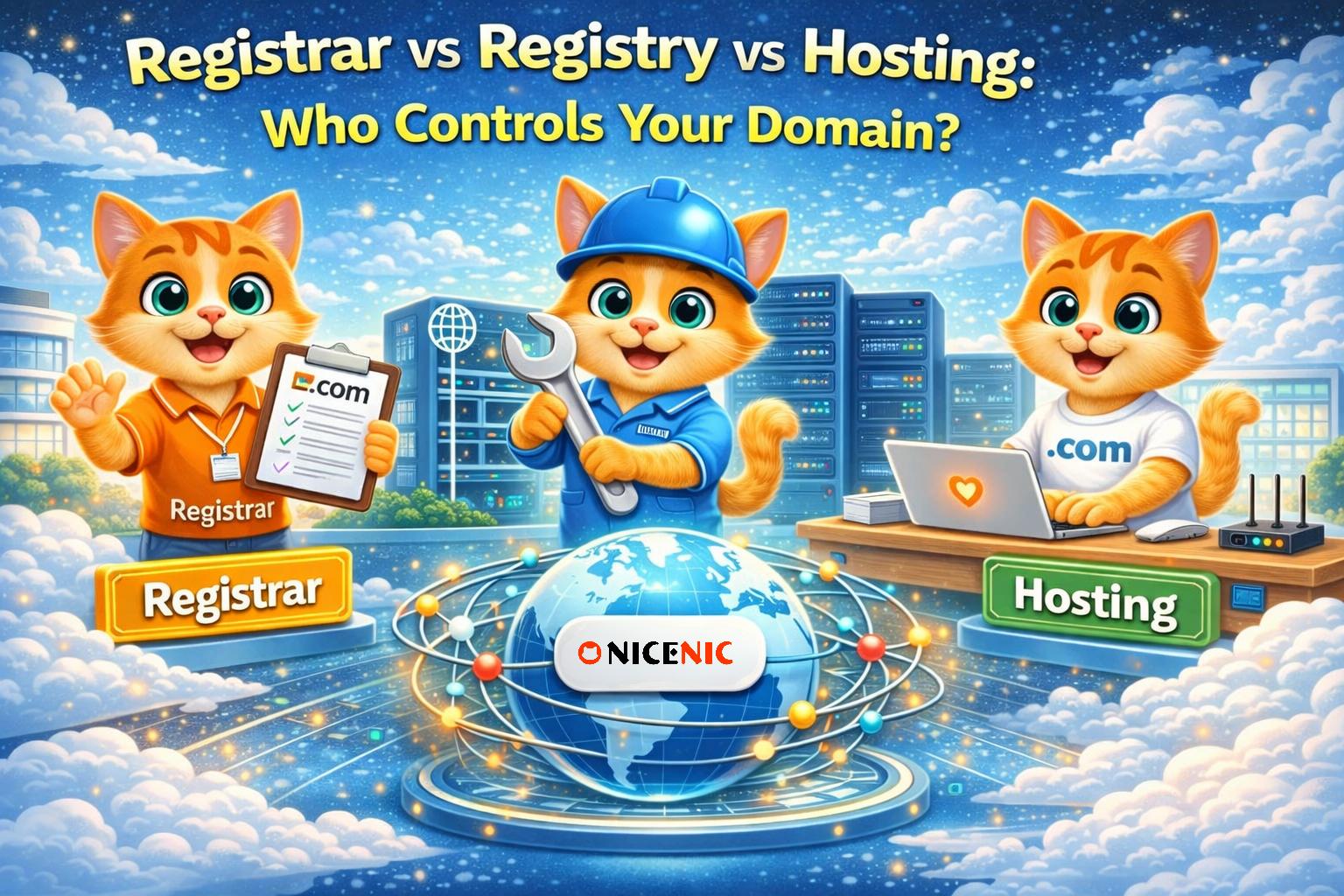
In reality, the answer is not always clear-cut. Many issues arise because people misunderstand the roles of the Registrar, Registry, and Hosting Provider. By understanding these roles, you can resolve domain problems faster and more effectively.
The Three Layers of Domain Management
Domain management operates across three key layers, each with distinct responsibilities:
-
Registrar: The company you purchase and manage your domain from, like Nicenic
-
Registry: The organization responsible for managing domain extensions
-
Hosting Provider: The company that stores and delivers your website content
Each layer plays a different role. Understanding these roles will help you navigate domain issues quickly.
Registrar: Your Direct Service Provider
The Registrar is the company you register your domain with. This is usually the only layer most users interact with.
-
Maintaining WHOIS data (your registration information)
-
Providing DNS, nameserver, and domain management tools
-
Handling abuse reports according to ICANN rules
-
Communicating with domain owners
What Registrars Can Do:
-
Apply clientHold status
-
Request corrective actions from domain owners
-
Take action when required under compliance policies
-
What Registrars Cannot Control:
-
Website content (handled by hosting providers)
-
Server-level issues
-
Infrastructure outside the domain system
-
Key Insight: Often, users expect registrars to immediately remove harmful content, but the issue often lies with the hosting provider, not the registrar.
Registry: The Operator Behind Your Domain Extension
The Registry is the organization that manages top-level domain (TLD) extensions, such as .com, .net, and country-code domains like .uk and .de.
-
Maintaining the central domain database
-
Ensuring DNS stability for the TLD
-
Setting policies for the extension (in line with ICANN)
-
Providing technical support to registrars
What Registries Can Do:
-
Apply serverHold status in specific situations
-
Enforce TLD-level policies
-
What Registries Cannot Do:
-
Communicate directly with domain owners
-
Handle individual abuse complaints
-
Key Insight: Registries manage the top-level domain but do not handle day-to-day user support or individual domain issues.
Hosting Provider: Where Your Website Actually Lives
The Hosting Provider is the company where your website’s content is stored and delivered.
-
Hosting website files and databases
-
Managing servers and ensuring uptime
-
Delivering content to users
What Hosting Providers Can Do:
-
Remove or suspend harmful website content
-
Disable hosting accounts or servers
-
Block access to specific pages
-
What Hosting Providers Cannot Control:
-
Domain ownership
-
Domain registration status
-
Key Insight: If the issue involves website content (such as phishing pages), the fastest resolution usually comes from the hosting provider, not the registrar.
How the System Works in Real Abuse Cases
Here’s an example of how these roles interact in a typical phishing website case:
-
Hosting Provider: Can remove the phishing page.
-
Registrar: May place the domain on clientHold if necessary.
-
Registry: May apply serverHold in escalated cases.
Understanding these roles helps you resolve domain-related issues faster.
Why Domain Issues Are Often Delayed
Delays are often caused by misalignment of expectations:
-
Reporting to the wrong party
-
Expecting immediate action without sufficient evidence
-
Confusing roles and responsibilities
Understanding who to contact can save time and avoid unnecessary delays.
How to Effectively Handle Domain Issues
-
Domain Ownership or Status: Contact the Registrar
-
Extension-Level Policy Issues: Contact the Registry
-
Website Content or Phishing Page Issues: Contact the Hosting Provider
Understanding the roles of these parties helps you resolve problems more quickly.
FAQ: Frequently Asked Questions
Q1: What’s the difference between a domain registrar and a registry?
Registrar is where you buy and manage your domain. Registry is the organization responsible for the technical management of domain extensions like .com or .net.Q2: Can the registrar remove harmful website content?
No. The registrar manages domain registration but doesn’t control website content. Content issues are handled by the Hosting Provider.Q3: How can I get my domain reinstated after suspension?
Contact your Registrar to understand why the domain was suspended. They will guide you through the necessary steps if it's a policy issue.Q4: Who handles abuse reports for my domain?
Registrars handle abuse reports related to domains, such as phishing, spamming, or other illegal activities.Choose NiceNIC for Trusted Domain Management
At NiceNIC, we provide a secure, reliable, and efficient domain registration service. As an ICANN-certified registrar, we ensure your domains are handled with professionalism and compliance. Our team is always ready to assist with domain management and abuse handling.
Why choose NiceNIC?
- Fair, Safe & Transparent Domain Operations — No suspension without valid evidence
- Responsive Human Support — Real Experts, Real Help, reply within 6 hours
- Lifetime Free WHOIS Privacy & Full Domain Control
- Crypto-Friendly Payments — BTC, USDT, ETH, LTC
- 2,500+ Domain Extensions with API Automation Tools
- Multilingual Service & ICANN Accreditation Worldwide
- Globally Recognized & Trusted Brand
Start managing your domains with us today and experience hassle-free service!