


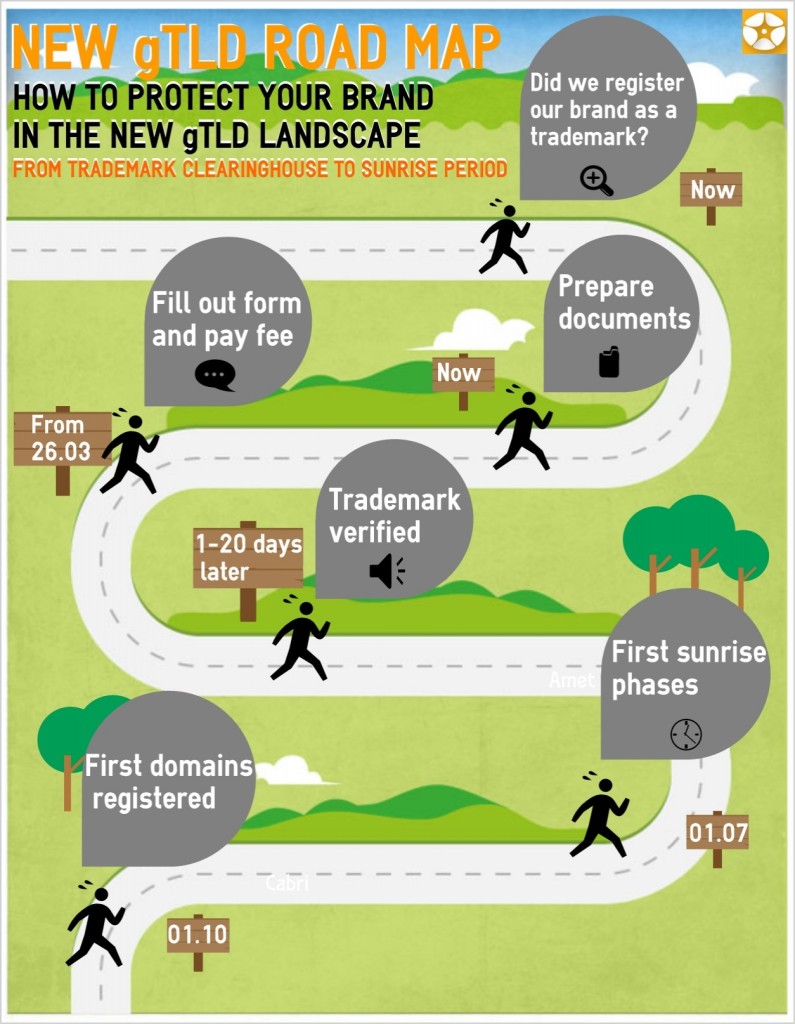
The Trademark Clearinghouse (TMCH) and Sunrise registration process were introduced to help trademark holders secure matching domain names before they became widely available.
Today, these protections remain relevant as ICANN’s 2026 New gTLD Program moves forward. However, recording a trademark does not automatically reserve domain names or prevent others from registering them.
For businesses planning a defensive registration strategy, the goal is to protect important brand names without accumulating unnecessary renewal costs. You can use NiceNIC Bulk Domain Search to check multiple names and compare registration and renewal prices before deciding which extensions are worth securing.
Step 1: Register Your Trademark With TMCH
The Trademark Clearinghouse is a centralized service that verifies eligible trademark records for use in new gTLD rights-protection mechanisms.
Trademark holders can submit qualifying trademarks for verification. Once approved, they can access services including:
- Sunrise Service: Priority registration opportunities during eligible new gTLD launches.
- Trademark Claims: Warnings to prospective registrants and notifications to trademark holders when matching names are registered during the applicable Claims Period.
- Ongoing Notifications: Monitoring of certain matching registrations beyond the initial Claims Period.
TMCH does not grant exclusive rights to every domain containing a trademark, nor does it automatically purchase domains on behalf of the trademark holder.
Step 2: Participate in Sunrise Registration
Sunrise allows eligible trademark holders to apply for matching domains before a new gTLD enters general availability.
To participate, trademark holders generally need a verified TMCH record, approved Proof of Use documentation and a valid Signed Mark Data (SMD) file.
The process involves three main actions:
- Verify the trademark and obtain the SMD file.
- Check the registry's official Sunrise dates, eligibility requirements and pricing.
- Submit the domain application through a registrar supporting that Sunrise launch.
Sunrise does not guarantee successful registration. If multiple eligible trademark holders apply for the same name, the registry may use an allocation procedure such as an auction.
Sunrise is associated with the launch of an extension. It is not an annual registration opportunity for TLDs that are already generally available.
For upcoming opportunities, refer to the TMCH Sunrise Service and its official launch calendar.
Step 3: Understand Trademark Claims Protection
After Sunrise, new gTLDs generally enter a Trademark Claims Period lasting at least 90 days.
If someone attempts to register a domain matching an applicable TMCH record, they receive a trademark notice. If they proceed with the registration, the trademark holder is notified.
However, Trademark Claims does not automatically block the registration.
A matching domain name does not always constitute trademark infringement. Different businesses may have legitimate rights to similar names.
Trademark holders should evaluate suspicious registrations and, where appropriate, consider dispute-resolution procedures such as the Uniform Domain-Name Dispute-Resolution Policy (UDRP) or Uniform Rapid Suspension (URS).
Step 4: Choose Which Domains Are Worth Protecting
Registering a brand name under every new extension may seem like the safest strategy, but it can become expensive.
Each registration creates a potential annual renewal obligation, while TMCH verification, Sunrise applications and monitoring services may involve separate fees.
A practical defensive registration strategy should prioritize:
- Core brand domains: Extensions customers already associate with the business.
- Important markets: Country-code and industry-related extensions relevant to the company's operations.
- High-risk names: Domains that could realistically be used for customer impersonation or fraudulent communications.
- Future business needs: Names associated with planned products or geographic expansion.
Lower-priority extensions may be better handled through monitoring rather than registration.
Some registries and service providers also offer domain blocking services, which may be worth comparing when a company needs protection across many extensions.
Before registering a large portfolio, review both the initial purchase price and the long-term renewal costs.
Step 5: Review Your Brand Protection Strategy
New gTLD launches, business expansion and changing customer behavior can affect which domains are worth protecting.
A company should periodically review its trademarks, registered domains, renewal costs and potential impersonation risks.
ICANN’s 2026 New gTLD Program creates further opportunities for namespace expansion, but proposed extensions must complete the applicable evaluation and approval processes before launch. Individual Sunrise dates depend on each registry’s official schedule.
Rather than attempting to register every possible variation, businesses should focus on the domains that protect their customers and support their actual operations.
Check multiple domain names with NiceNIC to review availability across supported extensions, then compare registration and renewal costs before expanding your portfolio.


