


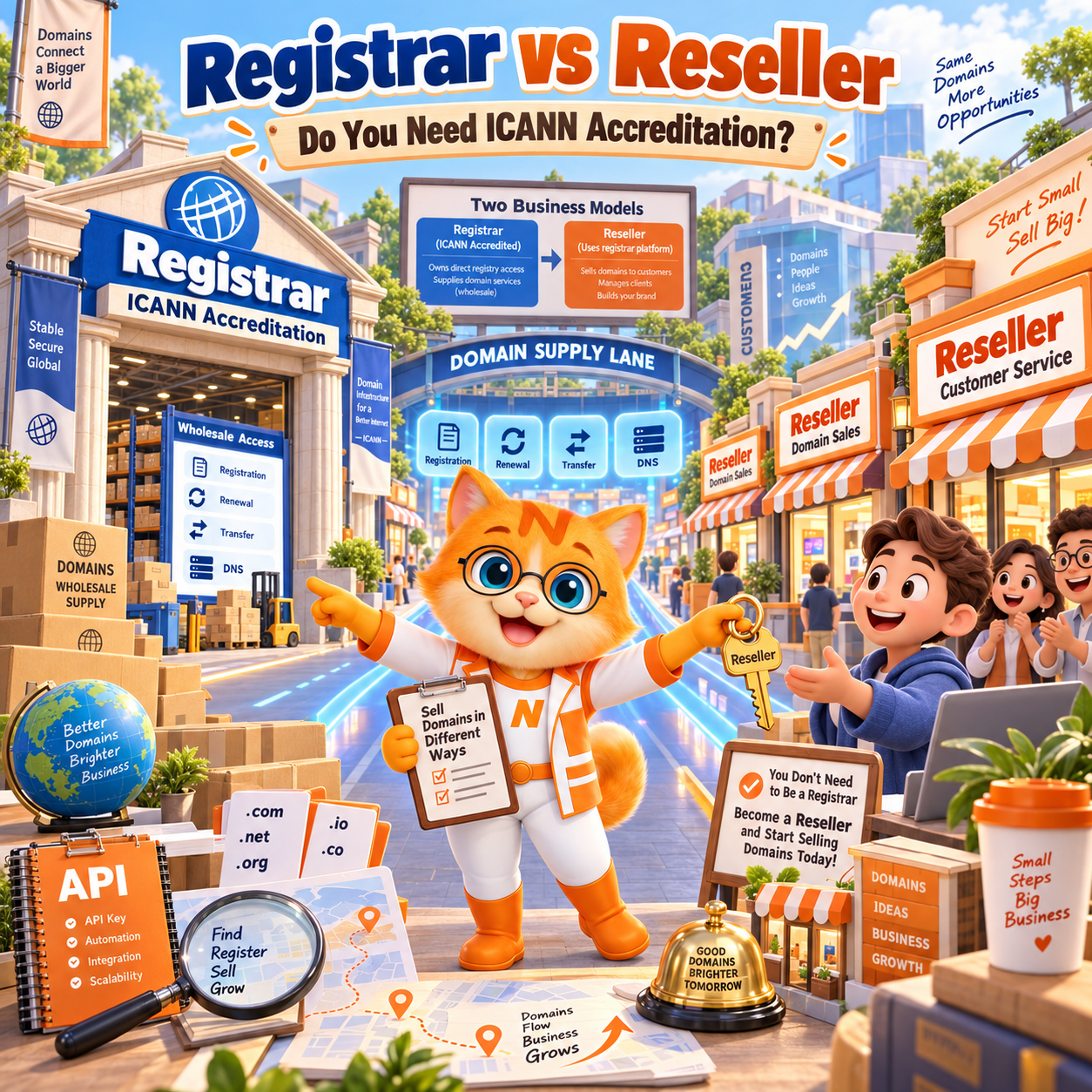
Direct Answer Capsule
No. You generally do not need your own ICANN registrar accreditation to sell domain registrations as a reseller.
ICANN recognizes that domain names can be sold through ICANN-accredited registrars and their resellers. A reseller operates under an agreement with a sponsoring registrar; the sponsoring registrar remains responsible and accountable to ICANN for registrar services, while the reseller still has contractual and policy responsibilities of its own.
A reseller must not claim to be ICANN accredited merely because it sells domains through an accredited registrar.
NiceNIC is an ICANN-accredited registrar, IANA ID 3765, and offers a Domain Reseller Program with control-panel tools, bulk operations, Domain API and WHMCS integration.
Before selling customer domains, review the NiceNIC Domain Reseller Agreement and understand who is responsible for the customer relationship, registrant data, pricing, renewals and required notices.
Registrar vs Reseller: The Difference in One Table
The reseller model therefore does not turn the reseller into a registrar.
It lets the reseller build a customer-facing domain business on top of registrar infrastructure.
What Does ICANN Say About Domain Resellers?
ICANN describes resellers as businesses affiliated with or under contract with registrars that offer domain-registration services and related services to customers.
ICANN also makes the responsibility structure clear:
The reseller is not ICANN accredited merely because it is a reseller, while the accredited registrar remains responsible and accountable for registrar services provided through the reseller relationship.
See:
ICANN — The Domain Name Registration Process
and:
This distinction matters for both marketing and customer protection.
Can a Reseller Say "We Are ICANN Accredited"?
Not unless that reseller independently holds ICANN accreditation and is authorized to make that statement.
ICANN’s Registrar Accreditation Agreement requires accredited registrars to ensure that resellers do not:
- display the ICANN logo improperly;
- display the ICANN-Accredited Registrar logo as though the reseller itself were accredited;
- otherwise represent themselves as ICANN accredited merely because of the reseller relationship.
See ICANN's Registrar Accreditation Agreement.
NiceNIC's current Domain Reseller Agreement applies the same principle.
A NiceNIC reseller can accurately say something such as:
Domain registration services powered by NiceNIC, an ICANN-accredited registrar.
But it should not say:
We are an ICANN-accredited registrar
unless the reseller itself actually has that accreditation.
Who Is the Sponsoring Registrar?
The sponsoring registrar is the ICANN-accredited registrar responsible for the domain at registrar level.
For domains sponsored through the NiceNIC reseller relationship, NiceNIC identifies:
NICENIC INTERNATIONAL GROUP CO., LIMITED
as its ICANN-accredited registrar entity.
NiceNIC’s IANA Registrar ID is:
3765
You can independently verify registrar accreditation through the ICANN List of Accredited Registrars.
NiceNIC also publishes its registrar information through the NiceNIC Trust Center.
Why Would a Hosting Company Use a Reseller Instead of Becoming a Registrar?
Because the two models solve very different problems.
A hosting company may simply want to add:
domain search → domain order → hosting → renewal
to its existing customer business.
It may not need to become a standalone registrar organization.
A reseller model allows the hosting company to focus on:
- customers;
- pricing;
- billing;
- hosting;
- support;
- marketing;
- product bundles.
while working through registrar infrastructure for supported domain operations.
Becoming an ICANN-Accredited Registrar Is a Separate Business Decision
ICANN accreditation involves much more than opening a reseller account.
ICANN’s current accreditation process includes requirements such as:
- an accreditation application;
- company and financial information;
- operational and technical information;
- security capabilities;
- Registrar Accreditation Agreement obligations;
- Registration Data requirements;
- Registrar Data Escrow;
- registry onboarding;
- registrar policies and customer agreements.
See ICANN — How to Become an ICANN-Accredited Registrar.
What Does ICANN Accreditation Cost?
ICANN’s current published financial considerations list:
- US$3,500 non-refundable application fee
- US$4,000 annual accreditation fee
- variable registrar fees
- other operational and registry-related costs
These amounts are only part of the cost.
See ICANN Registrar Accreditation Financial Considerations.
ICANN’s application instructions also require applicants to demonstrate appropriate operational, technical and financial capability.
Therefore:
Registrar accreditation is not simply a more expensive reseller tier.
It is a different operating model.
Registrar Data Escrow Is Another Example of the Difference
ICANN-accredited registrars have Registrar Data Escrow obligations.
ICANN’s current RDE program requires registrars to deposit specified registration data through an ICANN-designated or approved data escrow provider.
See ICANN Registrar Data Escrow Program.
A normal domain reseller does not independently become an ICANN registrar data-escrow operator merely because it sells domains.
The accredited registrar remains responsible for its applicable registrar-level obligations.
Does That Mean a Reseller Has No Compliance Responsibilities?
No.
This is one of the most important points in this article.
A reseller does not become an ICANN-accredited registrar.
But that does not mean:
the reseller can ignore domain policies.
ICANN requires registrar-reseller agreements to contain applicable obligations, and the sponsoring registrar must ensure the reseller relationship allows the registrar to comply with its accreditation requirements.
NiceNIC’s current reseller terms reflect this model.
What Responsibilities Does a Domain Reseller Still Have?
A serious reseller should understand at least the following areas.
1. Identify the Actual Registered Name Holder
If a customer registers the domain, the reseller should not simply put every domain in the reseller company’s own name.
The customer or intended legal entity should be accurately identified according to the applicable registration process.
NiceNIC's current Domain Name Registration Service Agreement specifically requires resellers and agents to handle Registered Name Holder information accurately.
2. Do Not Misrepresent Registrar Status
If NiceNIC is the sponsoring registrar:
NiceNIC is the registrar.
The reseller should not tell customers that the reseller itself is the accredited registrar unless that statement is independently true.
3. Make Required Registration Terms Available
Customers must be bound by the applicable registration terms and required notices.
NiceNIC’s reseller agreement provides for the NiceNIC registration agreement or another reseller agreement that incorporates required provisions.
The safest operational model is:
customer sees the required terms before the order is accepted.
4. Show Pricing Clearly
A reseller controls its own retail pricing model.
But customers should understand applicable:
- registration price;
- renewal price;
- post-expiration costs;
- restore/redemption charges;
- additional mandatory costs.
Do not advertise:
$1 domain
and hide the long-term renewal cost until the following year.
NiceNIC publishes current registrar-side pricing through NiceNIC Domain Prices.
5. Maintain Accurate Customer Information
Registry and registrar systems can require accurate:
- registrant name;
- organization;
- address;
- email;
- telephone;
- eligibility information.
Some TLDs also require:
- passport;
- company document;
- local presence;
- other registry-specific data.
A reseller should collect the correct information instead of using a generic reseller identity for every customer.
6. Forward Required Communications
Some registrar, registry, security or legal communications must reach the actual registrant.
A reseller relationship should not become a wall that prevents required notices from reaching the customer.
NiceNIC may also need to communicate directly with a Registered Name Holder where registrar, registry, security or legal requirements apply.
7. Handle Customer Support Properly
The reseller normally manages the first-line commercial relationship with its own customers.
For example:
- customer billing;
- retail pricing;
- storefront questions;
- account access to reseller services.
NiceNIC handles registrar-side and registry-facing matters for NiceNIC-sponsored domains.
This division is particularly useful when a customer encounters:
- registry rejection;
- transfer exception;
- TLD verification;
- abuse/compliance case;
- registrar-level domain status.
Who Should Consider the Reseller Model?
The reseller route can make sense for several types of businesses.
Hosting Providers
A customer buying hosting often also needs:
- domain registration;
- renewal;
- transfer;
- DNS.
Domains can remain inside the same hosting-business relationship.
Web Agencies
An agency can manage:
- domain;
- website;
- DNS;
- SSL;
- Business Email
for the same client.
SaaS Platforms
A SaaS product may want users to search and register domains without leaving the application.
That usually calls for API-based domain automation rather than becoming a registrar.
Website Builders
A website builder can connect:
create site → find domain → register → configure DNS → publish
through registrar-backed domain services.
IT Service Companies
Domains can become part of a managed business stack alongside:
- website;
- email;
- security;
- server infrastructure.
Existing Domain Resellers
A reseller may want:
- broader TLD coverage;
- better renewal economics;
- API;
- WHMCS;
- bulk tools;
- a different upstream registrar.
How Does the NiceNIC Reseller Model Work?
NiceNIC currently offers reseller pricing with usable prepaid account credit.
Current published levels are:
Current program terms state:
- no separate setup fee
- no annual reseller fee
- credit does not expire
- qualifying deposits become usable NiceNIC account credit
- reseller levels can be upgraded as the business grows
See NiceNIC Domain Reseller Program.
The account credit can be used for eligible:
- registrations;
- renewals;
- transfers.
The reseller deposit is therefore different from an application fee or annual membership charge.
Do You Have to Become a Reseller Before Testing NiceNIC?
No.
This is useful for businesses evaluating NiceNIC.
NiceNIC currently separates:
API access
from:
reseller pricing
Active Market Accounts and Reseller Accounts can use the current NiceNIC Domain API model.
This means a developer can first:
Create Account → Enable API → Test → Evaluate Workflow
before deciding whether reseller pricing is commercially useful.
Can You Test the API Without Creating Real Domain Orders?
Yes.
NiceNIC provides a dedicated API Sandbox.
The Sandbox is intended to test:
- authentication;
- requests;
- response parsing;
- application logic;
- error handling.
Sandbox operations do not create real production domain orders or real charges.
That reduces the technical risk of testing a new registrar integration.
Do You Need to Build an API Integration?
No.
There are several ways to operate as a reseller.
Option 1: Control Panel
Best for:
- small volume;
- agencies;
- manual domain management;
- initial testing.
Option 2: Bulk Tools
Useful when staff manage many domains but still approve operations manually.
Option 3: WHMCS
If your hosting business already uses WHMCS, NiceNIC provides an official WHMCS Registrar Integration.
This can keep domain operations inside the billing workflow you already use.
Option 4: Domain API
Use NiceNIC Domain API when you need:
- custom storefront;
- SaaS integration;
- proprietary billing system;
- customer portal;
- automated provisioning.
There is no requirement to build custom software if your business does not need it.
Registrar vs Reseller vs Affiliate: Do Not Confuse Them
These business models are different.
A reseller is more than an affiliate.
The reseller can build domain services into its own commercial workflow.
Can You Use Your Own Brand as a Domain Reseller?
Generally, yes, within the limits of the applicable reseller agreement and law.
For example, your website may sell:
domain registration
alongside:
- hosting;
- website design;
- SaaS;
- SSL;
- Business Email.
But branding freedom does not allow accreditation misrepresentation.
Your storefront can be your brand.
The sponsoring registrar remains the sponsoring registrar.
Can You Set Your Own Domain Prices?
A reseller typically controls its customer-facing retail pricing, subject to:
- law;
- taxes;
- registry or policy requirements;
- required disclosures;
- reseller agreement.
Your business should therefore separate:
Upstream Cost
What NiceNIC charges your account.
Customer Price
What you charge the customer.
Margin
The difference before:
- payment costs;
- tax;
- support;
- refunds/chargebacks;
- software;
- staffing.
Do not treat:
Customer Price − Registration Cost
as guaranteed net profit.
Registration Margin Is Only One Part of the Business
A reseller customer may remain for years.
So a strong reseller model also considers:
- renewal margin;
- transfer business;
- hosting;
- Business Email;
- SSL;
- support cost;
- payment cost;
- customer retention.
Before setting a retail domain price, compare both:
Registration
and:
Renewal
through NiceNIC Domain Prices.
What About ccTLDs?
ICANN accreditation applies to the gTLD registrar framework.
Country-code TLDs can have separate registry rules.
A reseller relationship with an ICANN-accredited registrar therefore does not mean:
every ccTLD automatically follows ICANN's standard gTLD model.
ccTLD registries may define separate:
- eligibility;
- accreditation;
- reseller;
- local-presence;
- documentation;
- transfer
requirements.
NiceNIC currently supports more than 2,500 domain extensions, but each extension remains subject to its applicable registry rules.
Use NiceNIC ccTLD Requirements where relevant.
What Happens if a Customer Domain Receives an Abuse Complaint?
The reseller relationship does not remove registrar responsibilities.
NiceNIC may coordinate with the reseller, but NiceNIC remains responsible for applicable registrar-level obligations for NiceNIC-sponsored domains.
NiceNIC may also contact the Registered Name Holder where required for:
- security;
- mandatory notices;
- abuse mitigation;
- legal compliance;
- protection of registrant rights.
See NiceNIC Abuse Reporting & Handling Policy.
A serious reseller should therefore maintain:
- accurate customer identity;
- reachable contact information;
- clear escalation path.
A Good Reseller Workflow Keeps Roles Clear
For each customer domain, your system should know:
Customer
Who is the actual Registered Name Holder?
Reseller
Who manages the commercial relationship?
Registrar
Which accredited registrar sponsors the domain?
Registry
Which organization operates the extension?
That becomes:
Registry → Registrar → Reseller → Registrant
Do not collapse all four roles into one.
How to Start Selling Domains Without Becoming a Registrar
Use this practical sequence.
Step 1: Choose the Business Model
Decide whether domains will be:
- your main business;
- an add-on to hosting;
- part of agency services;
- part of a SaaS product.
Do not integrate technology before deciding what customers actually need.
Step 2: Verify the Sponsoring Registrar
Do not trust a reseller platform simply because it uses the word:
"Registrar."
Verify the underlying accredited entity.
For NiceNIC, use:
and:
ICANN Accredited Registrar List.
Step 3: Read the Reseller Agreement
Review:
- customer relationship;
- registrant data;
- accreditation representation;
- registration agreements;
- payments;
- renewals;
- compliance;
- termination.
NiceNIC publishes the current Domain Reseller Agreement in its Legal Center.
Step 4: Compare the TLDs You Actually Sell
Do not select an upstream registrar based only on:
.COM first-year price.
Compare your actual mix:
-
.COM -
.NET - country domains
- AI/technology domains
- client-specific extensions.
Step 5: Choose Your Workflow
Use:
- Control Panel;
- Bulk Tools;
- WHMCS;
- Domain API.
Choose the simplest system that meets the business requirement.
Step 6: Test Before Moving Significant Volume
NiceNIC explicitly supports evaluation without requiring you to move your entire existing portfolio.
Test:
- selected new registrations;
- a few transfers;
- one TLD group;
- WHMCS;
- API.
Measure the real operational result.
Step 7: Upgrade Reseller Pricing When It Makes Economic Sense
If the workflow works and volume grows, compare:
- Basic;
- Super;
- VIP.
The correct reseller level is the one supported by your real volume and TLD mix.
Do not choose a higher level merely because it exists.
A Low-Risk NiceNIC Reseller Pilot
For an existing hosting provider:
Week 1
Create a NiceNIC account.
Review:
- prices;
- TLD coverage;
- reseller agreement.
Week 2
Connect the workflow you already use.
For a WHMCS host:
For a custom platform:
Week 3
Route a small number of:
- new registrations;
- selected transfers;
- renewals
where appropriate.
Week 4
Measure:
- actual registrar cost;
- completion time;
- failed-order handling;
- manual work;
- support experience.
Then decide whether to:
- keep testing;
- increase volume;
- activate a higher reseller level.
This is a more reliable decision than moving hundreds of domains based only on a marketing claim.
Common Domain Reseller Mistakes
"I sell domains, so I can say I am ICANN accredited."
No.
Only use that claim if your organization independently holds the accreditation.
"The registrar handles compliance, so I have no responsibilities."
Incorrect.
The sponsoring registrar remains accountable to ICANN, but the reseller still has contractual responsibilities.
"I should register every customer's domain in my company name."
No.
Use the correct Registered Name Holder according to the actual registration arrangement.
"Customers never need to know the sponsoring registrar."
Incorrect.
Applicable reseller rules require the sponsoring registrar to be identifiable.
"I need ICANN accreditation before I can start selling domains."
Not under the ordinary reseller model.
"I need a reseller account just to test NiceNIC API."
No.
Current NiceNIC API access and reseller pricing are separate.
"Becoming a reseller means I need to rebuild my billing system."
No.
A hosting company already using WHMCS can use the NiceNIC WHMCS integration.
"The reseller deposit is an annual membership fee."
Not under NiceNIC’s current standard reseller model.
The qualifying prepayment becomes usable account credit.
"The highest reseller tier must be the best one."
Not necessarily.
Calculate your actual volume and TLD mix first.
Frequently Asked Questions
Do I need ICANN accreditation to sell domain names?
Generally no, if you are selling domains as a reseller under an ICANN-accredited registrar. The reseller does not become ICANN accredited merely because it sells registrar services.
What is a domain reseller?
A domain reseller sells registration and related services through a sponsoring registrar’s infrastructure and commercial relationship.
Is a reseller an ICANN-accredited registrar?
No, unless the reseller independently holds ICANN accreditation.
Can a reseller display the ICANN-accredited logo?
Not merely because it is a reseller. ICANN rules prohibit resellers from representing themselves as ICANN accredited unless properly authorized.
Who is responsible for domains sold by a reseller?
The reseller handles its applicable customer and contractual responsibilities. The sponsoring registrar remains responsible and accountable for applicable ICANN registrar obligations.
Who sponsors domains sold through NiceNIC resellers?
For domains sponsored through NiceNIC’s registrar accreditation, the sponsoring registrar is NICENIC INTERNATIONAL GROUP CO., LIMITED, subject to applicable TLD and registry requirements.
What is NiceNIC's IANA ID?
NiceNIC’s registrar entity uses IANA ID 3765.
Can I sell domains under my own brand?
A reseller can operate its own customer-facing business, subject to the reseller agreement, applicable policy and law. It must not falsely represent itself as the accredited registrar.
Can I set my own retail prices?
A reseller typically sets its own customer-facing pricing, subject to applicable agreements, required disclosures, law and taxes.
Do I need to identify the real customer as registrant?
Yes. The appropriate Registered Name Holder information must be used according to the applicable registration agreement and registry requirements.
Does NiceNIC charge a reseller membership fee?
NiceNIC currently lists no separate setup fee and no annual reseller membership fee for its standard reseller levels.
Is the reseller deposit lost?
No. Under NiceNIC’s current model, the qualifying prepayment becomes usable account credit for eligible domain registrations, renewals and transfers.
What is the minimum NiceNIC reseller level?
The current Basic level starts with $200 usable account credit.
Do I need reseller status to use NiceNIC API?
No. NiceNIC currently makes Domain API access available to active Market and Reseller Accounts.
Can I test the API without real orders?
Yes. Use the NiceNIC API Sandbox.
Does NiceNIC support WHMCS?
Yes. NiceNIC provides an official WHMCS Registrar Integration.
Can a reseller sell ccTLDs?
Where the upstream registrar supports the TLD and the customer satisfies the applicable registry requirements. ccTLD rules can differ from ICANN’s gTLD framework.
Do I need my own registry connections?
Not for the normal NiceNIC reseller workflow. NiceNIC manages registrar-side and registry-facing supported operations.
Final Reseller Readiness Checklist
Before selling customer domains:
- Sponsoring registrar verified
- Registrar accreditation independently checked
- Reseller agreement reviewed
- You understand that reseller ≠ ICANN-accredited registrar
- Website does not misrepresent ICANN accreditation
- Sponsoring registrar can be identified
- Customer registration agreement process ready
- Registered Name Holder data collected correctly
- Registration price defined
- Renewal price defined
- Expiration/restore pricing understood
- Customer-support responsibility assigned
- Required registrar communications can reach customers
- TLD eligibility process documented
- Account funding process ready
- Renewal responsibility defined
- Abuse/compliance escalation path documented
- Control Panel / Bulk / WHMCS / API workflow chosen
- Test orders completed before scaling
- Actual operating costs measured
- Reseller tier chosen based on real volume
The most important principle is:
You do not need to become the registrar to build a domain business.
But you do need to understand:
who the registrar is, what the reseller is responsible for, and what your customers must be told.
Start Selling Domains Through an ICANN-Accredited Registrar
Compare NiceNIC reseller levels
Explore the NiceNIC Domain Reseller Program
Verify the registrar first
Visit the NiceNIC Trust Center
Review the reseller terms
Read NiceNIC Legal Policies and Domain Reseller Agreement
Compare your upstream domain costs
Already run WHMCS?
Building your own storefront or SaaS?
Test before production
New to NiceNIC?
Need reseller integration help?
Submit a NiceNIC Support Ticket
Primary Sources and Further Reading
- ICANN — The Domain Name Registration Process
- ICANN — FAQs for Registrants
- ICANN — Registrar Accreditation Agreement
- ICANN — How to Become an ICANN-Accredited Registrar
- ICANN — Registrar Accreditation Financial Considerations
- ICANN — Registrar Data Escrow Program
- NiceNIC — Domain Reseller Program
- NiceNIC — Trust Center
- NiceNIC — Legal Policies / Domain Reseller Agreement
- NiceNIC — Domain API v2
- NiceNIC — WHMCS Integration
Last verified: September 14, 2026. ICANN accreditation procedures, reseller obligations, NiceNIC commercial terms and individual registry requirements can change. This guide explains the general registrar/reseller model and NiceNIC’s current published workflow; it is not legal advice for a specific business or jurisdiction.


