


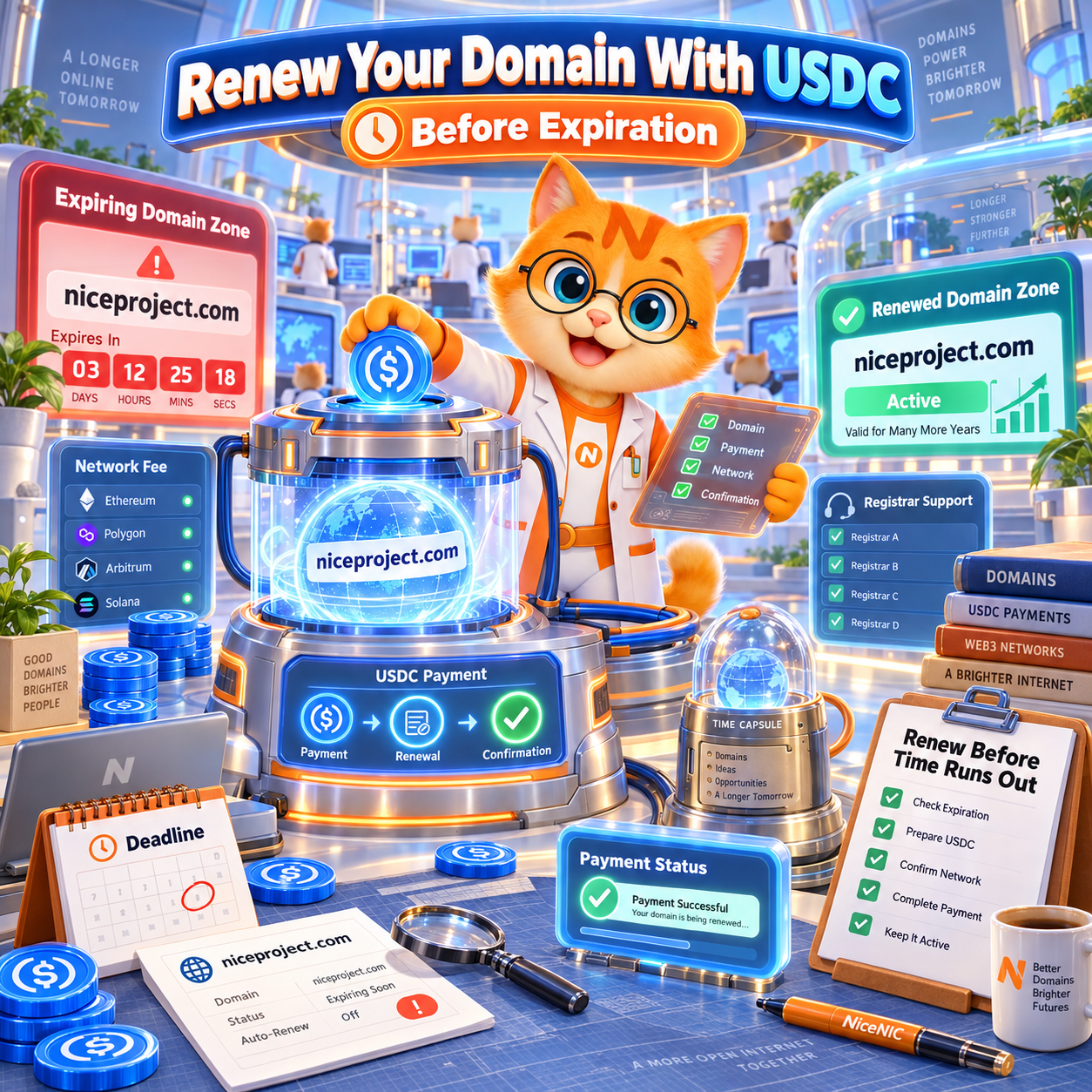
Direct Answer: Can You Renew a Domain With USDC?
Yes. Domain owners can use USDC to fund eligible registrar services when the registrar supports stablecoin payments.
For businesses managing domain portfolios, USDC provides another option for maintaining a USD-denominated account balance without relying only on traditional payment methods.
This can be especially useful for:
- Domain investors managing multiple renewals
- Hosting companies with recurring domain operations
- Agencies managing customer domains
- Companies protecting multiple brand domains
- Developers running automated domain workflows
At NiceNIC, supported crypto funding options allow customers to add account balance and use that balance for eligible domain services, including renewals.
NiceNIC is an ICANN-accredited registrar operating under IANA Registrar ID 3765 and has provided domain services since 2006.
The key points to understand:
- NiceNIC crypto processing fee: 0%
- Online Crypto payments are currently processed by Triple-A
- Triple-A currently charges a 1.5% service fee
- Wallet, exchange, and blockchain-network fees may also apply
The exact supported asset, network, and payment cost should always be confirmed through the current NiceNIC Payment Options page.
Why Businesses Use USDC for Domain Renewals
Domain renewals are recurring operational expenses.
A single domain renewal is simple.
However, managing hundreds or thousands of domains creates additional challenges:
- Different expiration dates
- Multiple renewal cycles
- International payment restrictions
- Accounting complexity
- Manual payment tracking
- Failed renewal risks
USDC can help businesses create a more structured funding workflow.
1. USD-Denominated Account Management
USDC is designed to maintain a value close to the U.S. dollar.
For companies already using stablecoins, this can simplify internal budgeting compared with highly volatile cryptocurrencies.
However, businesses should still follow their own accounting, compliance, and tax policies.
USDC should not automatically be treated as identical to traditional cash in every accounting environment.
2. Alternative Global Payment Route
International domain operations may encounter:
- Card authorization failures
- Bank transfer delays
- Currency conversion steps
- Regional payment restrictions
USDC provides another settlement option for organizations already operating blockchain-based payment workflows.
The benefit is not that every transaction becomes free.
The actual cost may include:
- Payment provider fees
- Exchange withdrawal fees
- Blockchain transaction costs
- Conversion spreads
3. Better Planning for Domain Portfolios
A domain portfolio requires predictable renewal management.
Instead of paying each renewal individually, businesses can maintain available registrar balance and use it when domains approach expiration.
This approach can support:
- Brand protection programs
- Domain investment portfolios
- Hosting businesses
- SaaS companies
- International operations
Domain Renewal Payment Methods Comparison
Choosing a renewal payment method is not only about transaction speed.
Businesses should consider:
- Payment reliability
- Currency exposure
- Automation capability
- Operational complexity
- Total transaction cost
Key takeaway:
USDC is not valuable because every transaction is free.
Its main advantage is providing a USD-denominated blockchain payment option that can integrate with account funding and automated renewal workflows.
How USDC Domain Renewal Costs Are Calculated
The total renewal cost includes several components.
1. Domain Renewal Price
The largest cost component is usually the domain renewal itself.
Pricing depends on:
- Domain extension
- Registry pricing
- Renewal period
- Registrar pricing
You can review current pricing through the NiceNIC Domain Pricing page.
2. NiceNIC Processing Fee
NiceNIC currently charges:
0% crypto processing fee
This means NiceNIC does not add its own percentage surcharge simply because you choose crypto funding.
3. Online Crypto Provider Fee
NiceNIC Online Crypto payments are currently processed through Triple-A.
Triple-A currently charges:
1.5% service fee
4. Network and Wallet Costs
Additional costs may come from:
- Blockchain network fees
- Wallet transaction fees
- Exchange withdrawal fees
- Stablecoin conversion costs
Therefore:
Total USDC renewal cost = Domain renewal price + provider fee + wallet/network/exchange costs
Choosing the Right USDC Network
USDC exists across multiple blockchain networks.
The best network depends on:
- Your wallet
- Your exchange
- Your existing treasury setup
- The network supported by the current payment instructions
Do not choose a network only because an article says it has the lowest gas cost.
A cheaper blockchain fee can be outweighed by:
- Exchange withdrawal fees
- Conversion costs
- Additional transfers
- Operational complexity
The most efficient route is usually:
The supported network where your funds already exist.
Ethereum, Polygon, Arbitrum, and Solana: What Should You Consider?
Ethereum
Ethereum provides broad ecosystem support and deep liquidity.
It may be suitable for:
- Institutional wallets
- Organizations already using Ethereum infrastructure
- Larger treasury operations
However, Ethereum mainnet costs can vary depending on network conditions.
Polygon
Polygon is commonly used for lower-cost transactions compared with Ethereum mainnet.
It can be suitable for users already operating Polygon-based infrastructure.
Arbitrum One
Arbitrum provides an Ethereum-compatible Layer 2 environment.
It can be useful for users seeking Ethereum ecosystem compatibility with lower transaction costs.
Solana
Solana is designed for fast transaction processing and low blockchain-level fees.
It can be useful for users already holding USDC on Solana.
However:
Blockchain speed is not the same as complete domain renewal speed.
A complete renewal workflow still involves:
Blockchain transaction
→ Payment confirmation
→ Registrar balance credit
→ Renewal request
→ Registry processing
How to Renew a Domain With USDC at NiceNIC
The typical workflow is:
USDC payment → Payment confirmation → NiceNIC account balance credit → Renewal order → Registry processing
Step 1: Review Your Domain Portfolio
Sign in to your registrar account and check:
- Domains approaching expiration
- Renewal dates
- Renewal prices
- Domain status
- Any registry-specific requirements
You can search available domains through the NiceNIC Domain Search.
Step 2: Calculate Required Balance
Before funding your account, review:
- Number of domains
- Renewal costs
- Renewal period
- Expected portfolio growth
For large portfolios, maintaining sufficient account balance reduces renewal interruptions.
Step 3: Choose USDC Payment Route
Open the current NiceNIC Payment Options.
Confirm:
- USDC availability
- Supported network
- Destination address
- Payment amount
- Applicable provider fee
Never use an old payment address or previous invoice unless the current payment instructions confirm it is valid.
Step 4: Send USDC
Send USDC from:
- Self-custody wallet
- Exchange wallet
- Business treasury wallet
Before confirming:
Verify:
Asset + Network + Address + Amount
USDC on one blockchain is not automatically interchangeable with USDC on another network.
Step 5: Wait for Payment Confirmation
After the payment is confirmed:
- The payment provider verifies the transaction.
- NiceNIC credits the account balance.
- The balance becomes available for eligible services.
Payment confirmation and domain renewal completion are separate events.
Step 6: Renew Domains
Use your available balance to renew eligible domains.
Renewal processing depends on:
- Domain extension
- Registry rules
- Domain status
- Renewal timing
Some ccTLDs have different lifecycle requirements.
Managing Large Domain Portfolios With USDC
For organizations managing many domains, USDC can support a more structured renewal workflow.
Account Balance Management
Maintain sufficient balance for:
- Renewals
- Transfers
- New registrations
API-Based Automation
Businesses can integrate domain operations through the NiceNIC Domain API.
API automation can support workflows such as:
- Portfolio management
- Availability checks
- Renewal operations
- Internal provisioning systems
WHMCS Automation
Hosting companies can connect domain operations with billing workflows through NiceNIC WHMCS Integration.
This allows businesses to combine:
- Customer billing
- Hosting services
- Domain lifecycle management
Can You Transfer Domains and Renew With USDC?
Yes, when supported by the registrar workflow.
A typical migration process includes:
- Unlocking the domain.
- Obtaining the transfer authorization code.
- Submitting the transfer request.
- Funding the registrar account.
- Completing transfer and renewal according to registry rules.
You can review the NiceNIC Domain Transfer process.
For larger portfolios, the Bulk Domain Transfer tool can simplify migration workflows.
Transfer renewal rules vary by TLD.
Many standard gTLD transfers include an additional renewal year, but some extensions follow different policies.
USDC and WHOIS Privacy
Payment method does not determine privacy eligibility.
NiceNIC provides free WHOIS privacy on eligible TLDs where registry policy permits it.
Privacy availability depends on:
- Domain extension
- Registry policy
- Local requirements
- Registrant eligibility
USDC payment does not make a domain anonymous.
Payment privacy and WHOIS privacy are separate concepts.
ICANN Accreditation and Registrar Reliability
Stablecoin support is only one factor when choosing a registrar.
NiceNIC is an ICANN-accredited registrar operating under:
IANA Registrar ID: 3765
A domain provider may operate as:
- ICANN-accredited registrar
- Registrar reseller
- Hosting provider using an upstream registrar
These models can all be legitimate.
The important questions are:
- Who is the sponsoring registrar?
- Who manages registry communication?
- Who handles transfers?
- Who provides compliance support?
Payment flexibility should complement registrar reliability.
Frequently Asked Questions
Can I renew a domain with USDC?
Yes.
When supported by the registrar payment workflow, USDC can be used to fund account balance and pay eligible renewal services.
Does NiceNIC charge a USDC processing fee?
NiceNIC currently charges:
0% crypto processing fee
Online Crypto payments are currently processed by Triple-A, which charges a 1.5% service fee.
Additional wallet, exchange, or blockchain costs may apply.
How fast does USDC domain renewal complete?
The process includes:
USDC transfer confirmation
→ Payment-provider confirmation
→ Account credit
→ Renewal request
→ Registry processing
Blockchain speed alone does not determine final renewal completion time.
Can I automate USDC domain renewals?
Yes.
Businesses can combine:
- Funded registrar balance
- Domain API
- WHMCS automation
to create renewal workflows.
Does USDC make domain renewal anonymous?
No.
Stablecoin payment does not remove:
- Registrar requirements
- Registry rules
- Registration-data obligations
- Compliance procedures
WHOIS privacy is a separate service.
Can I manage hundreds of domains with USDC?
Yes.
USDC can be useful for organizations managing recurring domain expenses when combined with:
- Registrar balance management
- API automation
- Portfolio workflows
Final Verdict: Is USDC Good for Domain Renewals?
USDC can be a practical option for domain renewals when your business already uses stablecoins or wants an alternative funding method.
The main benefits are:
- USD-denominated value
- Global blockchain settlement
- Account balance management
- API and WHMCS automation potential
However, the correct question is not:
"Is USDC always cheaper than traditional payments?"
The better question is:
"Does USDC fit my renewal workflow, accounting process, and operational requirements?"
For businesses managing domain portfolios, combining:
- Stablecoin funding
- Registrar balance management
- API automation
- WHMCS workflows
can create a more predictable renewal process.


