


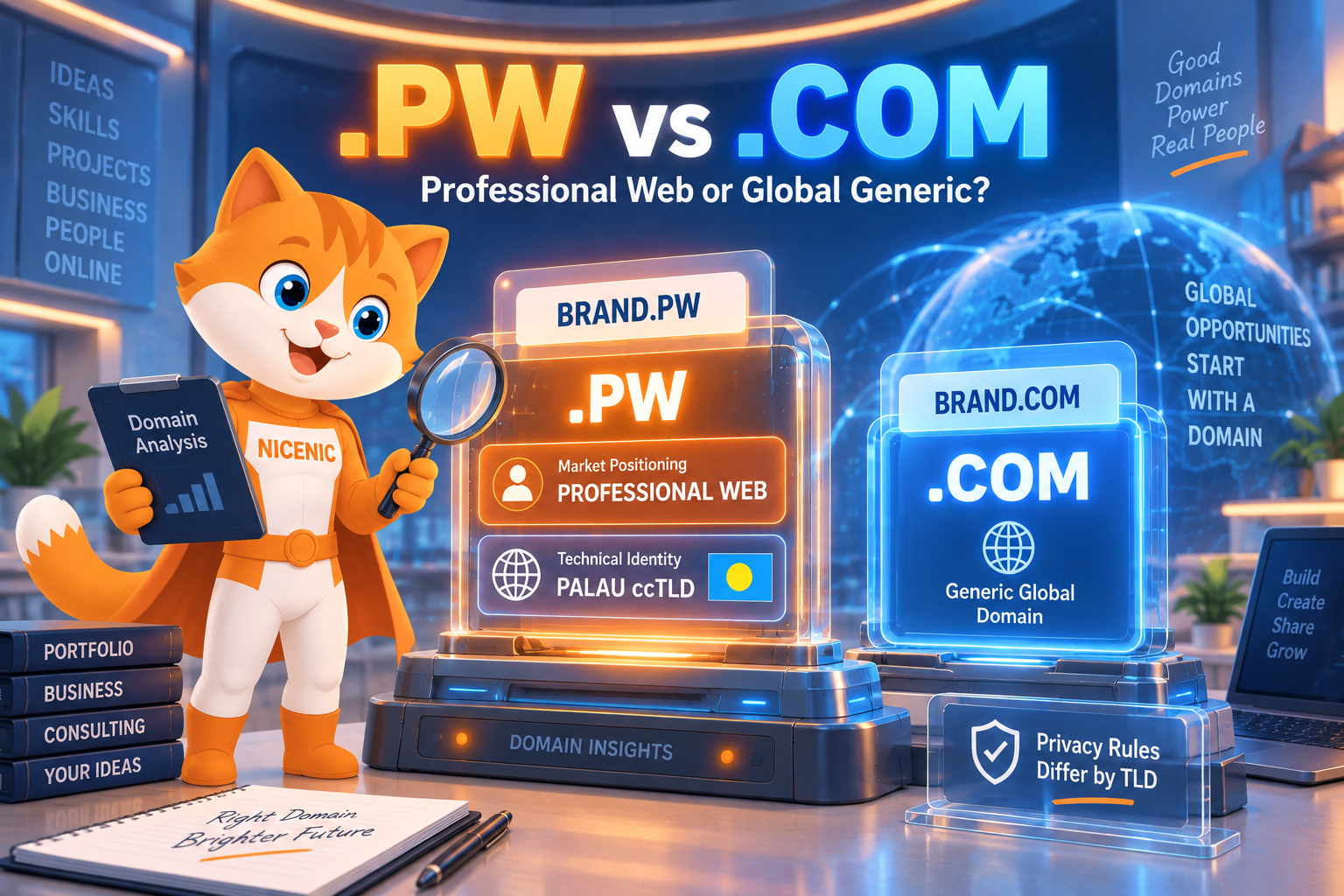
.PW and .COM can both be used for a business, portfolio, personal brand, or online project.
But they are not the same type of domain extension.
.COM is a generic top-level domain designed for broad global use.
.PW is technically the country-code top-level domain for Palau, although the .PW Registry also markets the namespace globally as “Professional Web” and allows registrations from users around the world.
That distinction matters for branding, search strategy, privacy expectations, and long-term domain planning.
Choose .COM when you want a broadly recognized primary domain that can represent a company, product, or personal brand without a geographic association.
Consider .PW when you want a short domain for a professional website, portfolio, consultant profile, project, or brand and the .PW name itself fits your intended identity.
Before deciding, compare the exact names and current long-term costs:
Check .COM Domain Availability
.PW vs .COM at a Glance
Choose .PW if: you want a short professional or portfolio-oriented name and understand that .PW remains technically a Palau ccTLD despite its global “Professional Web” positioning.
Choose .COM if: you need a broadly neutral primary domain for a company, product, or global brand.
.PW type: Country-code top-level domain, or ccTLD, for Palau.
Registry positioning: The .PW Registry markets .PW internationally as “Professional Web.”
Who can register .PW: The Registry currently states that users worldwide can register .PW without a Palau residency requirement or registration documents.
Google geographic context: Google’s current list of ccTLDs treated as generic does not include .PW, so do not assume Google treats .PW exactly like .COM for geographic targeting.
WHOIS Privacy: NiceNIC’s current .PW information states that private registration / WHOIS contact hiding is not supported for .PW.
Pricing: .PW currently has a lower first-year NiceNIC Market price than .COM, but a higher renewal price.
What Is the Main Difference Between .PW and .COM?
The most important difference is not the number of characters.
It is their underlying domain classification.
.COM is a generic top-level domain.
It does not represent a specific country.
A company using:
northstar.com
could operate from or serve customers in:
- the United States
- Europe
- Asia
- Latin America
- Africa
- multiple global markets
without the extension itself pointing to one country.
.PW is different.
IANA currently classifies .PW as the country-code top-level domain for Palau.
At the same time, the .PW Registry has developed a broader commercial identity around Professional Web and allows worldwide registration.
So .PW effectively has two important contexts:
Technical identity: Palau ccTLD
Commercial positioning: Professional Web for global registrants
Understanding both is important before choosing .PW as a long-term business domain.
What Does .PW Actually Mean?
Technically, .PW corresponds to Palau.
IANA’s current delegation record identifies .PW as a country-code top-level domain and lists the Micronesia Investment and Development Corporation as the ccTLD manager.
For registration and marketing purposes, the .PW Registry promotes the extension as:
Professional Web
The Registry states that individuals and businesses around the world can register .PW names.
That makes .PW unusual.
Its DNS classification remains country-code based, while its commercial use has expanded well beyond Palau.
For official references:
.PW Registry Information for Registrants
Is .PW a gTLD?
No.
This is worth stating clearly because older articles online sometimes describe .PW as if it became a generic top-level domain after its global relaunch.
It did not change its IANA root-zone classification.
IANA continues to list .PW as:
Country-code top-level domain
The Registry’s global “Professional Web” positioning changes how the namespace is marketed and used.
It does not turn .PW into a gTLD.
That distinction is especially important when discussing international SEO or geographic signals.
Who Can Register a .PW Domain?
The .PW Registry currently states that anyone in the world can register a .PW domain.
Its registrant guidance says there are:
- No country restrictions
- No Palau residency requirement
- No registration documents required for ordinary registrations
Registration is still subject to:
- Domain availability
- Registry rules
- Registrar requirements
- Reserved-name policies
- Accurate registrant information
- Applicable law and third-party rights
So:
.PW is a ccTLD
does not mean:
only Palau residents can register it.
Those are separate questions.
How Much Do .PW and .COM Cost?
At publication, NiceNIC currently shows:
.PW Market Account
- First year: $5.99
- Renewal: $29.99
.COM Market Account
- First year: $14.99
- Renewal: $17.99
The current .PW first-year registration price is substantially lower.
Its current renewal price is higher.
That changes the decision depending on how long you expect to keep the domain.
For example, a portfolio used for one year and a consulting brand expected to operate for ten years have very different cost considerations.
Prices can change because of:
- Registry pricing
- Promotions
- Account level
- Domain-specific pricing
- Policy changes
Always check the current amount before ordering:
Compare NiceNIC Domain Registration and Renewal Prices
When Should You Choose .COM?
Choose .COM when:
- You are building the permanent corporate website.
- You want a geographically neutral domain.
- Your business may expand into several industries.
- You serve customers in many countries.
- You want one long-term company identity.
- Broad familiarity is important to your brand strategy.
- You expect to keep the domain for many years.
-
A suitable
.COMis available.
Imagine a consultant who starts with individual professional services.
Several years later, the business may expand into:
- Software
- Training
- Events
- Research
- Ecommerce
- Managed services
- Media
A .COM domain can continue representing the broader organization without tying its identity to one interpretation of “PW.”
If this fits your plan:
Check Your Preferred .COM Domain
When Does .PW Make More Sense?
.PW becomes more interesting when the available name fits a professional, portfolio, or project-oriented identity.
Possible uses include:
- Personal portfolios
- Consultants
- Freelancers
- Professional profiles
- Small businesses
- Creative portfolios
- Agencies
- Startup projects
- Service pages
- Personal websites
- Professional communities
- Short brand names
Illustrative naming structures might include:
alex.pw
studio.pw
consulting.pw
portfolio.pw
design.pw
project.pw
These are naming examples only.
Actual availability must be checked before registration.
If a .PW version creates a clean name that fits your project:
Is .PW Good for a Professional Portfolio?
It can be.
A portfolio site often needs to communicate:
- Who you are
- What you do
- Your work
- Your skills
- Your experience
- Contact information
A freelancer might compare:
alexsmithdesign.com
with:
alexsmith.pw
The .PW version is shorter.
The .COM version may communicate a broader conventional business identity.
Neither is automatically better.
The decision depends on how people will encounter the address and what the domain needs to represent over time.
Does .PW Prove Someone Is a Professional?
No.
The Registry markets .PW as Professional Web.
That does not make the domain a professional qualification.
Registering:
example.pw
does not prove that the registrant:
- Holds a professional license
- Has a certification
- Has a particular degree
- Belongs to a professional body
- Has verified industry experience
If credentials matter to customers, show them separately on the website.
For example:
- Professional biography
- Qualifications
- Licensing information where applicable
- Portfolio
- Case studies
- Relevant certifications
- Contact information
The domain can support positioning.
The person or organization provides the evidence.
Is .PW Good for Freelancers?
Potentially.
Freelancers often need a relatively simple website containing:
- Services
- Portfolio
- Contact form
- Client work
- About page
- Booking
- Resume or CV
A short .PW name can work particularly well when a clean .COM alternative would require several extra words.
For example:
maria.pw
may be easier to present than a much longer constructed .COM.
But do not assume the shorter extension automatically makes the brand more memorable or professional.
Test the complete name with the actual audience.
Is .PW Good for Small Businesses?
It can be, especially when the name itself fits.
A small business could use .PW for:
- Consulting
- Creative services
- Design
- Development
- Local services
- Online projects
But the same questions apply as with any long-term company domain:
- Will the name still fit in five years?
- Will customers understand the extension?
- Will you use email on the domain?
- Is the renewal price acceptable?
- Does geographic search positioning matter?
-
Is the matching
.COMrelevant?
The domain should fit the business model rather than simply being available.
The Most Important SEO Difference: .PW Is Still a ccTLD
This is where .PW vs .COM becomes more than a branding comparison.
Google distinguishes between:
- Generic top-level domains
- Country-code top-level domains
- Certain ccTLDs that Google treats as generic because of widespread non-geographic use
Google currently publishes a list of ccTLDs that it treats as generic.
Examples on that list include:
.AI
.CC
.CO
.IO
.ME
.TV
.WS
At the time of publication, .PW is not included in that published generic-ccTLD list.
That means site owners should not simply assume:
“PW means Professional Web, therefore Google will treat it exactly like .COM.”
From the DNS and IANA perspective, .PW remains Palau’s country-code domain.
If global organic search is a major part of your business plan, evaluate this distinction before using .PW as the sole primary domain.
For current guidance:
Google Search Central: Managing Multi-Regional and Multilingual Sites
Does That Mean a .PW Website Cannot Rank Globally?
No.
A country-code domain is not automatically excluded from search results outside its associated country.
Google still evaluates pages based on many signals, including:
- Search relevance
- Content quality
- Language
- Links
- Technical accessibility
- Page performance
- User experience
- Other regional signals
The important point is narrower:
Do not market .PW as if it has exactly the same geographic neutrality as .COM.
If your main objective is a broad global company identity, .COM may provide a simpler geographic signal.
If .PW creates a strong brand name and organic search geography is not the deciding factor, the trade-off may still be acceptable.
Does .PW Get an Automatic SEO Advantage Because It Means "Professional Web"?
No.
Google does not provide an automatic ranking bonus because an extension contains or is marketed around a particular concept.
A .PW site does not automatically rank better for searches involving:
- professional
- portfolio
- consultant
- freelancer
- professional website
Likewise, .COM does not automatically rank better simply because it is .COM.
Search performance depends much more on the website and its pages.
Choose .PW because the name and positioning fit.
Do not choose it because of an assumed keyword-ranking advantage.
.PW vs .COM for a Global Personal Brand
A personal brand may operate differently from a multinational company.
A freelancer, creator, designer, developer, or consultant may care more about securing:
firstname.pw
or:
name.pw
than about building a complex international site architecture.
In that case, evaluate:
- How the complete domain sounds
- How easy it is to type
-
How people interpret
.PW - Search geography
- Email use
- Renewal cost
- Privacy requirements
A global personal brand can technically operate on many domain extensions.
The question is which trade-offs matter most.
.PW and WHOIS Privacy: Check This Before Registering
This is a significant operational difference.
NiceNIC’s current .PW domain information states that the .PW zone does not support private registration / WHOIS contact hiding.
That means buyers should not assume that the same privacy option available for many other domain extensions is available for .PW.
Before registering, review:
- What registrant information is required
- What data the registry publishes
- What data the registrar can protect
- Current registry privacy policy
- Whether the domain will be registered personally or through an organization
By contrast, NiceNIC currently offers WHOIS Privacy for eligible .COM registrations.
Privacy support depends on the registry and extension.
It is not solely a registrar-level decision.
For .PW, check the current policy before using personal contact details.
Why Does WHOIS Privacy Differ Between TLDs?
Domain registrars do not control every registry policy.
Different TLD registries can set different rules for:
- Registrant data
- Privacy services
- Contact publication
- Verification
- Transfers
- Registration periods
A privacy feature available on one extension may not be available on another.
That is why buyers should compare more than:
registration price
when choosing a long-term domain.
For .PW, privacy policy is a real selection factor.
Is .PW Really Global If It Is a Palau ccTLD?
There are two different meanings of “global” here.
Registration access
Yes.
The .PW Registry currently states that users around the world can register .PW.
Technical domain classification
No.
.PW remains Palau’s ccTLD in the IANA root zone.
Those facts can both be true at the same time.
The Registry can operate an open worldwide registration model without changing the extension’s underlying country-code classification.
This is why buyers should separate:
who can register the domain
from:
how the TLD is technically classified.
Does Registering .PW Mean My Business Is in Palau?
No.
Worldwide registration is permitted under the current Registry rules.
A .PW registrant may be located outside Palau.
Therefore, seeing:
example.pw
does not by itself prove that:
- The company is incorporated in Palau
- The owner lives in Palau
- The business operates from Palau
- The website primarily serves Palau
At the same time, the TLD remains technically assigned to Palau.
That distinction should be explained accurately.
Does .PW Mean "Personal Website"?
You may see .PW interpreted in several informal ways online.
Some people use associations such as:
- Professional Web
- Personal Website
- Personal Web
The Registry’s own current branding is:
Professional Web
That is the interpretation that should be described as the Registry positioning.
Other interpretations can be used creatively in branding, but they should not be presented as the official technical meaning of the ccTLD.
Technically:
.PW = Palau country-code top-level domain
Commercially:
.PW Registry markets the namespace as Professional Web
Keeping those statements separate avoids confusion.
.PW vs .COM for Business Email
Both .PW and .COM domains can be configured for email when the relevant DNS and mail services are set up correctly.
Examples include:
and:
Before making .PW your primary business email identity, consider:
- Customer familiarity
- Spoken clarity
- Domain renewal planning
- WHOIS/privacy requirements
- Brand longevity
- Mail configuration
The extension itself does not automatically improve email deliverability.
Email performance can depend on:
- SPF
- DKIM
- DMARC
- Sending reputation
- IP reputation
- Message quality
- Sending behavior
- Recipient engagement
Choose the domain based on branding and operational requirements.
Configure email security separately.
Does .PW Make a Brand More Professional?
That should not be assumed automatically.
The Registry’s Professional Web positioning can make .PW relevant to professional websites.
But customer perception depends on more than the extension.
Professional presentation can also depend on:
- Website quality
- Business identity
- Portfolio
- Communication
- Credentials
- HTTPS
- Contact information
- Customer support
- Reviews
- Brand consistency
A .PW domain can support a professional positioning.
The business itself creates the professional experience.
Is a Short .PW Better Than a Long .COM?
Sometimes.
Compare:
alex.pw
with:
alexsmithprofessionalservices.com
The .PW version is considerably shorter.
Now compare:
alex.pw
with:
alex.com
If both were available at acceptable prices, the decision becomes more nuanced.
.COM provides:
- Generic global classification
- Broad brand flexibility
- Lower current NiceNIC renewal pricing
.PW may provide:
- A shorter available name
- Professional Web positioning
- Lower current first-year NiceNIC pricing
The correct comparison is between the complete names and long-term use cases.
Should You Register .PW If the .COM Is Taken?
Not automatically.
Before registering:
brand.pw
because:
brand.com
is already registered, check:
-
Who owns the
.COM - Whether it is an active company
- Relevant trademarks
- Similar products or services
- Potential user confusion
-
Whether
.PWgenuinely fits your brand
An available domain can still be a poor branding choice when the same name is strongly associated with another business.
Availability is only one part of the decision.
Should You Register Both .PW and .COM?
For an important professional brand, owning both may make sense when both are available and the cost fits the plan.
For example:
brand.com → primary company website
brand.pw → professional profile, redirect, or defensive registration
Another structure could be:
company.com → main company
consultant.pw → individual expert profile
or:
agency.com → business
portfolio.pw → portfolio project
There is usually little reason to publish identical websites on both domains.
Choose one primary address or give each domain a specific role.
What a .PW Domain Does — and Does Not — Tell You
A .PW domain can support a Professional Web or portfolio-oriented brand identity.
It does not automatically prove:
- Professional qualifications
- Business registration
- Palau residence
- Global SEO neutrality
- Higher Google rankings
- Better click-through rates
- Better email deliverability
- Website security
- Customer trust
Those qualities depend on the registrant, website, content, technical configuration, and business.
This is one reason .PW should be evaluated on more than name availability alone.
.PW vs .COM: Which Should You Choose?
Choose .COM if:
- You are building the permanent website for a global business.
- Geographic neutrality is important.
- Your company may expand across several industries.
- Broad audience familiarity matters.
- You want NiceNIC-supported WHOIS Privacy where eligible.
- You expect to keep the domain for many years.
- Lower current renewal pricing matters.
-
A suitable
.COMis available.
Consider .PW if:
- You want a short professional or portfolio-oriented domain.
- "Professional Web" fits the intended positioning.
-
A suitable
.PWcreates a significantly cleaner complete name. -
You understand that
.PWis technically a Palau ccTLD. - Global registration availability fits your needs.
- You have reviewed the Google geographic-targeting implications.
-
You have reviewed the current
.PWWHOIS privacy policy. - The renewal cost fits your long-term plan.
Final Verdict
.COM remains the simpler choice when a company wants one broad, geographically neutral primary domain for long-term global use.
.PW solves a different naming problem.
It can be attractive for professionals, portfolios, consultants, personal brands, and projects that want a shorter domain and like the Registry’s “Professional Web” positioning.
But .PW has an important technical nuance that buyers should understand before registering:
It is globally open for registration, but it remains a Palau country-code top-level domain.
That distinction affects how the extension should be described and may matter when geographic search strategy is important.
There is also an operational difference at NiceNIC:
.PW currently does not support private registration / WHOIS contact hiding, while eligible .COM domains can use WHOIS Privacy.
Before choosing, ask five questions:
Do I need a globally neutral primary domain?
Does .PW create a meaningfully better complete name?
Does the Professional Web positioning fit my project?
Have I considered geographic SEO and WHOIS privacy differences?
Does the long-term renewal cost fit the plan?
Then choose the domain that best fits the brand, audience, privacy requirements, search strategy, and expected lifetime of the project.
How to Register a .PW or .COM Domain at NiceNIC
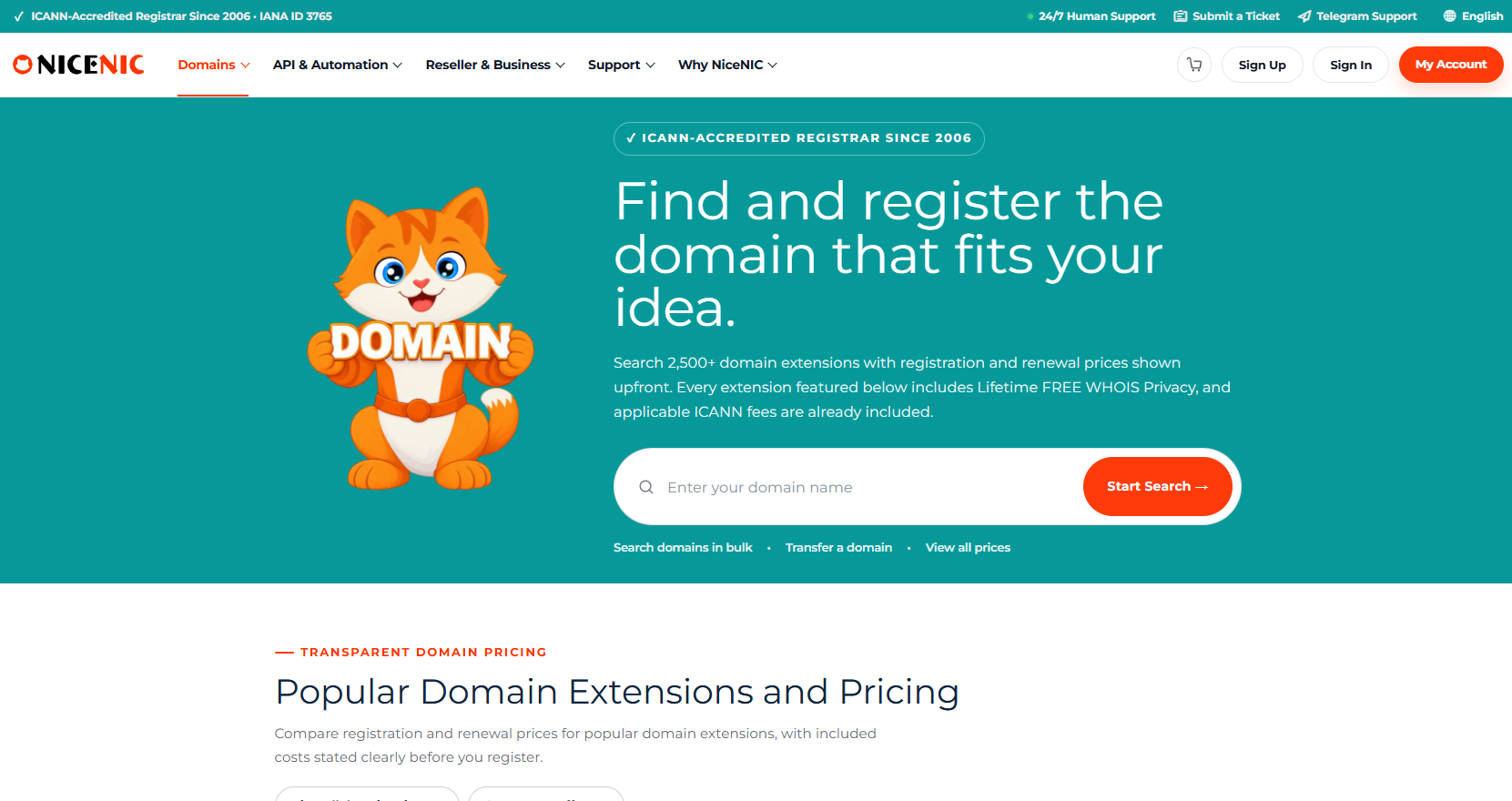
Step 1: Search the Exact Name
Compare your preferred professional, portfolio, consultant, company, or project name under .PW, .COM, or both.
Step 2: Compare More Than the First-Year Price
Review:
- Complete domain name
- Domain classification
- Brand meaning
- Audience familiarity
- Geographic search strategy
- WHOIS privacy support
- Registration price
- Renewal price
- Long-term purpose
Check the latest NiceNIC Domain Prices before ordering.
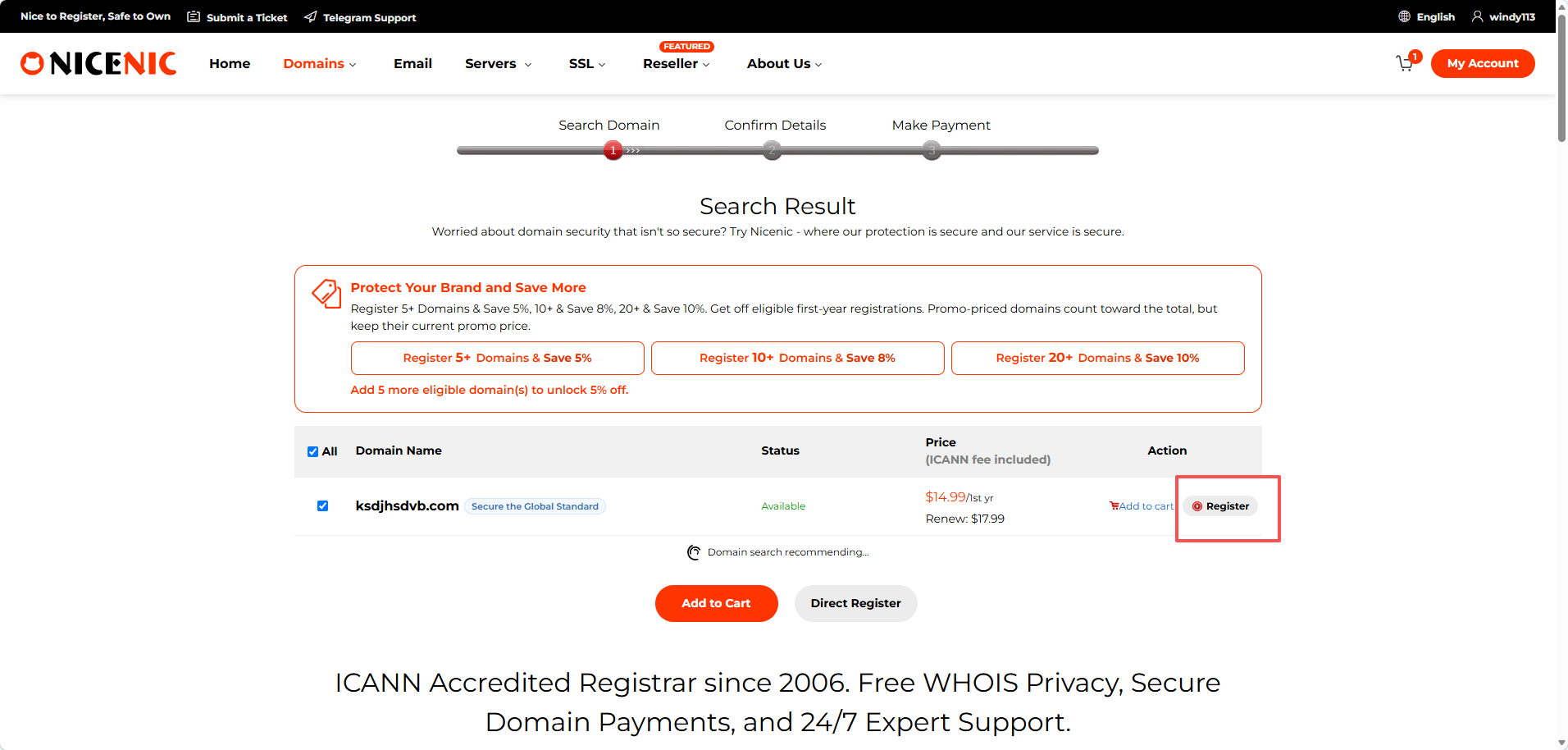
Step 3: Complete Registration
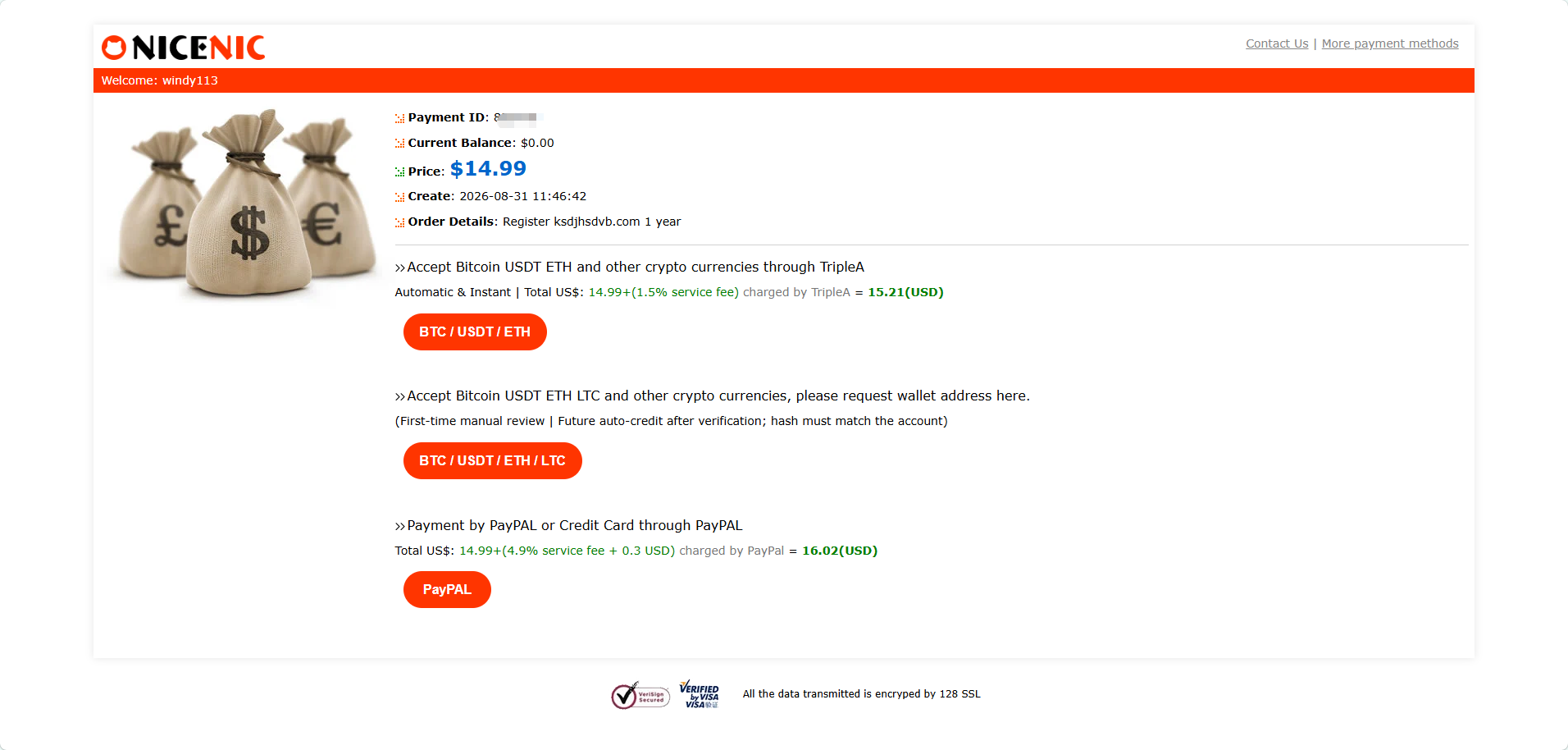
Add the selected domain to your order, confirm the registrant information, choose an available payment method, and complete payment.
After registration, manage the domain through your NiceNIC account.
Check Your Name in .PW and .COM
Ready to compare the actual name you want?
Checking several professional, portfolio, or client names? Use NiceNIC Bulk Domain Search.
Managing customer domains or integrating domain services into your platform? Explore the NiceNIC Domain API.
Already own the domain elsewhere? Start with NiceNIC Domain Transfer.


