


Most domain registrations are simple: search for an available name, enter your contact information, pay, and complete the registration.
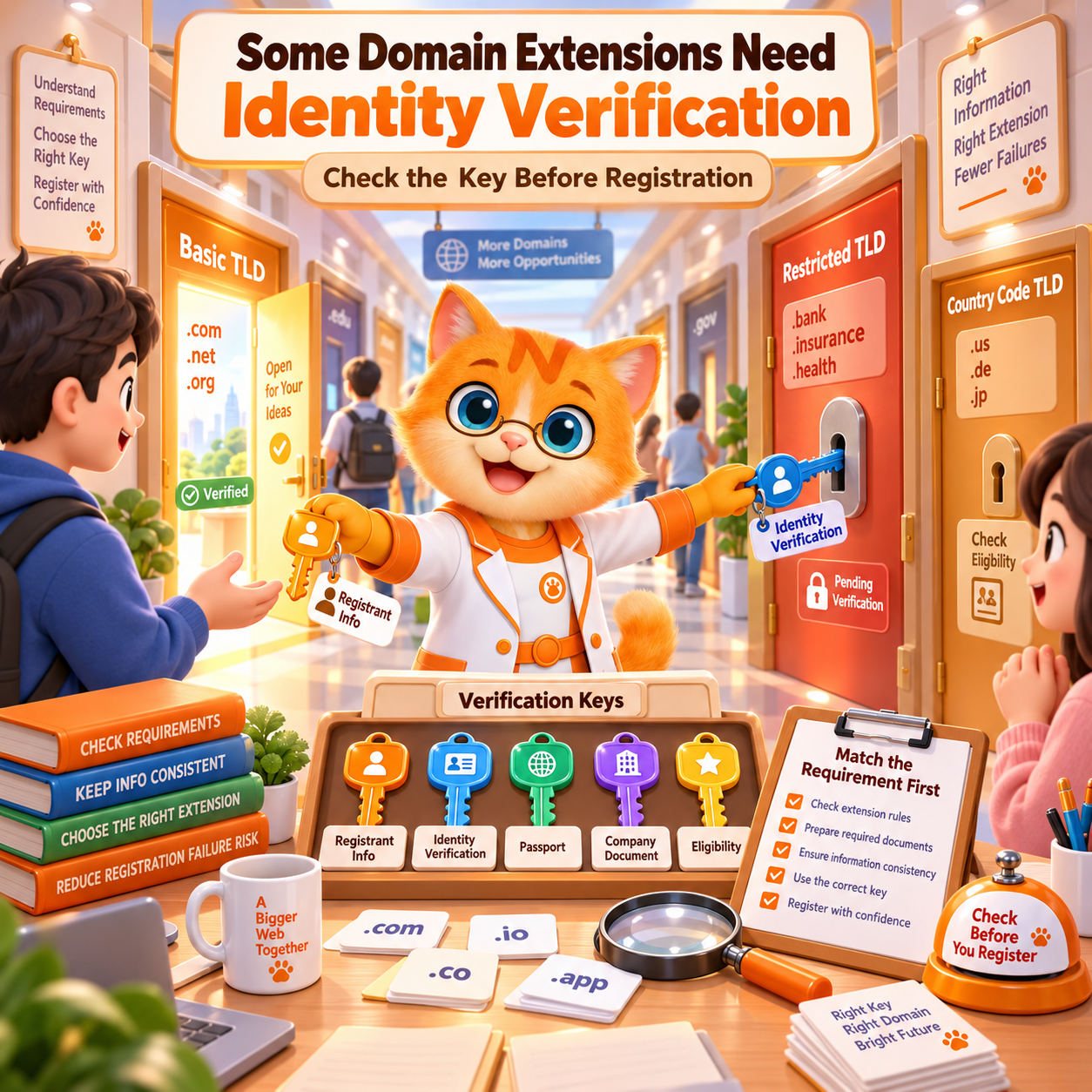
With some domain extensions, however, there may be one additional step: identity, contact, or eligibility verification.
You may be asked to confirm your identity, provide company registration information, verify an address, or submit documents before a domain can be activated. In other cases, verification may happen later if the registry needs to confirm that the holder information is still accurate.
This can be surprising if you are used to registering extensions such as .COM, but it is a normal part of the registration framework for some country-code and restricted domain extensions.
The important thing to remember is that there is no single global “domain KYC” rule. Requirements vary by registry, extension, applicant, and sometimes the action being performed.
If you are planning a new registration, you can search domain availability at NiceNIC and check the applicable requirements before placing your order.
Why Would a Domain Registry Need to Verify the Registrant?
Every top-level domain operates under a set of policies.
For many generic extensions, registration is open with relatively few eligibility restrictions. Some country-code top-level domains, or ccTLDs, operate differently because their registries may need to comply with local laws, maintain particular registration standards, or confirm that applicants meet specific eligibility requirements.
Identity verification can therefore serve several different purposes.
Keeping Registrant Data Accurate
A domain registration contains information about the individual or organization responsible for the domain.
Registries may need that information to be accurate, complete, and current.
For example, DENIC, the registry for .DE, currently uses a risk-based holder-data verification process. Holder information is checked for completeness and plausibility, and additional verification can be requested when the information cannot be sufficiently verified.
That does not mean every .DE registrant goes through an identical document-upload process.
It means that accurate holder information matters and further checks may be triggered when necessary.
You can learn more about the extension on the NiceNIC .DE domain page.
Confirming That the Applicant Is Eligible
Some extensions are intended for people, businesses, or organizations with a particular connection to a country.
Norway’s .NO namespace is one example. Norid requires applicants to meet defined Norwegian eligibility requirements and verifies organizations or individuals against relevant official records.
Australia provides another example. .AU applicants must meet the applicable Australian Presence requirement, while individual namespaces can have additional eligibility and allocation rules.
In situations like these, verification is about more than confirming that a person exists.
The registry may also need to determine:
Is this person or organization eligible to hold this particular domain?
That distinction matters.
Identity verification does not automatically equal domain eligibility.
Meeting Registry or Local Regulatory Requirements
Registries also operate within different national and regulatory environments.
This is why registration requirements for one ccTLD cannot simply be copied to another.
China's .CN, for example, requires authentic, accurate, and complete registrant information together with applicable verification materials. Customers considering a .CN can review the current process on the NiceNIC .CN domain registration page.
Sweden’s .SE registry also carries out holder-verification checks, while Vietnam’s .VN framework supports electronic identity-verification processes such as eKYC.
The terminology may vary:
- Identity verification
- Holder verification
- Real-name verification
- Eligibility validation
- Data verification
- eKYC
Although these terms are related, they are not always interchangeable.
The exact process is determined by the relevant registry rules and the registrar’s implementation of those requirements.
Why Are More Domain Buyers Seeing Verification Requests?
Identity checks in the domain industry are becoming more visible.
One reason is that registries and registrars are placing greater emphasis on the accuracy of registration data.
Another is that national and regional regulatory frameworks increasingly require operators to maintain reliable information about domain holders.
Technology is changing the process as well. Verification that once required manual paperwork can increasingly be completed through electronic identification, database checks, or eKYC.
For the registrant, this means a request for verification does not necessarily indicate that something is wrong with the registration.
In many cases, it is simply part of the normal process for that extension.
Not Every Verification Request Means "Upload Your Passport"
This is one of the most common misunderstandings around domain KYC.
Verification can take many forms.
Depending on the registry and applicant, it may involve:
- Confirming an email address or telephone number
- Checking an individual against an official database
- Validating a company registration number
- Confirming a business's legal name
- Checking an address
- Providing an identification document
- Providing a company registration certificate
- Confirming local presence
- Demonstrating that the applicant meets eligibility rules
Some checks can happen automatically without the registrant uploading anything.
Others require additional information.
This is why it is better to think in terms of domain verification requirements rather than assume every restricted TLD operates the same traditional KYC process.
When Can Domain Verification Happen?
Verification is not always limited to a new registration.
Depending on the domain extension and registry policy, it may occur when:
- A new domain is registered
- A domain is transferred
- The registrant or holder changes
- Important contact information is updated
- Existing holder data cannot be independently verified
- The registry performs a data-accuracy review
- Eligibility needs to be reconfirmed
This is particularly important for existing domain holders.
Successfully registering a domain several years ago does not necessarily mean its contact information will never need to be checked again.
For example, some registries perform ongoing data-quality checks rather than treating verification as a one-time event.
Why Accurate Domain Contact Information Matters
It can be tempting to treat domain contact information as something that only matters during checkout.
That creates unnecessary risk.
A domain holder should keep information such as the legal name, organization name, address, email address, and telephone number accurate throughout the life of the domain.
Incorrect or outdated information can make future verification more difficult.
It can also create problems when you need to:
- Transfer the domain
- Update the registrant
- Recover account access
- Respond to a registry request
- Confirm ownership or control
- Complete an extension-specific verification process
For extensions requiring supporting documents, consistency matters as well.
If the registration says one company name while the submitted certificate shows another, the application may need further review even when both records relate to a legitimate business.
Does Identity Verification Make Your Information Public?
No. These are separate issues.
Identity verification does not automatically mean that your identification documents will appear in public domain-registration records.
A registry or registrar may need information to verify the person or organization behind a registration without publishing the submitted document.
Public registration-data disclosure is governed separately by the applicable registry rules, registrar policies, privacy requirements, and registration-data framework.
This distinction is particularly important because users sometimes confuse three different things:
information you provide when registering a domain, information used to verify the registration, and information that may be publicly displayed.
They are not necessarily the same.
Does Verification Prevent Domain Abuse?
Verification can improve the accuracy and accountability of registration information, but it should not be treated as a guarantee that a domain will never be misused.
Domain security and abuse prevention involve a much wider set of controls, including:
- Account security
- Transfer protection
- DNS security
- Registry and registrar policies
- Abuse-reporting procedures
- Evidence review
- Registrant notifications
- Dispute mechanisms
Identity verification is therefore one part of the domain ecosystem rather than a complete solution by itself.
What Should You Check Before Registering a Domain?
Before registering an unfamiliar ccTLD or restricted extension, it is worth checking a few things beyond the registration price.
Ask:
- Can individuals and companies both register it?
- Is local presence required?
- Is identity or company verification required?
- Are additional documents needed?
- Can an overseas applicant register it?
- Can verification happen after registration?
- Are there special transfer or renewal rules?
A few minutes spent checking these requirements can prevent delays later.
NiceNIC provides individual pages for supported domain extensions so customers can check availability, pricing, registration information, transfer options, and other extension-specific details.
For example, you can review:
You can also compare current domain registration and renewal prices before ordering.
Domain Verification Is Becoming Part of Normal Domain Management
For domain buyers, the practical lesson is straightforward:
Do not assume every domain extension follows the same registration process.
Some extensions are open globally with minimal additional requirements. Others need identity verification, local eligibility, business information, or supporting documents.
And those requirements can evolve.
The best approach is to check the extension’s current rules before registration, provide accurate holder information, and keep that information current after the domain is active.
For registrars, the responsibility is equally important: verification requirements should be explained clearly enough that customers understand what is required and why.
A request for additional information should not feel like an unexpected obstacle at the final step of registration.
It should be part of a transparent registration process.
Looking for a Domain?
Search more than 2,500 domain extensions at NiceNIC and review the relevant registration requirements before placing your order.
Search Domains | View Domain Prices
Frequently Asked Questions
Why is my domain registrar asking for identity verification?
Some registries require registrars to verify registrant identity, contact information, local presence, or eligibility. The exact reason depends on the domain extension and applicable registry requirements.
Do all ccTLDs require KYC?
No. ccTLD registration rules vary significantly. Some have open registration, while others require additional identity, eligibility, local-presence, or documentation checks.
Do I always have to upload an ID to register a domain?
No. Verification can involve electronic database checks, email or telephone confirmation, company information, electronic identification, supporting documents, or other methods. The process depends on the extension.
Can a domain require verification after it has already been registered?
Yes. Some registries perform ongoing data-accuracy checks or may request verification when holder information changes or cannot be independently confirmed.
Is identity verification the same as WHOIS disclosure?
No. Information used to verify a registrant and information made available through public registration-data services are separate matters.
What happens if I do not complete required domain verification?
The result depends on the registry and situation. A new registration or transfer may not complete, while an existing domain may be subject to restrictions or other action under the applicable registry rules. Always respond promptly to a genuine verification request.
Further Reading
For extension-specific information, refer to the relevant registry rules and the registration information provided by your registrar.
Useful official resources include DENIC’s guidance on .DE holder-data verification, Norid’s .NO domain policy, The Swedish Internet Foundation’s holder-verification guidance, auDA’s .AU rules, CNNIC’s .CN requirements, and VNNIC’s .VN domain information.
Registry policies can change, so requirements should always be checked against current information before registration or transfer.
Last reviewed: September 2026.


