


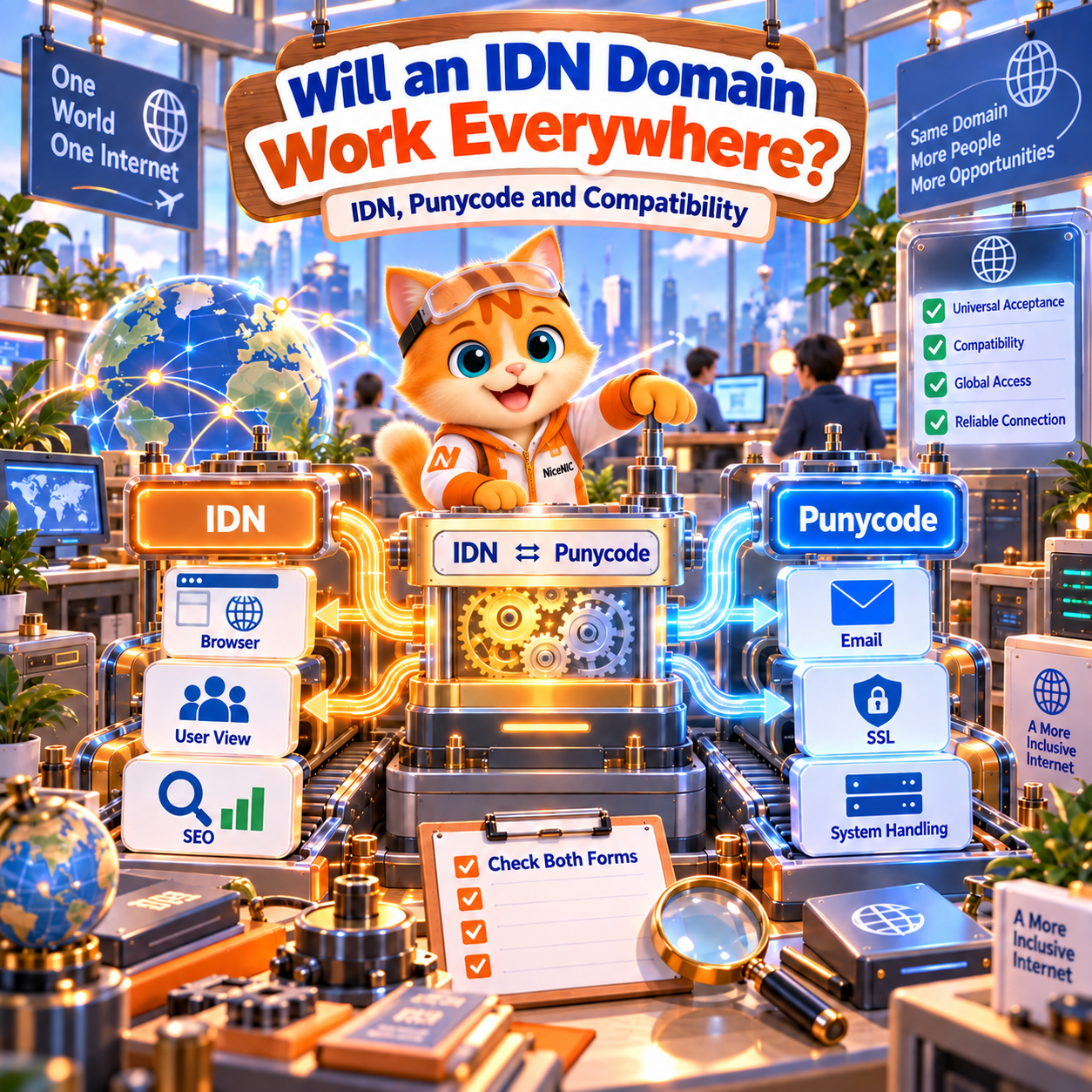
Internationalized Domain Names make it possible to use domain names in languages and scripts such as Chinese, Arabic, Cyrillic, Devanagari, Japanese, Korean, Thai, and Latin characters with accents.
But there is an important distinction that every business should understand:
A domain can be valid and successfully registered without being accepted correctly by every website, app, login form, email system, or third-party platform.
That gap is called Universal Acceptance, or UA.
ICANN’s latest 2026 data shows how significant IDNs have become. As of June 2026, 151 IDN top-level domains had been delegated across 37 languages and 23 scripts, with approximately 4.3 million IDNs registered at the second level. At the same time, ICANN says Universal Acceptance gaps still remain across Internet-enabled applications, devices, and systems.
If you are considering a local-language domain, you can search current domain availability with NiceNIC Search domains with NiceNIC and review the NiceNIC IDN introduction What Is an IDN?.
The practical question in 2026 is no longer simply:
“Can I register an IDN?”
It is:
“Will this IDN actually work everywhere my customers, employees, software, email providers, payment systems, and business partners need to use it?”
What Is an Internationalized Domain Name?
An Internationalized Domain Name, or IDN, is a domain name that contains characters outside the basic ASCII letters a-z, digits, and hyphen traditionally used in domain names.
For example, an IDN can contain Chinese, Arabic, Cyrillic, Devanagari, Japanese, Korean, Thai, or accented Latin characters.
Users normally see and type the readable Unicode version of the domain. Behind the scenes, applications convert the internationalized label into an ASCII-compatible representation known as an A-label, commonly using Punycode.
A Punycode label normally begins with:
xn--
Punycode is not a separate domain and does not mean a domain is suspicious. It is a technical encoding used so internationalized domain labels can work through infrastructure originally built around ASCII. ICANN describes IDNs as local-language domain names implemented through internationalized-domain protocols, while the underlying Punycode mechanism is standardized through the IETF.
What Is Universal Acceptance?
Universal Acceptance means that all valid domain names and email addresses should be accepted, validated, processed, stored, and displayed correctly by Internet applications and systems, regardless of the language, script, TLD length, or character set involved.
That includes conventional domains such as .com, newer extensions such as .technology, Internationalized Domain Names, IDN top-level domains, and internationalized email addresses.
UA matters because a domain can be completely valid in the DNS while an individual website, signup form, mobile application, CRM, payment service, or email platform still rejects it.
ICANN documents real examples of these failures: software may incorrectly decide that a domain or email address is invalid, fail to convert between Unicode and the internal ASCII form, or display an internationalized address incorrectly.
In other words:
DNS validity and application compatibility are not the same thing.
Does an IDN Work in Web Browsers?
In general, current mainstream browsers understand Internationalized Domain Names and can resolve them through their Punycode representation.
However, what the user sees in the address bar can vary.
A browser may display the Unicode form when it considers the script and domain safe to display. In other situations, particularly where characters could be visually confusing, it may display the xn-- Punycode form instead.
That does not necessarily mean anything is wrong with the domain. It may be a security decision made by the browser.
Businesses should therefore test the exact domain they plan to use in the browsers and devices most important to their customers rather than assuming that every environment will display the domain identically.
Can You Use an IDN for Email?
Yes, but email requires more careful testing than a website.
There are two separate internationalization questions in an email address.
The part after @ is the domain. An internationalized domain can be represented internally in its Punycode form.
The part before @ is the mailbox or local part. Using non-ASCII characters there requires support for internationalized email standards, commonly associated with Email Address Internationalization and SMTPUTF8.
A system might therefore support:
name@国际化域名.example
while failing to support a fully internationalized address where the mailbox name itself also contains non-ASCII characters.
ICANN specifically includes internationalized email addresses within Universal Acceptance and notes that compatibility gaps remain.
For business-critical email, test the actual mail provider, receiving systems, web forms, CRM, billing system, support desk, mailing platform, and authentication systems you rely on.
Do not assume that successful domain registration automatically means every email system supports the address format you want to use.
Why Does a Website Say My IDN or Email Address Is Invalid?
Usually because the application is using outdated validation logic.
Older software may assume that domains contain only ASCII characters. Some applications maintain outdated TLD lists, use overly restrictive regular expressions, or incorrectly limit how long a valid domain or email address can be.
This is one of the problems Universal Acceptance is designed to solve.
For example, an IDN may:
resolve correctly in DNS;
open normally in a browser;
have a valid registration;
and still be rejected by a signup form as an “invalid domain.”
The failure is then in the application’s validation logic, not necessarily in the domain.
For companies operating customer-facing systems, UA readiness should therefore be treated as an application-compatibility requirement rather than merely a domain-registration issue.
Can an IDN Use HTTPS and an SSL/TLS Certificate?
IDNs can use HTTPS, but certificate-provider support and input requirements should be checked before deployment.
Some certificate systems require the ASCII-compatible Punycode form of the domain.
As a current example, Google Trust Services expanded its certificate support in February 2026 to allow TLS certificate requests for domains containing Punycode labels.
That does not mean every certificate product, validation method, control panel, or legacy certificate tool handles every IDN in exactly the same way.
Before putting an IDN into production, verify certificate issuance, renewal automation, ACME integration, redirects, HSTS configuration, and both the Unicode and Punycode forms used by your infrastructure.
Do IDN Domains Affect SEO?
An IDN is not inherently an SEO advantage or disadvantage simply because it uses an internationalized script.
Google explicitly states that localized words can be used in URLs and that using an Internationalized Domain Name is acceptable. Google recommends proper UTF-8 handling for internationalized URLs.
The more important SEO questions are the same ones that apply to other multilingual websites: content quality, language relevance, crawlability, internal linking, technical SEO, localization, hreflang where appropriate, backlinks, and whether the page actually satisfies the searcher’s intent.
An IDN can still provide an important human-language and branding advantage when customers naturally search for, remember, and type a brand or phrase in their own script.
But choosing an IDN does not remove the need for high-quality localized content.
For international businesses, also remember that language targeting and country targeting are different concepts. A Chinese-language domain or page does not automatically mean the website targets only China, just as a multilingual .com can target several markets.
Is Punycode Bad for SEO?
No.
Punycode is the technical ASCII representation used to make an internationalized domain work with DNS and compatible software.
Search engines and browsers understand this relationship.
For users, the readable Unicode form may often be displayed. For DNS, APIs, logs, developer tools, certificate systems, and some control panels, the xn-- form may appear instead.
You should therefore know both representations of your domain and make sure your technical team stores them correctly.
For automation, this matters even more. NiceNIC’s current Domain MCP workflow accepts IDNs in their ASCII-compatible Punycode form for domain availability and pricing operations. That provides a practical example of why Unicode-to-Punycode normalization should be part of an IDN automation workflow.
Are IDN Domains Safe?
IDNs themselves are legitimate Internet identifiers, but internationalized scripts introduce an additional security consideration: visually confusable characters.
Some characters from different scripts can look very similar. This is the basis of what is commonly called a homograph or lookalike-domain attack.
Registries, browser vendors, ICANN, Unicode standards, and other ecosystem participants use script rules, character tables, Label Generation Rules, display policies, and other controls to reduce this risk.
ICANN’s IDN implementation guidance specifically addresses visual similarity and the mixing of potentially confusable characters from different scripts.
Businesses using an IDN should still apply normal domain-security practices: secure the registrar account, enable 2FA, protect the administrative email address, review similar-looking brand registrations, monitor DNS changes, and understand both the Unicode and Punycode versions of the domain.
A brand may also choose to register an ASCII version alongside the IDN and redirect one version to the other where appropriate.
Does Every TLD Support the Same IDN Characters?
No.
IDN support depends on the registry and the rules for the specific top-level domain.
A registry may support particular languages or scripts and reject characters outside its approved repertoire. Registries can use IDN tables and Label Generation Rules to define which code points, variants, and combinations are permitted.
That means a word that can be registered under one extension may not necessarily be allowed under another.
Always check the exact TLD rather than assuming that “IDN supported” means every Unicode character is available under that extension.
Can an IDN Be Transferred Between Registrars?
An IDN can generally follow the transfer process applicable to its TLD, provided both registrars and the registry support the registration.
Operationally, some registrar systems and APIs may require the Punycode version rather than the visible Unicode form.
Before transferring an important IDN, confirm the domain’s transfer eligibility, Auth/EPP requirements where applicable, the exact Punycode representation, current nameservers, DNSSEC configuration, email dependencies, and whether the gaining registrar supports that IDN under the same registry rules.
A registrar transfer normally should not be confused with a DNS migration. If authoritative nameservers remain unchanged, a transfer does not inherently require changing the domain’s DNS records.
Will My IDN Work in Every Login Form, Payment System, CRM, or SaaS Platform?
Not necessarily.
This is one of the most important practical consequences of Universal Acceptance.
A technically valid domain can still fail because a third-party service:
rejects Unicode;
uses an outdated domain validator;
does not recognize an internationalized TLD;
does not correctly convert Unicode and Punycode;
rejects an internationalized email address;
stores the address incorrectly;
or displays it incorrectly later.
For a consumer blog this may be inconvenient.
For a business using the domain for account recovery, payments, identity, email, advertising, or customer authentication, it can become an operational problem.
That is why businesses should perform UA testing before moving critical services to an IDN.
How Should a Business Test an IDN Before Launch?
Use this practical readiness checklist before making an IDN your primary business identity:
- Confirm registration rules. Verify that the chosen TLD supports the required language, script, and characters, and confirm the exact Unicode and Punycode versions before registration.
- Test DNS and browser resolution. Open the domain on the browsers, operating systems, and mobile devices used by your customers, and verify that the address resolves and displays as expected.
- Test HTTPS. Confirm that your certificate provider accepts the IDN, that certificate issuance and renewal work, and that HTTPS functions with your production configuration.
- Test business email separately. Check both an ASCII mailbox on an IDN domain and, if required, a fully internationalized mailbox. Test sending, receiving, forwarding, spam filtering, password resets, and common external providers.
- Test third-party forms and identity systems. Try the domain or email address in your CRM, payment provider, advertising account, social networks, support desk, newsletter platform, cloud provider, authentication system, developer tools, and any critical supplier portals.
-
Check SEO and localization. Make sure localized pages are crawlable, use the correct language, link properly between language versions, and use
hreflangwhere appropriate. Do not rely on the IDN alone to provide localization. - Review security and lookalikes. Check visually similar domains, enable registrar 2FA, monitor DNS, and document the Punycode form so administrators can identify unexpected variants.
- Maintain a fallback plan. For critical businesses, consider maintaining an ASCII domain or ASCII-compatible email address for services that are not yet UA-ready.
The objective is not to prove that an IDN works in one browser. It is to prove that it works across the complete business workflow where customers and staff will depend on it.
Should You Use an IDN as Your Main Business Domain?
An IDN can be an excellent choice when local language and script are central to the brand, customer experience, or market.
It may be especially useful when customers naturally recognize and remember your brand more easily in Chinese, Arabic, Cyrillic, Hindi, Japanese, Korean, Thai, or another local script.
But for a business that depends heavily on many third-party SaaS tools, global email interoperability, international account systems, or legacy enterprise software, UA testing should be part of the decision.
A practical strategy for many businesses is to register both the local-language IDN and an ASCII domain, decide which one should be the primary public identity, and use redirects or complementary branding where appropriate.
How Big Is the IDN Internet in 2026?
IDNs are no longer an experimental edge case.
ICANN’s September 2026 report states that, as of June 2026, there were 151 delegated IDN TLDs representing 37 languages and 23 scripts, with about 4.3 million second-level IDNs registered.
The remaining challenge is therefore increasingly about usability, not simply whether internationalized names can exist in the DNS.
That is exactly what Universal Acceptance addresses.
The multilingual Internet has reached meaningful scale. The next challenge is making sure websites, apps, forms, email systems, APIs, payment systems, and identity platforms actually support it.
IDN and Universal Acceptance FAQ
What is the difference between an IDN and Universal Acceptance?
An IDN is an internationalized domain name. Universal Acceptance describes whether software and Internet systems correctly accept and process valid domains and email addresses, including IDNs.
Why does my internationalized domain start with xn--?
That is its ASCII-compatible encoded representation. IDN applications use Punycode so Unicode labels can operate through DNS infrastructure and systems that expect ASCII.
Can I register Chinese, Arabic, Cyrillic, Hindi, Japanese, Korean or Thai domains?
Many TLDs support one or more internationalized scripts, but the exact characters and languages depend on each registry’s IDN policies and tables.
Can I use an IDN for email?
Potentially, yes. The internationalized domain part and the internationalized mailbox/local part have different technical requirements. A fully internationalized address can require SMTPUTF8/EAI support, so compatibility should be tested with the actual email providers and systems you use.
Can an IDN use SSL?
Yes, supported certificate authorities can issue certificates for IDNs, commonly using the domain’s Punycode representation. Verify your specific CA, ACME tooling, and hosting environment.
Do IDNs rank lower in Google?
Google allows Internationalized Domain Names and localized words in URLs. There is no need to avoid an IDN simply because of SEO. Search performance still depends primarily on useful content, technical accessibility, localization, links, and relevance.
Why does one website accept my IDN while another rejects it?
The rejecting application may not be Universal Acceptance ready. Its validation rules, software libraries, database, email handling, or user interface may still make outdated assumptions about valid domain names.
Are IDNs vulnerable to phishing?
IDNs are not inherently phishing domains, but visually confusable Unicode characters can be abused in lookalike attacks. Registry policies and browser protections reduce this risk, but organizations should still monitor confusingly similar names and train users to verify important domains.
Should I use the Unicode or Punycode version in an API?
Follow the API’s specification. Many technical systems accept or require the ASCII-compatible Punycode form. Store both representations when managing IDNs programmatically.
Is Universal Acceptance solved in 2026?
No. ICANN reports significant progress but also states that UA gaps remain and continued implementation is needed across applications, devices, email systems, and Internet services.
The Bottom Line
The most important thing to understand about IDNs in 2026 is simple:
Registration is only the first test.
A successful IDN strategy also requires DNS resolution, browser compatibility, HTTPS, email interoperability, form validation, account-system compatibility, security, localization, and Universal Acceptance.
For individuals, brands, registrars, developers, and global businesses, the better question is no longer:
“Can I register this internationalized domain?”
It is:
“Can every important system my users depend on understand it?”
That is the difference between owning an IDN and operating a truly multilingual Internet presence.
NiceNIC supports a wide range of global domain extensions, Domain API, bulk domain tools, and AI-ready domain management workflows. Before deploying an internationalized domain for a critical website or business service, verify both registration eligibility and real-world application compatibility.
Search your domain and check current availability with NiceNIC Search domains at NiceNIC.


