


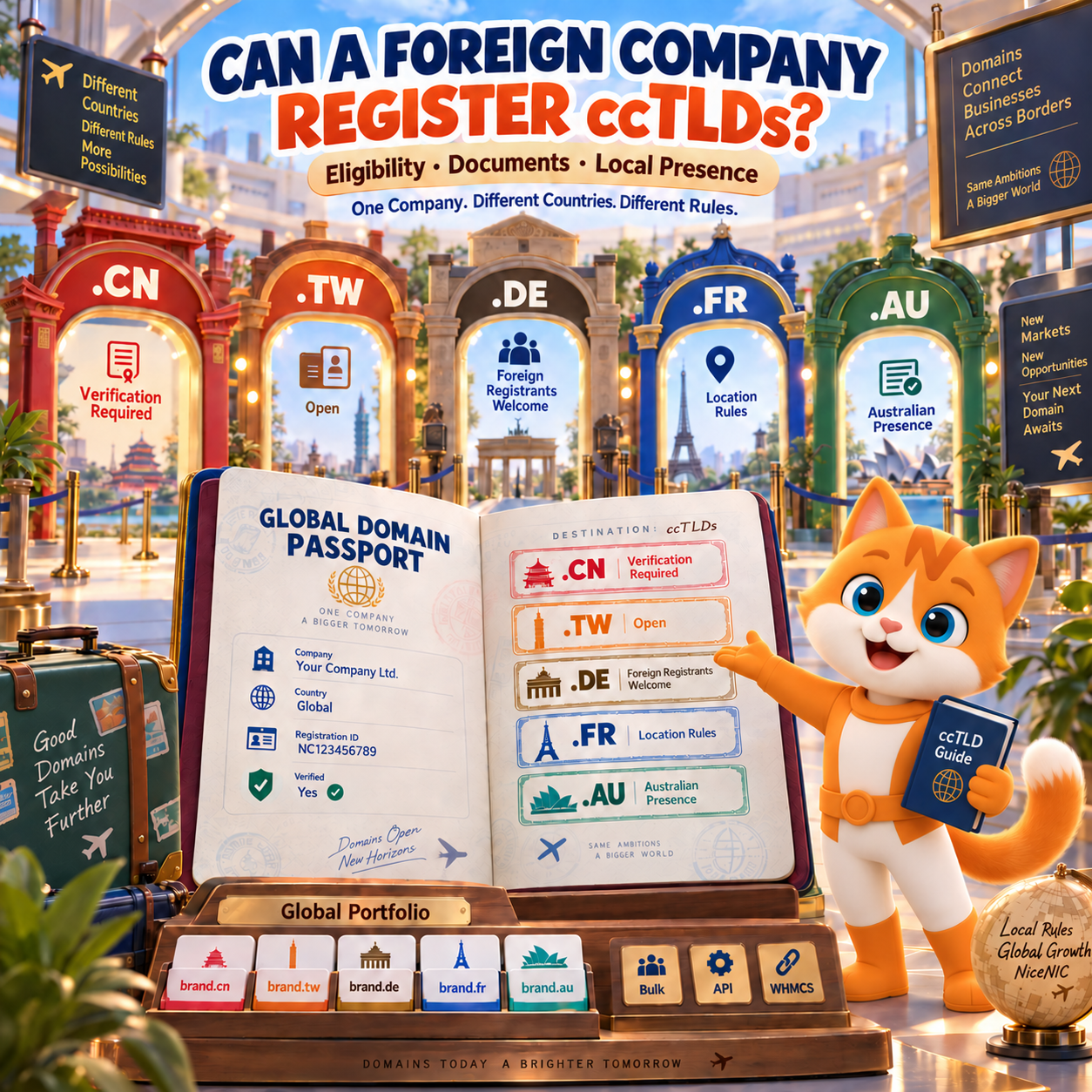
Yes. Foreign companies can register many country-code top-level domains (ccTLDs), but there is no universal eligibility rule.
Some ccTLDs are open internationally. Others require a company registration certificate, passport, local presence, trademark right, qualifying business connection, local contact or other registry-specific information.
For example, .DE is open to registrants in Germany and abroad, .CN allows foreign companies after required real-name verification, generic .TW has broad eligibility, .COM.TW accepts qualifying foreign businesses, .FR restricts the holder’s location, and Australian namespaces apply Australian-presence rules.
Before ordering, check the official registry rule for the exact extension, then verify registration, renewal, transfer, restore and documentation requirements.
NiceNIC currently supports 2,500+ domain extensions. Hosting providers and resellers can combine that coverage with reseller pricing, Domain API and WHMCS.
The safest rule is:
Never apply one country's domain rules to another country's ccTLD.
What Is a ccTLD?
A ccTLD is a country-code top-level domain associated with a country or territory.
Examples include:
-
.CN— China -
.TW— Taiwan -
.DE— Germany -
.FR— France -
.AU— Australia -
.SE— Sweden -
.IN— India
Country-code domains differ from common generic extensions such as .COM because each ccTLD operates under its own registry rules.
That registry can determine:
- who may register;
- what information is required;
- whether documents are needed;
- whether local presence is required;
- registration period;
- nameserver rules;
- renewal timing;
- transfer procedure;
- expiration and recovery;
- privacy and public registration-data handling.
NiceNIC maintains a ccTLD requirements guide for extensions that need additional operational information.
But for important registrations, also check the corresponding registry source because registry rules can change.
Can Every Foreign Company Register Every ccTLD?
No.
There are several common models.
Model 1: Globally Open
The registry allows foreign individuals or organizations to register without requiring a local company merely because the registrant is overseas.
.DE is a useful example.
DENIC currently states that .DE is:
open to everyone, whether located in Germany or abroad.
The domain holder still needs accurate and complete registration data, and DENIC can require verification.
See DENIC's official .DE registration requirements.
Model 2: Foreign Registration Allowed, but Verification Is Required
.CN is a good example.
NiceNIC’s current direct .CN registration workflow allows individuals and companies outside China to register .CN and .COM.CN, but CNNIC real-name verification must be completed.
For a foreign company, NiceNIC currently requires:
- valid Certificate of Incorporation, business registration certificate or equivalent official document;
- complete legal company name;
- company registration number.
The company name and registration number must match the document.
Model 3: The Main ccTLD Is Open, but a Category-Based Namespace Has Eligibility Rules
.TW illustrates this model well.
TWNIC’s current rules state that generic .TW domain names have no general applicant qualification restriction.
But .COM.TW is a commercial category.
TWNIC permits qualifying foreign:
- corporations;
- limited partnerships;
- other organizational entities
registered under the laws of their home country.
See TWNIC's official .TW requirements.
So:
brand.tw
and:
brand.com.tw
should not automatically be treated as having identical eligibility rules simply because both end in .tw.
Model 4: Registrant Location Is Restricted
.FR is a clear example.
Afnic currently states that an individual or legal entity registering .FR must be resident or have its registered office/main establishment in:
- an EU member state;
- Iceland;
- Liechtenstein;
- Norway;
- Switzerland.
The United Kingdom is no longer eligible for new .FR registrations under this location rule following Brexit.
See Afnic's official registration FAQ.
This means:
Being a legally registered company somewhere in the world does not automatically qualify the company for .FR.
Model 5: A Specific Local Connection Is Required
Australian domains illustrate another model.
auDA requires an Australian Presence for .AU domains.
Depending on the namespace and registrant, a qualifying connection can include circumstances such as:
- Australian company or business registration;
- an eligible foreign company licensed to trade in Australia;
- an Australian trademark right;
- another qualifying Australian connection under auDA rules.
The exact rule depends on whether you are applying for:
-
.AUdirect; -
.COM.AU; - another Australian namespace.
See auDA's .AU domain requirements.
Five ccTLD Examples: What a Foreign Business Should Check
Do not memorize this as a permanent registration table. Use it to understand what kinds of differences exist, then check the live registry rules before ordering.
.CN — China
Foreign company registration: Possible
Main issue:
CNNIC real-name verification
Prepare:
- company registration certificate;
- exact legal company name;
- registration number.
NiceNIC currently provides a direct .CN registration workflow.
.TW — Taiwan
Generic .TW: broadly available.
.COM.TW: business eligibility applies.
A qualifying foreign company registered under its home-country laws can be eligible for .COM.TW.
NiceNIC’s current standard .TW registration flow does not require the same additional document-upload process used for .CN, but underlying TWNIC eligibility still applies.
.DE — Germany
Foreign registration: Possible
DENIC states .DE is open to registrants in Germany and abroad.
Important operational issues include:
- accurate holder data;
- potential data verification;
- valid DNS/nameserver configuration.
Do not assume that every foreign .DE registrant needs to establish a German company.
.FR — France
Foreign registration: Restricted by location
The company must meet Afnic’s holder-location rule.
A company based only in an ineligible country cannot solve the issue simply by selecting .FR in a registrar search box.
Eligibility comes before checkout.
.AU / .COM.AU — Australia
Foreign registration: Possible in qualifying circumstances
An Australian connection is required.
For foreign companies, possible qualification routes depend on the exact namespace and can include:
- authorization to trade in Australia;
- eligible Australian trademark rights;
- other defined Australian Presence criteria.
What Documents Might a Foreign Company Need?
There is no universal ccTLD document pack.
Possible requirements include:
- Certificate of Incorporation;
- business registration certificate;
- company registration number;
- tax or VAT number;
- trademark certificate;
- passport of an authorized individual;
- local address;
- local administrative contact;
- proof of local presence;
- proof of business connection;
- signed registry forms;
- other registry-specific information.
The safest process is:
Check the exact extension first → collect only the documents that extension actually requires.
Do not ask every customer for a passport simply because one ccTLD needs identity verification.
That creates unnecessary friction and unnecessary handling of sensitive information.
Registrant Data Must Match the Supporting Document
For document-based registrations, small differences can matter.
Check:
- legal company name;
- legal form;
- registration number;
- registrant address;
- country;
- authorized contact.
For example:
If a company certificate says:
Example Technology Holdings Limited
do not casually enter:
Example Tech
unless the applicable registry process explicitly permits that form.
NiceNIC’s current .CN workflow is particularly strict on this point:
company name + registration number must match the submitted company document.
Mismatch can delay or prevent verification.
Does "No Document Upload" Mean There Is No Eligibility Rule?
No.
This is an important distinction.
A registry may allow the registration to be submitted online without asking for a document at checkout.
That does not necessarily mean:
anyone is eligible.
TWNIC, for example, states that new .TW registrations no longer require prior paper-document review, while the applicable eligibility rules still remain.
A registrant that does not satisfy those rules can still face post-registration review.
So separate:
Document collection
from:
Eligibility
They are related, but they are not the same thing.
Does Local Presence Always Mean You Need to Create a Local Company?
No.
“Local presence” can mean different things depending on the registry.
Depending on the TLD, the requirement could involve:
- local registrant;
- local address;
- local administrative contact;
- registered office;
- local trademark;
- legal representative;
- trustee/local-presence service.
Never assume:
Local presence = incorporate a new company.
Check the exact registry definition.
Can a Registrar or Trustee Solve a Local-Presence Requirement?
Sometimes, where the registry permits that type of service and the registrar actually offers it.
But trustee or local-presence service should never be assumed for every ccTLD.
Before using one, confirm:
- the registry permits the arrangement;
- the service is available for the exact TLD;
- who will be listed as registrant;
- what authority the trustee has;
- annual service cost;
- renewal obligations;
- transfer implications;
- what happens if the service is cancelled.
A local-presence service changes more than the checkout screen.
It can affect long-term domain control.
Registration Availability Is Not Eligibility
Suppose a search shows:
brand.country— Available
That only answers:
Is the domain currently unregistered and potentially registrable?
It does not necessarily answer:
Is your company eligible to register it?
For restricted ccTLDs, the complete path is:
Availability → Eligibility → Documents → Price → Order → Verification → Registry Acceptance
This is why a domain can be:
available
but still fail registration.
Foreign Company ccTLD Registration: The Safer Workflow
Use this sequence.
Step 1: Decide Which Market the Domain Is For
Do not build a ccTLD portfolio simply because thousands of extensions exist.
Ask:
- Are customers in this country?
- Is there a local company?
- Is the domain for brand protection?
- Is it for a marketing campaign?
- Is it required by a client?
Give every domain a reason to exist.
Step 2: Check Availability
For multiple markets or brand variations, use Bulk Domain Search.
Availability is the first check, not the last one.
Step 3: Check Official Registry Eligibility
Find the registry responsible for the extension.
Ask:
- Can foreign companies register?
- Is local presence required?
- Is the exact namespace restricted?
- Are trademark rights relevant?
For policy questions, the registry is the authoritative source.
Step 4: Check NiceNIC's Operational Requirements
Once registry eligibility is understood, check how that TLD is handled through NiceNIC.
Use NiceNIC's ccTLD Requirements Guide and the individual extension page where available.
This can identify:
- required contact information;
- document submission;
- support-assisted steps;
- nameserver requirements;
- registrar workflow.
Registry policy and registrar workflow are two separate layers.
Step 5: Check Registration and Renewal Cost
Do not look only at:
first-year registration price.
For a long-term portfolio, check:
- registration;
- renewal;
- restore/redemption;
- Premium pricing;
- required service cost;
- trustee/local-presence cost where applicable.
For ten countries and hundreds of client domains, renewal cost usually matters more than one promotional first year.
Step 6: Collect the Required Information Before Submission
Prepare only what the TLD actually requires.
For a business registration, this can include:
- legal company name;
- registration number;
- document;
- eligible address;
- contact details.
Check for consistency before placing the live order.
Step 7: Submit the Domain
Depending on the TLD, the result may be:
- registered immediately;
- pending;
- waiting for verification;
- waiting for documentation;
- under registry review.
Do not tell the customer:
Your domain is active
simply because payment succeeded.
Step 8: Confirm the Actual Registry Result
After the order, verify:
- domain status;
- registration date;
- expiration date;
- registrant information;
- nameservers.
The order is complete when the domain is actually registered and usable.
ccTLD Renewals Can Differ From .COM
Do not build a renewal system based on one assumption:
Every domain can be renewed at the same time and in the same way.
ccTLD registries can define:
- different renewal windows;
- different billing cycles;
- different expiry behavior;
- different restore processes;
- no standard Redemption Grace Period;
- shortened renewal deadlines.
For a reseller portfolio, store the renewal rule with the TLD.
Do not rely on staff remembering it.
ccTLD Transfers Can Also Work Differently
Do not assume every ccTLD transfer follows the standard .COM flow.
Transfer methods can differ in:
- authorization code;
- registry approval;
- holder verification;
- document requirement;
- renewal behavior;
- transfer timing;
- change-of-holder process.
Before promising a customer:
"Transfer completes in X days"
check the exact TLD.
NiceNIC provides single and bulk domain transfer workflows, but registry rules still control what can happen for each extension.
WHOIS Privacy Is Not Universal Across ccTLDs
Do not promise:
free WHOIS privacy on every country domain.
Privacy services depend on registry rules.
Some ccTLDs:
- do not support registrar privacy services;
- redact data themselves;
- publish organization information;
- use their own public-registration-data model.
NiceNIC provides Domain Privacy where the applicable extension supports it.
Always check the TLD.
Nameserver Rules Can Be Different Too
A domain may be available and the registrant may be eligible, but registration or delegation can still fail because the nameservers do not satisfy registry requirements.
Possible registry checks can include:
- authoritative DNS;
- zone configuration;
- nameserver reachability;
- DNSSEC;
- network diversity;
- registry-specific validation.
.DE, for example, has defined technical requirements for domain delegation.
See DENIC Nameserver Requirements.
If registration fails at the nameserver stage, do not immediately assume the company is ineligible.
Build a ccTLD Requirements Matrix Before You Scale
For an agency, hosting company or reseller, do not store these rules in people’s memory.
Create a TLD requirements record containing:
- TLD;
- registry;
- foreign-company eligibility;
- required documents;
- local-presence requirement;
- trademark requirement;
- registrant-data rule;
- nameserver requirement;
- registration term;
- registration price;
- renewal price;
- restore cost;
- renewal window;
- transfer method;
- WHOIS/privacy rule;
- automation level;
- manual-review requirement;
- last verified date.
That turns:
"I think .FR works like this…"
into:
a repeatable operational process.
Do Not Hard-Code Registry Rules Forever
This matters if you sell ccTLDs through software.
Registry policies change.
A field that was optional can become required.
A country can change:
- eligibility;
- verification;
- data requirements;
- pricing;
- renewal process.
So your application should not assume:
TLD rule = permanent
Maintain:
- current documentation;
- last-verified date;
- exception handling;
- human escalation.
NiceNIC's Domain Prices and individual TLD guidance should be checked alongside the registry's own rules.
How Should a Hosting Provider Sell ccTLDs?
The safest ordering model is:
Customer Chooses TLD
↓
System Checks Availability
↓
System Checks Price
↓
Eligibility Question
↓
Collect Required Information
↓
Submit Registration
↓
Pending / Action Required / Registered
Do not reduce every ccTLD to:
Search → Pay → Done
That works for many standard domains.
It does not work reliably across every country-code registry.
Build Two Order Lanes
For a reseller business, separate domain orders into:
Standard Lane
Domains that can be processed through your normal automated workflow.
These can often move through:
- WHMCS;
- API;
- bulk tools.
Exception Lane
Domains requiring:
- documents;
- local presence;
- identity verification;
- special nameserver setup;
- registry review;
- other manual actions.
Route those orders to a human queue.
This is more scalable than either extreme:
manually process every domain
or:
pretend every ccTLD can be fully automated.
Can You Automate ccTLD Registration With an API?
For supported operations, yes.
NiceNIC Domain API v2 supports domain workflows including:
- availability checks;
- registration;
- renewal;
- transfer;
- pricing;
- domain details;
- nameservers;
- contact management;
- DNS.
API access is currently available to both Market and Reseller Accounts.
But:
API automation does not override registry eligibility or document requirements.
If a TLD requires:
- company verification;
- passport;
- local presence;
- manual review;
your application needs an exception path.
What Does the API Sandbox Prove?
Use the NiceNIC API Sandbox to test:
- authentication;
- request formatting;
- response parsing;
- error handling;
- application workflow.
Sandbox operations do not create real domain orders or charges.
But passing a Sandbox request does not mean:
every live foreign company is automatically eligible for every ccTLD.
Registry eligibility is a separate production requirement.
This distinction matters for reseller platforms.
Can You Sell ccTLDs Through WHMCS?
NiceNIC provides a WHMCS Registrar Integration for hosting providers and domain resellers.
WHMCS can automate standard supported registrar operations.
For restricted ccTLDs, your business still needs to handle:
- eligibility questions;
- required fields;
- documents;
- manual exceptions.
A practical model is:
WHMCS for routine domain lifecycle
plus:
human review for registry-specific exceptions.
That keeps the customer inside the billing workflow without pretending policy differences do not exist.
Why Broad ccTLD Coverage Matters to a Reseller
A hosting company often starts with:
-
.COM; -
.NET; -
.ORG.
Then customers begin asking for:
- their home-country extension;
- regional brand protection;
- country-specific ecommerce;
- local campaigns;
- international expansion.
Maintaining a separate upstream provider for each group of TLDs creates:
- more balances;
- more control panels;
- more API integrations;
- more invoices;
- more renewal systems;
- more support relationships.
NiceNIC currently supports more than 2,500 domain extensions, including gTLDs, ccTLDs, multi-level country domains and new extensions.
That does not make all 2,500 TLDs identical.
The value for a reseller is the ability to manage a broader range of registry rules through fewer operational systems.
NiceNIC Reseller Options for International Domain Businesses
For businesses with recurring domain volume, NiceNIC's current Reseller Program includes three standard starting levels.
Basic
$200 usable account credit
Designed for agencies, hosting companies and newer resellers.
Super
$600 usable account credit
For recurring domain volume.
VIP
$1,500 usable account credit
For higher-volume domain businesses.
Under the current reseller model:
- there is no separate setup fee;
- there is no annual reseller membership fee;
- qualifying deposits become usable account credit;
- credit does not expire;
- Control Panel, bulk tools, API and WHMCS workflows are available.
Do not choose the highest level merely because it exists.
Compare the TLDs and volume you actually sell using current NiceNIC prices.
A Lower-Risk Way to Test NiceNIC for ccTLD Business
If your company already has another registrar, you do not have to migrate everything first.
Use a controlled pilot.
Step 1
Identify the ccTLDs your current registrar handles poorly or does not offer.
Step 2
Check those extensions at NiceNIC.
Step 3
Compare:
- registration;
- renewal;
- transfer;
- document workflow;
- support process.
Step 4
Test a small number of new registrations.
Step 5
Use the workflow that fits your business:
- Control Panel;
- Bulk Tools;
- WHMCS;
- Domain API.
Step 6
Evaluate the actual result.
Measure:
- completion rate;
- manual work;
- support effort;
- cost;
- renewal management.
Step 7
Scale only if the workflow works for your business.
This is a better reseller decision than moving an entire portfolio based on a marketing page.
Common ccTLD Registration Mistakes
"All country domains require local presence."
No.
Some do.
Some are globally open.
"Foreign companies cannot register .CN."
Incorrect.
NiceNIC’s current .CN workflow supports companies outside China after the required CNNIC real-name verification.
".TW and .COM.TW have identical eligibility."
No.
Generic .TW and category-based .COM.TW have different eligibility structures.
"A foreign company cannot register .DE."
Incorrect.
DENIC currently states that .DE is open to registrants in Germany and abroad.
"If the domain is available, my company must be eligible."
No.
Availability and eligibility are separate checks.
"No document requested at checkout means there is no eligibility rule."
No.
A registry can conduct later eligibility review.
"Every ccTLD transfer uses EPP and the standard .COM transfer process."
No.
Transfer procedures vary by registry.
"All ccTLDs have the same redemption period."
No.
Expiration and recovery models vary.
"WHOIS Privacy works the same for every ccTLD."
No.
Privacy and public-data rules are registry-specific.
"API automation eliminates document requirements."
No.
The API can automate supported registrar operations.
It cannot remove registry policy.
ccTLD Registration Troubleshooting: Symptom → Likely Cause → Next Step
Domain shows Available but registration fails
Possible causes:
- registrant is not eligible;
- required document missing;
- contact data invalid;
- nameserver validation failed;
- registry review required.
Next step: identify the exact registry response and check the TLD requirement.
Registration remains Pending
Possible causes:
- real-name verification;
- document review;
- registry processing;
- manual registrar workflow.
Next step: do not repeatedly submit the same order. Check what action is required.
Company document is rejected
Possible causes:
- legal name mismatch;
- registration number mismatch;
- expired or unreadable document;
- wrong document type.
Next step: compare the registrant profile directly with the legal document.
Customer qualifies but the automated order still fails
Possible causes:
- API/WHMCS does not contain every required special field;
- the TLD needs manual processing;
- a registry-specific operation is required.
Next step: move the order into the exception lane and contact NiceNIC Support with the exact error.
Nameserver update fails
Possible causes:
- invalid delegation;
- non-authoritative DNS;
- registry-specific nameserver requirement.
Next step: validate DNS against the exact registry rule before resubmitting.
Frequently Asked Questions
Can a foreign company register a ccTLD?
Often yes, but it depends entirely on the registry and namespace. Some ccTLDs are globally open; others require local presence, documents, trademarks or other eligibility.
Can a foreign company register .CN?
Yes. NiceNIC’s current .CN workflow supports foreign companies after CNNIC real-name verification using valid company registration documentation.
Can a foreign company register .TW?
Generic .TW has broad eligibility under current TWNIC rules.
Can a foreign company register .COM.TW?
Yes, qualifying foreign companies and organizations registered under their home-country laws can be eligible under TWNIC rules.
Can a foreign company register .DE?
Yes. DENIC currently states that .DE is open to holders in Germany and abroad. Accurate and verifiable holder information is still required.
Can any foreign company register .FR?
No. The registrant must satisfy Afnic’s location eligibility requirements.
Can a foreign company register .AU?
Potentially, if it meets the applicable Australian Presence requirement for the specific .AU namespace.
Do all ccTLDs require documents?
No.
Some require only standard registrant data, while others require documents or additional verification.
Do all ccTLDs require local presence?
No.
The rule varies by registry.
Is a local-presence service available for every ccTLD?
No. It depends on registry rules and registrar service availability.
Does domain availability prove eligibility?
No. An available domain can still be restricted to a particular type of registrant.
Can I automate ccTLD registrations?
Many supported operations can be automated, but TLD-specific verification and manual requirements still need exception handling.
Do I need a reseller account to use NiceNIC API?
No. NiceNIC currently provides Domain API access to active Market and Reseller Accounts. Reseller pricing is a separate account-level decision.
Can NiceNIC resellers use WHMCS for ccTLDs?
NiceNIC provides a WHMCS registrar module for supported domain operations. TLD-specific eligibility and manual requirements still apply.
How many TLDs does NiceNIC support?
NiceNIC currently lists more than 2,500 domain extensions, including gTLDs, ccTLDs and multi-level country domains.
Final Foreign-Company ccTLD Checklist
Before submitting a ccTLD registration, confirm:
- Exact extension
-
Exact namespace, such as
.TWvs.COM.TW - Registry identified
- Foreign-company eligibility confirmed
- Local-presence requirement confirmed
- Trustee availability confirmed if relevant
- Legal company name confirmed
- Company number confirmed
- Required documents prepared
- Registrant data matches documents
- Registration price checked
- Renewal price checked
- Restore/recovery cost checked
- Minimum registration term checked
- Nameserver requirements checked
- Privacy availability checked
- Transfer method understood
- Renewal/expiration rule understood
- Automated vs manual workflow decided
- Last rule-verification date recorded
The most important rule is:
Treat every ccTLD as its own product with its own registry policy.
Do not build an international domain portfolio by assuming:
.country = .COM with a different ending.
Build a Global Domain Portfolio With NiceNIC
Search country-code domains
Search 2,500+ Domain Extensions
Check TLD-specific operational requirements
Review NiceNIC ccTLD Requirements
Compare registration, renewal and restore costs
Searching many country domains?
Use NiceNIC Bulk Domain Search
Managing domains for customers?
Explore the NiceNIC Reseller Program
Building your own domain platform?
Test before production
Already use WHMCS?
Review NiceNIC WHMCS Integration
Need help with a restricted ccTLD?
Submit a NiceNIC Support Ticket
Primary Sources and Further Reading
- DENIC — Register a .DE Domain
- DENIC — Nameserver and NSEntry Requirements
- Afnic — Domain Registration Eligibility FAQ
- TWNIC — .TW Registration Requirements
- auDA — .AU Direct Domain Requirements
- NiceNIC — .CN Registration and Real-Name Verification
- NiceNIC — ccTLD Registration Requirements
- NiceNIC — Domain Prices
- NiceNIC — Domain Reseller Program
- NiceNIC — Domain API v2
Last verified: September 12, 2026. ccTLD eligibility, documents, local-presence rules, prices, transfer procedures and renewal policies can change. Verify the exact registry rule and current NiceNIC workflow for the extension before submitting a registration or promising eligibility to a customer.


