


Wyświetlenia:69
Czas:2026-08-18 12:07:39 Autor: windy 
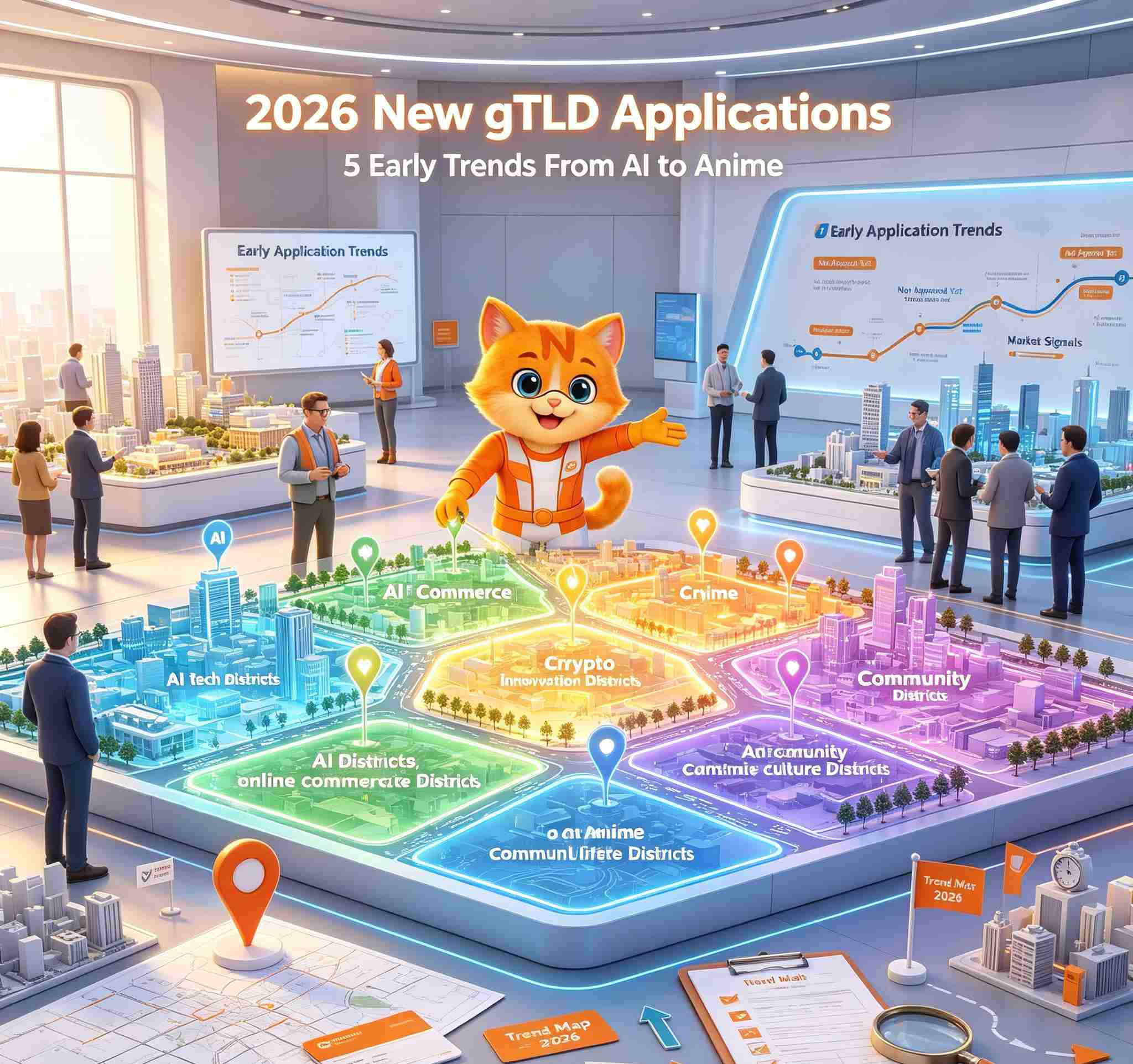
The full official application list will not be published until Reveal Day, but several applicants have already voluntarily disclosed hundreds of proposed strings — enough to show where some registry operators are placing their bets.
The early names range from AI and developer infrastructure to commerce, crypto and online culture.
But there is an important distinction: These applications tell us where registry operators are placing their bets. They do not yet tell us where domain buyers will place theirs.
A memorable string can attract attention. Building a successful TLD requires something harder: real users, registrar distribution and renewals that continue after launch promotions end.
Here are five early trends worth watching.
Quick Take
The early disclosures suggest five themes:
- AI and technology vocabulary is becoming namespace infrastructure.
- Commerce applicants are betting on action-oriented domain names.
- Community identity may be as important as broad generic keywords.
- Crypto-related strings are moving into the regulated DNS namespace conversation.
- Experienced registrar executives are moving upstream into the registry business.
1. AI Is Moving From Branding to Infrastructure
AI is one of the clearest themes in the early disclosures.
Link Freedom Group (LFG), which says it submitted more than 300 proposed TLDs, publicly highlighted AI and technology applications including:
- .llm
- .agi
- .quantum
- .robot
- .portal
- .core
- .bit
- .internet
- .url
Applicants appear to be betting that some of today's technology vocabulary could become part of the Internet's naming infrastructure.
There is an important difference between a fashionable AI term and a functional namespace.
A TLD associated with developers, infrastructure or a clearly defined technical activity may have a more obvious use case than one dependent entirely on current technology terminology.
But even a strong keyword does not guarantee demand.
AI language changes quickly. A term that feels essential in 2026 may have very different relevance several years from now.
For future registries, the real test will be whether businesses and developers continue building on these namespaces after the initial AI excitement fades.
2. Commerce TLDs Are Betting on Intent
Another visible category is commerce.
LFG has publicly highlighted proposed strings including:
- .cart
- .brand
- .merch
- .mall
Instead of only identifying who a website belongs to, the extension itself can potentially communicate what the user expects to do there.
That creates interesting branding possibilities for ecommerce, product discovery and online retail.
But commercially obvious words have failed before when the economics did not work.
For a commerce-focused TLD, the important questions will include:
- Can businesses immediately understand the use case?
- Will registrars distribute it widely?
- Will the first-year and renewal prices make sense?
- Will companies build real websites on it?
- Will premium pricing help or restrict adoption?
3. Community TLDs May Have an Advantage That Generic Terms Do Not
Some of the most interesting early applications are not broad business words at all.
Oinkadot, a company formed by Porkbun CEO Ray King and Dynadot CEO Todd Han, has submitted 25 primary applications including:
- .anime
- .manga
- .dragon
- .ghost
- .heart
- .moon
- .panda
- .stack
Names such as .anime and .manga illustrate a different registry strategy.
Their potential audience may be narrower than a generic term such as .online, but the connection between the namespace and its community can be much stronger.
That raises an important question for the next generation of TLDs:
Is a smaller but highly identifiable community more valuable than a very broad namespace with weaker identity?
For registries, registration count alone will not answer that.
A namespace with 100,000 users who strongly identify with it and continue renewing may ultimately have healthier economics than one that generates a much larger first-year spike through aggressive discounting.
That is why renewal behavior will eventually matter much more than launch headlines.
4. Crypto Strings Are Entering a More Complicated Naming Market
Crypto and Web3 terminology is also present in the disclosed applications.
LFG has highlighted proposed strings including:
- .block
- .btc
- .coin
- .nft
An ICANN-approved gTLD, however, would operate within the globally coordinated Domain Name System and the contractual framework governing ICANN registries.
So the long-term question is bigger than: Will people register crypto domains?
It is also about how DNS-based namespaces, blockchain naming systems and digital identity technologies may coexist.
For domain buyers, that distinction will matter.
A proposed .btc gTLD should not be confused with an alternative naming-system identifier simply because both use similar terminology.
The technical and governance models are different.
5. Registrar Experience Is Moving Upstream
One of the most important signals in the early disclosures is not a string at all.
It is who is applying. Oinkadot brings together two longtime registrar executives: Ray King of Porkbun and Todd Han of Dynadot.
The company has paid $5.675 million in application fees for 25 primary TLD applications and has said it is prepared for contention-set auctions.
King also has previous registry experience through Top Level Design, which successfully operated TLDs including .design, .wiki, .ink and .gay before those registry assets were later sold.
This matters because registrar executives already understand several parts of the TLD business that a new registry eventually has to solve:
- distribution
- pricing
- domain investors
- renewals
- customer acquisition
- registrar integration
Registry → Registrar → Reseller → Registrant
The 2026 Round shows that experienced participants are increasingly willing to operate across more than one layer of that chain.
For registrars and resellers, that is worth watching closely.
Early Contention Is Already Emerging
Even before ICANN's official Reveal Day, some potential competition is visible.
Public disclosures indicate that both Link Freedom Group and Endpoint Domains have applied for .fart. Other disclosed applications suggest competition around strings such as .factory and .etc. Oinkadot may also encounter contention involving some of its applications.
This does not tell us who will ultimately operate any of these TLDs.
It does show something useful: Different applicants can independently identify the same namespace as commercially or strategically interesting.
But contention also changes the economics.
An attractive $227,000 application can become substantially more expensive if multiple qualified applicants eventually compete for the same string.
That is one reason Reveal Day will be so important.
What Should Domain Buyers Watch?
There is no reason to treat the currently disclosed strings as available domain products yet. They are applications.
Instead of trying to predict winners from names alone, watch what happens after Reveal Day:
- Who actually applied?
- Which strings face contention?
- Which applicants move forward?
- Will the TLD be open to everyone or restricted?
- What pricing model will the registry use?
- Which registrars will distribute it?
- What happens to renewals after the first launch year?
What Should Registrars and Resellers Watch?
For registrars, hosting providers and resellers, the next opportunity is ultimately about distribution.
A good string still needs to reach customers. That means successful future registries will need registrar connections, APIs, reseller channels, pricing integration, billing support and customer education.
NiceNIC already supports hundreds of existing new gTLDs and provides reseller and API infrastructure for domain businesses.
As the 2026 Round moves from applications toward actual registry launches, the commercial question will shift from:
"Who applied?" to "Which TLDs will customers actually want us to sell?"
That is the question worth preparing for now.
The Bigger Signal
The most interesting story is not whether .anime, .cart, .btc or an AI-related extension eventually records the largest launch.
It is that applicants are placing large financial bets on very different versions of how people may identify themselves online in the next decade.
- Some are betting on technology.
- Some on commerce.
- Some on communities.
- Some on digital identity.
Reveal Day will finally show us the complete official field. Only later will registration and renewal data tell us which of those bets were right.
Akredytowany rejestrator ICANN od 2006 roku
Kup i zarejestruj swoją domenę .ONLINE już dziś
Sprawdź dostępność domeny .ONLINE, zarejestruj nową domenę .ONLINE, wyszukaj wiele nazw hurtowo lub przenieś istniejące domeny .ONLINE do NiceNIC. Stworzone dla firm, inwestorów domen, agencji, dostawców hostingu i resellerów.
Odnów: $34.99
Rynek
$5.99 $3.99
pierwszy rok
Odnów: $31.99
Podstawowe
$3.99
0% off
Odnów: $30.99
Super
$3.99
0% off
Odnów: $29.99
VIP
$3.99
0% off
POWIĄZANE WIADOMOŚCI:
Ostatnie wiadomości:
How to Transfer a Domain Name: Eligibility, EPP Codes, Timing, Costs, and Downtime
Najnowsze wiadomości: ICANN 2026 Round: 1,600+ New gTLD Applications and What Comes Next
Najnowsze wiadomości: ICANN 2026 Round: 1,600+ New gTLD Applications and What Comes Next


