


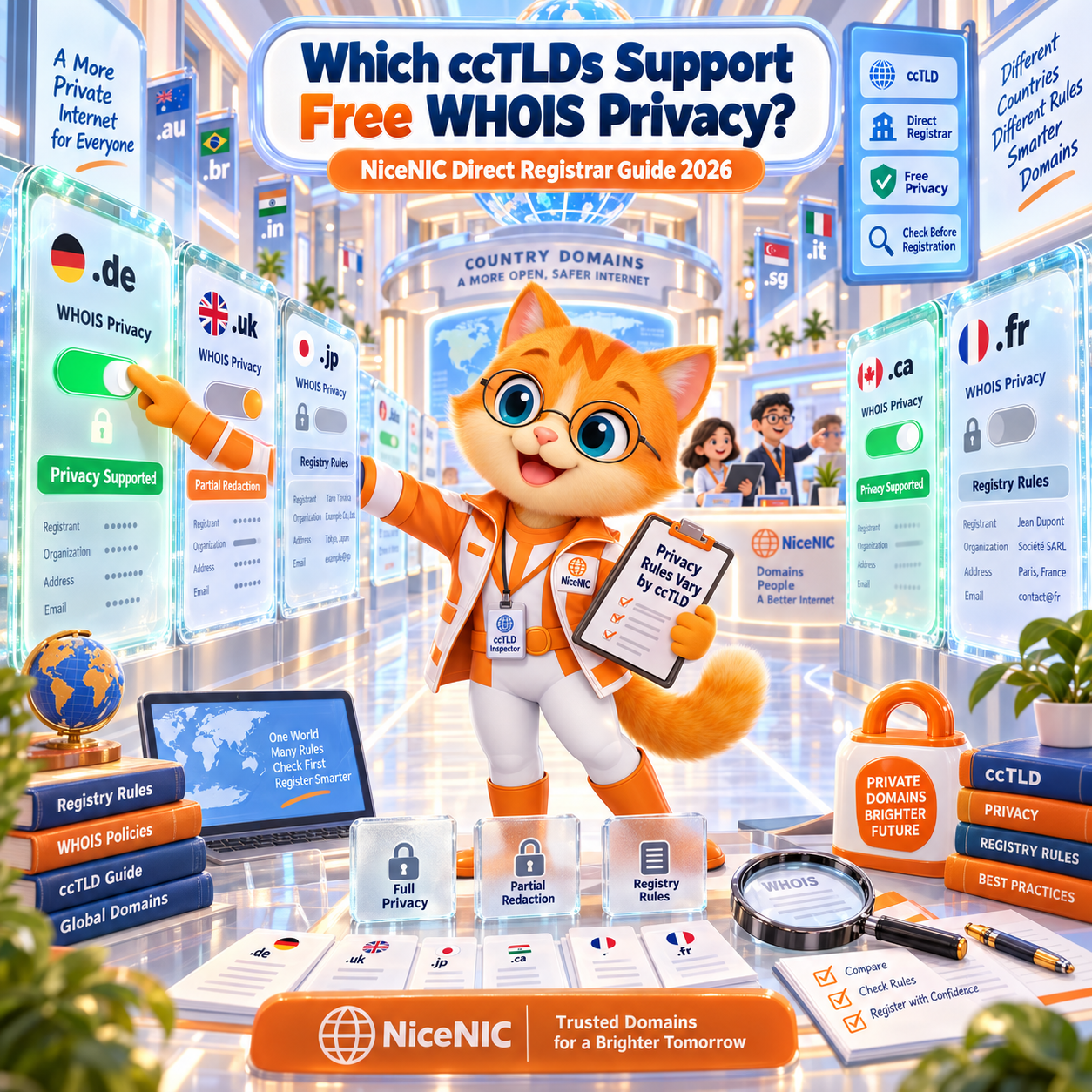
WHOIS Privacy for country-code domains is not identical across every extension. Each ccTLD registry can set its own rules for registration data, public disclosure, verification, and privacy.
NiceNIC currently provides direct registrar service with free WHOIS Privacy or applicable public registration-data protection for 25 ccTLDs, including widely used extensions such as .AI, .IO, .CO, .ST, .TW, .CC, .TV, and .ME.
You can search and register domains at NiceNIC or learn more about NiceNIC WHOIS Privacy before choosing your domain.
This guide explains which ccTLDs are currently covered, what direct registrar service means, how privacy can differ between country-code extensions, and what else you should check before registering.
Which ccTLDs Support Free WHOIS Privacy at NiceNIC?
NiceNIC currently provides direct registrar service with free WHOIS Privacy or applicable public registration-data protection for these 25 country-code domain extensions:
.CC, .CO, .ST, .ME, .TO, .SH, .AC, .IO, .TV, .AI, .CM, .BH, .FO, .PW, .VG, .GL, .LC, .AG, .VC, .FM, .GD, .BZ, .MN, .SC, and .TW.
These extensions cover a wide range of use cases, from local country-focused websites to internationally used domains for technology, media, personal brands, startups, and online communities.
NiceNIC also provides free WHOIS Privacy for .PRO. However, .PRO is a generic top-level domain, or gTLD, rather than a country-code top-level domain, so it is not included in the 25-ccTLD count above.
The exact privacy mechanism can vary by extension because registry policies determine how registration data is collected, displayed, redacted, or protected.
What Does Direct Registrar Mean for These ccTLDs?
Not every company selling a ccTLD has the same relationship with the underlying registry.
For the extensions listed above, NiceNIC maintains direct registrar coverage rather than offering them only as another retail domain listing through an unrelated registrar.
This matters because ccTLDs can operate very differently from one another. Registration periods, renewal rules, transfer processes, registrant requirements, verification procedures, and privacy policies may all vary by registry.
Direct registrar status does not mean that every extension is automatically cheaper, faster, or free from restrictions. Those conditions remain subject to the policies and pricing of each registry.
For customers, the practical advantage is having these extensions available within NiceNIC’s direct registrar infrastructure and managing multiple international domains through the same platform.
This is especially relevant for domain investors, agencies, hosting companies, resellers, and businesses managing domain portfolios across multiple countries and extensions.
You can also review NiceNIC's latest direct ccTLD registrar coverage update.
How Does WHOIS Privacy Work Differently Across ccTLDs?
There is no single WHOIS Privacy model used by every ccTLD.
For one extension, privacy may be provided through a registrar privacy service. For another, the registry itself may limit which registrant details are publicly displayed. Some registries may instead use public registration-data redaction.
From the domain owner’s point of view, the result may look similar because eligible personal information is not exposed in public WHOIS or registration-data results.
Technically, however, the mechanisms are different.
This distinction is important because a registrar cannot override the rules of a country-code registry. The registry ultimately determines what data must be collected, which fields may be publicly displayed, and what type of privacy or redaction is permitted.
This is why NiceNIC applies free WHOIS Privacy or the applicable form of public registration-data protection according to the rules of each eligible extension rather than treating every ccTLD as if it followed the same system.
What Information Can WHOIS Privacy Protect?
Where permitted by the registry, WHOIS Privacy can reduce the amount of personal contact information visible through public domain-registration lookup services.
Depending on the extension and its policy, this may include a registrant’s personal email address, telephone number, postal address, or other eligible contact details.
The exact information protected can differ between TLDs.
This can be useful for individuals, entrepreneurs, domain investors, and businesses that do not want personal contact information unnecessarily exposed in public registration records.
However, privacy protection applies to public visibility. It does not mean that the registrar or registry no longer maintains the underlying registration information.
Does WHOIS Privacy Mean Anonymous Domain Registration?
No.
WHOIS Privacy does not make a domain registration anonymous.
Registrants must still provide accurate information where required. Depending on the extension, the registry or registrar may also require contact verification, identity verification, company information, local eligibility information, or supporting documentation.
Privacy protection also does not prevent legitimate compliance reviews or lawful registration-data disclosure processes.
The simplest way to understand the difference is this:
WHOIS Privacy reduces unnecessary public exposure of eligible registration data. It does not remove the registrant’s responsibilities or the underlying registration record.
This distinction is particularly important with ccTLDs because registration and disclosure requirements can vary significantly between countries and registries.
Do All ccTLDs Use the Same WHOIS Privacy Rules?
No.
Every ccTLD can have its own registry policy.
Some country-code domains support registrar-based privacy services. Some rely primarily on registry-level protection or redaction. Others may require certain registration information to remain publicly available.
Privacy availability should therefore always be checked for the specific extension being registered.
The fact that a registrar supports a ccTLD does not automatically mean that the extension supports the same privacy mechanism as another TLD.
For customers managing many international domains, this extension-by-extension approach is more reliable than assuming all ccTLDs operate like .COM or another generic top-level domain.
What Should You Check Before Registering a ccTLD?
WHOIS Privacy is useful, but it should not be the only factor in choosing a country-code domain.
First, check the extension’s registration requirements. Some ccTLDs are available internationally, while others may require additional information, documentation, or eligibility conditions.
Next, review the registration and renewal terms. Country-code extensions do not always follow the same registration periods, expiration processes, or renewal rules.
Transfer procedures also deserve attention. Some ccTLDs use processes that differ from the familiar authorization-code model used by many generic TLDs.
Finally, consider whether the extension fits the project itself. A domain should make sense for the target market, brand, audience, and expected long-term use, not simply because the exact name is available.
For domain investors, resellers, agencies, and businesses managing larger portfolios, these operational differences can become just as important as the initial registration price.
Why Does Free WHOIS Privacy Matter?
Public domain-registration information can be collected by automated tools, data aggregators, marketers, and other third parties.
Where registry policy permits privacy protection, reducing unnecessary public exposure can help limit the amount of personal information openly associated with a domain.
For an individual registrant, this may help prevent a personal email address, telephone number, or physical address from being unnecessarily displayed in public registration results.
For agencies, businesses, and resellers, privacy availability can also become part of the domain-selection process when managing registrations for multiple projects or customers.
There is also no need to choose between privacy and accurate registration data. A domain can have protected public information while the correct underlying registrant information remains on record with the registrar and registry.
How to Register a ccTLD With Free WHOIS Privacy at NiceNIC
Step 1: Search Your Domain
Use NiceNIC Domain Search to enter your preferred name and check which extensions are available.
Step 2: Choose Your Extension
Select the ccTLD that fits your project and review its registration price, renewal price, registration period, and any extension-specific requirements.
Step 3: Complete Registration
Complete your domain registration. For eligible extensions, free WHOIS Privacy or the applicable public registration-data protection is provided according to the relevant registry policy.
Frequently Asked Questions About ccTLD WHOIS Privacy
Is WHOIS Privacy free at NiceNIC?
For eligible extensions, NiceNIC provides WHOIS Privacy or applicable public registration-data protection without a separate privacy fee.
Does WHOIS Privacy affect domain ownership?
No. Privacy changes how eligible registration information is displayed publicly. It does not transfer ownership or change the underlying registrant record.
Can a ccTLD registry require some registration information to remain public?
Yes. Country-code registries can establish their own registration-data requirements. Registrars must follow the applicable registry policy.
Can ccTLD privacy rules change?
Yes. Registry policies, disclosure requirements, and privacy mechanisms can change. Customers should therefore check the current requirements for an extension when registering or managing a domain.
Does WHOIS Privacy hide registration information from NiceNIC or the registry?
No. WHOIS Privacy concerns public visibility. Accurate registration information may still be collected, retained, and verified by the registrar or registry where required.
Can resellers manage these ccTLDs through NiceNIC?
NiceNIC supports individual domain customers as well as resellers, agencies, hosting providers, and domain portfolio operators. Supported domains can be managed through the NiceNIC platform, with Domain API and bulk tools available for customers that need domain automation or larger-scale management.
Register Your ccTLD With NiceNIC
Choosing a country-code domain involves more than finding an available name. Privacy rules, registration requirements, renewal policies, transfer procedures, and eligibility conditions can all vary between ccTLD registries.
NiceNIC currently provides direct registrar coverage with free WHOIS Privacy or applicable public registration-data protection for 25 ccTLDs, including .AI, .IO, .CO, .ST, .TW, .CC, .TV, and .ME.
By checking both the domain and the extension rules before registration, you can choose a ccTLD that fits your brand, target market, privacy requirements, and long-term plans.
Search and register your domain at NiceNIC
NiceNIC is an ICANN Accredited Registrar since 2006, providing access to 2,500+ domain extensions, free WHOIS Privacy for eligible TLDs, Domain API, bulk tools, and human support.


