


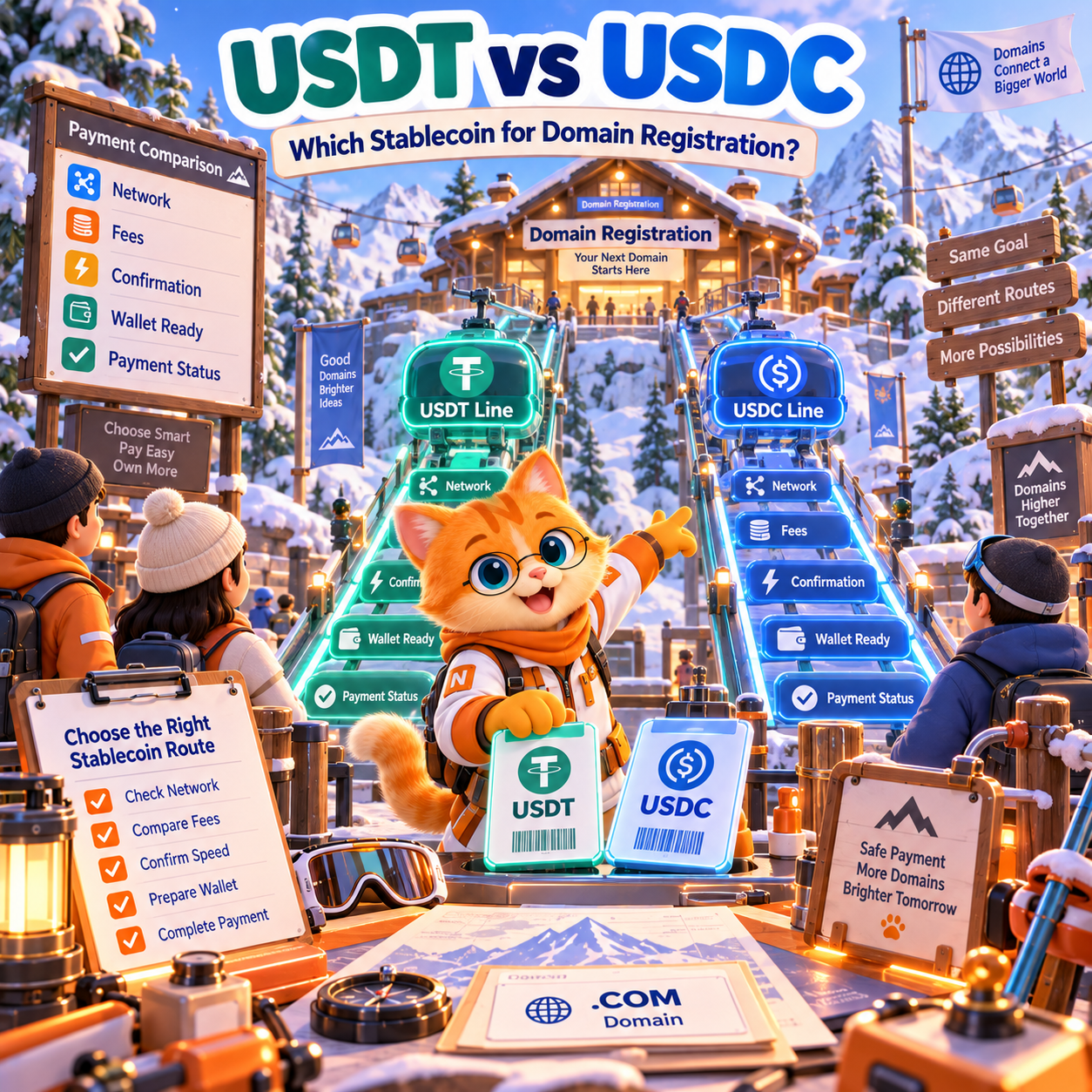
Both USDT and USDC can be practical stablecoins for domain payments. The better choice usually depends on the stablecoin you already hold, the blockchain network you use, and the total cost of moving the funds.
At NiceNIC, the current online crypto checkout supports:
USDT
- Ethereum
- TRON
- Polygon
- Solana
- Arbitrum One
USDC
- Ethereum
- Polygon
- Solana
- Arbitrum One
NiceNIC adds a 0% crypto processing fee. Online crypto checkout is currently processed by Triple-A, which charges a 1.5% service fee. Your wallet, exchange, or blockchain network may also charge a separate fee.
NiceNIC is an ICANN-accredited registrar operating under IANA Registrar ID 3765, and NiceNIC has provided domain services since 2006. Its current registrar status can also be verified independently in the ICANN Accredited Registrar Directory.
The practical decision is therefore:
Choose USDT if you already hold USDT or specifically want the TRON payment route.
Choose USDC if you already hold USDC or prefer Solana, Polygon, Ethereum, or Arbitrum One.
Do not convert from one stablecoin to the other solely because one network appears cheaper. Trading spreads, exchange withdrawal fees, and an additional transfer can eliminate the expected saving.
Check Before You Pay: Review the current stablecoins, supported networks, and payment fees on the NiceNIC Payment Options page. The live checkout is authoritative for the actual transaction.
USDT vs USDC for NiceNIC Domain Payments
The table below focuses on the factors that directly affect a NiceNIC domain payment rather than comparing the entire global USDT and USDC ecosystems.
There is no universal winner in this table.
The best payment route is usually the one that lets you reach your NiceNIC balance with the fewest unnecessary conversions, transfers, and external fees.
The Network Can Matter More Than the Stablecoin
USDT and USDC are both designed to track the U.S. dollar, but the token name alone does not determine your payment cost.
The blockchain route matters.
For example:
- USDT on TRON is different from USDT on Ethereum.
- USDC on Solana is different from USDC on Ethereum.
- Network fees are different.
- Wallet and exchange withdrawal fees can be different.
- Confirmation requirements can be different.
For a NiceNIC payment, always match:
Stablecoin + Network + Active Payment Instructions
If the checkout displays USDT on TRON, use USDT on TRON.
If the checkout displays USDC on Solana, use USDC on Solana.
Never assume that because the token ticker is the same, funds can be sent through a different blockchain network.
What Does a USDT or USDC Domain Payment Actually Cost?
There are three separate costs to understand.
1. Domain Price
This is the price of the domain registration, transfer, renewal, or other eligible domain service.
You can review current availability and pricing through the NiceNIC Domain Search.
2. NiceNIC Crypto Processing Fee
NiceNIC currently adds:
0% crypto processing fee
This means NiceNIC does not add its own percentage processing surcharge simply because you choose crypto.
3. Provider, Wallet, and Network Costs
NiceNIC’s online crypto checkout is currently processed through Triple-A.
The current Triple-A online service fee is:
1.5%
Additional costs may also come from:
- Your wallet
- Your cryptocurrency exchange
- Blockchain transaction fees
- Exchange withdrawal fees
- Stablecoin conversion spreads
The useful formula is:
Total payment cost = domain price + Triple-A service fee + applicable wallet/network/exchange costs
So 0% NiceNIC processing fee does not mean the entire crypto transaction costs 0%.
When Does USDT Make More Sense?
USDT is often the simpler choice when you already hold USDT and do not need to trade into another stablecoin before paying.
NiceNIC Supports USDT on TRON
The most obvious difference between NiceNIC’s current USDT and USDC payment options is TRON.
USDT is currently available through:
- Ethereum
- TRON
- Polygon
- Solana
- Arbitrum One
USDC currently does not list TRON.
That makes USDT particularly relevant to customers whose existing exchange, treasury, or wallet workflow already uses TRC20.
TRON Does Not Have One Fixed USDT Fee
Articles often describe a TRC20 transfer as costing a fixed dollar amount.
That can be misleading.
TRON uses Bandwidth and Energy resources. Actual transaction economics can depend on the resources available to the sending account as well as wallet or exchange policies.
A centralized exchange may also apply a withdrawal fee that differs from the underlying blockchain resource cost.
For that reason, use the fee shown by your actual wallet or exchange instead of assuming every USDT TRON transfer costs the same amount.
Tether Reporting and Issuer Structure
USDT is issued by Tether International, S.A. de C.V.
Tether publishes regular reserve reporting. In August 2026, Tether also announced that KPMG U.S. completed a full independent audit of Tether International’s financial statements for the year ended December 31, 2025 and issued an unqualified opinion.
You can review the current issuer information directly through Tether.
For most individual domain purchases, network compatibility may matter more than the stablecoin issuer’s reporting structure.
For larger businesses, treasury teams may also consider accounting, reserve reporting, jurisdiction, and internal compliance policies.
When Does USDC Make More Sense?
USDC can be the more natural choice when you already hold USDC or your treasury workflow uses Solana, Polygon, Ethereum, or Arbitrum One.
USDC on Solana Can Have Very Low Blockchain-Level Costs
NiceNIC currently supports USDC on Solana.
Solana’s own payment documentation gives current examples for a simple USDC transfer of approximately:
- $0.001-$0.005 under normal conditions
- $0.01-$0.05 during congestion
- Potentially more under heavier congestion
These figures describe the Solana blockchain transaction, not the total NiceNIC payment cost.
Your exchange may still charge a withdrawal fee, and Triple-A’s current 1.5% online service fee remains separate.
So a very low blockchain fee does not automatically mean the entire checkout is almost free.
Circle Reserve Transparency
USDC is issued through regulated affiliates of Circle.
Circle currently publishes reserve holdings on a weekly basis and states that a Big Four accounting firm provides monthly third-party assurance that the value of USDC reserves meets or exceeds USDC in circulation.
Circle also states that the majority of USDC reserves are held in the Circle Reserve Fund, an SEC-registered government money market fund managed by BlackRock.
Current reserve information is available through Circle's Transparency page.
For organizations whose internal treasury policies value frequent reserve disclosure or Circle’s regulated structure, this may be relevant.
It does not automatically make USDC the better choice for every domain payment.
Which Stablecoin Should You Choose?
Instead of asking:
“Is USDT better than USDC?”
ask:
“Which stablecoin can I move to my NiceNIC account with the fewest unnecessary steps and the lowest total cost?”
Choose USDT when:
- You already hold USDT
- Your exchange or wallet primarily uses USDT
- You specifically want the TRON route
- Converting to USDC would create another trade or withdrawal
- Your operational treasury already uses USDT
Choose USDC when:
- You already hold USDC
- You use Solana, Polygon, Ethereum, or Arbitrum One
- Low blockchain-level Solana transfer costs fit your workflow
- Your treasury policies prefer Circle's current reserve-reporting structure
Either can work when:
- You already hold both
- Both are on a NiceNIC-supported network
- External fees are comparable
- You mainly need to fund the same NiceNIC account balance
In that situation, the simpler route is usually better.
Network Confirmation Is Not the Same as Domain Registration
A fast blockchain does not mean the domain is registered at the exact moment the stablecoin transaction appears on-chain.
A crypto-funded domain purchase normally involves several steps.
1. Blockchain Transaction
Your wallet sends USDT or USDC through the selected network.
2. Payment-Provider Confirmation
Triple-A detects and confirms the payment according to its payment-processing requirements.
3. NiceNIC Account Credit
After payment confirmation, NiceNIC credits the corresponding amount to your account balance.
4. Domain Order
Your available balance can then be used for an eligible registration, renewal, transfer, or other supported service.
5. Registry Processing
The relevant registry processes the domain command.
That means:
Blockchain speed ≠ payment-provider confirmation speed ≠ account-credit time ≠ registry provisioning time
Keeping those stages separate makes payment expectations much clearer.
Why Registrar Status Still Matters
Stablecoin support is only one part of choosing where to register a domain.
NiceNIC is an ICANN-accredited registrar operating under IANA Registrar ID 3765 and has provided domain services since 2006.
The current accreditation can also be independently checked through the ICANN Accredited Registrar Directory.
That distinction is useful because crypto-friendly domain sellers can operate under different models, including:
- ICANN-accredited registrars
- Registrar resellers
- Hosting companies using upstream registrar platforms
- Privacy or intermediary services
These models can all be legitimate.
What matters is understanding:
- Who the sponsoring registrar is
- Who manages domain lifecycle operations
- Who handles transfer requirements
- Who processes registry communication
- Who handles compliance and support escalation
Payment flexibility should complement registrar reliability, not replace it.
Does Stablecoin Choice Affect WHOIS Privacy?
No.
Your payment method and your public registration-data protection are separate.
NiceNIC provides free WHOIS privacy on eligible TLDs where registry policy permits it.
Whether you fund your balance using USDT, USDC, another supported crypto option, PayPal, or bank transfer does not determine whether the TLD supports privacy.
Certain ccTLDs and restricted namespaces follow different registry policies.
Does Paying With USDT or USDC Make Domain Registration Anonymous?
Not necessarily.
Paying with stablecoins changes the payment route.
It does not remove:
- Domain registration-data requirements
- Registry requirements
- Payment-provider checks
- Registrar compliance obligations
- Applicable eligibility or identity verification
- Public blockchain transaction records
WHOIS privacy can reduce the amount of eligible registration information displayed publicly, but privacy protection is not the same as anonymous domain ownership.
Security Checklist Before Sending USDT or USDC
Before confirming a payment:
- Check the token. Make sure the checkout says USDT or USDC.
- Check the network. Match your wallet network exactly to the current payment instruction.
- Check the address. Use the destination generated for the current transaction.
- Review all fees. Include Triple-A, wallet, exchange, and network costs.
- Check the amount. Confirm what will be sent and what is expected to be credited.
- Save the TXID. Keep the transaction hash until your balance is confirmed.
- Do not assume reversibility. Blockchain transfers are generally difficult or impossible to reverse after confirmation.
The safest pre-send check is:
Token + Network + Address + Amount
Frequently Asked Questions
Does NiceNIC accept both USDT and USDC?
Yes.
Current NiceNIC online crypto options include both USDT and USDC.
USDT currently supports Ethereum, TRON, Polygon, Solana, and Arbitrum One.
USDC currently supports Ethereum, Polygon, Solana, and Arbitrum One.
Check the NiceNIC Payment Options page before paying because supported networks can change.
Does NiceNIC charge 0% for USDT and USDC?
NiceNIC currently adds a 0% crypto processing fee.
Triple-A currently charges a 1.5% online service fee, and wallet, exchange, or blockchain fees may also apply.
Which is cheaper, USDT or USDC?
Neither is always cheaper.
The total cost depends on:
- Network
- Wallet
- Exchange
- Withdrawal fee
- Provider fee
- Conversion spread
Using the compatible stablecoin you already hold can be cheaper than converting solely to use another network.
Is USDC on Solana always cheaper than USDT on TRON?
No.
A simple Solana USDC transaction can have a very low blockchain-level fee, but the total payment may also include Triple-A and exchange costs.
TRON uses a different Bandwidth/Energy model, and wallet or exchange withdrawal fees can vary.
Compare the actual payment routes available to you.
Is NiceNIC an ICANN-accredited registrar?
Yes.
NICENIC INTERNATIONAL GROUP CO., LIMITED is the ICANN-accredited registrar entity behind NiceNIC and operates under IANA Registrar ID 3765.
You can verify this through the NiceNIC Trust Center or the ICANN registrar directory.
Can I register a domain anonymously with USDT or USDC?
Not necessarily.
Crypto payment and domain-registration identity requirements are separate. Registrants must still comply with applicable registrar and registry requirements.
Final Verdict: USDT or USDC?
There is no universal winner.
For NiceNIC domain funding:
Already hold USDT and want TRON? USDT is likely the simpler route.
Already hold USDC and use Solana, Polygon, Ethereum, or Arbitrum One? USDC may be more convenient.
Already hold either stablecoin on another NiceNIC-supported network? Compare the actual provider, exchange, and network costs before converting anything.
Both stablecoins ultimately fund the same NiceNIC account balance for eligible domain operations.
The most useful question is therefore not:
USDT or USDC—which one is better?
It is:
Which supported stablecoin and network lets me fund my domain account with the fewest unnecessary conversions, fees, and operational steps?
NiceNIC combines both stablecoin options with a verifiable ICANN-accredited registrar relationship, more than 2,500 supported domain extensions, and multiple account-funding methods.
Review Current Crypto Payment Options
Verify NiceNIC Registrar Status
Verification Notes
Payment assets, supported networks, provider fees, blockchain costs, and stablecoin issuer disclosures can change.
This article was last checked on September 15, 2026 against NiceNIC’s current payment documentation and current public information from ICANN, Tether, Circle, TRON, and Solana.
For an actual transaction, the live NiceNIC checkout and the fee displayed by your wallet or exchange should be treated as authoritative.


