


Views:95
Time:2026-08-21 11:24:44 Author: windy 

Should you choose the familiar .COM, or use .HOST to immediately communicate what your business provides?
Choose a .COM domain when you want a broad company identity that can expand beyond hosting services.
Choose a .HOST domain when hosting, servers, infrastructure, or managed services are central to your brand.
For many technology businesses, both can have a purpose:
company.com → main corporate website
service.host → hosting platform, VPS service, or infrastructure product
.HOST vs .COM: The Quick Answer
.COM is the broader business choice. It is familiar worldwide and gives a company flexibility to expand into different technology services.
.HOST is more specialized. It immediately signals hosting, servers, web infrastructure, or managed services.
The key question is:
Do you want your domain to represent the entire company, or clearly position your hosting service?
A hosting company selling only infrastructure services may benefit from .HOST. A technology company offering many products may prefer .COM as the primary brand.
Check Your Hosting Brand in .HOST and .COM
Before deciding, check whether your actual company or product name is available.
At publication, NiceNIC currently lists:
.HOST: starting from $9.99 first year
.COM: $16.99 first year for a Market Account
Pricing may vary by account level, renewal period, and premium-domain status, so always check the current registration and renewal prices before ordering.
What Is the Main Difference Between .HOST and .COM?
The biggest difference is:
technical positioning versus broad brand flexibility.
.COM is neutral.
A technology company can start with hosting, then expand into:
- Cloud services
- Cybersecurity
- Software products
- Consulting
- Managed IT
- Business solutions
.HOST communicates the category immediately.
A name like:
- fastcloud.host
- secure.host
- managed.host
For companies where hosting is the main product, this clarity can become part of the brand.
When Should You Choose .COM?
Choose .COM when the domain represents the whole company.
It is usually the better choice when:
- You provide multiple technology services.
- You want the strongest general brand recognition.
- You plan to expand beyond hosting.
- Your company needs one domain for sales, careers, partnerships, and corporate information.
- A strong matching .COM is available.
Over time it may add:
- VPS services
- Cloud platforms
- Security solutions
- Backup services
- Software tools
That flexibility is one of .COM's biggest advantages.
When Does .HOST Make More Sense?
Choose .HOST when hosting is not just a service—it is the identity of the business.
It can work well for:
- Web hosting companies
- VPS providers
- Server providers
- Managed hosting businesses
- MSPs
- Infrastructure platforms
- Reseller hosting companies
- Developer hosting services
novagrid.host
immediately tells visitors that the company focuses on hosting or infrastructure.
This can be especially useful when:
- The matching .COM is unavailable.
- The .HOST version is shorter and cleaner.
- The business wants clearer positioning.
- Customers already understand the hosting category.
- The extension itself becomes part of the message.
.COM + .HOST Can Work Together
Hosting businesses do not always need to choose only one extension.
A common structure is:
company.com → company brand, sales, support, corporate information
platform.host → hosting product, VPS platform, or customer portal
This approach separates the company identity from the technical service.
For example:
A hosting company may use:
brand.com for the business.
And:
brand.host for a dedicated hosting platform or customer experience.
There is usually no need to build two identical websites.
Choose one primary domain and use the second domain for a specific service, campaign, or redirect.
Does .HOST Affect SEO?
Using .HOST does not automatically improve search rankings because the extension describes hosting.
Google generally treats new generic top-level domains like other gTLDs. The keyword inside the domain extension does not create an automatic ranking advantage or disadvantage.
That means:
cloud.host does not automatically rank higher than a .COM website for cloud hosting searches.
SEO performance depends more on:
- Useful content
- Search intent
- Website structure
- Internal links
- External links
- Technical performance
- User experience
- Brand authority
What Hosting Businesses Should Look for Beyond the Domain Extension
For a hosting company, choosing the domain extension is only the first step.
Unlike a normal website owner, hosting providers often manage domains as part of their daily business operations.
As the customer base grows, the registrar becomes part of the infrastructure behind the business.
Automation and API Integration
Hosting companies often need to connect domain operations with their own systems.
Important workflows may include:
- Domain availability checks
- Registration
- Renewal
- Transfer
- DNS updates
- Customer management
NiceNIC provides Reseller API v2 documentation covering domain-related operations, including registration, renewal, transfer, DNS management, price lookup, and integration workflows.
Bulk and Portfolio Management
Hosting businesses rarely manage only one domain.
As the portfolio grows, efficient tools become important for:
- Multiple registrations
- Renewals
- Transfers
- Domain searches
- Client portfolio management
Transparent Pricing and Long-Term Costs
Hosting companies also need predictable costs.
A domain may become part of a hosting package, so registration and renewal pricing directly affect margins.
Before choosing a registrar, compare:
- Registration prices
- Renewal prices
- Transfer costs
- Premium-domain rules
.HOST or .COM: Which Should You Choose?
Choose .COM if:
- You want the broadest company identity.
- You may expand beyond hosting.
- You need maximum customer familiarity.
- Your brand covers multiple technology services.
- A strong matching .COM is available.
- Hosting is the core business.
- You operate VPS, server, infrastructure, or managed hosting services.
- You want customers to understand your category immediately.
- The .HOST version gives you a cleaner brand name.
- .COM represents the company.
- .HOST represents the hosting product or platform.
- You want to protect the matching brand name.
Why Hosting Businesses Choose NiceNIC
Hosting companies need more than a domain search box.
As domain operations become part of their business model, they need:
- Reliable registration workflows
- Transparent pricing
- Transfer support
- Automation options
- Bulk management capabilities
- Human assistance when issues require review
Final Thoughts
For a broad technology company, .COM remains the safer and more flexible choice.
For hosting providers, VPS companies, and infrastructure businesses, .HOST can communicate the service category more directly.
The best choice depends on what the domain represents.
Use:
- .COM for the company.
- .HOST for the hosting service.
- Or choose .HOST as the primary brand when hosting itself is the core business.
How to Register a .HOST or .COM Domain at NiceNIC
Once you have chosen the extension, registration only takes a few steps.
Step 1: Search Your Domain
Enter your preferred hosting or company name, select .HOST, .COM, or both, and click Search.
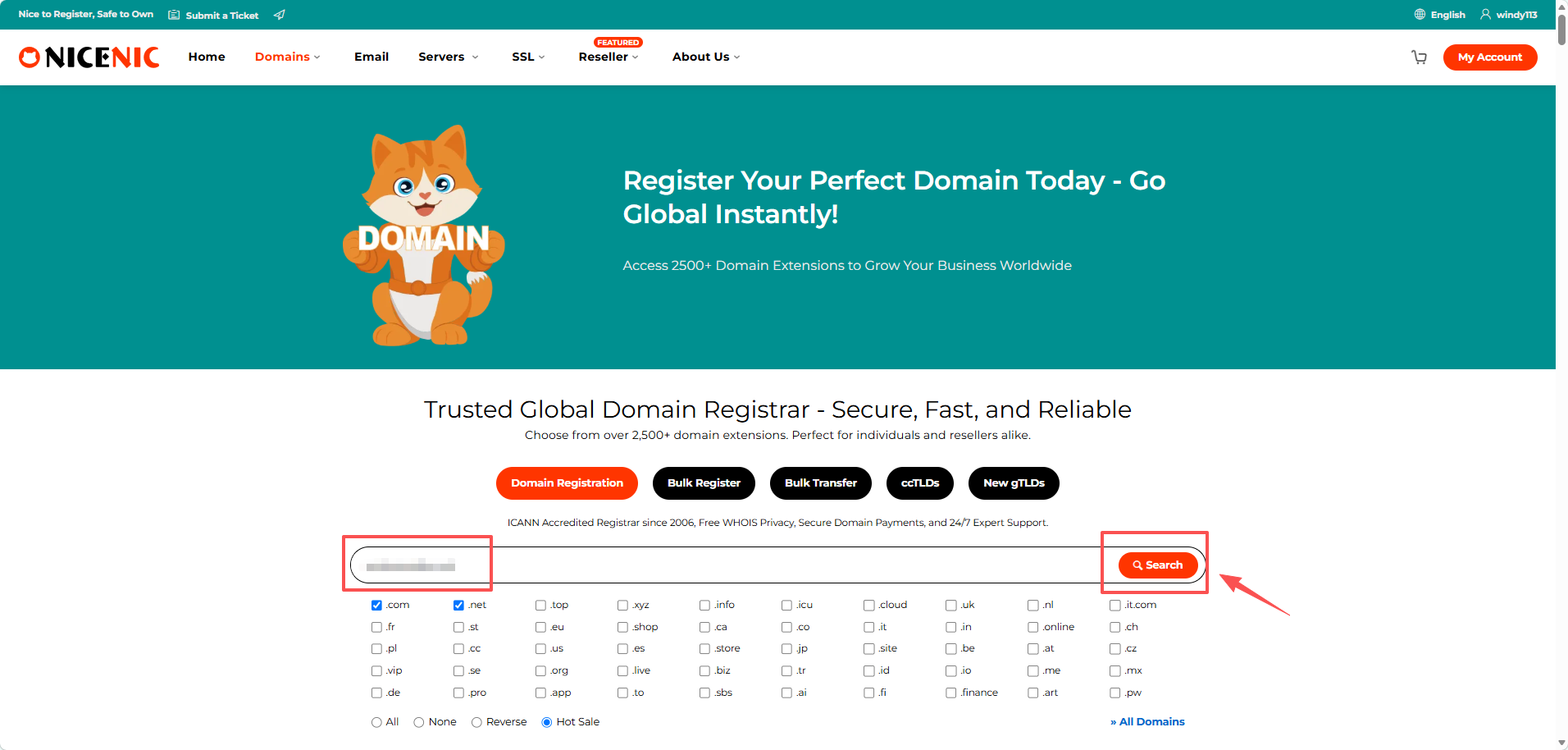
Search your brand name and select the extensions you want to check.
Step 2: Choose an Available Domain
Review availability and current pricing, then click Register or add the domain to your cart.
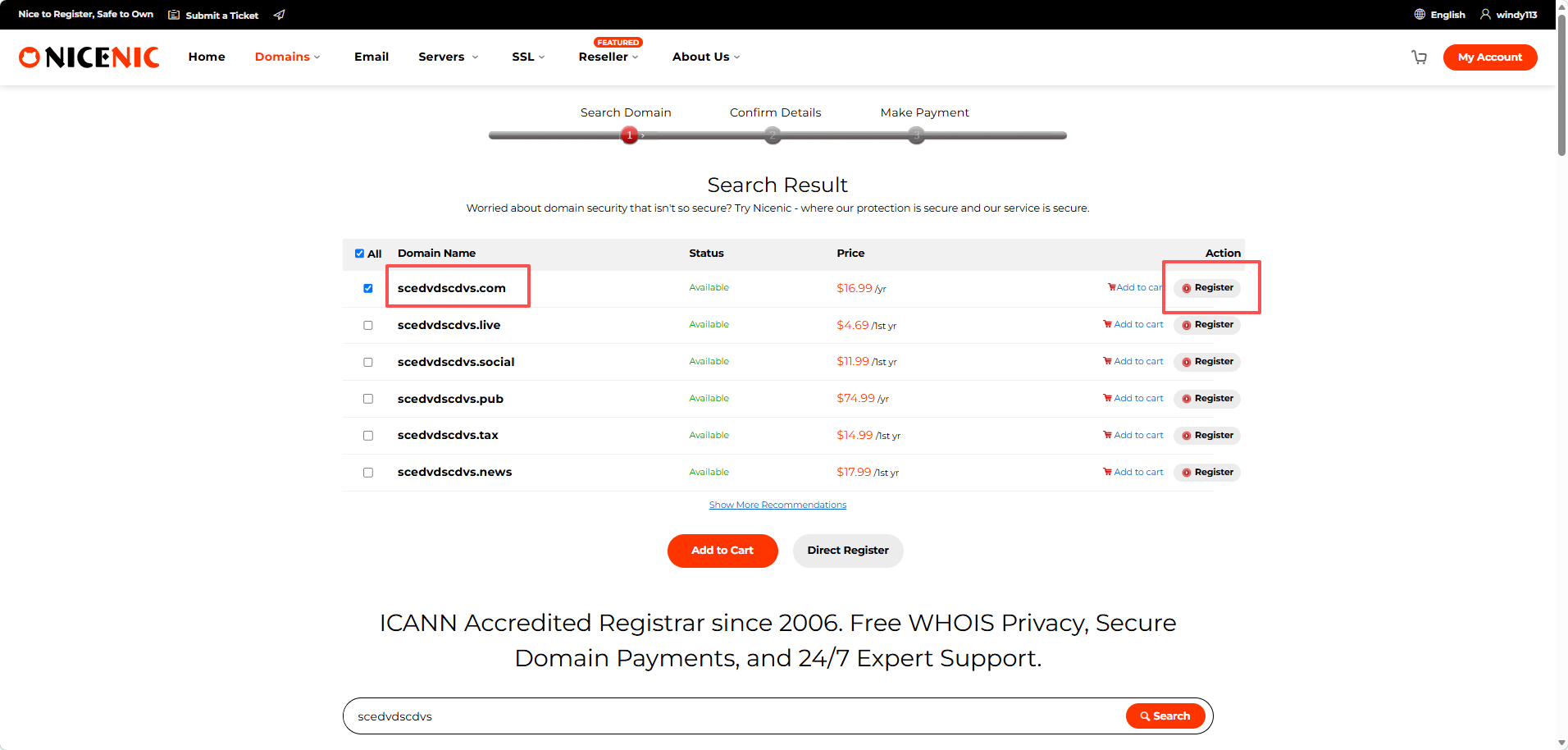
Check availability and choose the domain you want.
Step 3: Complete Payment
Confirm your order details, select a payment method, and complete the registration.
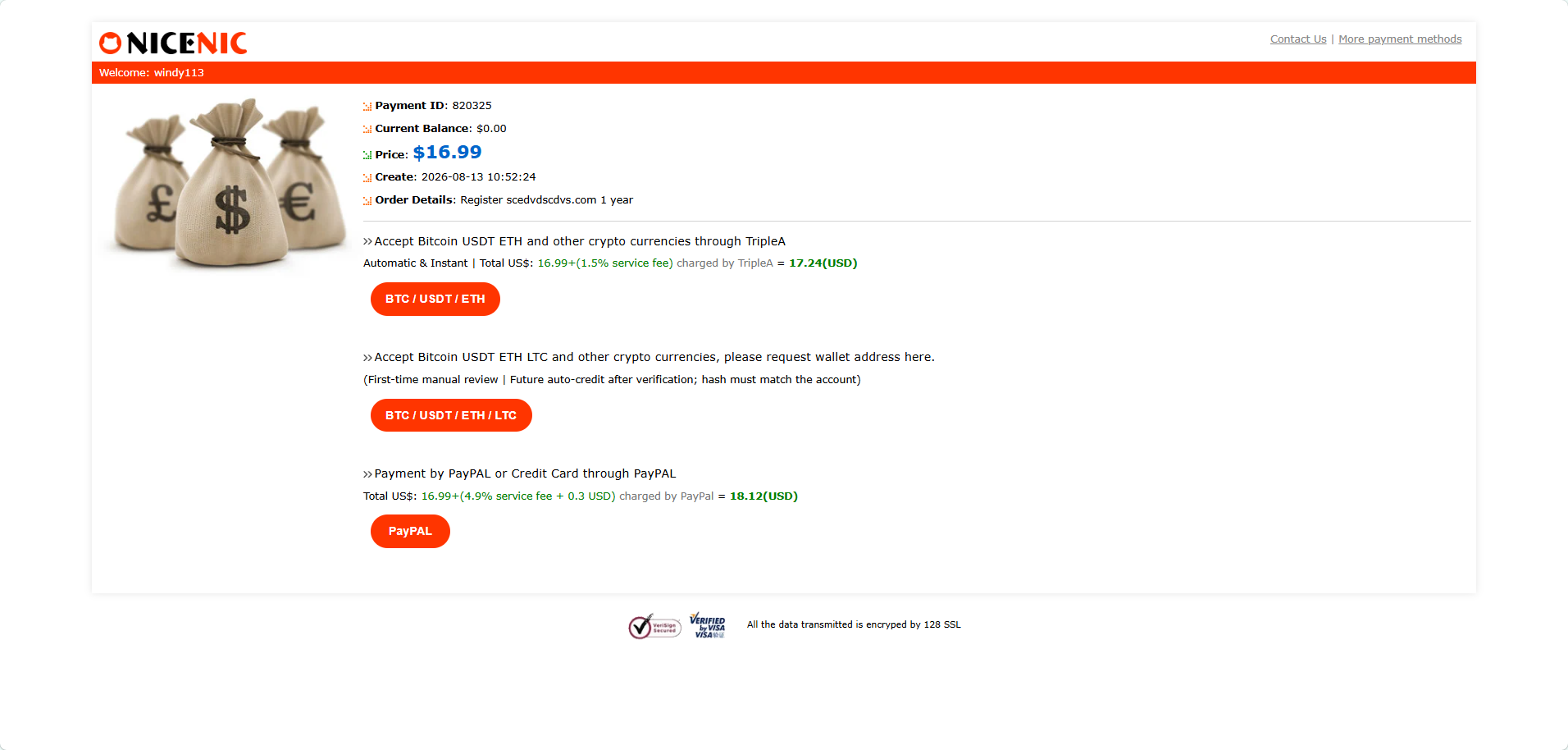
Review the order and complete payment.
After registration, you can manage the domain from your NiceNIC account.
Check Your Hosting Brand in .HOST and .COM
Compare your actual company or service name before making the final decision.
Check Your .HOST Domain
Check Your .COM Domain
Managing many customer domains? Explore NiceNIC Reseller API v2
Found the right name? Create a free NiceNIC account and complete your registration.
ICANN Accredited Registrar Since 2006
Buy and Register Your .HOST Domain Today
Check .HOST domain availability, register a new .HOST domain, search multiple names in bulk, or transfer your existing .HOST domains to NiceNIC. Built for businesses, domain investors, agencies, hosting providers, and resellers.
Renew: $55.99
Market
$14.99 $9.99
first year
Renew: $55.99
Basic
$9.99
0% off
Renew: $55.99
Super
$9.99
0% off
Renew: $55.99
VIP
$9.99
0% off
RELATED NEWS:
Last News:
Registering 5, 10 or 20 Domains? How NiceNIC Volume Pricing Works
Next News: Register 5+ Domains and Save Up to 10% with NiceNIC
Next News: Register 5+ Domains and Save Up to 10% with NiceNIC


