


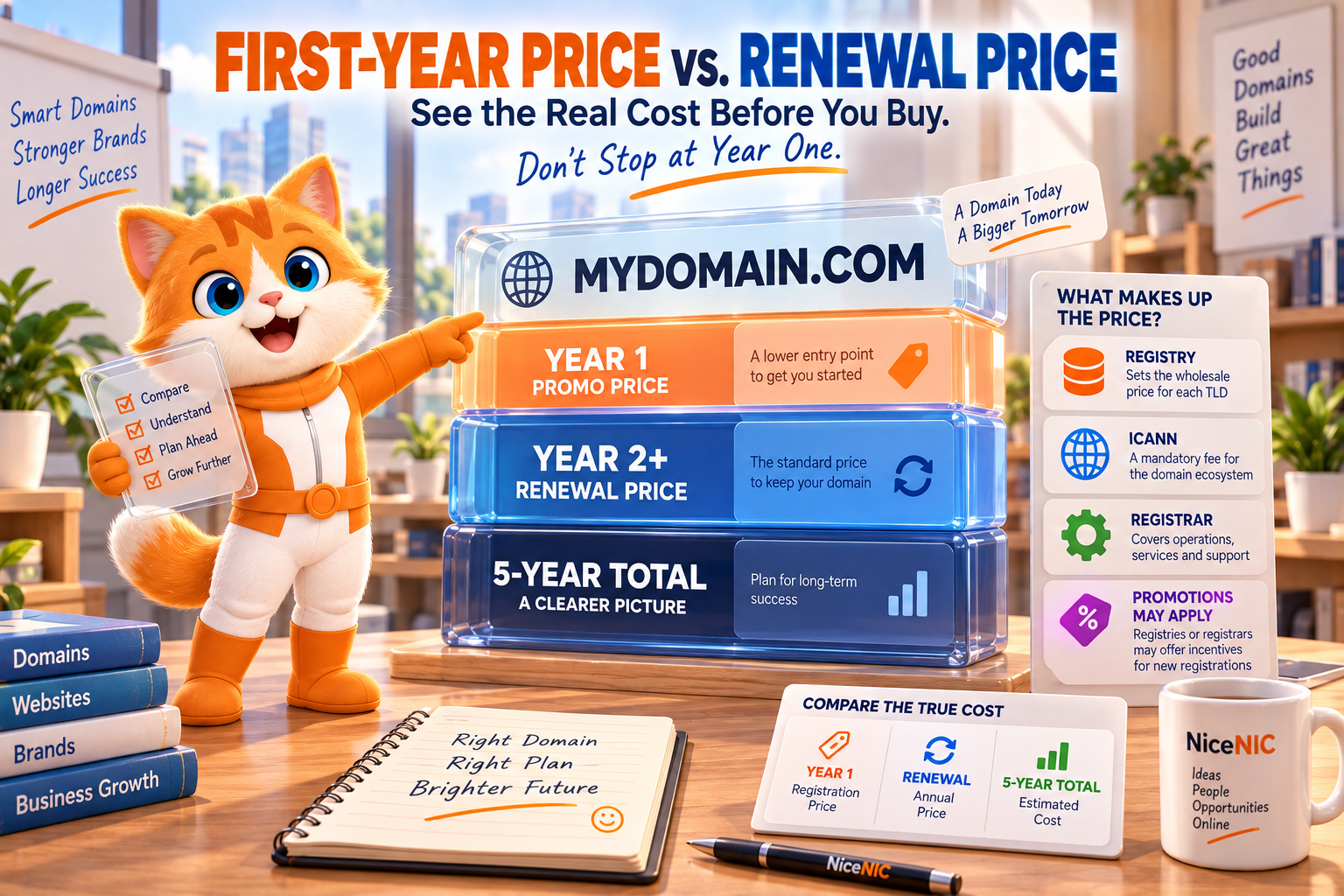
Domain renewal prices are often higher because the first-year registration price is promotional, while renewal returns to the normal recurring price.
That recurring price can reflect the registry’s wholesale fee, applicable ICANN registrar transaction fees, the registrar’s operating costs and retail margin, and any Premium or TLD-specific costs.
A very low first-year price does not necessarily mean the registrar is losing money. Registries can also offer promotional incentives that reduce the effective first-year cost for participating registrars.
A current .COM example shows why the distinction matters. Verisign’s registry-level wholesale price for a standard .COM registration or renewal is $10.26 through October 31, 2026, and Verisign has announced an increase to $10.97 effective November 1, 2026. ICANN’s current transaction-based registrar fee for applicable gTLD transactions is $0.20 per annual increment.
Before registering a domain, compare more than the first-year price. Check the current registration, renewal, restore, Premium status, privacy and any TLD-specific costs. NiceNIC shows registration and renewal pricing separately on NiceNIC Domain Prices.
Why Can a $2 Domain Cost $20 or More to Renew?
The simplest answer is:
The first-year price and the recurring price are often two different products from a pricing perspective.
A registrar or registry may use a discounted introductory price to make a new registration easier to start.
When the promotional period ends, the domain renews at its normal recurring rate.
For example, a domain might be marketed as:
First year: $2.99
but have a disclosed renewal price of:
$24.99 per year
That does not automatically mean the renewal increased from $2.99 to $24.99 after purchase.
It may mean that:
$2.99 was the promotional acquisition price and $24.99 was the regular renewal price from the beginning.
The important question is therefore not:
"How cheap is year one?"
It is:
"What will this domain cost me if I keep it?"
What Can Make Up a Domain's Retail Price?
A domain’s retail price is affected by several layers.
Understanding those layers helps explain why registration and renewal can differ.
1. Registry Wholesale Pricing
The registry operates the top-level domain.
Examples include:
-
Verisign for
.COM; - Identity Digital for many generic extensions;
- country-code registries for ccTLDs.
The registry establishes the underlying commercial terms for registrations, renewals and other supported lifecycle operations.
Registrars purchase domain years under those registry arrangements and then set their own customer-facing retail price.
The registry wholesale cost is therefore an important part of the floor beneath a standard domain’s retail economics.
2. Registry Promotions and Incentives
The registry’s headline wholesale price is not always the whole story for a new registration.
Registries can offer:
- launch promotions;
- acquisition incentives;
- registrar marketing programs;
- temporary rebates;
- volume-based promotional programs.
That means a registrar may be able to offer a deeply discounted first year without absorbing the entire discount itself.
So this calculation is usually too simplistic:
Registry price = $10 Customer pays $2 Registrar loses exactly $8
The true economics may also include a registry incentive or promotional arrangement.
This is why first-year retail price alone does not tell you the registrar’s actual margin.
Who Funds the First-Year Discount?
There are several possibilities.
Registrar-funded promotion
The registrar accepts a lower or negative margin in the first year to acquire a customer.
Registry-funded promotion
The registry reduces the effective cost of selected new registrations through an incentive program.
Shared promotion
Registry incentives and registrar marketing subsidies are combined.
Promotional product strategy
The registrar accepts a low margin on the domain because it expects to sell related services such as:
- hosting;
- Business Email;
- SSL;
- other products.
The important point is:
A low registration price tells you what the customer pays today. It does not tell you exactly who funded the discount.
Real Example: What Does a .COM Cost the Registrar?
.COM provides a useful real-world example because its registry pricing is publicly disclosed.
As of September 15, 2026, Verisign’s annual registry-level wholesale fee for a standard new or renewal .COM registration is:
$10.26
Verisign has announced that this will become:
$10.97
effective:
November 1, 2026
See Verisign's official 2026 pricing announcement.
That is the registry-level cost.
It is not automatically the final retail price customers should expect from every registrar.
The registrar still has its own commercial model and operating costs.
What About the ICANN Fee?
For applicable gTLD transactions, ICANN currently assesses accredited registrars a:
$0.20 transaction-based fee per annual increment
for qualifying:
- registrations;
- renewals;
- transfers
that survive the applicable grace period.
The $0.20 fee took effect on July 1, 2025 for ICANN FY26.
This is more accurate than describing ICANN’s fee as:
"a universal $0.20 fee added separately to every domain checkout."
Registrars can incorporate applicable ICANN costs into their displayed domain price.
NiceNIC currently does exactly that for applicable standard domains:
Applicable ICANN Fee Included
3. Registrar Operating Costs and Retail Pricing
Registrars also operate the customer-facing infrastructure around a domain.
Costs can include:
- registry integrations;
- DNS systems;
- security;
- account infrastructure;
- payment processing;
- customer support;
- compliance;
- API infrastructure;
- fraud prevention;
- engineering;
- operations.
The registrar then determines its own retail pricing strategy.
Different registrars can therefore sell the same underlying TLD at different customer prices.
That difference does not necessarily mean one registrar’s registry cost is completely different.
Their retail:
- margins;
- promotions;
- service bundle;
- customer-acquisition strategy
may simply differ.
4. Premium and TLD-Specific Costs
Not every domain under one extension has standard pricing.
A Registry Premium domain can have special pricing set by the registry.
Depending on the registry, Premium pricing can affect:
- registration;
- renewal;
- transfer.
Country-code and restricted domains can also introduce costs such as:
- trustee/local-presence service;
- verification;
- minimum registration period;
- special recovery fees.
Before comparing two domains, confirm that both are standard domains with comparable conditions.
See What Is a Premium Domain? for the distinction between standard and Premium pricing.
Why Does Renewal Return to a Higher Price?
For many promotions, the incentive applies primarily to acquiring a new registration.
The registrar or registry wants to encourage someone to start using the extension.
Renewal serves a different purpose:
keeping an existing registration active.
Once the first-year promotion ends, renewal normally uses the current renewal rate.
That is why this pattern is common:
Promotional registration → Standard recurring renewal
It does not mean every registrar uses the same markup or every TLD has the same pricing structure.
Registry Price Changes Can Also Raise Renewals
Promotions are only one reason renewal prices can change.
The underlying registry can also change its wholesale price.
.COM is a current example.
Verisign has announced that its .COM wholesale registration and renewal price will increase from:
$10.26
to:
$10.97
on November 1, 2026.
NiceNIC has already published advance notice that its .COM customer pricing will also change on that date.
See NiceNIC's .COM Price Update Notice.
This is an important distinction:
Not every renewal-price change is caused by a registrar suddenly increasing its margin.
Sometimes the underlying registry cost has changed.
NiceNIC Also Uses First-Year Promotions
Transparent pricing does not mean:
registration and renewal must always cost the same.
NiceNIC also offers promotional first-year pricing on selected extensions.
The difference users should care about is whether the renewal price is visible before they commit.
NiceNIC’s current pricing experience displays registration and renewal pricing separately so users can evaluate both the first-year and recurring cost.
This is a more useful transparency standard than pretending promotions should not exist.
First-Year Price vs Long-Term Cost
Suppose three hypothetical domains have these prices.
Domain A
First year:
$2
Renewal:
$25 per year
Estimated five-year cost:
$102
Domain B
First year:
$12
Renewal:
$12 per year
Estimated five-year cost:
$60
Domain C
First year:
$18
Renewal:
$10 per year
Estimated five-year cost:
$58
These are illustrative numbers, not current NiceNIC prices.
The lesson is simple:
The cheapest first year can be the most expensive five-year option.
How to Estimate a Domain's Five-Year Cost
For a standard domain starting with a one-year registration, a useful current-rate estimate is:
Five-Year Cost = First-Year Registration + 4 × Current Annual Renewal
For example:
Registration:
$8
Current renewal:
$15
Five-year current-rate estimate:
$8 + ($15 × 4) = $68
This is an estimate, not a guaranteed future total.
Registry and registrar prices can change during those five years.
Premium pricing, taxes and required services can also change the result.
NiceNIC now provides a long-term cost estimator on Domain Prices using currently published pricing.
Should You Add Redemption Cost to the Five-Year Price?
Normally no.
Redemption or restore cost is not part of ordinary planned ownership.
It applies only if an eligible expired domain enters a recoverable post-expiration stage.
So treat restore pricing as:
risk exposure
rather than:
a normal annual ownership cost.
Still check the restore price before choosing a TLD, especially when managing a large portfolio.
A renewal failure involving hundreds of domains can turn restore pricing into a substantial operational risk.
Domain Pricing Transparency Checklist
Before choosing a registrar or TLD, answer these questions.
What is the first-year registration price?
Confirm whether it is:
- standard;
- promotional;
- Registry Premium.
What is the renewal price?
This is usually the more important number for a long-term brand.
Is the applicable ICANN fee already included?
Avoid comparing:
all-inclusive price
with:
base price plus checkout fee
as though they were identical.
Is WHOIS Privacy included?
NiceNIC currently provides privacy at no separate charge for eligible TLDs where registry policy permits it.
Privacy is not available for every ccTLD or restricted extension.
What is the restore price?
Know the possible cost of recovering an eligible expired domain.
Is this a Premium domain?
A specific Premium name can behave differently from the standard TLD price.
Does the TLD require additional services?
Check:
- local presence;
- trustee;
- documents;
- minimum registration term.
What is the current multi-year cost?
Calculate the actual holding period you expect.
This is much more useful than comparing only promotional banners.
"No Hidden Fees" Should Mean You Can Calculate the Cost
A transparent registrar does not need every domain operation to have the same price.
It needs the customer to be able to answer:
What am I paying now?
What is the current renewal price?
What else is required?
before committing.
NiceNIC’s current Domain Prices page publishes:
- registration price;
- renewal price;
- restore price;
- account pricing level;
- Premium/TLD-specific exceptions.
It also states that:
- applicable ICANN fees are included in listed standard prices;
- WHOIS Privacy is included for eligible TLDs;
- Registry Premium pricing and special TLD requirements are handled separately where applicable.
How to Compare Two Registrars Fairly
Do not compare:
Registrar A's first-year promotional price
with:
Registrar B's renewal price.
Use the same metric.
For example:
Compare Year 1
Registration vs registration.
Compare Year 2+
Renewal vs renewal.
Compare 5-Year Cost
Registration + four current renewals.
Compare Included Services
Check:
- applicable fees;
- privacy;
- DNS;
- required add-ons.
Compare Exit Cost
Check:
- transfer;
- unlock/Auth Code access;
- any applicable restrictions.
Compare Recovery Risk
Check restore/redemption pricing.
Only then do you have a useful comparison.
Is the Cheapest Registrar Always the Best Choice?
No.
Price matters, especially across hundreds or thousands of domains.
But a domain portfolio also creates operational costs.
Consider:
- renewal visibility;
- support;
- bulk tools;
- API;
- WHMCS;
- ccTLD coverage;
- account security;
- transfer workflow.
Saving:
$0.30 per domain
does not help much if the operational system creates significantly more manual work or renewal risk.
The correct question for a portfolio is:
What is the total financial and operational cost of managing these domains?
Why Renewal Pricing Matters More for Hosting Companies and Resellers
A consumer with one domain may notice a $5 renewal difference once a year.
A hosting provider with:
2,000 customer domains
sees that same difference at portfolio scale.
For example:
A $3 difference in annual renewal cost across 2,000 domains represents:
$6,000 per year
before considering:
- customer support;
- payment cost;
- manual processing;
- failed renewals.
That is why upstream renewal pricing deserves as much attention as the first-year acquisition price.
NiceNIC Reseller Pricing for Portfolio Businesses
NiceNIC offers account-level reseller pricing for businesses managing recurring domain volume.
Current standard reseller levels include:
Basic — $200 usable account credit
Super — $600 usable account credit
VIP — $1,500 usable account credit
Under NiceNIC’s current model:
- there is no separate setup fee;
- there is no annual reseller membership fee;
- qualifying prepayments become usable account credit;
- account credit does not expire.
See NiceNIC Domain Reseller Program.
Before upgrading, compare the extensions and volume you actually manage.
A higher reseller level is useful when the account-level pricing benefits the real portfolio.
Do You Need a Reseller Account to Use NiceNIC Domain API?
No.
NiceNIC currently separates:
API access
from:
reseller pricing
Active Market Accounts and Reseller Accounts can use NiceNIC Domain API v2.
This allows developers and hosting providers to:
Create Account → Test Integration → Validate Workflow → Decide Whether Reseller Pricing Fits
instead of paying a reseller prepayment simply to obtain API access.
How API Users Should Handle Renewal Pricing
Do not permanently hard-code:
.COM renewal = $X forever
into your billing software.
Registry and registrar prices change.
A better production workflow is:
- retrieve or synchronize current pricing;
- store the price quoted to the customer;
- notify customers before renewal;
- reconcile the actual registrar operation.
NiceNIC’s Domain API provides account-level pricing queries for supported domain operations.
See NiceNIC Domain API.
How WHMCS Users Should Handle Renewal Pricing
Hosting providers using WHMCS should separate:
Customer Retail Price
What your customer pays you.
Registrar Cost
What your upstream registrar charges.
Margin
The difference before:
- support;
- payment costs;
- tax;
- failed orders;
- other operating expenses.
NiceNIC provides an official WHMCS Registrar Integration for supported domain operations.
When upstream renewal pricing changes:
review your customer pricing before the renewal cycle reaches the customer.
Do not discover a margin problem only after the registrar charge occurs.
Can Transferring a Domain Reduce Your Next Cost?
Sometimes.
For many standard gTLDs, an eligible registrar transfer includes an additional registration term


