


By NiceNIC Content Team | References checked: October 22, 2026
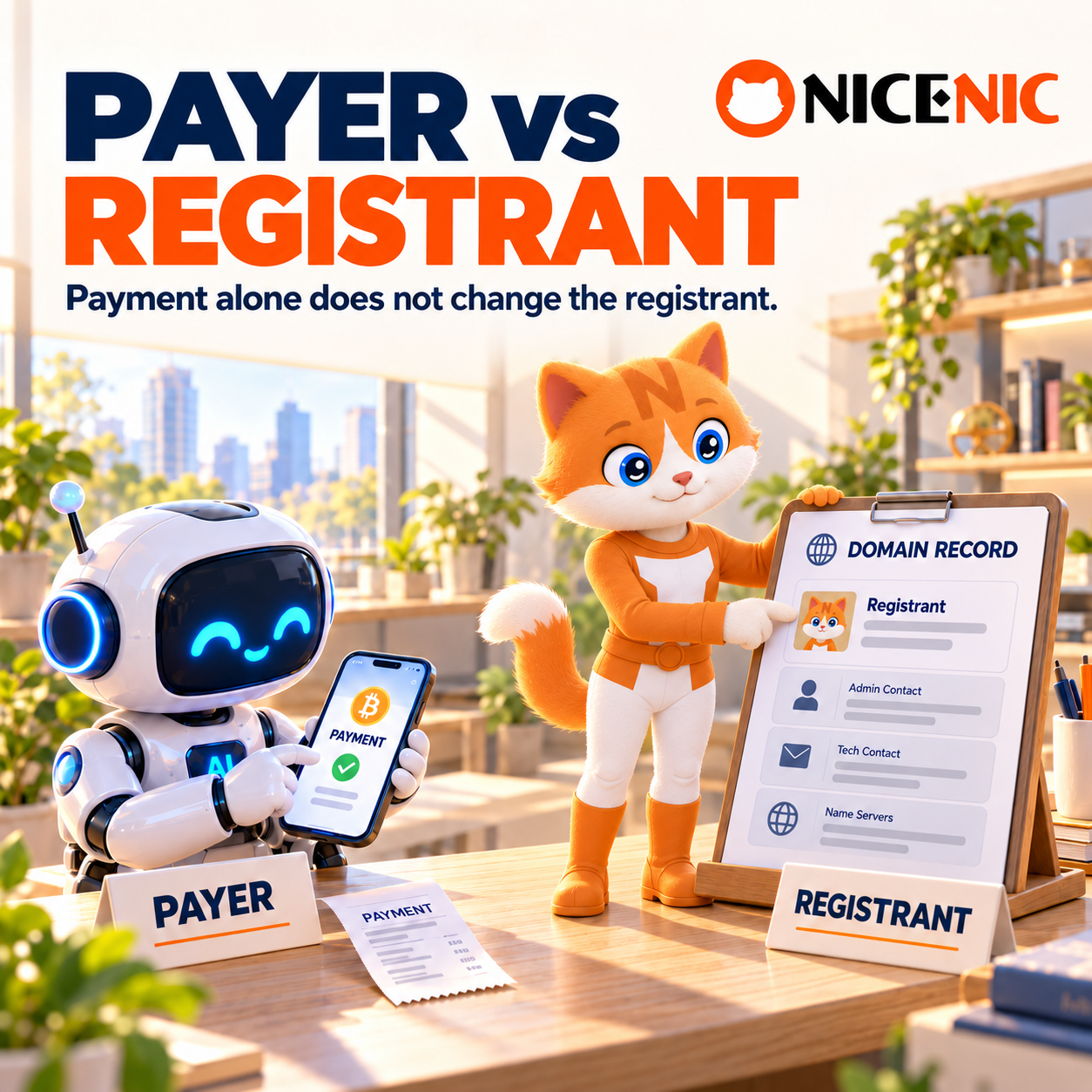
Someone else may pay for your domain where the registrar and payment provider permit the arrangement. Making that payment does not automatically make the payer the domain’s registrant or give them access to your registrar account.
This distinction matters when a company finance team funds a purchase, an agency registers a client’s domain, or a co-founder pays from a personal wallet. The payment source, the account receiving the funds, and the person or organization holding the registration rights can be different.
At NiceNIC, crypto payments fund an account balance that can then be used for eligible domain orders. Before arranging payment from someone else's wallet or exchange account, confirm that the selected route permits it and follow any applicable verification requirements. Start with NiceNIC Payment Options.
Payer, Account Holder, and Registrant: Three Different Roles
A payment receipt, an account login, and a domain registration record answer different questions.
The ICANN Registrar Accreditation Agreement expressly recognizes that the Registered Name Holder and account holder may differ. It also requires registration agreements and accurate registrant information for the gTLD registrations it governs. Country-code domains follow their applicable registry rules.
For example, a design agency may manage a client’s domain in its reseller account while the client is recorded as the registrant. The agency’s operational access and the client’s registration rights need to be addressed separately in their service arrangement.
Possession of a password does not establish lawful account ownership. Likewise, a registration record should not be presented as automatically resolving every contractual or legal ownership dispute.
Does Crypto Payment Remove Identity Checks?
No. A wallet address does not remove payment verification or domain registration requirements.
The fact that a blockchain transfer does not ordinarily display the sender’s legal name is not evidence that a payment provider accepts every third-party payment or performs no identity checks.
For example, Triple-A's invoicing-tool guidance describes identity verification for that product. Requirements can depend on the service and transaction, so follow the instructions for the actual NiceNIC payment route rather than assuming that every Triple-A product works identically.
NiceNIC offers online crypto funding and a separate manual crypto route for regular resellers. The manual route includes an initial payment review and transaction matching. For the operational differences, see Crypto Payment Gateway vs Manual Crypto Payment.
NiceNIC currently adds 0% crypto processing fee, while the online provider currently charges a 1.5% service fee. Wallet, exchange, or network fees may also apply. Check the current payment screen before sending funds.
Four Common Arrangements and What to Get Right
A company finance team pays for a business domain
For a domain intended to belong to an existing company, use the company’s accurate registrant details and an account managed under company authorization. A finance employee sending the payment does not need to become the registrant merely because they operate the wallet.
Keep the payment approval, registrar account details, and renewal responsibility in company records. This makes handover easier when an employee changes roles.
An agency or developer registers a domain for a client
Agree whether the domain will be managed in the client’s own account or through the agency’s reseller account. If the client is to hold the registration rights, use the client’s authorized registrant information.
The service agreement should address renewal charges, access, and handover when the relationship ends. Paying the agency’s invoice alone does not explain who was entered as registrant or how the client will regain direct management.
A friend or co-founder pays from a personal wallet
Record whose purchase the payment is funding and whether it is a gift, reimbursement, loan, or business expense. That agreement can help prevent later disagreement, but it does not bypass the registrar’s or provider’s payment rules.
If a company has not yet been formed, do not submit an invented legal entity as registrant. Use accurate information for the actual eligible holder and handle any later change through the applicable process.
A reseller funds domains for multiple customers
A reseller can manage account funding separately from each customer’s registration details. For customer-owned registrations, keep each domain associated with the correct customer and retain the authorization for registration and ongoing management.
Customers considering this model can review the NiceNIC Reseller Program. Define your own customer billing and refund terms carefully; they do not change the terms that govern your NiceNIC account.
What to Agree Before Anyone Sends Funds
A short written record is useful when payment, account management, and registration involve different parties. Include:
- Purpose and amount: Which domain or service the payment funds, the approved budget, and who covers external payment fees.
- Account and registrant: Which NiceNIC account should receive the funds and who should be recorded as the domain holder.
- Ongoing responsibility: Who monitors registration notices, maintains contact information, and pays for renewals.
- Exceptions and handover: Who contacts support, how any permitted refund or balance adjustment will be reconciled between the parties, and how management will be handed over.
These are practical arrangements between the parties. They cannot require NiceNIC, a payment provider, or a registry to offer a refund or transfer outside its applicable terms.
Confirm the domain's availability and current registration and renewal costs using NiceNIC Domain Search and NiceNIC Domain Prices. Adding funds does not reserve a domain.
How to Coordinate an Approved Third-Party Payment
Once the payment arrangement has been confirmed as acceptable, keep payment instructions and account access separate.
1. Create the payment request in the intended NiceNIC account. Sign in and use the current account-funding workflow. For the manual route, obtain current instructions through NiceNIC’s official support channel. Do not use another customer’s payment details.
2. Match the actual payment options. Agree on the asset and, where applicable, network offered for this transaction. A payment provider’s general list of supported networks does not establish which options are available in your NiceNIC checkout.
3. Share only the information needed to pay. Use the current payment request and verify the destination, required amount, selected network, and validity period together. Do not share your password, 2FA codes, API secrets, wallet private keys, or recovery phrase. Review NiceNIC Account Security and 2FA if account access needs attention.
If the request expires, follow its current instructions before proceeding. Do not assume that an address copied from an old screenshot remains valid.
4. Check the amount the recipient will receive. An exchange may deduct a withdrawal fee from the amount sent. A short payment may reach the destination on-chain without completing the payment request in full. Triple-A's short-payment guidance also explains that refund handling depends on merchant settings.
5. Verify account credit, then complete the domain order. Save the payment reference and confirm the available balance inside NiceNIC. Submit the order with accurate registrant details and a valid contact email that the registrant or an authorized representative can reliably monitor. Check the final registration result.
Payment sent, provider confirmation, account credit, and successful registration are separate events. The NiceNIC Payment FAQ explains the checks to make when those records do not agree.
Where Do the Funds Go If Something Goes Wrong?
Having a different payer does not create an extra right to withdraw account credit or reverse a completed domain registration. Identify which transaction needs attention.
The payment has not reached the NiceNIC balance. Compare the payment request with the sender’s transaction record. An expired, short, rejected, or unmatched payment requires the applicable provider process. Confirm any permitted return instructions through official channels; do not independently choose a replacement wallet address or assume a fixed refund deadline.
The payment has been credited to NiceNIC. The published NiceNIC Billing Help states that cryptocurrency payments are non-refundable. Do not fund an account on the assumption that unused crypto-funded credit can later be withdrawn.
A domain order fails after a charge. Review the actual order status and applicable eligibility under NiceNIC Refund Guidance. An eligible order adjustment is separate from returning the original cryptocurrency. A pending order should not be treated as a confirmed failure.
For the detailed distinction, see Crypto Payment Confirmed but Domain Registration Failed.
If the records do not match, have the account holder submit a NiceNIC support ticket with the account identifier, payment route, invoice or payment reference, asset, network where applicable, amount, timestamp, and affected domain order. Include the TXID for an on-chain transfer, or the relevant service payment reference.
Do not send a second payment solely because the balance has not updated. Keep unrelated personal information and security credentials out of screenshots.
Can a Payer Claim the Domain by Showing a TXID?
Not by payment alone. A transaction hash can help locate a blockchain transaction. Because transaction hashes can be public, presenting one does not by itself verify the claimant’s identity, payment authorization, or rights to a domain.
If a client reimburses a developer who registered the domain in the developer’s own name, the reimbursement does not automatically change the registrant. A dispute may require the parties’ agreement, evidence of authorization, and the relevant contractual or legal process.
For gTLDs, the ICANN Transfer Policy governs covered registrar transfers and changes of registrant. Paying a bill is not a substitute for the required authorization.
Before a developer, employee, or agency leaves, review the account arrangement, registrant details, contact email, and handover plan. This is easier to resolve while everyone involved can still cooperate.
Put the Domain in the Right Hands From the Start
Choose the intended registrant and account arrangement before funding the purchase. Record any third-party payment authorization, use current payment instructions, and verify both the account credit and the completed domain order.
You can search for a domain at NiceNIC once those arrangements are clear. For an uncertain payment setup, contact support before transferring funds.
NiceNIC has operated since 2006. Its registrar services are provided by NICENIC INTERNATIONAL GROUP CO., LIMITED, an ICANN-accredited registrar with IANA Registrar ID 3765. Verify the entity in the IANA Registrar IDs Registry and review published company information, policies, and official contact channels at the NiceNIC Trust Center.
Primary Sources
- ICANN Registrar Accreditation Agreement - Registration agreements, registrant information, and the distinction between registrants and account holders.
- ICANN Transfer Policy - Authorization and procedures for covered domain transfers and registrant changes.
- NiceNIC Payment Options - Available funding routes, current charges, and transaction-specific payment instructions.
- NiceNIC Payment FAQ - Payment confirmation, account credit, and reconciliation.
- NiceNIC Billing Help - Published billing guidance, including the non-refundable crypto-payment policy.
- NiceNIC Refund Guidance - Product and order-status considerations for refund or account-credit reviews.
- Triple-A Invoicing Tool - Identity-verification requirements described for that specific product.
- Triple-A Short Payments - Short-payment handling and merchant-setting differences.
- IANA Registrar IDs Registry - Independent verification of the accredited registrar entity and IANA ID.


