


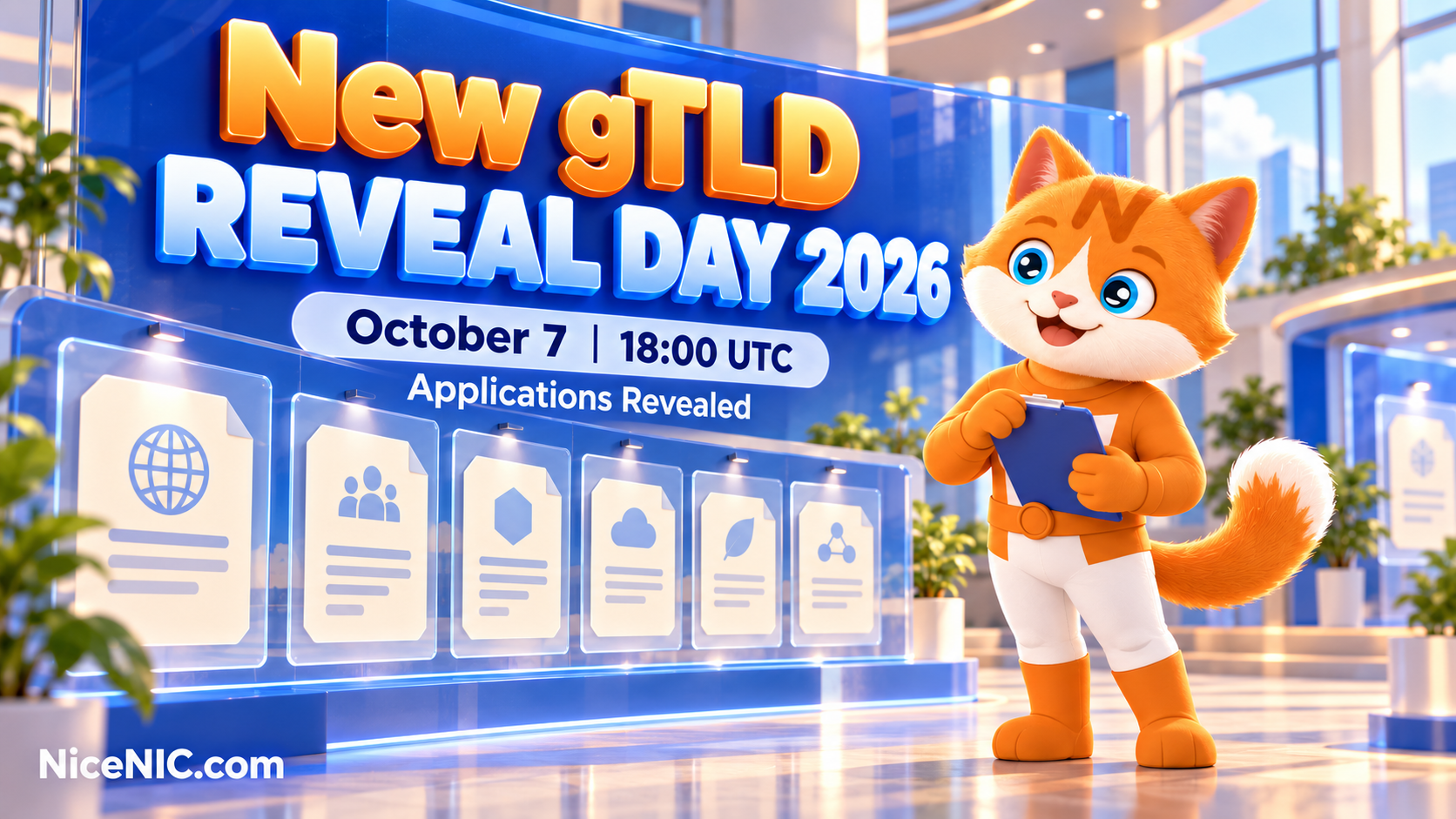
ICANN has scheduled New gTLD Reveal Day for October 7, 2026, at 18:00 UTC. For readers in Beijing, Hong Kong and Singapore, that is October 8 at 02:00 local time. The announcement gives businesses a date to begin assessing the next round of proposed domain extensions.
Reveal Day publishes applications. Retail registration depends on later evaluation, contracting, delegation and launch arrangements. For domain buyers and brand owners, the immediate opportunity is to identify relevant proposals and prepare a focused watchlist.
For projects ready to launch today, use NiceNIC Domain Search to check currently supported extensions. You can establish a working domain now while monitoring future options that fit your business.
What Will ICANN Publish on Reveal Day?
A generic top-level domain, or gTLD, is an extension such as .com or .shop. In this program, an applicant seeks to operate an extension. That is different from a customer registering an individual domain through a registrar.
ICANN confirmed on September 22 that 1,616 paid applications will proceed in the 2026 round, following 1,663 submitted applications. These figures count applications, not approved extensions or domains available for purchase.
The public release will include:
- The applying entities and public portions of their applications.
- Applied-for primary strings, together with applicable variant and replacement strings.
- Initial contention sets, identifying applications that require contention resolution.
ICANN plans to publish the records through its 2026 Round Application Publication and Statistics website. Use the official New gTLD Program website and ICANN's announcement links to locate the release when it becomes available.
For buyers, the useful questions are specific: Which proposals fit your market? Who is behind them? What registration policies are proposed? Which strings face competing applications?
Which Dates Should Buyers and Brands Track?
The following schedule comes from ICANN's September 29 milestone announcement. Dates and times below use UTC.
These are application-process milestones, with later processing and launch dates remaining separate.
String Confirmation Day confirms the strings being applied for; it does not approve them for launch.
Set calendar reminders for the initial release and String Confirmation Day. Comparing both versions will help your team avoid building plans around an application that has changed.
Can You Register Domains in These Extensions on October 7?
Publication of an application does not create a registration opportunity. ICANN's 2026 Round Applicant Journey includes string evaluation, contention resolution where applicable, applicant and application evaluation, contracting, and technical onboarding and delegation.
For a buyer, three checks matter before placing an order:
- The extension has reached the appropriate operational stage. An application listing alone is insufficient.
- The registry has published registration policies and launch details. Confirm the relevant phase and your eligibility.
- Your registrar supports that extension and phase. A registry announcement does not establish availability at every registrar.
Treat any expression-of-interest form or preorder according to its published terms. Before paying, establish what the service provides, when a request can be submitted, how competing requests are handled, and what happens if registration fails.
This article does not announce NiceNIC preorder support or registration availability for any 2026-round application.
How Should You Read the Application List?
Start with relevance and eligibility. A memorable extension has limited practical value to your project if you cannot register or use a name under its policies.
A replacement string is an alternative designated by an applicant in its application. It is not an additional extension that the same application automatically receives. ICANN limits when and under what conditions an applicant can switch, and using a replacement does not eliminate every possibility of later contention.
Also distinguish a .Brand TLD from an extension intended for broad public registration. The 2026 Applicant Guidebook provides a specific framework for .Brand eligibility and operation. Do not assume an attractive brand-related string will become a retail product anyone can buy.
Our recommendation is to maintain a short list with an owner and next review date for each entry. Record unknown prices and launch dates as “not announced” instead of filling the gaps with estimates.
What Should Brand Owners Do Next?
Brand teams have two different review tasks: assessing proposed extensions and preparing for possible registrations beneath extensions that eventually launch.
Review Applications That May Affect Your Rights
Once the official records are available, review strings relevant to your trademarks, products and markets. Preserve the application reference and the specific facts that warrant further attention.
ICANN provides application comments and formal objection mechanisms. Formal objections have defined grounds and standing requirements; an ordinary application comment is a different process. A concern about an applied-for extension should be assessed against the relevant rules, with qualified trademark advice where needed. Consult ICANN's Community Input, Objections and Appeals guidance for the applicable route.
Prepare for Future Trademark Protection Opportunities
For extensions that progress toward launch, check whether your trademark records and supporting documentation are ready for applicable rights protection services.
Under ICANN’s 2026 Trademark Clearinghouse requirements, Sunrise registration is restricted to eligible rights holders and uses valid Signed Mark Data, or SMD, files. Registry-specific eligibility and allocation policies still matter.
Recording a trademark in the Trademark Clearinghouse does not automatically register that name across new extensions. ICANN's Trademark Clearinghouse FAQs explain that allocation follows each registry's policies.
Prioritize names with a clear business or protection purpose. Preparing a shortlist, evidence and budget now gives your team time to respond when a relevant launch is confirmed.
What Should Domain Buyers Budget For?
Build a budget around the exact domain and registration phase once prices are published. A headline extension price may not answer every question about the name you want.
Before committing, check:
- Registration cost: the price and minimum term for the exact name.
- Renewal cost: whether standard or premium renewal pricing applies.
- Launch charges: any separate application or early-access charge, if offered.
- Allocation terms: how the provider handles multiple requests for the same name.
- Refund conditions: what happens to each payment if the request is unsuccessful.
- Operational fit: whether your website, email and customer-facing tools handle the chosen domain correctly.
For domains already supported by NiceNIC, consult the Domain Price List and the specific search or checkout result. Those current listings should not be treated as quotations for extensions still going through the application process.
Questions Before You Plan a Purchase
Does 1,616 Applications Mean 1,616 New Extensions Will Launch?
No. It is the number of paid applications proceeding in the round. Contention, withdrawals and evaluation outcomes can affect what eventually progresses to delegation and launch.
Should I Move My Existing Website Because of Reveal Day?
Our recommendation is to keep your current website plan unless a future extension offers a clear benefit. Evaluate customer recognition, operational compatibility, migration work and ongoing costs before deciding to move.
Does a Trademark Give Me an Automatic Right to a Matching Domain?
TMCH validation does not guarantee allocation. Review the relevant rights protection service, matching rules, registry eligibility requirements and allocation policy before applying.
Can I Use NiceNIC Bulk Search to Reserve Newly Revealed Strings?
Use NiceNIC Bulk Domain Search to check domains in currently supported extensions. An application appearing in ICANN's publication does not establish NiceNIC support, a reservation service or a successful registration.
Find the Domain That Fits Your Project
Use Reveal Day to identify future possibilities while keeping today’s domain decisions tied to your project requirements.
- Launching a website: use NiceNIC Domain Search to find a suitable name in a currently supported extension.
- Comparing several names: use Bulk Domain Search to review your shortlist.
- Planning a long-term budget: check the Domain Price List for current registration and renewal information.
- Managing domains through your own systems: explore the NiceNIC Domain API and test the operations your workflow requires.
- Consolidating an existing portfolio: review Domain Transfer options and the rules applicable to each domain.
- Checking your registrar: visit the NiceNIC Trust Center for accreditation verification, published policies and official contact channels.
For a future extension, confirm its launch phase, eligibility, exact-name pricing and registrar support before ordering. For a project ready now, begin with an availability search and choose a domain you can confidently use and maintain.
Primary Sources
- ICANN: Reveal Day and Other 2026 Round Milestones — September 29, 2026
- ICANN: Applications Proceeding in the 2026 Round — September 22, 2026
- ICANN: Pre-Evaluation and Application Publication
- ICANN: 2026 Round Applicant Journey
- ICANN: Replacement Strings and the Replacement Period
- ICANN: Community Input, Objections and Appeals
- ICANN: 2026 Round Applicant Guidebook
- ICANN: Trademark Clearinghouse Requirements — March 12, 2026
- ICANN: Trademark Clearinghouse FAQs
Information checked on October 5, 2026. Future milestones, registry policies and registrar availability should be rechecked before making a purchasing decision.


