


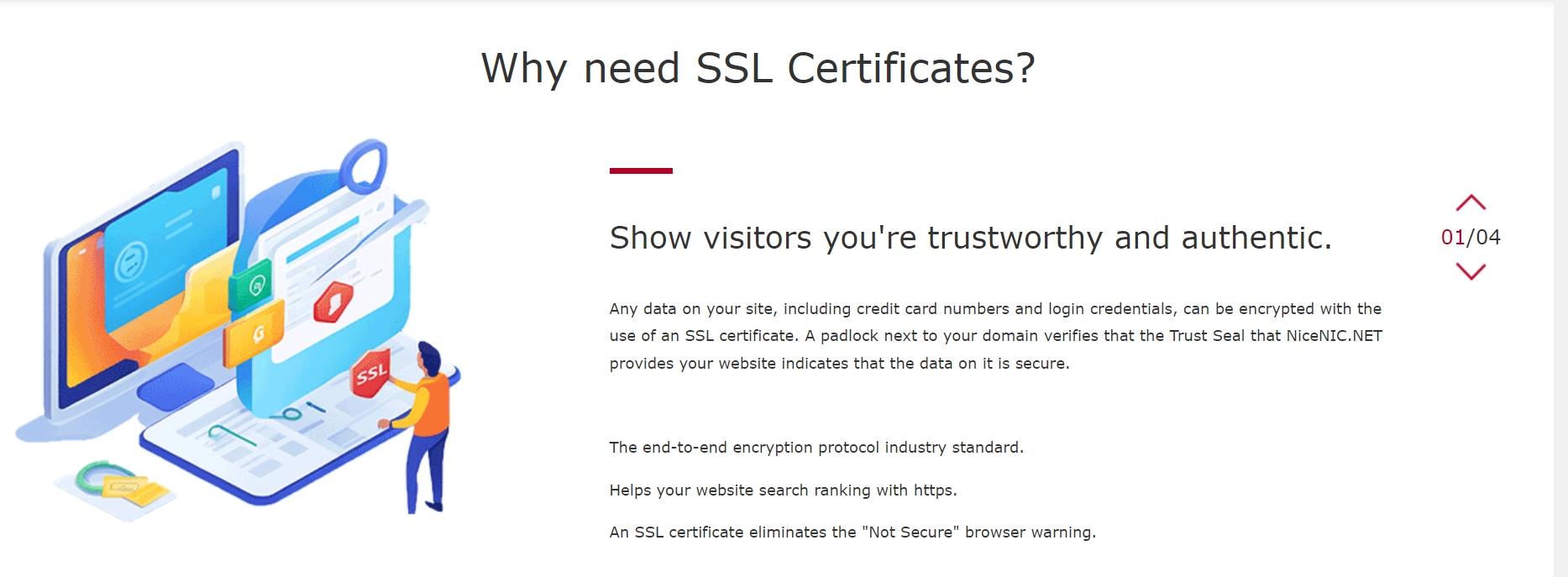
An SSL certificate helps protect the connection between a website and its visitors. When SSL is installed correctly, a website can use HTTPS instead of HTTP. This means information sent between the visitor’s browser and the website server is encrypted during transmission.
For website owners, SSL is not only a technical setting. It affects user trust, checkout confidence, login security, browser warnings, and how professional the website appears.
Need to secure your website? View SSL options and Buy SSL Certificates with NiceNIC.
What Is an SSL Certificate?
An SSL certificate is a digital certificate used to help secure a website connection.
It connects a domain name with a public key and allows browsers to create an encrypted connection with the website server. Today, people often say "SSL certificate," but the modern security protocol used by websites is usually TLS.
In simple terms, an SSL certificate helps your website:
- Enable HTTPS
- Encrypt data in transit
- Confirm that visitors are connecting to the correct website
- Reduce browser "Not Secure" warnings
- Build more trust with users
If a website asks users to submit information, log in, complete a payment, send a form, or access private content, SSL is essential.
What Is HTTPS?
HTTPS means Hypertext Transfer Protocol Secure. It is the secure version of HTTP. When a website uses HTTPS, the data exchanged between the browser and server is encrypted.
Without HTTPS, information may be easier to intercept, modify, or expose during transmission. With HTTPS, visitors get a safer connection and browsers can show a more trustworthy security status. That is why most modern websites should use HTTPS by default.
How do SSL certificates work?
An SSL certificate works by using encryption and identity validation.
The process is simplified below:
- A visitor opens your website.
- The browser requests a secure connection.
- Your server sends its SSL certificate.
- The browser checks whether the certificate is valid and trusted.
- If everything is correct, the browser and server create an encrypted HTTPS connection.
The SSL certificate contains information such as:
- The domain name covered by the certificate
- The certificate authority that issued it
- The certificate’s validity period
- The public key
- The digital signature of the issuing certificate authority
Why do websites need SSL certificates?
Websites need SSL certificates because online trust depends on secure connections.
1. Protect User Data
SSL/TLS helps protect information sent through your website, including:
- Login details
- Contact forms
- Payment information
- Account data
- Personal information
- Customer messages
2. Enable HTTPS
A website cannot properly use HTTPS without a valid SSL certificate.
HTTPS is now expected by users, browsers, search engines, and many online platforms. If your website still loads over HTTP, it may look outdated or unsafe.
3. Avoid "Not Secure" Browser Warnings
Modern browsers warn users when a website connection is not secure.
If visitors see a "Not Secure" warning, they may leave before reading your content, creating an account, submitting a form, or completing checkout.
4. Build Trust with Visitors
A secure HTTPS connection gives visitors more confidence that your website is managed responsibly.
SSL does not prove that every business is trustworthy, but it does show that the website owner has taken a basic security step to protect communication between the browser and the server.
5. Support Checkout, Login, and Forms
If your website includes checkout pages, user accounts, admin login, customer portals, booking forms, or contact forms, SSL is no longer optional. Users are less likely to submit sensitive information on a website that does not use HTTPS.
6. Support SEO Best Practices
HTTPS is a lightweight ranking signal, but it is not an SEO shortcut.
Search performance still depends on helpful content, technical structure, website speed, backlinks, user experience, and search intent. SSL should be viewed as a required trust and security layer, not a standalone ranking strategy.
Which Websites Need SSL Immediately?
Almost every public website should use SSL today, but some websites should treat SSL as urgent. If users need to trust your site before submitting information or completing an action, HTTPS should be active from the beginning.
Your website should have SSL before launch if it includes:
- Contact forms: inquiry forms, quote requests, booking forms, or support forms.
- Login pages: member areas, customer portals, dashboards, or admin access.
- Ecommerce pages: product checkout, payment pages, order forms, or customer accounts.
- Business websites: company websites that need to look credible to customers and partners.
- SaaS or application pages: signup pages, app dashboards, user settings, or subscription areas.
- Subdomains: shop, app, mail, portal, support, or client subdomains under the same domain.
Choose SSL based on how your website is used.
Choose an SSL Certificate | Protect Subdomains With Wildcard SSL | Secure Multiple Domains
How to Buy and Set Up SSL with NiceNIC
Buying an SSL certificate is only the first step. It must also be activated, validated, installed, and renewed properly.
The basic process is:
- Choose the SSL certificate type that fits your website.
- Buy the SSL certificate from NiceNIC.
- Activate the certificate in your account.
- Submit or generate the required CSR if needed.
- Complete domain or organization validation.
- Install the issued certificate on your server.
- Redirect HTTP traffic to HTTPS.
- Test your website for mixed content and certificate errors.
- Renew or reissue the certificate when needed.
For more specific process, our SSL activation and installation support. If you are unsure which SSL certificate fits your website, you can compare SSL types on the NiceNIC SSL page or contact support before purchase.
Secure Your Website With NiceNIC SSL
SSL is now a basic requirement for modern websites. It helps protect browser connections, enable HTTPS, reduce "Not Secure" warnings, support checkout and login security, and build visitor confidence.
NiceNIC helps website owners, businesses, developers, agencies, and online stores prepare a stronger website foundation with domain registration, SSL certificates, DNS management, Business Email, Cloud Server, and Dedicated Server services.
If your website collects forms, logins, payments, customer data, or business inquiries, choose the right SSL certificate before visitors see security warnings.
Start securing your website today.
Compare SSL Certificates | Buy DV SSL | Register a Domain | View Cloud Servers
Start Securing Your Website
SSL is now a basic requirement for modern websites.
It helps protect visitors, enable HTTPS, reduce browser warnings, support checkout and login security, and build trust with users.
Use NiceNIC to compare SSL certificate options, choose the right type, and secure your website before visitors see security warnings.
FAQ
Is SSL the same as TLS?
People often still say SSL, but most modern website security uses TLS. In everyday website management, “SSL certificate” usually refers to the certificate used to enable HTTPS.
Why does my website need SSL?
Your website needs SSL to protect user data, enable HTTPS, avoid browser “Not Secure” warnings, and build trust with visitors.
Does every website need an SSL certificate?
Yes, almost every public website should use SSL. This includes business websites, blogs, landing pages, online stores, login pages, contact forms, and customer portals.
Does SSL help SEO?
HTTPS is a lightweight ranking signal, but SSL alone does not guarantee better rankings. SEO still depends on content quality, website performance, technical structure, backlinks, and user experience.
NiceNIC is an ICANN Accredited Domain Registrar since 2006, helping customers register, renew, transfer, and manage domains with practical support and reliable account tools.
• 2,500+ domain extensions in one account
• Crypto payment support: USDT, BTC, ETH, and LTC
• 24/7 real human support, with replies within 6 hours
• Fair abuse review based on evidence, policies, and registry requirements
• 47+ website languages and reseller API tools for global users, agencies, and domain resellers
Kupte a zaregistrujte svou doménu .COM ještě dnes
Zkontrolujte dostupnost domény .COM, zaregistrujte novou doménu .COM, hromadně vyhledejte několik jmen nebo přesuňte své stávající domény .COM do NiceNIC. Vytvořeno pro firmy, investory do domén, agentury, poskytovatele hostingu a prodejce.
Další novinky: What Is An SSL Certificate | How Does an SSL Certificate Work?


