


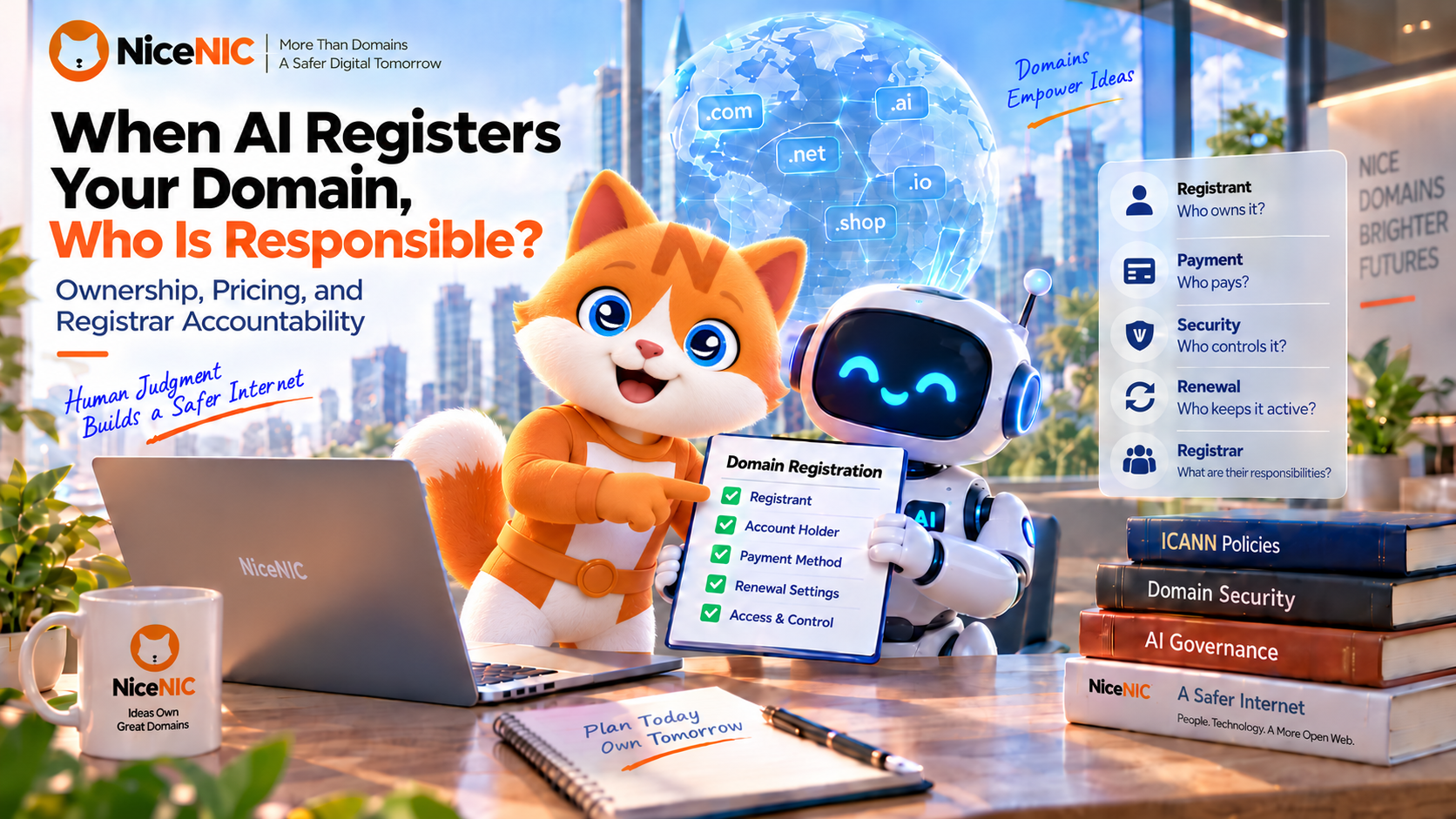
When an AI agent registers a domain, responsibility does not automatically pass to the software. For a generic top-level domain (gTLD), the Registered Name Holder has the registration rights and obligations set out in the applicable agreement and policies. The person paying for or managing the domain may be someone else. The sponsoring registrar remains responsible for its own registrar obligations, including when services are provided through a reseller. An AI platform or agency may have additional responsibilities under its agreement with the customer and applicable law.
Before allowing an agent to buy a domain, answer four questions: Who will be recorded as the registrant? Who controls the registrar account? Who approves the purchase and future renewals? And can the customer still manage the domain if the AI platform disappears? Those answers matter more than which program submits the registration request.
For a practical starting point, NiceNIC's Trust Center identifies the accredited registrar entity and links to domain policies and support channels. The underlying distinction between registrants and account holders comes from the ICANN Registrar Accreditation Agreement, not from an AI product's marketing claims.
The Person Who Pays May Not Be the Registered Name Holder
An AI agent may find a name, fill in contact information and submit an authorized order. None of those actions establishes that the AI itself holds the domain’s registration rights.
For gTLD registrations, ICANN uses two terms that are easy to confuse:
- Registered Name Holder (registrant): The person or organization holding the domain registration under the applicable agreement. This party has corresponding rights and responsibilities, including maintaining accurate registration information.
- Account Holder: Under the ICANN Registrar Accreditation Agreement, a different person or organization that pays for the domain or controls its management without being the Registered Name Holder.
The ICANN Registrants' Benefits and Responsibilities explain important registrant rights, including access to the registration agreement, registrar identity, pricing and instructions for managing and transferring a domain.
This is about contractual registration rights, not an unconditional property title that overrides trademarks, dispute procedures or local law. Privacy or proxy arrangements may also affect what appears in public registration data. Since January 28, 2025, RDAP has been the definitive service for obtaining gTLD registration information, replacing the former general WHOIS requirement. Public results may redact personal details, so a public lookup alone might not establish the complete registrant record. See ICANN's RDAP announcement.
Country-code domains may follow different registry rules. An AI workflow should not assume that every ccTLD applies exactly the same registration, verification or transfer policies as a gTLD.
Three AI Domain Setups That Look Similar but Create Different Risks
Imagine a website builder offering the same button in all three cases: “Let AI choose and register my domain.” The customer experience looks identical, but the underlying arrangements can be very different.
These are illustrative arrangements, not claims about every AI website builder. An agency can manage domains responsibly as a reseller, and an accredited registrar may offer services through resellers. The issue is whether the customer knows which party holds each right and operational capability.
Under Section 3.12 of the ICANN Registrar Accreditation Agreement, the sponsoring registrar retains applicable compliance obligations for registrar services provided through its resellers. A reseller is not automatically an unsafe or illegitimate choice; it should identify the sponsoring registrar and explain how customers obtain the required registration and support services.
A client paying an agency’s invoice should not assume the invoice alone proves that the client is the Registered Name Holder. Likewise, an agency’s access to an account does not by itself make the agency the registrant. Check the registration records and the actual contracts, rather than relying on the appearance of a dashboard.
When an Agent Gets Something Wrong, Responsibility Depends on What Happened
There is no universal rule that a human customer must absorb 100% of every loss caused by an AI-assisted domain order. The outcome depends on the registration agreement, any agency or platform contract, the nature of the incident and applicable law. Different failures involve different parties.
The agent buys a name outside the approved budget. The customer and platform need to examine the authorization the agent received and the controls placed on the purchase. The registration may already have been completed, and a change of mind does not automatically create a right to a refund. Neither a low introductory quote nor an AI-generated price estimate should override the final order price and approval limits.
The agent registers a name that raises trademark concerns. Automation does not exempt the registration from applicable trademark law or domain-dispute policies. The facts, parties and dispute forum determine the consequences; a registrar should not be described as automatically deciding trademark ownership simply because it processed the order.
The agent changes DNS and email stops working. Identify which system actually hosts the authoritative DNS zone, who authorized the change and what records were altered. Registrar services and third-party DNS or hosting services are not interchangeable. A completed domain registration does not guarantee that the associated website or email configuration is correct.
The agent receives a webpage instruction to register a different name. External pages, messages and files can supply research material, but they should not become independent purchasing authority. An application should reject domain purchases or DNS changes that fall outside the customer’s recorded instructions, even if an AI model recommends them.
The common thread is traceability: preserve the requested domain, intended registrant, approved term, quoted price, final amount, tool response and person or policy that authorized the action. These are recommended application-level controls, not a claim that NiceNIC automatically provides an AI approval system.
The Practical Test: Can the Customer Recover Control if the AI Platform Shuts Down?
A platform shutdown does not automatically cancel an existing domain registration. But if the platform controlled the registrar login, renewal notices, nameservers and contact email, a customer may still face a serious access problem.
Check these items before relying on a platform for a business-critical domain:
- Registrant record: Is the intended business or individual recorded correctly under the relevant registration agreement? Keep a copy of the order confirmation and registration agreement.
- Sponsoring registrar: Can the customer identify and contact the actual registrar, whether the order was placed directly or through a reseller? For gTLDs, ICANN Lookup can help identify registration details, though contact fields may be redacted.
- Independent contact channel: Are the registrant and recovery email addresses accessible outside the AI platform? A shutdown is much harder to resolve if verification emails can only reach a mailbox operated by that platform.
- Renewal funding: Who monitors the expiry date, enables any auto-renewal setting and keeps the necessary payment method or account credit available?
- Exit process: How does the customer request a change of account control, registrant details or registrar transfer? What evidence and security checks may be required?
- DNS continuity: Are nameserver and DNS settings recorded so the customer can restore the website and email if the platform's DNS or hosting service disappears?
Optional renewal funding: For eligible renewals, organizations can maintain NiceNIC account credit funded with supported stablecoins such as USDT, USDC, or PYUSD, reducing dependence on a new card or bank authorization for each renewal. NiceNIC adds 0% crypto processing fee; its online payment provider currently charges 1.5%, and wallet or network fees may apply. Pre-funding alone does not enable auto-renewal or guarantee completion. Check the renewal settings, sufficient credit, and domain status. See NiceNIC Payment Options.
A registrar transfer may be subject to the ICANN Transfer Policy, domain status, authorized contact procedures and any applicable registry restrictions. Do not assume a transfer is possible at any moment or that every extension uses an EPP authorization code in the same way.
For a domain managed at NiceNIC, the published transfer-out guide explains a control-panel Auth Code request, 2FA verification and delivery to the registrant email address. It also explains that some registration channels require a support ticket rather than direct code retrieval. That is more useful to an exit plan than an unsupported promise of instant API-based transfer codes.
What a Responsible AI Purchase Authorization Should Contain
The safest approach is not to ban automation. It is to distinguish an agent’s ability to recommend an action from its authority to execute a paid or potentially disruptive one.
A team can use an approval record like this before granting a live registration request:
These are recommended controls for the integrating application or organization. Their precise implementation depends on its identity system, billing arrangement and registrar interface; an API connection alone does not enforce them.
In particular, a timeout must not trigger unlimited repeat purchase attempts. Before retrying, check whether an order exists or is still being processed. A pending response is not proof of success, but neither is it necessarily proof of failure.
For the implementation details of connecting an agent, consult the separate NiceNIC guide Domain APIs for AI Agents: Registration, DNS, MCP and Spending Controls. This article addresses the allocation of responsibility and recoverability, not a second API integration tutorial.
What NiceNIC Can Verify and What the Customer Must Decide
NiceNIC registrar services are provided by NICENIC INTERNATIONAL GROUP CO., LIMITED, an ICANN-accredited registrar with IANA Registrar ID 3765. Its status can be checked through the NiceNIC Trust Center and the independent ICANN Accredited Registrar Directory.
NiceNIC publishes domain registration and renewal prices, which customers and applications should check for the relevant extension and account pricing level. A first-year promotion, a standard renewal and any Premium or restoration charge are different costs; an agent should not base a multi-year commitment on the first-year quote alone.
The NiceNIC Domain API is documented for Market and Reseller accounts, with access and reseller pricing treated as separate matters. Its documentation covers availability, pricing, supported domain operations and account information. For documented operations, applications must inspect the response: code: 0 indicates success for applicable completed responses, while a registration response with code: 201 can mean that the order is pending further processing. Neither a submitted request nor a balance deduction alone establishes a completed registration.
Those capabilities support accountable automation, but they do not replace the customer’s decision about registrant identity, financial authorization, agency contracts or how to recover access if a third-party platform closes. NiceNIC’s registrar duties, the customer’s registration obligations and an AI provider’s own commitments remain distinct.
Before a production deployment, verify the intended registrant and sponsoring registrar, compare the actual lifecycle costs, establish an independent recovery contact, and test read-only API operations before granting purchase access. That gives both the customer and the agent a clearer answer to the question that matters after registration: who can still manage this domain, and under what authority?
Primary Sources
- ICANN Registrar Accreditation Agreement and Related Materials - Definitions of account and registration roles, registrar obligations and applicable agreement materials.
- ICANN Registrants' Benefits and Responsibilities - Registrant rights, contractual obligations and access to registration procedures.
- ICANN RDAP Transition - gTLD registration-data access framework.
- ICANN Transfer Policy - Transfer authorization, restrictions and registered-holder changes.
- NiceNIC Trust Center - Registrar entity, IANA identifier, policies and support channels.
- NiceNIC Domain API Documentation - Available account types, pricing and registration response handling.
- NiceNIC Domain Transfer-Out Guide - Account verification, transfer code delivery and special handling channels.


