


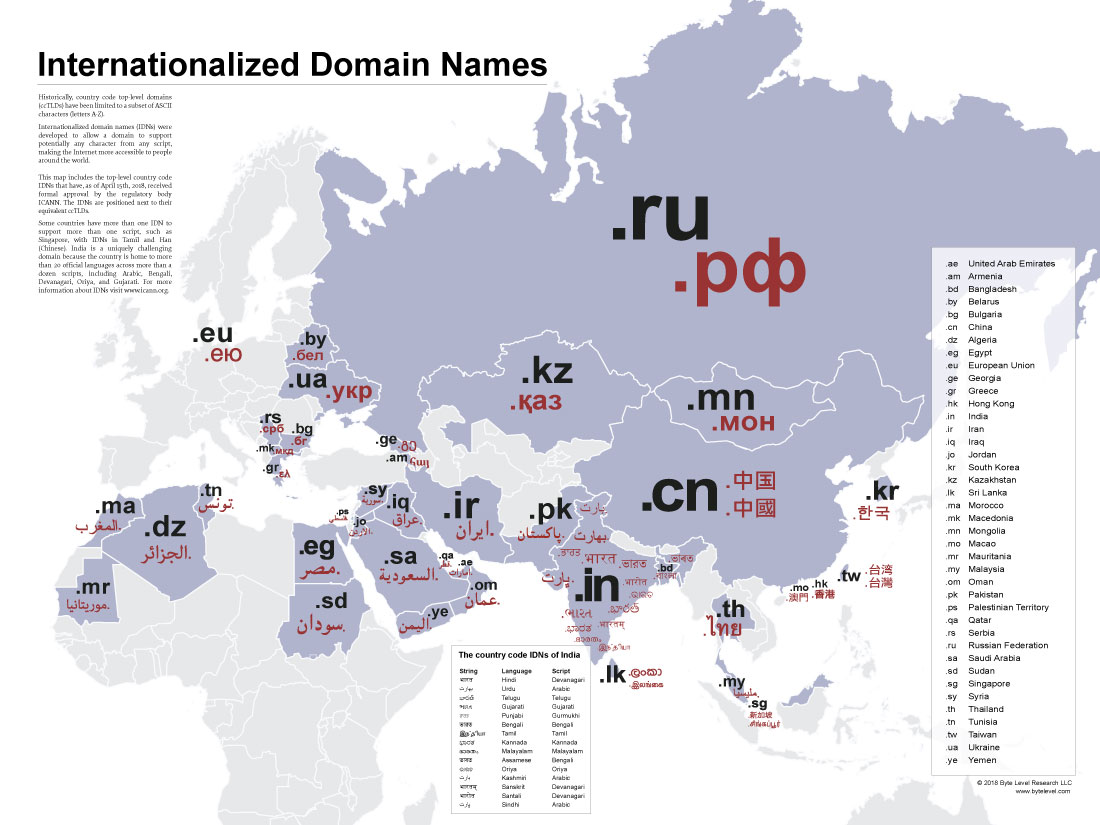
Internationalized Domain Names (IDNs) allow people to use domain names containing characters from languages and scripts such as Chinese, Arabic, Cyrillic, Hindi, and accented Latin alphabets.
For businesses serving local-language audiences, these names can offer a more recognizable web address. If you're considering one, you can explore IDN registration options at NiceNIC, then confirm whether your chosen extension supports the exact characters you want.
But successful registration is only part of the decision. Browser display, email compatibility, online forms, and the applications your customers use can all affect whether an IDN works in practice.
So are IDNs actually shrinking, and what should businesses check before using one?
What Did ICANN's Original IDN Statistics Show?
The original report described a decline in internationalized domain registrations during an earlier period of the market.
According to ICANN’s historical figures:
- December 2022: Approximately 1.52 million second-level IDN registrations existed under gTLDs.
- March 2024: The corresponding gTLD registration total was approximately 1.467 million.
- March 2025: That figure fell to approximately 1.396 million, representing a 4.84% decline from March 2024.
Chinese-script registrations represented approximately 49% of the measured gTLD IDN registrations in March 2025, followed by Latin-script registrations at 28%.
These figures come from ICANN's 2025 IDN Annual Report.
They show that a measurable decline occurred within the specific gTLD segment during those periods.
However, they do not tell the entire story of internationalized domain adoption.
What Do the Latest 2026 IDN Figures Tell Us?
ICANN published its latest IDN and Universal Acceptance report in September 2026.
As of June 2026, ICANN reported:
- 151 delegated IDN top-level domains.
- 37 languages represented.
- 23 writing systems represented.
- Approximately 4.3 million registered second-level IDNs in its broader market overview.
These figures demonstrate the continuing presence of internationalized domains throughout the global Domain Name System.
But there’s an important statistical distinction.
The 1.52 million figure from 2022 covered second-level registrations under gTLDs. The broader 2026 figure should not be treated as a directly comparable continuation of that same dataset.
Country-code domains and different reporting methodologies can change the population being measured.
Therefore, comparing those two numbers alone cannot establish that registrations have suddenly tripled, or that earlier declines have been completely reversed.
The better conclusion is that IDNs remain a significant part of the domain ecosystem, while the rate of adoption and technical readiness require separate examination.
See ICANN's September 2026 IDN and Universal Acceptance announcement.
What Is an IDN, and Why Does Punycode Matter?
Traditional domain names commonly use ASCII letters, digits, and hyphens.
Internationalized Domain Names extend this system so people can use supported characters from other languages and writing systems.
For example, a German-language domain might contain the word:
bücher.example
Its ASCII-compatible representation is:
xn--bcher-kva.example
These examples use the reserved .example extension for illustration and are not available for public registration.
The readable internationalized form is called a U-label.
The ASCII-compatible form is called an A-label. Internationalized labels use IDNA and Punycode encoding to produce a representation that can be used with DNS infrastructure.
The xn-- prefix identifies an encoded internationalized label.
Punycode is not a separate domain extension or an indication that a website is unsafe. It is a technical representation of an internationalized domain label.
This principle applies to supported accented Latin characters and non-Latin scripts alike.
However, being technically representable in Punycode does not mean every registry will allow the name.
Each top-level domain can have its own permitted languages, character sets, and registration rules.
Why Can a Valid IDN Still Cause Problems?
One reason IDN adoption is more complicated than registration statistics suggest is that not every application handles internationalized domains consistently.
This is the challenge known as Universal Acceptance (UA).
Universal Acceptance means that valid domain names and email addresses should be correctly accepted, validated, stored, processed, and displayed by Internet applications.
A domain can be registered successfully and still encounter problems in ordinary business workflows.
Browser Display Can Vary
Modern mainstream browsers generally support IDNs.
However, the same internationalized domain may appear in readable Unicode form in one situation and its xn-- representation in another.
Browsers may deliberately display Punycode when they detect characters that could be visually confusing.
This is partly a security measure against lookalike-domain attacks.
A Punycode display does not automatically mean the website is malicious, but it is a reason to verify the destination when dealing with sensitive information.
Email Compatibility Needs Separate Testing
An IDN may work for a website without automatically working in every email service.
There are two different cases:
An ASCII mailbox name with an internationalized domain
For example, the part before @ contains ordinary ASCII letters, while the domain contains internationalized characters.
Some systems can handle this through the domain’s ASCII-compatible representation.
A fully internationalized email address
Here, the mailbox name itself contains non-ASCII characters.
This requires appropriate Email Address Internationalization (EAI) support, including SMTPUTF8 where applicable.
Email providers, webmail interfaces, forwarding systems, spam filters, and receiving mail servers do not necessarily support every internationalized address format.
ICANN and the Universal Acceptance Steering Group provide resources for testing these capabilities.
For example, the UASG EAI Check can check whether a receiving mail server advertises support for internationalized email. That result alone does not guarantee successful end-to-end email delivery.
Online Forms May Reject Valid Domains
A valid IDN may also be rejected by:
- Website registration forms.
- Customer relationship management systems.
- Payment platforms.
- Email marketing software.
- Account recovery or verification systems.
These problems may be caused by outdated software validation rules or incomplete Unicode and IDNA handling.
They do not necessarily mean the domain itself is invalid.
For a detailed explanation of browser behavior, HTTPS, Punycode, email, SEO, and UA testing, see NiceNIC's Will an IDN Domain Work Everywhere?.
Five Checks Before Using an IDN for Your Business
If you’re considering an internationalized domain, use the following checks before making it your primary business address.
1. Confirm That the Extension Supports Your Language
Not every TLD accepts the same scripts or characters.
A name that works under one extension may be rejected under another.
Check the registry’s supported IDN tables, spelling requirements, reserved names, and any rules governing script mixing or character variants.
For Chinese-language domains, this may also involve simplified and traditional character variants.
Availability and variant-handling rules must be confirmed for the specific extension.
2. Verify Both the Unicode and Punycode Forms
Record the human-readable spelling and its exact ASCII-compatible representation.
This helps your technical team identify the domain correctly in DNS tools, logs, control panels, and software integrations.
Do not assume that two visually similar spellings represent the same registered domain.
3. Test Website Access and HTTPS
After obtaining the domain and configuring a test website, check it using the browsers and devices your customers actually use.
Confirm that:
- DNS resolves to the intended destination.
- The browser opens the correct website.
- HTTPS works without certificate warnings.
- The address displays as expected.
- Redirects work correctly.
Your hosting provider and certificate authority must support the domain’s required technical format.
4. Test Email and Business Applications
Before relying on an IDN for company email, confirm support with your actual email provider.
Test sending, receiving, forwarding, and account verification.
Also check important customer-facing systems such as your CRM, payment platform, website forms, and support desk.
An IDN that works in a browser but fails in a payment or account recovery system may not be suitable as your only business address.
5. Compare Costs and Prepare a Fallback
Registration and renewal prices depend on the chosen extension and the specific name.
Some names may be premium-priced, while certain character variants may have separate registration or allocation conditions.
Check the registration and renewal terms before purchasing.
If your business depends on customers or partners using older software, consider whether maintaining a familiar ASCII domain or email address would provide a useful compatibility fallback.
That doesn’t mean you must abandon your internationalized name. Both addresses can serve different purposes when configured carefully.
Do IDNs Help With SEO or Local Branding?
An IDN may be easier for customers to recognize when its spelling matches their language and the name they already associate with your business.
For example, a local business whose customers primarily read Chinese may find a suitable Chinese-language domain more natural to communicate than a romanized name.
But an IDN does not automatically rank higher in Google because it contains local-language characters.
Google supports internationalized domain names and localized words in URLs.
Search performance still depends on factors such as relevant content, technical accessibility, useful information, and appropriate localization.
Businesses operating multilingual websites should also consider correct language-specific URLs and hreflang implementation where applicable.
Google explains these considerations in its guidance on multilingual and multi-regional websites.
The business advantage of an IDN is therefore primarily about language accessibility and brand recognition—not guaranteed search rankings.
When Is an IDN Worth Registering?
An IDN can be a useful choice when a local-language name is central to how customers recognize and remember your brand.
It may be especially relevant for local businesses, publishers, community organizations, and services whose audiences naturally use Chinese, Arabic, Cyrillic, or other supported scripts.
However, a business relying heavily on international software platforms, global email systems, or older enterprise applications should test compatibility before depending exclusively on an IDN.
You may find that a local-language domain works well as a public-facing website while an ASCII address remains useful for certain technical or business operations.
There is no universal answer.
The right choice depends on your audience, supported scripts, compatibility requirements, and long-term management costs.
The Bigger Picture: IDN Adoption Is About More Than Registration Counts
The decline reported in the original 2023 article was a valid subject of discussion for the historical data being examined.
But IDN adoption cannot be fully evaluated through registration totals alone.
It also matters whether an internationalized domain can function reliably throughout the services people actually use.
A multilingual Internet requires more than names registered in different scripts. It requires compatible browsers, email providers, websites, software applications, and business systems.
For domain buyers, the most useful question is not simply whether IDNs are growing or shrinking. It is whether a particular internationalized domain will work for their intended audience and business requirements.
If you're considering a local-language domain, review NiceNIC's IDN registration options, check the specific extension's language rules, and verify compatibility before depending on it for a critical website or email service.
A domain in your customers’ own language can be valuable—but usability and reliability should come first.


