


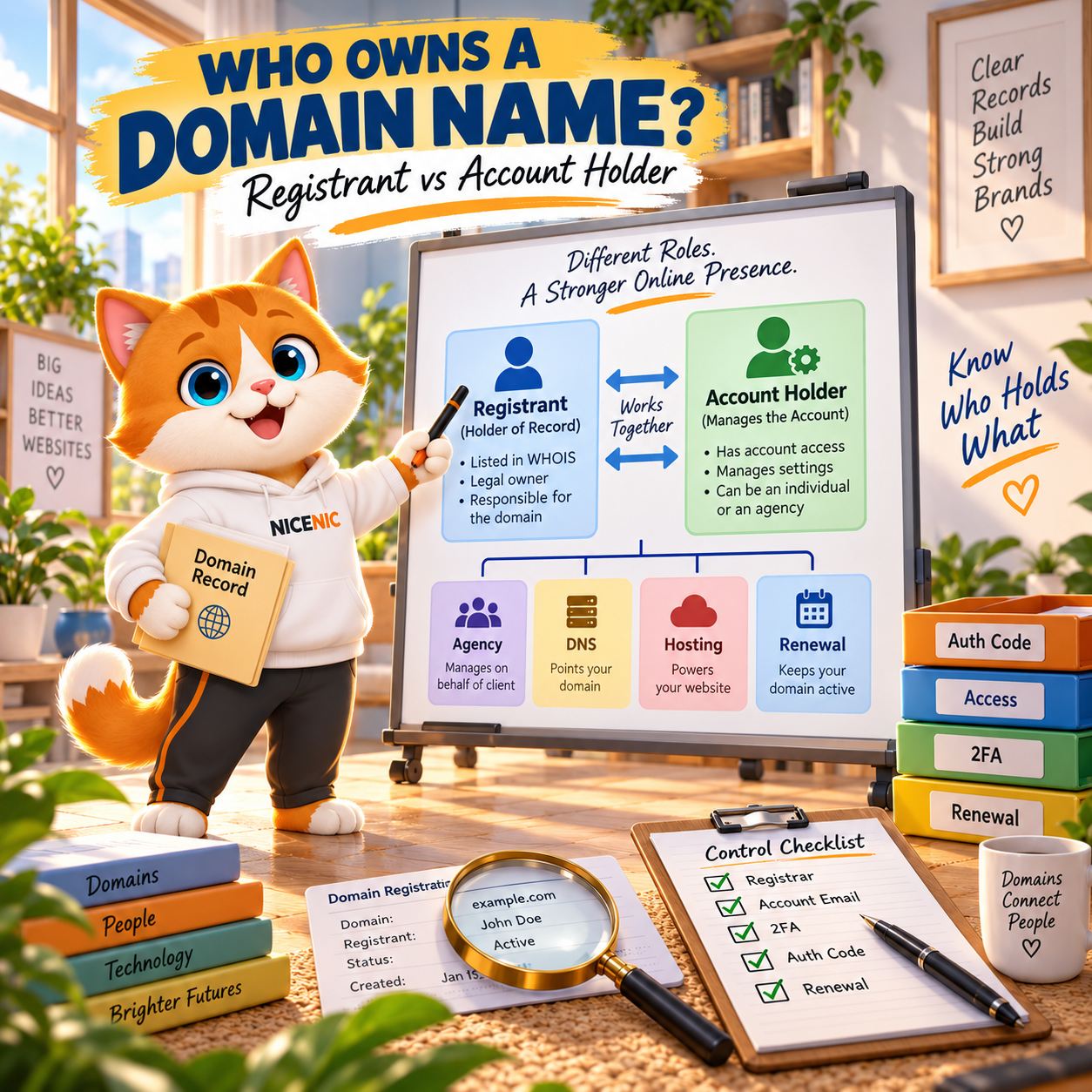
ICANN describes the registrant as the individual or entity that registers the domain and enters into the registration agreement with the registrar. NiceNIC's current Domain Name Registration Service Agreement similarly defines the Registered Name Holder as the person or legal entity identified as the holder of the registered domain.
That person may be different from:
- the person who paid for the domain;
- the NiceNIC Account Holder;
- a web developer;
- a hosting company;
- an agency;
- a reseller;
- the person controlling DNS;
- the person who built the website.
If you are unsure who controls a domain, first use ICANN Lookup to identify the sponsoring registrar, then confirm the registrar-held registration and account records.
Public RDAP data may be redacted for privacy, so a public lookup does not always display the registrant’s name.
For a business-critical domain, the safest setup is:
Your business is correctly identified as the Registered Name Holder, your business controls or authorizes the registrar account, and your access, renewal, transfer and recovery rights are documented.
Quick Answer: Who Owns or Controls What?
The most common ownership mistake is confusing:
"I can manage the domain"
with:
"I am the Registered Name Holder."
They are not always the same thing.
What Does It Mean to "Own" a Domain Name?
The word ownership is convenient, but domain names work through registration agreements rather than permanent property ownership in the ordinary sense.
When a domain is registered:
- a registrant enters into an agreement with a registrar;
- the registrar submits the registration through the applicable registry system;
- the registrant receives registration rights for a defined term;
- those rights continue subject to renewal, policies, applicable law and the registration agreement.
ICANN describes the registrant as the person or entity that holds the rights to the registered domain name.
See ICANN's Domain Name Registration Process.
So in normal registrar operations, the most useful question is:
Who is the Registered Name Holder of record?
Legal disputes involving contracts, trademarks, company ownership, court orders or other rights can be more complicated and may require qualified legal advice.
What Is a Registered Name Holder?
The Registered Name Holder, or Registrant, is the person or legal entity identified as the holder of the domain registration.
ICANN uses both terms in its registrar framework.
NiceNIC’s current registration agreement defines:
Registered Name Holder / RNH: the person or legal entity identified as the holder of a registered domain name.
See NiceNIC's Domain Name Registration Service Agreement.
This is the role that matters most when questions arise about:
- registration data;
- transfer authorization;
- Change of Registrant;
- domain renewal;
- disputes;
- account moves;
- authority over material domain instructions.
What Is an Account Holder?
An Account Holder controls the registrar account through which domains or services are managed.
At NiceNIC, the current registration agreement defines the Account Holder as the person or entity controlling the Account and responsible for:
- payment;
- account-level instructions;
- account management.
But:
Account Holder and Registered Name Holder do not have to be the same person.
This is common in:
- agencies;
- hosting companies;
- reseller businesses;
- corporate IT departments;
- managed domain services.
For example:
Registered Name Holder
Example Corporation Limited
NiceNIC Account Holder
Example Web Agency
That arrangement can work if the agency is properly authorized to manage the domain for the company.
What matters is that the actual Registered Name Holder is identified accurately and that the Account Holder has authority to act.
Registered Name Holder vs Account Holder
The critical risk appears when:
the client believes it is the registrant, but the agency has actually entered itself as the Registered Name Holder.
That should be discovered before the relationship ends.
Paying for a Domain Does Not Automatically Make You the Registrant
Payment is evidence of a transaction.
It is not, by itself, the same thing as being the Registered Name Holder.
Imagine:
Person A
Pays the registrar invoice.
Company B
Is entered as the registrant.
Agency C
Controls the registrar account.
Those are three different roles.
The payment receipt may be useful evidence in a later dispute, but it does not automatically replace the actual registration agreement and Registered Name Holder information.
This distinction matters especially when:
- founders use personal cards;
- agencies pay on behalf of clients;
- employees expense registrations;
- resellers purchase domains for customers.
Does the Person Who Controls the Registrar Login Own the Domain?
Not necessarily.
Account control is extremely powerful.
Someone who controls the account may be able to:
- change nameservers;
- update DNS;
- change contacts;
- change renewal settings;
- request an Auth/EPP Code;
- start supported transfer processes.
But operational control does not automatically make that person the Registered Name Holder.
NiceNIC’s current agreement specifically states that when the Account Holder and Registered Name Holder are different, the Account Holder must accurately identify the Registered Name Holder and must not substitute its own information without authorization.
That distinction protects both customers and legitimate managed-service relationships.
Does the Web Developer Own the Domain?
No, not simply because they built the website.
Website development and domain registration are different layers.
A developer may control:
- website code;
- CMS;
- Git repository;
- hosting;
- deployment.
The domain may still be registered to:
- the business;
- the founder;
- the client;
- an agency;
- another legal entity.
For the infrastructure distinction, read Domain Registrar vs Web Hosting.
Does the Hosting Company Own the Domain?
No, not simply because the website is hosted there.
The hosting provider controls server infrastructure.
The registrar manages the domain registration.
You can have:
Changing hosting does not automatically change the Registered Name Holder.
Likewise, transferring the domain to another registrar does not automatically move the website.
Does the Person Who Controls DNS Own the Domain?
No.
DNS control can be very powerful because it determines where services point.
A DNS administrator may be able to redirect:
- website traffic;
- email;
- APIs;
- verification records.
But DNS authority is not the same as registrar-level registration rights.
This distinction is especially important during:
- agency handovers;
- Cloudflare migrations;
- hosting changes;
- security incidents.
A person can control DNS without being the registrant.
Does the Trademark Owner Automatically Own the Domain?
No.
Trademark rights and domain-registration control are separate questions.
A trademark owner may have rights that could support:
- negotiation;
- a domain dispute;
- court action;
- a UDRP complaint.
But owning a trademark does not automatically log the trademark holder into the registrar account or instantly change the Registered Name Holder.
Similarly, registering a domain does not automatically give the registrant trademark rights.
If a serious trademark dispute exists, obtain qualified legal advice.
My Agency Registered My Domain. Who Owns It?
This is one of the most important situations to check.
Suppose you hired an agency to:
- register the domain;
- build the website;
- host the site;
- manage email.
There are several possible arrangements.
Scenario 1: Your Company Is the Registered Name Holder
Example:
Registrant: Your Company Account Holder: Agency
This can be a legitimate managed-service arrangement.
The agency manages the domain with the company’s authorization.
You should still document:
- registrar;
- domain;
- registrant;
- renewal responsibility;
- account access;
- transfer procedure;
- termination procedure.
Scenario 2: The Agency Is the Registered Name Holder
Example:
Registrant: Agency Ltd Client: Your Company
This is materially different.
The agency is now the holder of record in the registrar relationship.
If that was not the intended commercial arrangement, it should be corrected through the appropriate authorized process.
Do not wait until:
- the agency relationship breaks down;
- the website needs to move;
- the agency closes;
- an employee disappears.
Scenario 3: Nobody Knows
This is the riskiest situation.
The client knows:
"We paid for the domain."
The developer knows:
"It is somewhere in our old account."
Nobody knows:
- registrar;
- Registered Name Holder;
- account email;
- renewal date;
- transfer access.
Resolve this while the website is working.
Not during an emergency.
How to Check Who Is the Registered Name Holder
Use this process.
Step 1: Identify the Registrar
Use ICANN Lookup for applicable gTLD registration data.
Look for:
- sponsoring registrar;
- domain status;
- nameservers;
- creation/expiration information.
Step 2: Do Not Assume the Public Registrant Name Will Be Visible
Modern registration data may be redacted.
Under ICANN's current Registration Data Policy, registrant fields can be redacted from public RDAP output.
So this:
Registrant Name: REDACTED
does not mean the domain has no registrant.
It means the public lookup may not show the underlying registration data.
Step 3: Check the Registrar Account
If you are authorized to manage the domain, review:
- registrant name;
- registrant organization;
- account email;
- contact details;
- renewal settings.
The registrar-held records are more useful than an old public WHOIS screenshot.
Step 4: Review the Registration Agreement and Business Records
Check:
- domain invoice;
- acquisition agreement;
- agency contract;
- company asset register;
- domain assignment;
- registrar emails;
- change-of-registrant records.
These help establish what the parties intended and what actions occurred.
WHOIS/RDAP Does Not Always Prove Domain Ownership
This point has become increasingly important.
Historically, users often searched WHOIS and expected to see:
- registrant name;
- address;
- phone;
- email.
Today, personal registration data may be redacted in public RDAP results.
Therefore:
"I can't see my name in public WHOIS/RDAP" does not automatically mean you are not the Registered Name Holder.
Use the registrar account and registrar-held registration data to verify the actual record.
For a deeper explanation, see What Is WHOIS Privacy? Domain Privacy, RDAP, Public Registration Data, and What It Does and Does Not Hide.
Privacy Service vs Proxy Service: An Important Ownership Difference
Privacy and proxy are not the same thing.
ICANN explains the distinction.
Privacy Service
The customer remains the Registered Name Holder, while alternative contact information is used in public registration data.
Proxy Service
The proxy provider becomes the Registered Name Holder of record and licenses use of the domain to the customer.
See ICANN's Privacy and Proxy Service explanation.
Therefore, when evaluating control, do not simply ask:
"Is WHOIS privacy enabled?"
Ask:
Is this a privacy service or a proxy arrangement, and who is actually the Registered Name Holder?
What Should a Business Control?
For a business-critical domain, maintain control or documented authority over these five things.
1. Registered Name Holder
The intended company or person should be recorded correctly.
2. Registrar Account
The business should either control the account or have a documented authorized-management arrangement.
3. Account Email
Use an email address that will remain accessible when staff change.
Avoid relying entirely on:
4. Two-Factor Authentication
Protect the registrar account.
NiceNIC customers can review Two-Factor Authentication.
5. Renewal and Transfer Process
Know:
- who pays;
- who receives reminders;
- who can unlock;
- who can obtain the Auth Code;
- what happens when the agency relationship ends.
Should an Agency Register a Domain in the Client's Name?
For a client-owned business domain, a clean model is usually:
Client / Client Company = Registered Name Holder
with:
Agency = Authorized Manager
when the business arrangement requires the agency to manage it.
NiceNIC’s current registration agreement supports this distinction: an Account Holder, reseller or agent acting for a Registered Name Holder must have the Registered Name Holder’s authorization.
See NiceNIC's Domain Name Registration Service Agreement.
This lets the agency provide management without creating unnecessary ambiguity about who the domain is registered for.
What Should a Reseller Do When Registering Domains for Clients?
A reseller should distinguish:
Reseller relationship
The reseller manages the transaction.
from:
Registered Name Holder
The actual customer for whom the domain is registered.
NiceNIC’s current Registration Agreement requires a reseller or agent acting for third parties to:
- obtain authorization;
- accurately identify the Registered Name Holder;
- provide applicable policies;
- obtain the Registered Name Holder's acceptance where required;
- pass relevant communications appropriately.
This is why a professional reseller workflow should collect the customer’s real registrant information instead of automatically putting every domain in the reseller company’s name.
Can a Reseller Manage a Domain Without Becoming the Registrant?
Yes, where the applicable registrar workflow and authorization allow it.
That is often the better architecture for:
- hosting companies;
- web agencies;
- SaaS platforms;
- domain resellers.
The client can remain the Registered Name Holder while the authorized reseller handles operations.
For businesses building domain services into their platform, see NiceNIC Domain API and the NiceNIC Reseller Program.
My Employee Registered the Company's Domain. Who Should Control It?
This is another common risk.
An employee may have registered the company domain using:
- personal name;
- personal email;
- personal phone;
- personal payment card.
That may work while the employee remains with the company.
It becomes dangerous when the employee:
- resigns;
- is terminated;
- loses access;
- changes email;
- becomes unavailable.
For a company-critical domain, review:
- Registered Name Holder;
- registrar account;
- recovery email;
- 2FA;
- payment;
- internal authorization.
Do not wait for the employee to leave before fixing the structure.
What If the Registrant Is a Former Employee?
First determine:
- what the registrar records show;
- who controls the account;
- what company agreements exist;
- whether the domain was registered for the business;
- whether there is an authorized Change of Registrant path.
Do not simply edit registration data without authorization.
A genuine change from one Registered Name Holder to another is a material domain action and can be subject to registrar verification and applicable transfer policy.
For gTLDs, review ICANN's Transfer Policy.
If ownership is disputed, legal advice may be necessary.
Account Push vs Change of Registrant vs Registrar Transfer
These three operations are often confused.
They solve different problems.
What Is an Account Push?
An account push moves or delegates domain management between accounts at the same registrar.
NiceNIC currently supports Domain Push & Sub-Account Management as part of its domain-management capabilities.
See NiceNIC Domain Transfer and Account Management.
An account push can change:
who controls the registrar account
without necessarily changing:
who is the Registered Name Holder.
Do not treat a push receipt alone as proof of a legal sale or assignment.
What Is a Change of Registrant?
A Change of Registrant changes the Registered Name Holder information.
Under the current ICANN Transfer Policy for applicable gTLDs, material changes to the registrant’s:
- name;
- organization;
can trigger the Change of Registrant process.
The registrar may need to obtain confirmations and apply the applicable policy requirements.
ccTLD rules can differ.
What Is an Inter-Registrar Transfer?
An inter-registrar transfer moves a domain from:
Registrar A
to:
Registrar B.
It does not, by itself, mean the Registered Name Holder changed.
A typical transfer may involve:
- eligibility check;
- transfer lock;
- Auth/EPP Code;
- authorization;
- registry processing.
NiceNIC customers can start from Transfer a Domain to NiceNIC.
If I Transfer the Domain, Do I Become the Owner?
No.
Changing the registrar does not automatically change the Registered Name Holder.
For example:
Before Transfer
Registrant: Example Company Registrar: Registrar A
After Transfer
Registrant: Example Company Registrar: NiceNIC
The registrar changed.
The registrant did not.
If I Push the Domain Into My Account, Do I Become the Registrant?
Not automatically.
An account push and a registrant change are separate concepts.
Before a high-value domain is pushed, document:
- sending account;
- receiving account;
- existing registrant;
- intended registrant;
- reason for the push;
- whether registration data should change.
This prevents an account move from being mistaken for an ownership transfer.
If I Buy a Domain, What Should I Keep as Proof?
Keep a complete transaction record.
Useful evidence includes:
- purchase agreement;
- invoice;
- escrow record;
- payment record;
- seller authorization;
- registrar transfer/push records;
- Change of Registrant record;
- confirmation emails;
- updated registrar account information.
Do not rely on one screenshot.
For a valuable transaction, use clear written terms and retain them.
How Do You Prove Control of a Domain?
There is no universal single document that settles every possible legal dispute.
But for operational registrar purposes, useful evidence can include:
No single item should automatically be treated as conclusive in every legal dispute.
My Agency Will Not Give Me the Domain. What Should I Do?
Do not begin by changing DNS randomly.
Use a structured process.
Step 1: Identify the Registrar
Use ICANN Lookup.
Step 2: Gather Your Records
Collect:
- agency contract;
- invoices;
- emails;
- domain purchase records;
- screenshots;
- business records;
- past registrar messages.
Step 3: Determine the Registered Name Holder
Ask:
Who is actually listed in the registrar-held registration data?
Public RDAP may be redacted, so the registrar may need to review the authorized account/registration records.
Step 4: Request the Correct Action in Writing
Depending on the situation, you may need:
- account access;
- account push;
- Change of Registrant;
- unlock;
- Auth/EPP Code;
- inter-registrar transfer.
Do not use the word “transfer” generically.
Specify what actually needs to happen.
Step 5: Contact the Sponsoring Registrar
If the agency or reseller is not resolving the matter, contact the sponsoring registrar through its official support channel with the relevant evidence.
The registrar may need to authenticate authority before making a material change.
Step 6: Treat a Genuine Ownership Dispute as a Legal Matter
A registrar can apply registration agreements and applicable policies.
It cannot necessarily decide every private contractual ownership dispute between:
- company;
- agency;
- founder;
- former employee;
- buyer;
- seller.
If the parties genuinely dispute legal rights, qualified legal advice may be necessary.
What If the Agency Refuses to Give Me the EPP/Auth Code?
First confirm whether:
- you are the Registered Name Holder;
- the domain is eligible for transfer;
- a transfer lock applies;
- a dispute or policy restriction exists;
- the correct authorization process has been followed.
For eligible gTLDs, the current ICANN Transfer Policy governs inter-registrar transfer requirements.
Do not assume every refusal is legitimate.
Do not assume every refusal is prohibited either.
The domain’s current status and policy matter.
If you are transferring an eligible domain into NiceNIC, use NiceNIC Domain Transfer.
What If I Have the Website Files but Not the Domain?
You control the website content.
You may not control the domain registration.
You can move:
- HTML;
- WordPress;
- database;
- images;
- hosting.
But without registrar or DNS authority, you may not be able to make the domain point to the new server.
That is why domain control should be documented independently from website ownership.
What If I Control the Domain but Not the Website?
Then you may control the registration layer but not:
- hosting files;
- CMS;
- database;
- application.
Again, these are separate assets.
A complete business handover should inventory:
- domain;
- registrar;
- DNS;
- hosting;
- email;
- SSL;
- source code;
- SaaS accounts.
What Happens When a Company Is Sold?
Domain names should be included explicitly in the transaction inventory.
Do not assume:
"The website is included"
automatically answers:
"Which domain registrations are being assigned?"
For each domain, document:
- domain name;
- current Registered Name Holder;
- registrar;
- account;
- renewal;
- intended new holder;
- required Change of Registrant;
- required registrar transfer/push;
- DNS responsibility.
High-value business sales should use appropriate legal and transaction advice.
What Happens When a Company Changes Its Legal Name?
A legal company-name change can require registration-data updates.
Do not simply create a new registrar account and forget the existing Registered Name Holder information.
Check:
- registrar records;
- registrant organization;
- applicable Change of Registrant rules;
- TLD-specific requirements.
For gTLDs, a material change can fall under the current ICANN Transfer Policy.
How to Set Up Domain Ownership Correctly From Day One
For a new business:
1. Decide the Intended Registrant
Usually:
- individual founder; or
- legal business entity.
Do this consciously.
2. Use a Controlled Registrar Account
Avoid an account tied only to a temporary freelancer.
3. Use a Durable Email Address
Make sure recovery does not depend on one employee.
4. Store the Registration Records
Keep:
- invoice;
- registrar;
- account information;
- domain list;
- renewal dates.
5. Enable Account Security
Use 2FA and strong credentials.
6. Define Agency Permissions
If an agency manages the domain, document:
- what it can change;
- who approves transfers;
- who pays renewals;
- what happens at termination.
A Business Domain Ownership Checklist
For every important domain, you should be able to answer:
- What is the exact domain?
- Which registrar sponsors it?
- Who is the Registered Name Holder?
- Who controls the registrar account?
- Who controls the account email?
- Who controls 2FA?
- Who pays renewals?
- What is the expiration date?
- Who controls nameservers?
- Who controls DNS?
- Who controls hosting?
- Who controls business email?
- Is an agency or reseller authorized?
- Is that authority documented?
- Can the business obtain the Auth Code when eligible?
- What happens if the agency relationship ends?
- Are purchase/assignment records stored?
- Is the registrant information accurate?
If you cannot answer several of these questions, fix the structure while the domain is working normally.
Common Domain Ownership Mistakes
"I paid for it, so I must be the registrant."
Not necessarily.
"It's inside my web developer's account, so the developer owns it."
Not necessarily.
Account Holder and Registered Name Holder can differ.
"I control DNS, so I own the domain."
DNS control is technical control, not automatically registration-holder status.
"My name is not visible in RDAP, so I am not the registrant."
Not necessarily.
Registration data can be redacted.
"WHOIS Privacy means the privacy company owns my domain."
Not necessarily.
Privacy and proxy services differ.
"Moving the domain into another account changes ownership."
Not automatically.
An account push and Change of Registrant are different actions.
"Transferring to another registrar changes ownership."
No.
Registrar and registrant are different roles.
"Owning the trademark automatically gives me the registrar account."
No.
Trademark rights and registration-account control are different issues.
Frequently Asked Questions
Who owns a domain name?
For registrar purposes, the Registered Name Holder or registrant is the person or legal entity identified as the holder of the domain registration under the registration agreement.
Is the registrant the legal owner?
The registrant is the holder of record and holds registration rights under the registrar agreement. Broader legal ownership disputes can involve contracts, trademark rights, court orders and applicable law.
Is the Account Holder the same as the registrant?
Not necessarily. NiceNIC’s current agreement explicitly distinguishes Account Holder from Registered Name Holder.
If I paid for the domain, am I the registrant?
Not automatically. Check the actual registration data and registration agreement.
Does my web designer own my domain?
Not simply because they designed or hosted the website. Check the Registered Name Holder.
Can an agency manage my domain without owning it?
Yes, where properly authorized. The client can remain the Registered Name Holder while the agency manages the registrar account or delegated workflow.
Can a reseller register a domain for a client?
Yes, subject to the registrar’s reseller model, authorization and applicable policies. NiceNIC requires agents/resellers acting for a Registered Name Holder to be authorized and accurately identify the holder.
How can I find my domain registrar?
Use ICANN Lookup for applicable gTLDs.
Why doesn't RDAP show my name?
Personal registration data can be redacted under applicable registration-data policy and law.
Does WHOIS privacy change who owns the domain?
A privacy service generally allows the customer to remain the registrant while alternative contact information is published. A proxy service is different and can make the proxy provider the registrant of record. Check the specific service terms.
Is DNS control proof of ownership?
No. It shows technical control over DNS.
Is a payment receipt proof of ownership?
It can support a transaction history but is not necessarily conclusive proof of Registered Name Holder status or legal ownership.
What is an account push?
An account push moves domain management between accounts at the same registrar. It does not necessarily change the Registered Name Holder.
What is a Change of Registrant?
It changes material Registered Name Holder information under the applicable registrar and policy process.
Does transferring the domain change the registrant?
An inter-registrar transfer changes the registrar. It does not automatically change the Registered Name Holder.
What should I do if my agency controls my domain?
Identify the registrar, confirm the Registered Name Holder, collect your records, document the intended arrangement and request the appropriate authorized account push, registrant change or transfer if needed.
What should I do if my agency refuses to release the domain?
Gather evidence, identify the sponsoring registrar and contact the registrar through its official support channel. If the parties genuinely dispute contractual or legal ownership, qualified legal advice may be required.
How should a company protect domain control?
Keep accurate registrant records, use a controlled registrar account/email, enable 2FA, document agency/reseller permissions, monitor renewals and keep acquisition/assignment records.
Keep Control of Your NiceNIC Domains
Review the registration terms
NiceNIC Domain Name Registration Service Agreement
Transfer an eligible domain
Protect your registrar account
Enable NiceNIC Two-Factor Authentication
Register a new domain in the correct holder's name
Search Available Domains at NiceNIC
Managing domains for clients?
Explore the NiceNIC Reseller Program
Building domain services into your platform?
Verify NiceNIC's registrar identity and policies
Visit the NiceNIC Trust Center
Need help with a NiceNIC domain?
Submit a NiceNIC Support Ticket
Primary Sources and Further Reading
- ICANN - Information for Domain Name Registrants
- ICANN - Domain Name Registration Process
- ICANN - Registrants' Benefits and Responsibilities
- ICANN - Registration Data Policy
- ICANN - Registration Data Lookup
- ICANN - Transfer Policy
- ICANN - Privacy and Proxy Service Information
- NiceNIC - Domain Name Registration Service Agreement
- NiceNIC - Domain Transfer
- NiceNIC - Trust Center
Last verified: September 7, 2026. Registrar procedures, Registration Data rules, transfer policies and TLD-specific requirements can change. This guide explains registrar-level domain control and registration roles; it is not legal advice for a disputed ownership claim.


