


By the NiceNIC Content Team
Last verified: November 26, 2026
How to Evaluate a Domain Registrar for Your Agency
Choosing a domain registrar for an agency is not simply a matter of finding the lowest registration price. When you manage domains for multiple clients, the registrar becomes part of your operational infrastructure. Its pricing, account policies, DNS compatibility, automation options, and support processes can directly affect your recurring costs and client relationships.
Direct Answer: To choose a domain registrar for your agency, evaluate seven areas: pricing transparency, client ownership and handover, DNS flexibility, API and billing integration, TLD coverage, payment management, and customer support. Compare registration and renewal costs separately, verify that clients can retain control of their domains, and test essential workflows before moving an entire portfolio. The right provider should fit your agency’s actual client agreements, technical environment, and operational requirements rather than simply offering the lowest advertised price.
This guide explains what to examine when comparing registrar platforms, identifying operational risks, and deciding whether a provider is suitable for your agency’s current and future workload.
1. Start With Your Agency's Actual Requirements
Before comparing registrars, identify how your agency manages domains today.
A web design studio managing 20 client domains may need straightforward renewals and flexible DNS settings. A hosting company managing 500 domains may require bulk operations, API integration, automated billing, and more structured financial reconciliation.
Start by documenting five things:
Also identify your most important TLDs.
An agency primarily serving US businesses may have different requirements from one managing clients across Europe and Asia. The latter may need country-code domains with additional eligibility, documentation, or local-presence requirements.
Do not evaluate a registrar’s advertised TLD count without checking whether the specific extensions you need support the registration, renewal, and transfer operations relevant to your business.
2. Compare Registrar Business Models Before Comparing Brands
Different registrar models are designed around different customer requirements.
Understanding the model helps you identify which providers deserve a closer evaluation.
These models are not mutually exclusive. Some retail registrars also offer reseller programs, APIs, or delegated access.
When comparing named providers, use their current official documentation rather than assuming that every provider in the same category offers identical features.
For example:
- GoDaddy Delegate Access provides a way to grant another person access to manage domains without sharing the account password.
- Namecheap MCP Documentation illustrates how a registrar can expose domain functions through an AI integration.
- Cloudflare Registrar Documentation explains its registrar model and associated nameserver requirements.
These examples demonstrate why agencies should compare actual workflows rather than judging providers by labels such as retail, wholesale, or reseller alone.
3. Evaluate the Seven Most Important Selection Criteria
A. Transparent registration and renewal pricing
Registration price is only one part of domain ownership cost.
For every important TLD, compare:
- First-year registration price.
- Standard annual renewal price.
- Transfer price.
- Redemption or restore charges.
- Premium-domain pricing.
- WHOIS privacy availability and conditions.
- Required local-presence or trustee fees.
- Payment-provider and other applicable charges.
Promotional prices should always be separated from standard registration and renewal prices.
For an agency with a large portfolio, a small difference in annual renewal cost can accumulate over time.
Use the following formula:
Annual Domain Cost = Registration and Renewal Charges + Required Recurring Services + Applicable Payment Fees
For a longer-term comparison:
Five-Year Cost = First-Year Cost + Four Renewals + Required Recurring Add-ons
Use current published rates and the same assumptions for every provider. If a promotional price applies only to the first year, do not extend it across the entire five-year calculation.
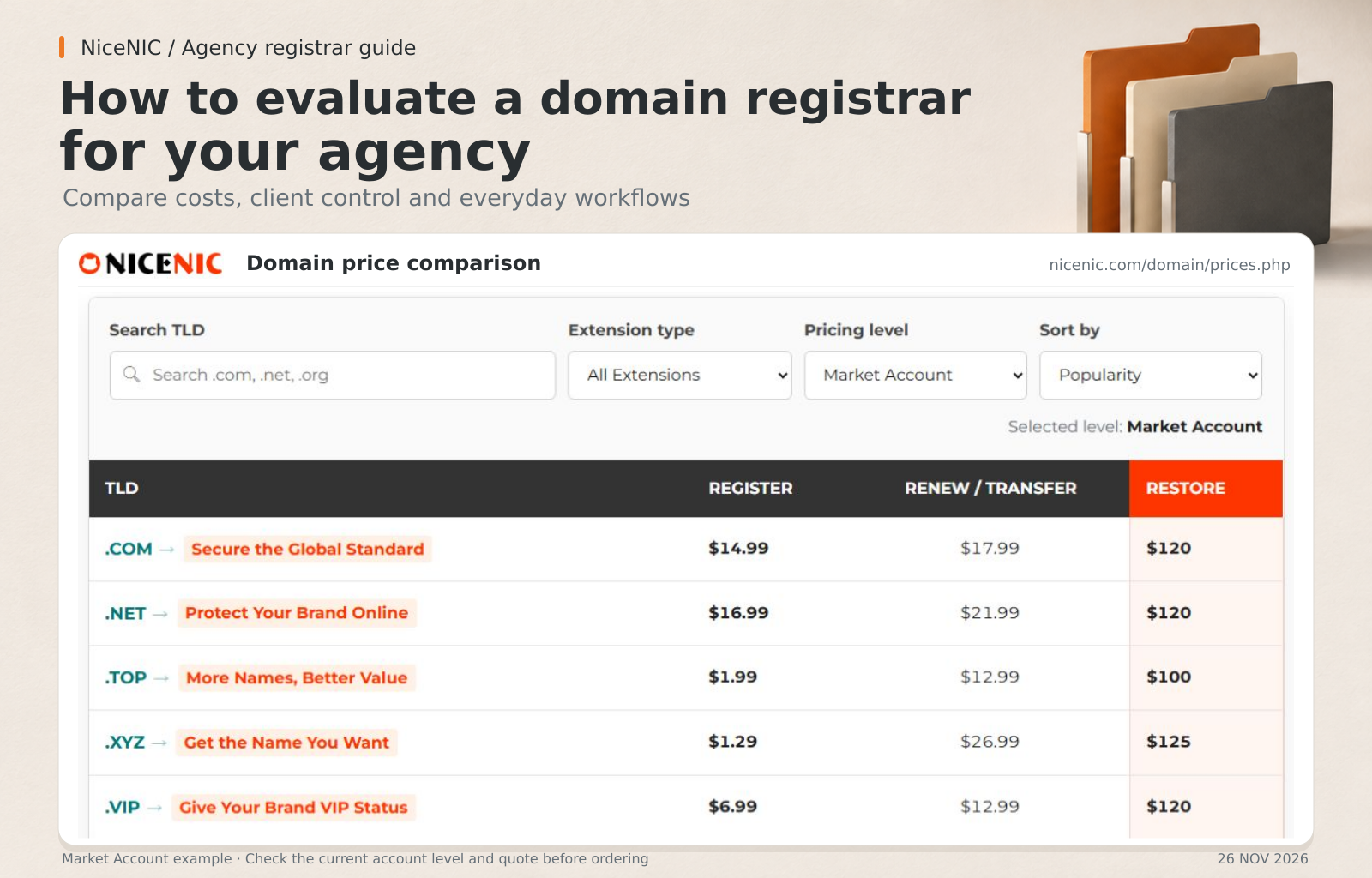
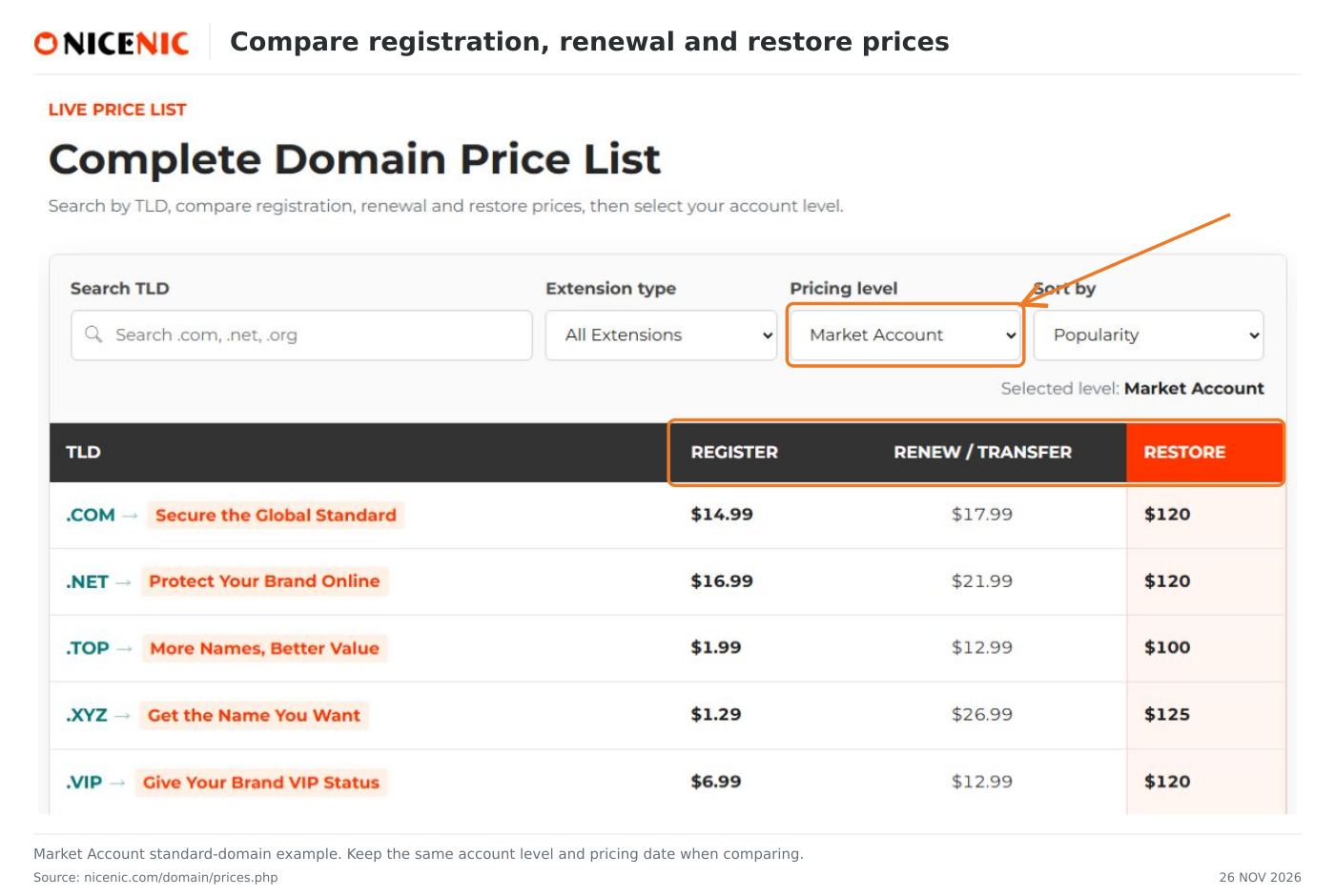
NiceNIC publishes separate registration, renewal, and transfer pricing through NiceNIC Domain Prices.
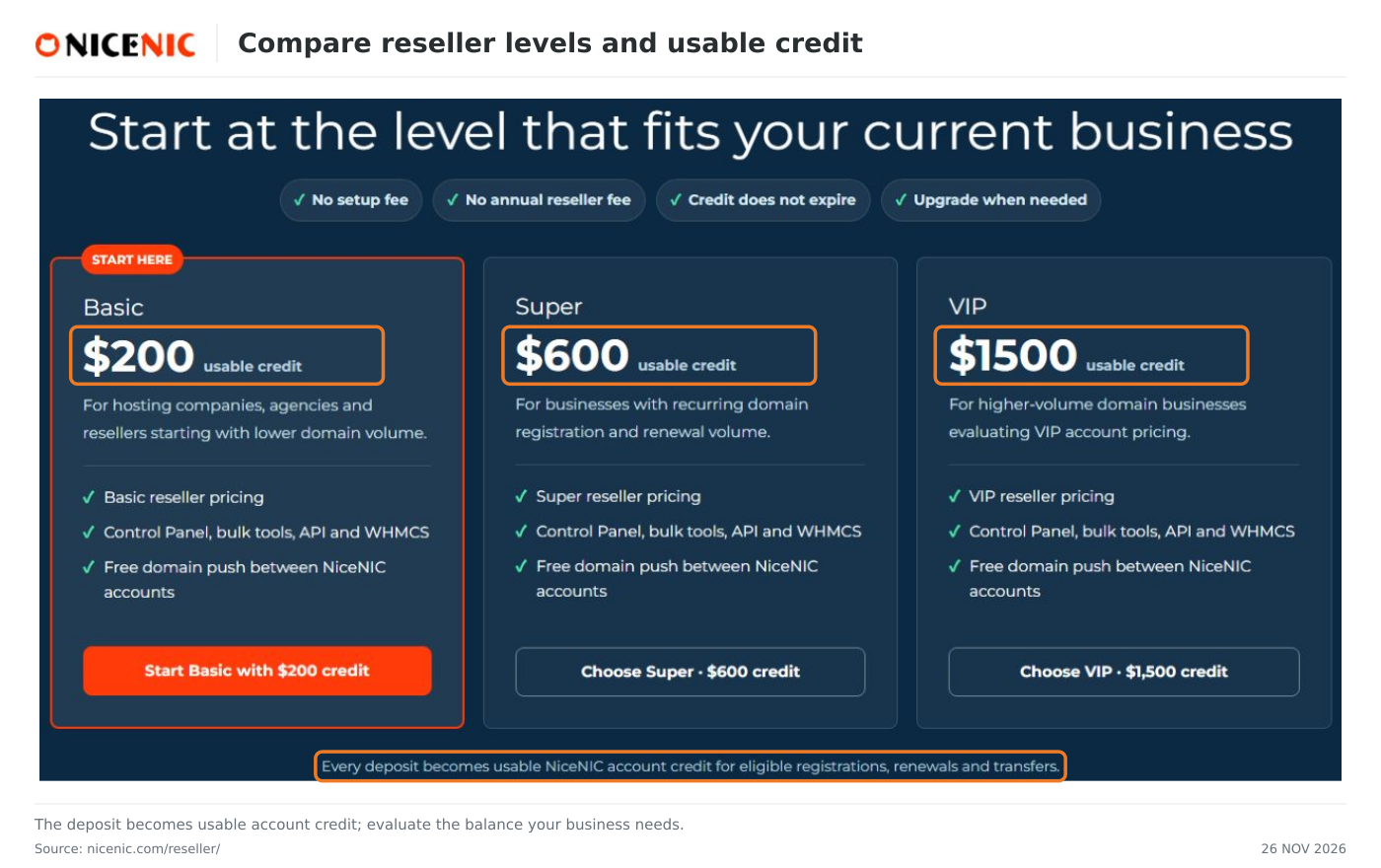
Its reseller program also provides different account levels:
For the published reseller levels, prepaid deposits become usable account credit rather than separate annual membership fees. Agencies should still consider the working capital required to maintain an appropriate balance.
See NiceNIC Reseller Pricing for current conditions.
B. Client ownership and handover
A registrar should make it possible to establish a clear relationship between the agency, the client, and the registered domain.
Evaluate:
- Whether client-specific registrant details can be maintained accurately.
- Whether delegated account access is available.
- Whether domains can be moved between accounts.
- Whether an external registrar transfer is supported.
- Whether additional verification is required.
- Whether account handover affects nameservers or associated services.
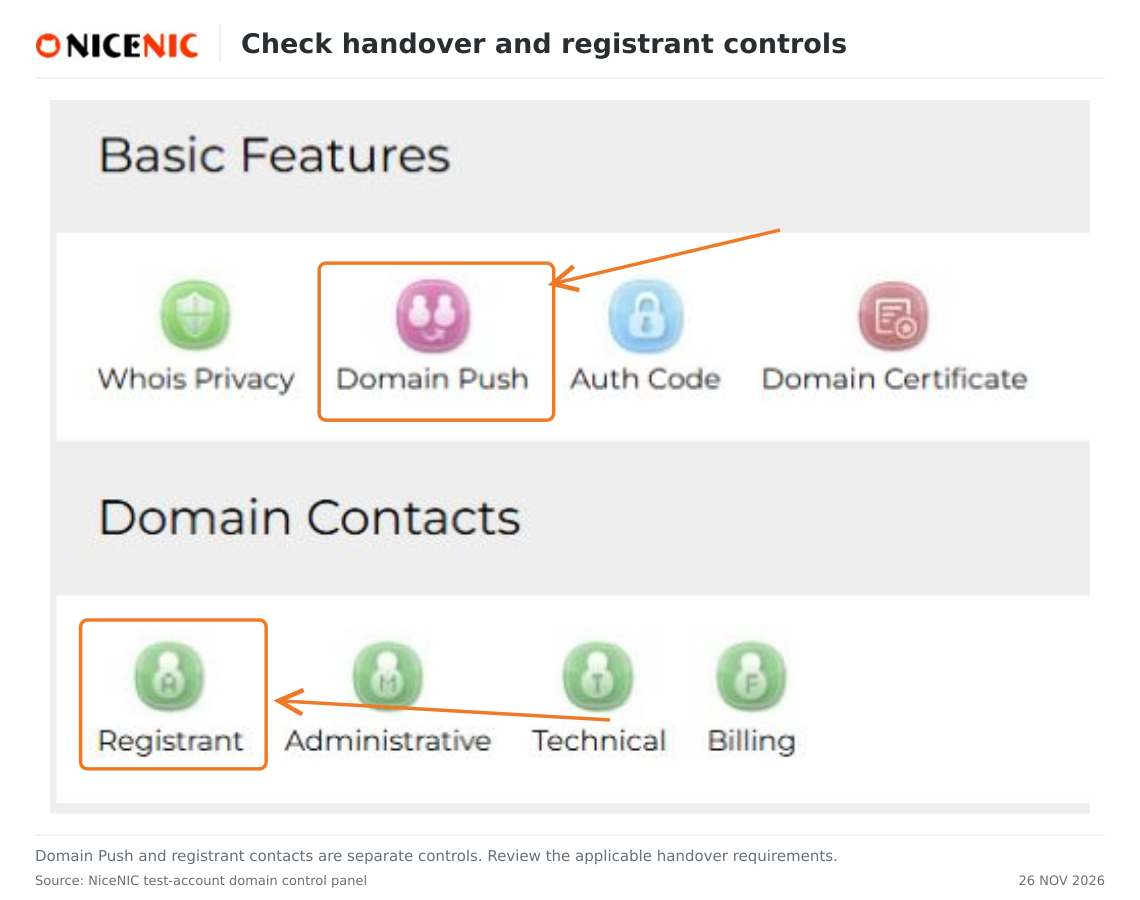
An important distinction is that an account transfer, a change of registrant, and an inter-registrar transfer are different operations.
A free internal account push may be convenient, but it should not automatically be treated as a guarantee of immediate external transfer eligibility.
For NiceNIC, Domain Transfer vs. Account Push explains the available distinctions.
For the wider legal and operational considerations, see Who Owns a Domain Name? Registrant vs. Account Holder.
C. DNS and infrastructure flexibility
Agencies frequently work with different hosting and DNS providers.
A registrar should be evaluated on whether its domain management functions fit the infrastructure your clients already use.
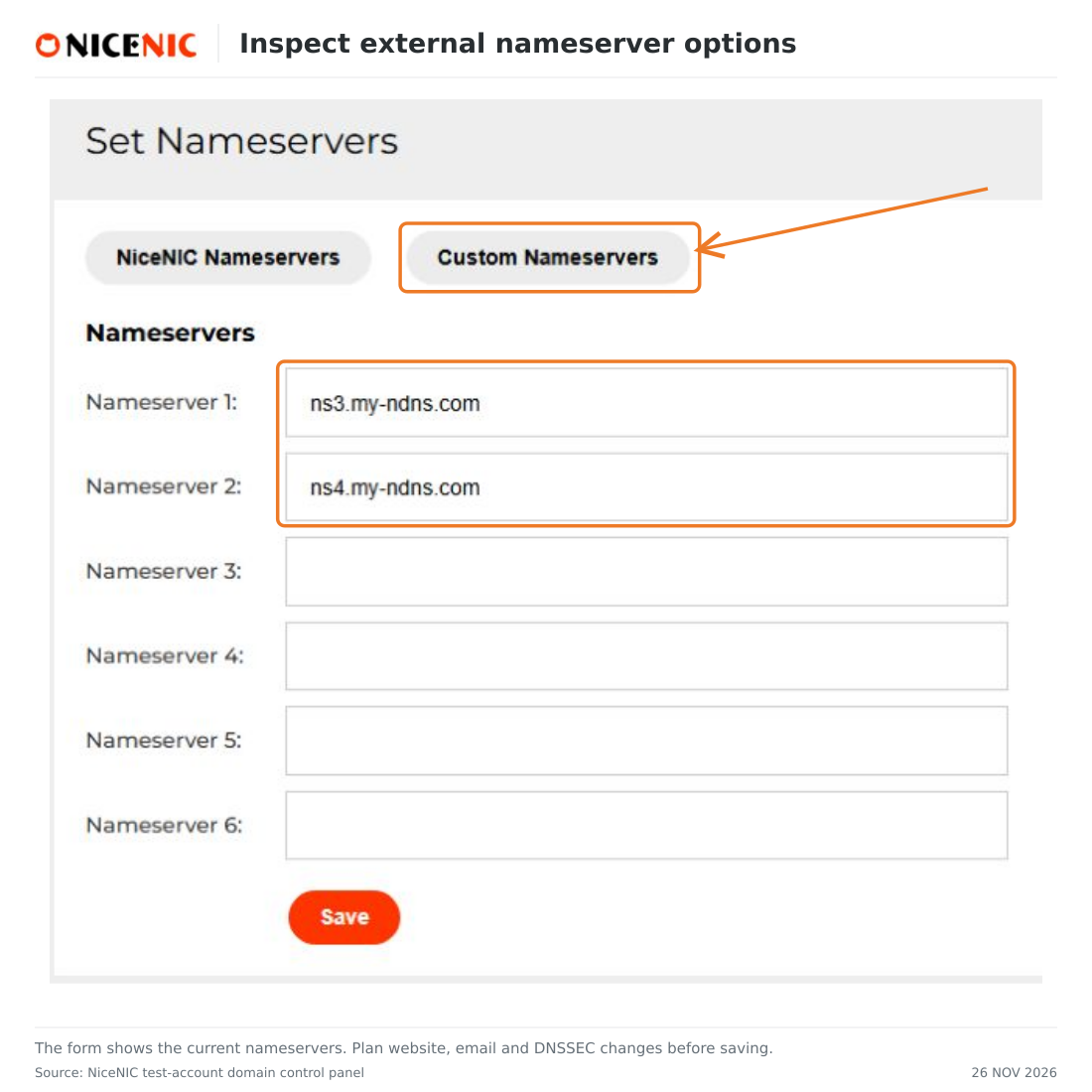
Check:
- External nameserver configuration.
- Private nameserver and glue-record management.
- DNS record management.
- DNSSEC and DS-record support.
- Compatibility with external hosting and email services.
- Procedures for nameserver changes and DNS migration.
Do not confuse registrar independence with DNS independence. A registrar may permit external nameservers while offering its own separate DNS hosting service.
Also, a successful nameserver update does not automatically verify that every website, email service, or DNSSEC configuration is functioning correctly.
Test at least one representative domain using your actual hosting and email setup.
D. API, WHMCS, and automation capabilities
Automation becomes increasingly valuable as the portfolio grows.
Rather than asking whether a registrar simply offers an API, determine whether the available integration supports your actual workflow.
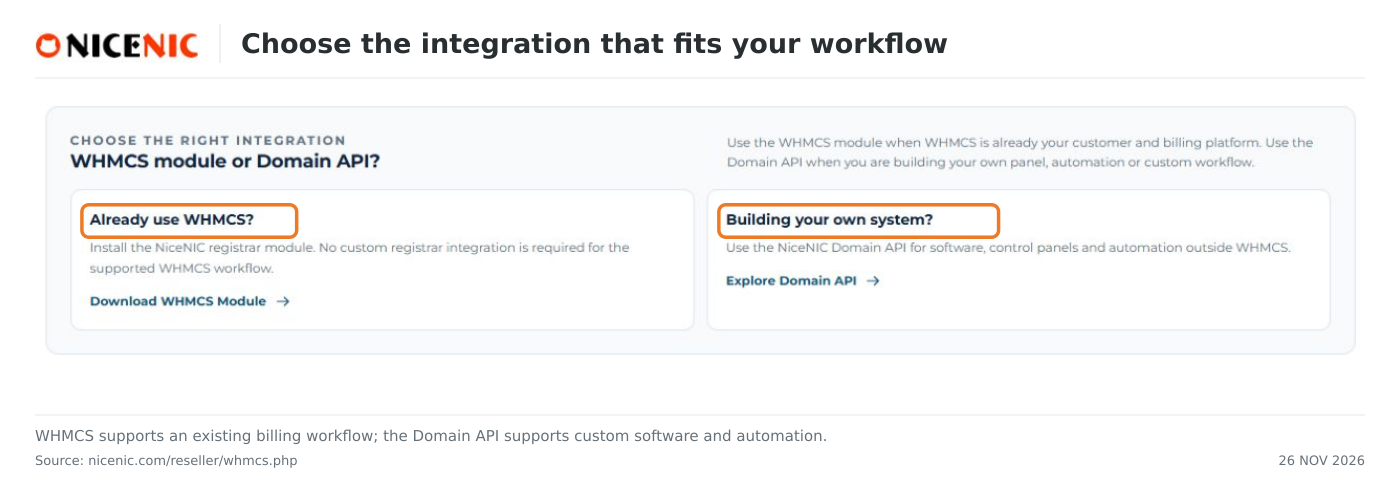
NiceNIC provides a Domain API, a separate API Sandbox, and a WHMCS Registrar Module.
These are different integration options, not interchangeable features.
An API is useful for custom applications and backend workflows. WHMCS is useful for hosting-oriented customer billing and domain management. Agencies should test the actual functions they intend to use rather than assuming that an available integration automatically supports every business requirement.
E. Global TLD coverage and eligibility
A large TLD catalogue is useful only when the extensions your clients need can actually be registered and managed under the required conditions.
Check:
- Whether the registrar supports the required TLDs.
- Whether registration and renewal are both available.
- Whether foreign companies or individuals qualify.
- Whether local presence is required.
- Whether identification or company documents are needed.
- Whether trustee services are available where permitted.
- Whether transfer and restore procedures differ by extension.
Country-code domains should be evaluated individually. Their rules are established by the relevant registry, not by a universal rule covering all ccTLDs.
NiceNIC's Domain Catalogue lists its available extensions, while its Trustee Services Guide explains one category of additional registration requirements.
F. Payment and financial management
An agency may need to fund hundreds of domain operations throughout the year.
Compare how each provider handles:
- Account funding.
- Prepaid balance.
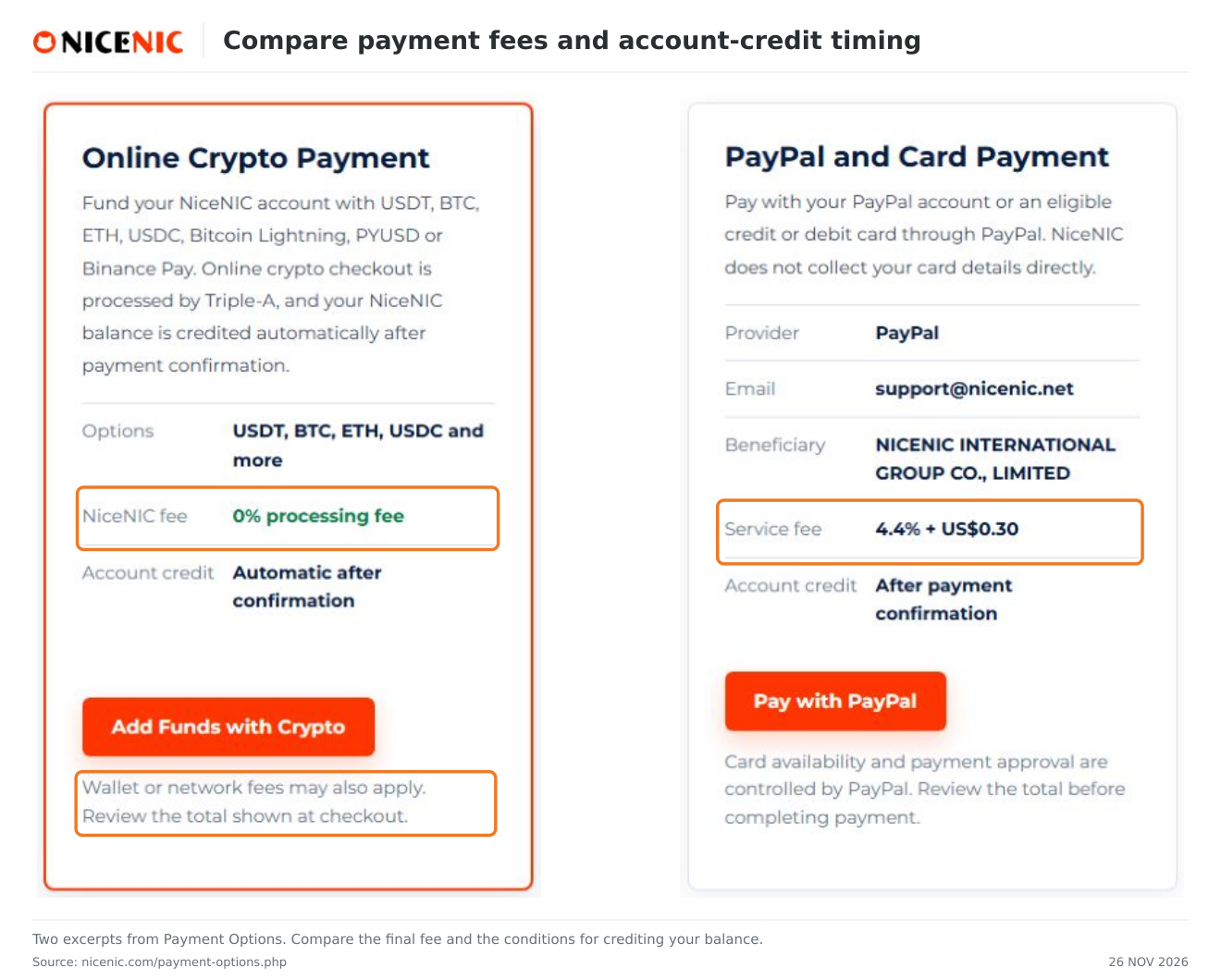
- Credit-card and payment-provider fees.
- Supported cryptocurrency options.
- Transaction records.
- Invoices and receipts.
- Client-level cost allocation.
- Refunds and failed transactions.
A centralized account balance can simplify payment administration, but it does not replace client-level accounting.
Your internal records should connect each expense to the relevant client, domain, order, and invoice.
NiceNIC supports multiple funding methods, including fiat and supported cryptocurrency payments. Its crypto processing fee is 0% at the NiceNIC level, although third-party payment and network fees may still apply.
See NiceNIC Payment Options for the current methods and conditions.
G. Support and operational accountability
Technical features do not eliminate the need for support.
When evaluating a registrar, determine:
- Which support channels are available.
- How account and payment issues are handled.
- Whether technical documentation is maintained.
- How domain complaints are communicated.
- Whether customers can track relevant domain statuses.
- How escalation works when an operation is pending or unsuccessful.
For agencies, the quality of exception handling can be more important than the speed of a routine registration.
A registrar should also have clear abuse-reporting and compliance procedures. No provider should be evaluated on an assumption that domains will never be restricted or suspended.
Review ICANN's Registrar Accreditation Agreement and the registrar's published abuse-handling documentation when assessing this area.
4. What to Verify Before Choosing a Domain Registrar
A registrar’s feature list does not always reflect how well it fits an agency’s daily operations. Before making a decision, verify the following requirements using current product documentation and, where possible, a real account.
Pricing and account conditions
- Compare registration, renewal, transfer, and restore prices separately.
- Check whether promotional prices apply only to the first year.
- Understand prepaid deposits, usable account credit, and recurring membership fees.
- Confirm additional costs for Premium domains, privacy, or restricted TLDs.
Client ownership and handover
- Confirm that accurate client registrant information can be maintained.
- Check whether delegated access or account-to-account domain push is available.
- Understand the difference between account handover, registrant changes, and external transfers.
- Verify any applicable transfer restrictions before promising a handover date.
DNS and infrastructure
- Confirm support for external nameservers and required glue records.
- Check DNSSEC and DS-record management capabilities.
- Verify that existing website and email configurations can be maintained during migration.
- Understand any provider-specific nameserver restrictions.
Automation and billing
- Check the actual API operations, limits, authentication requirements, and error responses.
- Verify WHMCS compatibility and required configuration.
- Determine which system generates renewal invoices and which system submits registrar renewal requests.
- Test transaction reconciliation and pending-order handling.
Support and compliance
- Review support channels and escalation procedures.
- Check how abuse reports and domain status notifications are handled.
- Confirm where clients can obtain account-specific assistance.
- Review the registrar's published terms and applicable ICANN or registry requirements.
These checks should be matched against your agency’s actual client agreements, technical environment, and service commitments. A feature that is useful for one agency may be unnecessary for another.
5. Run a Controlled Pilot Before Moving Your Portfolio
A registrar can look suitable on paper and still create operational problems in practice.
Before committing to a new provider, test a representative sample of domains.
Recommended pilot checklist
Include domains using different TLDs, hosting providers, and email configurations.
Do not move all domains simultaneously simply to test a provider.
For technical integration, test the Sandbox first where available. Then use a controlled production workflow to verify real registry and billing behavior.
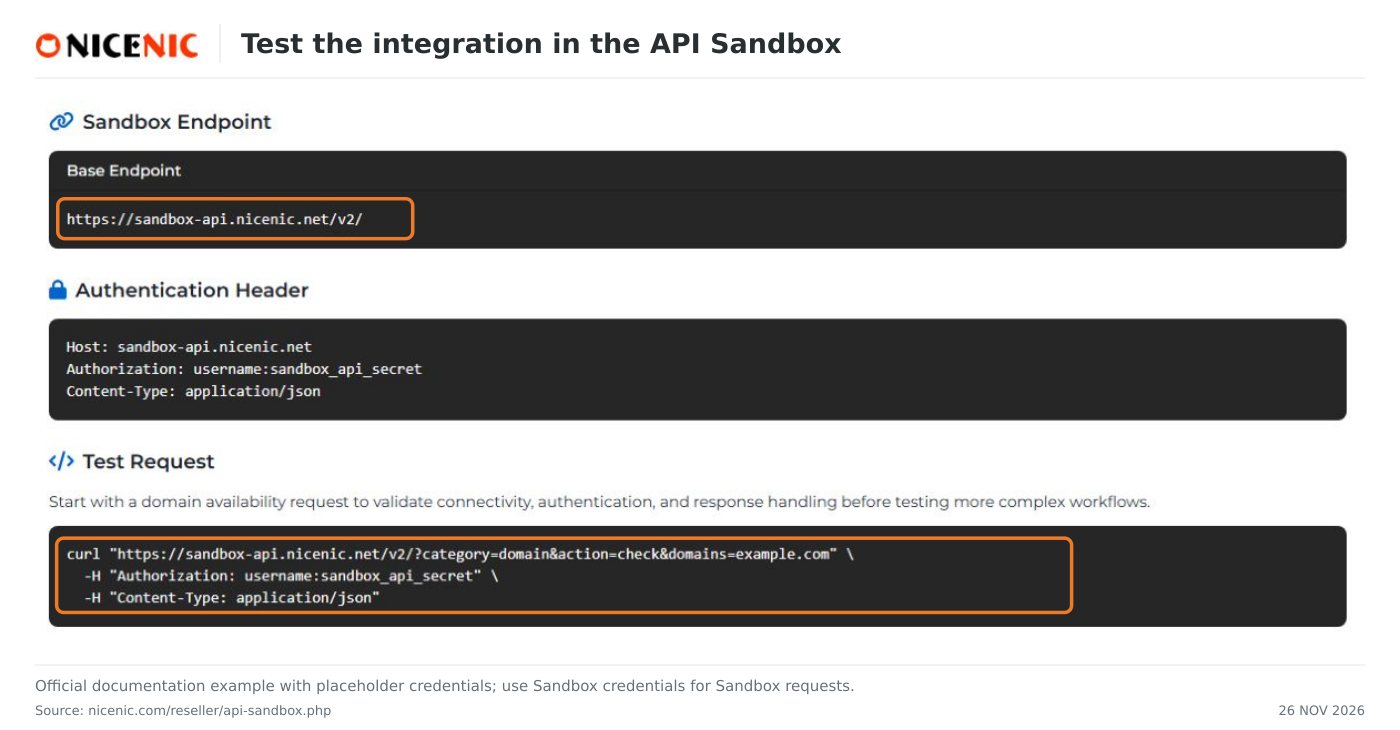
For API timeouts or pending responses, check the original order and transaction outcome before retrying. Avoid duplicate paid requests.
Review the results before expanding
Consider whether the pilot confirms:
- The required domains can be registered and renewed.
- Actual costs match the published pricing.
- DNS and email configurations remain functional.
- Client handover follows the expected process.
- Billing and registrar transactions can be reconciled.
- Support can resolve the issues your team encounters.
Expand the portfolio only after the provider has demonstrated that it meets your operational requirements.
6. Compare the Results Against Your Existing Registrar
The decision to change providers should be based on measurable operational improvement.
Use a comparison such as this:
Calculate the potential annual benefit:
Annual Operating Benefit = Domain Cost Reduction + Labor Cost Reduction − Additional Operating Costs
Use real figures from the pilot rather than promotional claims.
A provider with slightly higher registration prices may still be more economical if it significantly reduces administrative work. Conversely, a lower wholesale price may not justify a migration if the agency has to rebuild its existing billing and DNS workflows.
The objective is not simply to find the cheapest registrar. It is to find a platform that reduces the total cost and risk of managing client domains.
7. When Is NiceNIC Worth Evaluating?
NiceNIC may be worth including in an agency’s registrar shortlist when the business needs a combination of:
- Account-level domain pricing.
- A broad selection of global domain extensions.
- External nameserver configuration.
- Free account-to-account domain push for eligible domains.
- Bulk domain search and management tools.
- Domain API integration.
- WHMCS registrar integration.
- Multiple account funding options.
NiceNIC is operated by NICENIC INTERNATIONAL GROUP CO., LIMITED, an ICANN-accredited registrar with IANA Registrar ID 3765, operating since 2006.
Its Reseller Program offers Market, Basic, Super, and VIP account levels. Basic, Super, and VIP deposits become usable account credit, with no separate annual reseller membership fee.
Agencies can also evaluate the Domain API, API Sandbox, and WHMCS Module according to their integration requirements.
These capabilities should be evaluated against the agency’s actual workload. They do not eliminate the need to verify TLD eligibility, customer authorization, DNS configurations, and renewal procedures.
Frequently Asked Questions
What is the most important factor when choosing a domain registrar for an agency?
There is no single factor for every agency. Client ownership, pricing transparency, and operational compatibility are usually among the most important considerations. The right priorities depend on portfolio size, technical requirements, and client contracts.
Should an agency choose a retail registrar or a reseller platform?
A retail registrar may be sufficient for a small portfolio with limited automation requirements. A reseller platform may be more suitable when the agency needs account-level pricing, bulk operations, or integration with its own billing system. Compare the actual features and costs rather than relying on the platform label.
How should agencies compare domain registration and renewal prices?
Compare the same TLD, registration term, account level, and pricing date. Separate promotional first-year prices from standard renewal rates, and include applicable transfer, restore, privacy, and other recurring costs.
Does a lower wholesale price always mean higher agency profit?
No. Profitability also depends on client pricing, employee time, payment fees, software costs, support requirements, and the cost of maintaining the portfolio. Calculate the complete operating cost before choosing a pricing tier.
Can agencies manage domains registered under their clients' names?
Yes, subject to appropriate authorization and the registrar’s policies. The agency’s account access and the domain’s registered name holder are separate matters. Maintain accurate registrant information and document the management arrangement.
Should agencies use API or WHMCS integration?
An API is generally more suitable for custom software and backend automation. WHMCS is useful for agencies and hosting providers that manage customer billing and domain services through that platform. Some businesses use both, with clearly defined responsibilities.
Is it necessary to transfer all client domains to one registrar?
No. A phased approach is often more practical. Start with selected domains and workflows, verify the results, and consolidate only where there is a measurable business benefit.
Final Decision Checklist
Before selecting a domain registrar, confirm that:
- The registration and renewal prices are transparent.
- Required TLDs and eligibility conditions are supported.
- Client ownership and account access are clearly defined.
- Domain handover procedures are documented.
- Required DNS and nameserver configurations are supported.
- API and WHMCS integrations meet your actual requirements.
- Payment and client-level accounting are manageable.
- Renewal execution responsibilities are clear.
- Support and abuse-handling processes are documented.
- A representative pilot has been completed successfully.
- The provider meets all mandatory requirements.
Evaluate NiceNIC for Your Agency
If your agency is looking for a registrar that combines reseller pricing, global domain coverage, account management tools, and business integrations, consider including NiceNIC in your evaluation.
Start by comparing the available NiceNIC Reseller Levels, reviewing Domain Registration and Renewal Prices, and testing the NiceNIC Domain API where relevant.
You do not need to move your entire portfolio immediately.
Evaluate the platform against your own requirements, run a controlled pilot, and expand only when the results demonstrate a practical benefit.
Primary Sources
NiceNIC Official Resources
- NiceNIC Reseller Program — account levels, reseller conditions, and business services.
- NiceNIC Domain Prices — registration, renewal, and transfer pricing.
- NiceNIC Domain Catalogue — available domain extensions.
- NiceNIC Domain API — supported API operations.
- NiceNIC API Sandbox — integration testing.
- NiceNIC WHMCS Module — registrar integration.
- NiceNIC Account Push and Transfer Guide — account handover and transfer distinctions.
- NiceNIC DNSSEC Guide — DNSSEC setup and migration considerations.
External Official Resources
- ICANN Registrar Accreditation Agreement — registrar obligations and contractual requirements.
- GoDaddy Delegate Access — account delegation.
- Namecheap MCP Documentation — registrar MCP integration.
- Cloudflare Registrar Documentation — registrar operations and platform requirements.
- WHMCS Domain Renewals — billing and registrar renewal workflows.


