


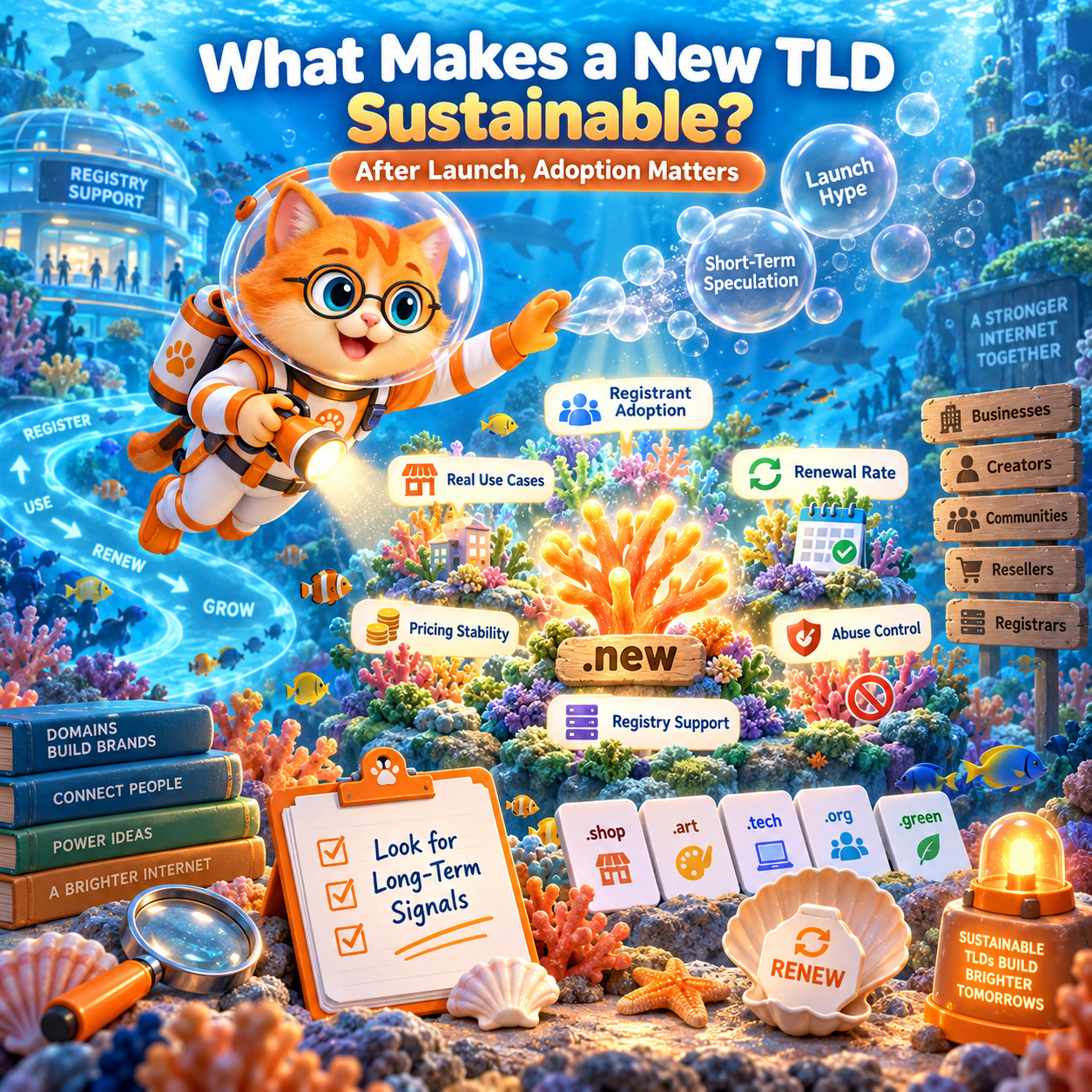
Keeping it relevant years later is a different challenge.
That question has become particularly timely as the domain industry prepares for another generation of new gTLDs.
One recent example is .helsinki.
The City of Helsinki has asked ICANN to terminate its Registry Agreement for the city TLD. ICANN records show that the termination notice was submitted on May 28, 2026, and ICANN has made a preliminary determination not to transition operation of .helsinki to another registry operator.
The case should not be read as evidence that city TLDs, geographic TLDs, or new gTLDs cannot work.
It does raise a much broader question:
What makes a TLD sustainable once the excitement of launch is over?
For registries, registrars and applicants considering future TLDs, the answer is likely to depend on much more than simply obtaining a string and putting it into the DNS root.
Launch Attention Is Not the Same as Long-Term Demand
New TLD launches naturally attract attention.
There may be Sunrise registrations, Early Access registrations, press coverage, brand-protection activity and an initial wave of users interested in securing attractive names.
Those first months can be useful indicators.
But they do not necessarily tell us how the namespace will perform five or ten years later.
Long-term sustainability depends on whether users continue to:
- register names
- renew them
- build websites and services on them
- trust the extension
- recommend it to others
- understand what the TLD stands for
A TLD therefore needs more than launch demand.
It needs a reason to remain useful.
1. Distribution Matters More Than Many TLDs Expect
A TLD cannot grow if customers rarely see it.
For most users, the domain-buying journey begins with a registrar, hosting company, website builder, reseller or platform.
That means registrar distribution matters enormously.
A strong TLD may still struggle if:
- only a small number of registrars offer it
- registration requires manual handling
- reseller systems do not support it
- APIs do not expose it properly
- hosting companies cannot provision it automatically
- pricing is difficult to understand
This is especially important today because more domain registrations happen inside broader workflows such as hosting, ecommerce, website builders and SaaS platforms.
For registry operators, registrar coverage is therefore more than a technical requirement.
It is a distribution strategy.
For registrars and hosting providers, good integration also means supporting the full domain lifecycle, including registration, renewal, transfer, DNS management and registry-specific requirements.
NiceNIC supports domain resellers and hosting providers through its Domain API and reseller program, allowing domains to be integrated into existing customer platforms and automated workflows.
2. A TLD Needs a Clear Reason to Exist
Some extensions immediately communicate their purpose.
Others require much more education.
A user deciding between several available domain extensions usually asks a simple question:
Why should this business, project or community use this TLD instead of another one?
A sustainable extension should have a clear answer.
That reason might be:
- geographic identity
- industry relevance
- community identity
- brand ownership
- language
- product positioning
- availability of meaningful names
The stronger the connection between the extension and the people expected to use it, the easier it becomes for registrars, businesses and users to explain its value.
A TLD that requires constant explanation may face a higher long-term marketing burden.
3. Registrations Matter, but Real Usage Matters More
Registration volume is one useful measurement of a TLD.
It should not be the only one.
A namespace containing thousands of actively used business websites, organizations, services or local projects can have very different long-term characteristics from one built mainly around short-term promotional registrations.
Useful signals can include:
- active websites
- business adoption
- email usage
- search visibility
- repeat registrations by existing users
- renewal rates
- development of recognizable brands on the extension
Real use creates visibility.
Visibility creates familiarity.
Familiarity can make future users more comfortable choosing the extension.
This is one reason successful namespaces often benefit from recognizable examples of real businesses or communities using them.
4. Renewal Economics Can Matter More Than the First-Year Price
A low introductory registration price can quickly create registrations.
But sustainable TLD economics are built over years, not only at checkout.
Registrants eventually care about questions such as:
- What does renewal cost?
- Is the renewal price predictable?
- Are premium domains priced differently?
- Can the price change significantly?
- Is the domain valuable enough to keep renewing?
Registries also need a healthy relationship between acquisition and retention.
Large numbers of first-year registrations do not automatically produce a strong namespace if users allow most of them to expire.
For customers, this is why the long-term price of a domain matters.
NiceNIC separates domain registration, renewal and other lifecycle pricing so users can evaluate more than the first-year cost before choosing an extension.
5. Registrar and Reseller Support Has to Continue After Launch
Distribution is not a one-time activity.
A TLD may launch with broad registrar support, but maintaining that support requires ongoing work.
Registrars need:
- reliable registry connections
- clear policy documentation
- stable pricing
- predictable error handling
- transfer support
- renewal support
- contact-management support
- timely policy updates
Resellers and hosting companies need even more automation.
If managing a TLD becomes unusually difficult, some distribution partners may simply prioritize easier extensions.
This means technical quality and operational simplicity can directly influence commercial reach.
For a Registry, being easy for registrars to integrate and maintain can be a meaningful competitive advantage.
6. Trust Has to Be Built Over Time
Users are more likely to adopt an extension when they understand who operates it and believe it will remain stable.
That trust grows through:
- reliable DNS operations
- clear registration rules
- consistent policies
- responsible abuse handling
- transparent communication
- predictable renewal processes
- long-term operational commitment
This is especially important for organizations considering a domain as a long-term digital identity.
A business may use the same domain for its website, email, authentication and customer communications for many years.
Changing that identity later can be costly.
The long-term stability of the namespace therefore matters just as much as the availability of a good name today.
7. A TLD Needs Continuing Investment After the Launch Campaign Ends
The launch of a new extension often comes with marketing campaigns, registrar promotions and industry attention.
But namespaces are long-term products.
They may require continued investment in:
- registrar relationships
- user education
- developer integrations
- brand awareness
- community building
- policy management
- abuse prevention
- new use cases
Without that ongoing effort, even a technically successful launch can gradually lose visibility.
This is one of the hardest parts of operating a TLD.
The product never really reaches a point where distribution and education are finished.
What Can the Industry Learn from .helsinki?
It would be too simple to look at the planned termination of .helsinki and conclude that city TLDs do not work.
Different TLDs have different objectives.
Some are designed for broad public registration.
Others support a specific community, city, organization or brand.
Some may measure success primarily through registration volume, while others may value identity, control, security or public-service use.
The more useful lesson is that operating a TLD is a long-term commitment.
The launch itself is only the beginning.
A sustainable namespace needs an operating model that continues to make sense years after the original application.
The Next New gTLD Round Makes This Question More Important
ICANN approved the 2026 Base Registry Agreement in March 2026 for applicants in the next New gTLD Program round.
The agreement defines the operational, technical and contractual responsibilities that successful applicants will need to meet as registry operators.
For future applicants, the application question is therefore only the first one.
The harder questions come next:
- Who will use the TLD?
- Which registrars will distribute it?
- Why will users choose it?
- What will make them renew it?
- How will it integrate with hosting and reseller platforms?
- What will keep the namespace relevant ten years later?
The strongest TLD strategies are likely to answer those questions before launch, not after it.
Sustainable TLDs Are Built Around Users, Not Just Strings
A memorable string can attract attention.
A sustainable TLD needs much more.
It needs distribution, a clear purpose, real users, sensible economics, reliable infrastructure and continued investment.
For registries, that means thinking beyond launch day.
For registrars, hosting companies and resellers, it means making useful extensions easy for customers to discover and manage.
And for businesses choosing a domain, it means looking beyond availability and considering whether an extension has the ecosystem and long-term stability needed to support a digital identity for years to come.
NiceNIC works with businesses, hosting providers and domain resellers across thousands of domain extensions.
Explore domain availability and pricing or learn more about the NiceNIC Reseller Program and Domain API.
Frequently Asked Questions
What makes a new TLD successful?
There is no single measure of success. Registration volume, renewal rates, active usage, registrar distribution, brand recognition and the original purpose of the TLD can all matter.
Why is registrar distribution important for a new TLD?
Registrars, hosting companies, resellers and website platforms are where most customers discover and register domains. Broader and easier distribution can make a TLD more accessible to users.
Are high first-year registration numbers enough to make a TLD sustainable?
Not necessarily. Long-term sustainability also depends on renewals, real usage, pricing, continued distribution and ongoing demand.
Do city TLDs have to achieve large registration volumes to be successful?
Not always. Geographic TLDs may have goals related to local identity, public services, branding or community use as well as commercial registration volume.
Why do renewal prices matter for TLD growth?
Registrants usually keep important domains for multiple years. Predictable and understandable long-term pricing can influence whether users retain or abandon a domain.
What should a new TLD applicant plan before launch?
In addition to technical and contractual requirements, applicants should think about target users, registrar distribution, pricing, renewals, real-world use cases, marketing, integrations and long-term operating costs.
Sources
ICANN, Registry Agreement Termination Information Page https://www.icann.org/en/contracted-parties/registry-operators/services/registry-agreement-termination-service
ICANN, .helsinki Registry Agreement https://www.icann.org/en/registry-agreements/details/helsinki
Domain Incite, Helsinki throws in the towel on city gTLD, September 3, 2026 https://domainincite.com/31910-helsinki-throws-in-the-towel-on-city-gtld


