


Skatījumi:96
Laiks:2026-07-30 12:07:11 Autors: windy 
A hosting customer often needs more than a server or hosting plan. They may also need a domain, an invoice, account access, renewal reminders, nameserver management, and support when an order does not complete normally.
A WHMCS domain registrar integration connects supported registrar operations with the billing and customer-management workflow that a hosting provider already uses.
Instead of sending customers to a separate registrar, the provider can keep eligible domain search, ordering, billing, renewal, and management activities within the same service relationship.
However, installing a registrar module does not make every domain process fully automatic. The hosting provider still controls pricing, billing rules, customer communication, TLD selection, account balance, and exception handling.
What a WHMCS Registrar Integration Solves
WHMCS is designed to connect customer management, billing, hosting services, and domain operations.
With a compatible registrar module, a hosting provider can build a workflow in which:
This can reduce repeated manual entry and keep domain and hosting records connected to the same customer account.
Who Should Use a WHMCS Domain Registrar Module?
Hosting Providers
This is the clearest use case.
When a customer orders shared hosting, a VPS, a dedicated server, or another hosting service, a domain is often part of the same purchase.
A WHMCS integration can help the provider manage the invoice, service, domain order, renewal cycle, and customer record in one environment.
Web Agencies and IT Service Companies
An agency that manages hosting and domains for clients may also benefit, especially when the number of customers has grown beyond a simple spreadsheet or manual reminder system.
The agency should still decide whether customers manage domains themselves or whether all domain changes require staff approval.
Domain Resellers Using WHMCS
A reseller can use WHMCS as the customer-facing billing and account system while using an upstream registrar for supported domain operations.
The reseller remains responsible for setting retail prices, collecting accurate customer information, and explaining the status of each order.
Control Panel, WHMCS, or Reseller API?
The right option depends on how the business operates.
Registrar Control Panel
A control panel may be enough when order volume is low and every request is reviewed manually.
This approach requires less development and setup, but it becomes less efficient as the number of customers and renewals grows.
WHMCS Registrar Module
WHMCS is usually the practical choice when the business already uses it for:
Domain Reseller API
A domain reseller API may be more suitable when the business needs a fully customized website, SaaS onboarding process, checkout, customer portal, queue, or order-status model.
The API provides more control, but it also requires more development, testing, monitoring, and maintenance.
Do not build a custom API platform simply because it appears more flexible. WHMCS may already provide the customer and billing functions a hosting business needs.
What the Integration Can Automate
The current NiceNIC WHMCS registrar module documents support for:
A module connects supported actions. It does not remove every registry rule or manual exception.
What the Hosting Provider Still Needs to Handle
The business remains responsible for:
Six Questions to Answer Before Connecting
1. Which TLDs Will You Sell?
Start with extensions your customers already request and your team understands.
Do not enable a large catalog only to make the storefront look bigger. Every extension may introduce different prices, periods, transfer rules, or customer-data requirements.
2. How Will You Set Retail Prices?
Check registration, renewal, and transfer costs separately.
A low first-year selling price may create problems when the renewal price is significantly higher. Your retail price also needs to account for payment costs, customer support, refunds, and operational risk.
Review the current NiceNIC Domain Price List before publishing customer prices.
3. When Will an Order Be Submitted?
Decide whether supported domain actions should be submitted after:
Successful payment
Manual order review
Fraud screening
Customer-data validation
Internal approval
Automatic submission is useful only when the order has already passed the checks your business requires.
4. Who Handles Exceptions?
Assign responsibility for:
5. How Will Renewals Work?
WHMCS can generate renewal invoices and notices, but the business must define the timing, customer price, payment process, grace-period communication, and registrar-side renewal rules.
Do not treat invoice generation and successful registrar renewal as the same event.
6. What Will Customers Be Allowed to Manage?
Decide whether customers can directly:
Where NiceNIC Fits
NiceNIC provides a WHMCS registrar module for eligible reseller workflows, supported by NiceNIC API v2 and registrar-side domain management.
The module currently covers the main domain lifecycle and management functions that hosting providers commonly need inside WHMCS. NiceNIC also provides prepaid reseller accounts, domain pricing, bulk tools, and a direct API option for businesses that later require a more customized workflow.
A prepaid NiceNIC reseller balance is used for actual domain operations rather than charged as a separate annual membership fee. Businesses should still compare the account level, required TLDs, expected volume, and current prices before upgrading.
Connect NiceNIC with Your WHMCS Workflow
A WHMCS registrar integration is most valuable when it supports a business process that is already clearly defined.
Choose the TLDs you can support, calculate sustainable prices, decide when orders should be submitted, assign responsibility for exceptions, and test the complete customer journey before increasing volume.
Review the NiceNIC WHMCS domain registrar integration to confirm the current supported functions and determine whether it fits your hosting or reseller business.
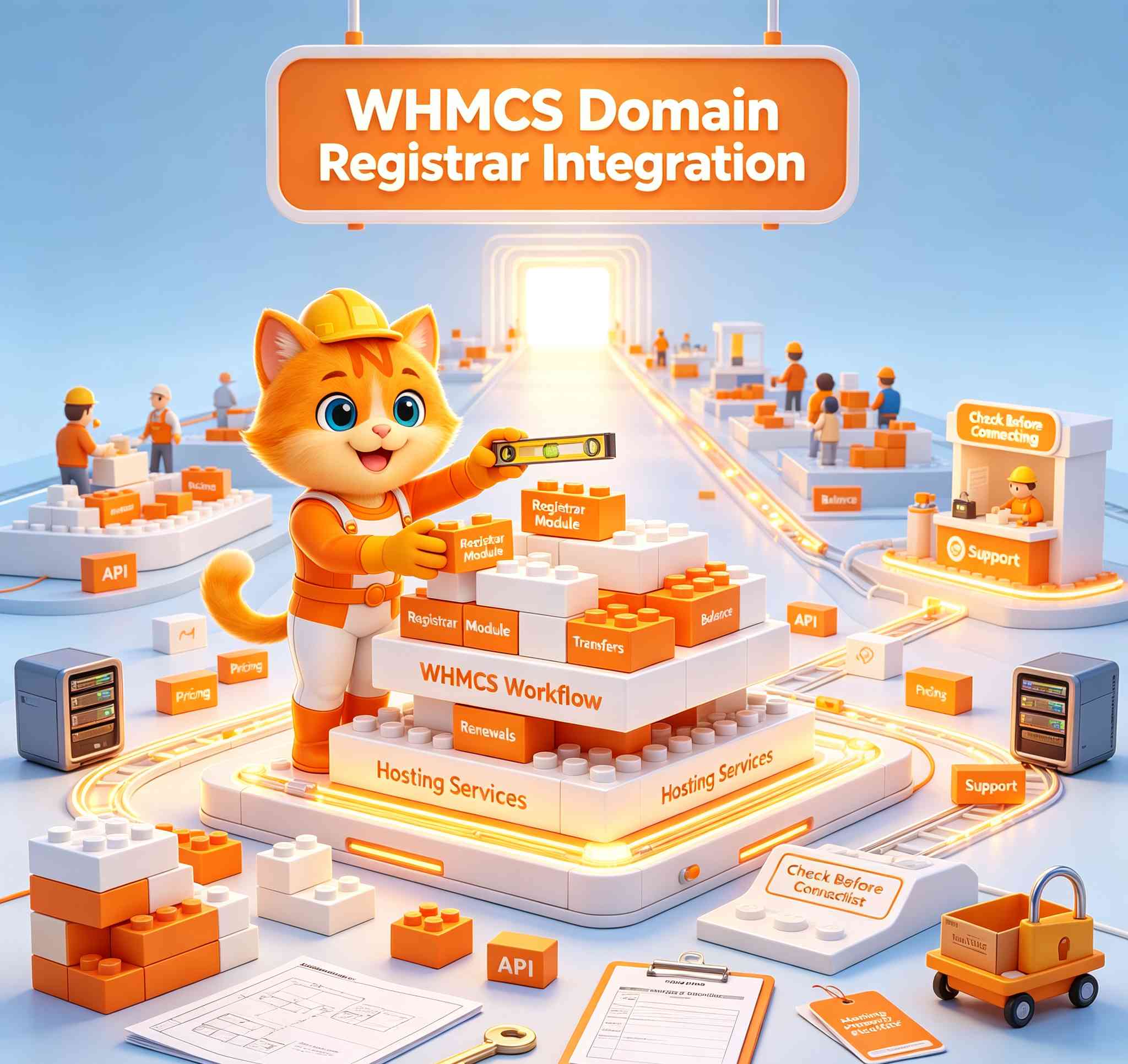
A WHMCS domain registrar integration connects supported registrar operations with the billing and customer-management workflow that a hosting provider already uses.
Instead of sending customers to a separate registrar, the provider can keep eligible domain search, ordering, billing, renewal, and management activities within the same service relationship.
However, installing a registrar module does not make every domain process fully automatic. The hosting provider still controls pricing, billing rules, customer communication, TLD selection, account balance, and exception handling.
What a WHMCS Registrar Integration Solves
WHMCS is designed to connect customer management, billing, hosting services, and domain operations.
With a compatible registrar module, a hosting provider can build a workflow in which:
- A customer searches for a domain.
- WHMCS displays the customer-facing price.
- The customer orders a domain with a hosting plan.
- WHMCS generates the invoice.
- A supported registrar action is submitted after the required payment or approval.
- The customer manages eligible domain functions from the WHMCS client area.
- Renewal invoices and notices follow the business's configured schedule.
This can reduce repeated manual entry and keep domain and hosting records connected to the same customer account.
Who Should Use a WHMCS Domain Registrar Module?
Hosting Providers
This is the clearest use case.
When a customer orders shared hosting, a VPS, a dedicated server, or another hosting service, a domain is often part of the same purchase.
A WHMCS integration can help the provider manage the invoice, service, domain order, renewal cycle, and customer record in one environment.
Web Agencies and IT Service Companies
An agency that manages hosting and domains for clients may also benefit, especially when the number of customers has grown beyond a simple spreadsheet or manual reminder system.
The agency should still decide whether customers manage domains themselves or whether all domain changes require staff approval.
Domain Resellers Using WHMCS
A reseller can use WHMCS as the customer-facing billing and account system while using an upstream registrar for supported domain operations.
The reseller remains responsible for setting retail prices, collecting accurate customer information, and explaining the status of each order.
Control Panel, WHMCS, or Reseller API?
The right option depends on how the business operates.
Registrar Control Panel
A control panel may be enough when order volume is low and every request is reviewed manually.
This approach requires less development and setup, but it becomes less efficient as the number of customers and renewals grows.
WHMCS Registrar Module
WHMCS is usually the practical choice when the business already uses it for:
- Customer accounts
- Hosting plans
- Invoices
- Payments
- Renewal notices
- Service provisioning
- Support workflows
Domain Reseller API
A domain reseller API may be more suitable when the business needs a fully customized website, SaaS onboarding process, checkout, customer portal, queue, or order-status model.
The API provides more control, but it also requires more development, testing, monitoring, and maintenance.
Do not build a custom API platform simply because it appears more flexible. WHMCS may already provide the customer and billing functions a hosting business needs.
What the Integration Can Automate
The current NiceNIC WHMCS registrar module documents support for:
- Domain availability checks
- Domain registration
- Domain renewal
- Domain transfer
- Domain information retrieval
- Nameserver management
- Contact information management
- Domain lock and unlock
- EPP or Auth Code retrieval
- Supported automated provisioning, logging, and test workflows
A module connects supported actions. It does not remove every registry rule or manual exception.
What the Hosting Provider Still Needs to Handle
The business remains responsible for:
- Customer retail pricing
- Payment and refund rules
- Registration, renewal, and transfer margins
- Accurate customer contact information
- TLD-specific information
- Premium-domain price approval
- Renewal notice timing
- Available reseller balance
- Failed or Pending orders
- Customer support
- Registry and compliance exceptions
Six Questions to Answer Before Connecting
1. Which TLDs Will You Sell?
Start with extensions your customers already request and your team understands.
Do not enable a large catalog only to make the storefront look bigger. Every extension may introduce different prices, periods, transfer rules, or customer-data requirements.
2. How Will You Set Retail Prices?
Check registration, renewal, and transfer costs separately.
A low first-year selling price may create problems when the renewal price is significantly higher. Your retail price also needs to account for payment costs, customer support, refunds, and operational risk.
Review the current NiceNIC Domain Price List before publishing customer prices.
3. When Will an Order Be Submitted?
Decide whether supported domain actions should be submitted after:
Successful payment
Manual order review
Fraud screening
Customer-data validation
Internal approval
Automatic submission is useful only when the order has already passed the checks your business requires.
4. Who Handles Exceptions?
Assign responsibility for:
- Failed registrations
- Pending results
- Incorrect customer data
- Transfer delays
- Low account balance
- Premium pricing differences
- TLD-specific requirements
5. How Will Renewals Work?
WHMCS can generate renewal invoices and notices, but the business must define the timing, customer price, payment process, grace-period communication, and registrar-side renewal rules.
Do not treat invoice generation and successful registrar renewal as the same event.
6. What Will Customers Be Allowed to Manage?
Decide whether customers can directly:
- Change nameservers
- Update domain contacts
- Retrieve Auth Codes
- Lock or unlock domains
- Request transfers
Where NiceNIC Fits
NiceNIC provides a WHMCS registrar module for eligible reseller workflows, supported by NiceNIC API v2 and registrar-side domain management.
The module currently covers the main domain lifecycle and management functions that hosting providers commonly need inside WHMCS. NiceNIC also provides prepaid reseller accounts, domain pricing, bulk tools, and a direct API option for businesses that later require a more customized workflow.
A prepaid NiceNIC reseller balance is used for actual domain operations rather than charged as a separate annual membership fee. Businesses should still compare the account level, required TLDs, expected volume, and current prices before upgrading.
A WHMCS registrar integration is most valuable when it supports a business process that is already clearly defined.
Choose the TLDs you can support, calculate sustainable prices, decide when orders should be submitted, assign responsibility for exceptions, and test the complete customer journey before increasing volume.
Review the NiceNIC WHMCS domain registrar integration to confirm the current supported functions and determine whether it fits your hosting or reseller business.
ICANN akreditēts reģistrators kopš 2006. gada
Nopērciet un reģistrējiet savu .COM domēnu jau šodien
Pārbaudiet .COM domēna pieejamību, reģistrējiet jaunu .COM domēnu, meklējiet vairākus vārdus vienlaikus vai pārsūtiet savus esošos .COM domēnus uz NiceNIC. Izveidots uzņēmumiem, domēnu investoriem, aģentūrām, hostinga pakalpojumu sniedzējiem un izplatītājiem.
Atjaunot: $17.99
Tirgus
$22.49 $14.99
pirmais gads
Atjaunot: $17.99
Pamata
$14.99
0% off
Atjaunot: $17.99
Super
$14.99
0% off
Atjaunot: $16.99
VIP
$14.99
0% off
SAISTĪTĀS ZIŅAS:
Pēdējās ziņas:
What Domain Owners Should Track in ICANN, Registry, and Registrar News
Nākamās ziņas: Registry Policy Changes: How They Affect Domain Owners
Nākamās ziņas: Registry Policy Changes: How They Affect Domain Owners


