


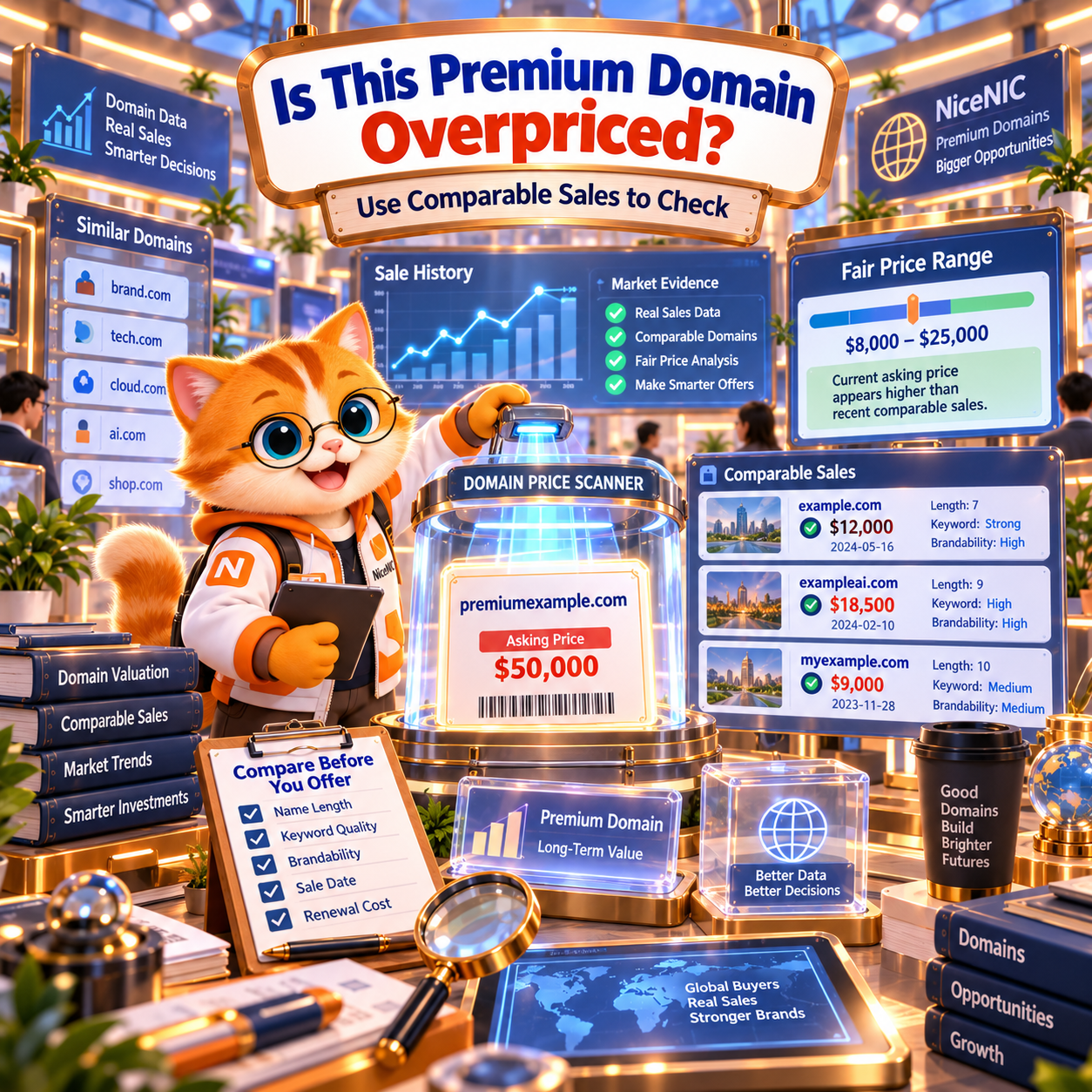
You find the Premium Domain you want and see a Buy Now price of $8,000.
Is $8,000 reasonable, or is the domain overpriced?
The asking price alone cannot answer that question. A seller can ask $2,000, $20,000 or $200,000 for a domain. What matters is whether there is enough market evidence and business value to support that price.
One of the best places to start is with comparable domain sales: real historical transactions involving domains with similar characteristics.
Already looking at a specific Premium Domain? Search the NiceNIC Buy Now Market to see its current fixed price, then compare that price with relevant historical domain sales before deciding whether it makes sense.
Quick Answer: How Do You Know If a Premium Domain Is Overpriced?
A Premium Domain may be overpriced for you when its asking price is difficult to support with comparable sales, the name is materially weaker than domains that sold for similar amounts, or a much cheaper alternative gives your business nearly the same value.
Start with four questions:
- What have genuinely similar domains actually sold for?
- How does this domain differ from those comparable sales?
- What is the best alternative you could use instead?
- What is the maximum value this exact name creates for your business?
Do not expect historical sales to produce one exact “correct” price. They are better used to establish a reasonable range.
If the asking price is well above that range, there should be a clear reason why this particular domain deserves the premium.
What Are Comparable Domain Sales?
Comparable sales, often called “comps,” are completed historical domain transactions that resemble the domain you are evaluating.
Suppose you want to buy a short two-word .COM. Useful comparable sales might include other two-word .COM domains with similar length, commercial meaning and brand quality.
The important word is completed.
A domain listed for $50,000 is evidence of what a seller wants.
A domain that actually sold for $50,000 is evidence that a buyer was willing to pay that amount.
Those are not the same thing.
Historical sales therefore give you a better market reference than simply browsing other domains currently listed for sale.
NiceNIC's upgraded Buy Now Market includes publicly reported historical Premium Domain sales for market reference alongside fixed-price domain search.
What Makes a Domain Sale Truly Comparable?
The biggest mistake is finding any expensive domain sale and calling it a comparison.
Two domains can both be .COM domains and still have completely different values.
A useful comparable should share several characteristics with the domain you want to buy.
Does It Use the Same Extension?
A .COM sale is generally more useful when evaluating another .COM than a sale under an unrelated extension.
That does not mean cross-extension comparisons are useless, but differences between extensions can materially affect demand and price.
Is the Length Similar?
Compare short domains with other reasonably short domains.
A four-letter name and a fifteen-character phrase may operate in very different markets even when both contain commercially useful terms.
Is the Word Structure Similar?
A one-word dictionary domain should generally be compared with other strong one-word names, not an arbitrary two- or three-word phrase.
Likewise, a two-word brandable domain is usually better compared with similar two-word names.
Is the Commercial Use Similar?
A domain related to insurance, finance or software may have a different buyer pool from a domain describing a hobby or a highly specific niche.
Commercial relevance can affect what an end user is willing to pay.
Is the Name Equally Memorable?
Two domains can look similar on paper while one is much easier to say, spell and remember.
That difference matters.
Comparable-sales analysis is not just matching character counts. It requires judging whether the names actually compete in a similar quality range.
How Many Comparable Sales Should You Look At?
Do not make a buying decision from one historical sale.
A single transaction may involve an unusually motivated buyer, a highly motivated seller or circumstances that do not apply to your domain.
Look for several genuinely relevant sales whenever possible.
If most comparable transactions cluster within a similar price range, that gives you a stronger market reference.
If comparable sales are scattered from $1,000 to $30,000, that tells you something important too: the market for that type of domain may be thin, highly buyer-dependent or difficult to price precisely.
A wide range is not a reason to average every number and call the result “market value.”
It is a reason to be more cautious.
How Recent Should Comparable Domain Sales Be?
More recent transactions are generally more useful because domain markets change.
Buyer demand can shift, certain industries become more attractive, new extensions grow or decline in popularity, and overall aftermarket conditions change.
A sale from many years ago can still provide useful context, especially for rare domains, but it should not automatically carry the same weight as a recent comparable transaction.
When possible, prioritize recent sales and then use older sales as supporting evidence.
Also check the date before comparing headline sales. A famous historical transaction may be interesting without being especially useful for determining today’s fair price.
Is the Asking Price the Same as the Domain's Market Value?
No.
An asking price is the amount the seller wants.
Market evidence is what buyers have actually paid for reasonably comparable domains.
Imagine three similar domains previously sold for approximately:
$3,500
$4,200
$5,000
The domain you want is listed at:
$18,000
That does not automatically prove the seller is wrong.
But it does create an important question:
What makes this domain significantly better than the $3,500-$5,000 comparables?
Perhaps it is shorter, a stronger dictionary word, a better brand, more commercially useful or an exact match for a valuable category.
If there is a convincing reason, the higher price may be defensible.
If there is no meaningful difference, the asking price deserves much closer scrutiny.
When Is a Premium Domain Probably Overpriced?
There is no universal percentage that makes a domain overpriced, but several warning signs should make you slow down.
The asking price may deserve more scrutiny when it is far above relevant completed sales without a clear quality difference, when the seller uses unrelated million-dollar sales to justify an ordinary domain, or when an equally strong alternative is available for a fraction of the cost.
Be especially careful when the argument for the price is simply:
“Another domain sold for $100,000.”
The useful question is not whether some domain sold for $100,000.
It is whether similar domains sold anywhere near that level.
Can a Premium Domain Be Priced Above Comparable Sales and Still Be Worth Buying?
Yes.
Comparable sales provide market context, not a price ceiling.
Suppose similar names usually sell for $5,000-$8,000, but the exact domain your company needs costs $12,000.
If the domain exactly matches an established brand, removes a major naming problem and will be used for many years, paying above the historical comparable range may still make business sense.
That is because there are two different concepts:
Market value asks what similar domains have generally sold for.
Buyer-specific value asks what this exact domain is worth to you.
A strategic buyer may rationally pay more than an investor or another business.
The important thing is to understand why you are paying above the market reference instead of assuming the seller’s price must be correct.
Can a Premium Domain Be Fairly Priced but Still Be Too Expensive for You?
Absolutely.
Suppose comparable sales support a price around $10,000.
That does not mean your business should spend $10,000.
A fair market price and a sensible purchase price for your company are different questions.
If your project has an excellent $20 alternative and the Premium Domain creates only a minor branding improvement, walking away can still be the better decision.
This is why P03’s buying framework matters: after checking whether the seller’s price is supported by the market, you still need to determine your own maximum budget.
Read How Much Should You Pay for a Premium Domain? for a step-by-step way to set your walk-away price.
Are Automated Domain Appraisal Tools Accurate Enough to Spot an Overpriced Domain?
Use them as a reference, not a verdict.
Automated tools can analyze measurable signals such as domain length, extension, keywords and historical transactions. That makes them useful for getting a quick second opinion.
But a single appraisal figure can create false precision.
One tool might estimate a domain at $2,500 while another estimates $8,000 because they use different data, comparable sales and valuation models.
More importantly, an automated system may not fully understand why a particular business wants that exact domain.
Instead of asking:
“What number did the appraisal tool give me?”
ask:
“What evidence is behind that number?”
If the tool shows relevant comparable sales, inspect those transactions yourself.
An estimate supported by good comparables is more useful than a precise-looking number with no explanation.
For a broader valuation process, see How Much Is My Domain Worth? Domain Valuation Guide.
What If Different Domain Appraisal Tools Give Very Different Prices?
Treat the disagreement as information.
If one tool says $1,500, another says $5,000 and another says $15,000, simply averaging the three numbers does not solve the problem.
The disagreement may mean:
- there are few good comparable sales;
- the domain is highly brandable and difficult to model;
- different tools are estimating different buyer types;
- one model places more weight on keywords;
- another places more weight on historical marketplace sales.
Go back to the evidence.
Look at the actual domains each system considers comparable and decide whether they really resemble the domain you want to buy.
The more unusual the name, the less confidence you should place in one automated number.
Should You Use the Most Expensive Historical Domain Sales as Comparables?
Usually not.
Major domain sales attract attention precisely because they are unusual.
A million-dollar one-word .COM is useful for understanding the top of the market, but it may tell you almost nothing about a two-word brandable domain listed for $8,000.
Extreme transactions can distort your judgment.
When using the historical sales data in the NiceNIC Buy Now Market, do not simply look for the biggest number.
Look for the closest match.
Compare domains with similar:
- extension;
- length;
- structure;
- commercial use;
- memorability;
- buyer appeal.
A less famous $6,000 transaction may be far more useful to your decision than a famous seven-figure sale.
What If You Cannot Find Any Good Comparable Sales?
This happens frequently.
Every domain is unique, and unusual brandable names may have very little directly comparable public sales data.
When good comps are scarce, widen your analysis carefully.
You can look at domains with a similar word structure, length, extension and commercial category, even if none is a perfect match.
Then place more weight on other factors:
- brand fit;
- memorability;
- number of realistic buyers;
- available alternatives;
- commercial use;
- your own maximum budget.
Also remember that public sales databases are incomplete. Many private domain transactions are never disclosed.
“No comparable sales found” does not mean the domain has no value.
It means your valuation has less market evidence behind it, so you should be less confident about any precise number.
Does a High Historical Sale Mean a Similar Domain Will Sell for the Same Price?
No.
A historical sale records one transaction between one buyer and one seller at one moment in time.
The buyer may have had a strategic reason to pay more than another buyer would.
The seller may also have been unusually motivated to accept a lower price.
That is why comparable sales should establish a range, not an exact formula.
If several similar domains sold between $4,000 and $8,000, you have useful evidence that the market has supported prices in that area.
You do not have proof that every similar domain is worth exactly $6,000.
Does the Seller's Ownership History Make the Asking Price Fair?
Not necessarily.
The seller may have purchased the domain years ago for $500 and now ask $10,000.
Or the seller may have paid $15,000 and now ask $20,000.
Neither number by itself establishes fair market value.
What the seller originally paid can be interesting, but your buying decision should focus on today’s evidence and today’s value to your business.
A seller’s cost basis is their concern.
Your concern is whether the current asking price makes sense for you.
Should You Compare the Premium Domain With a Cheaper Alternative?
Yes. This is one of the strongest reality checks.
Imagine the Premium Domain costs $12,000, while a clean alternative is available for normal registration.
Now ask what the extra $12,000 actually buys.
Does the Premium Domain give you the exact brand? Is it dramatically shorter? Is the alternative confusing? Would you eventually want to upgrade anyway?
If the Premium Domain provides substantial long-term value, paying more may be rational.
If the difference is mostly cosmetic, the cheaper alternative can expose an overpriced purchase from your perspective even if the seller’s price is supported by the broader market.
You can use NiceNIC Domain Search to compare available alternatives before making a final decision.
How Do You Use NiceNIC Historical Domain Sales to Check a Buy Now Price?
Start with the exact domain you are considering in the NiceNIC Buy Now Market.
Then use the historical sales information as market context rather than as a price calculator.
A practical process is:
- Identify the domain's extension, length and word structure.
- Look for reported sales with similar characteristics.
- Give more weight to recent and genuinely comparable transactions.
- Ignore headline sales that are clearly in a different quality category.
- Build a reasonable price range rather than searching for one exact number.
- Compare the current Buy Now price with that range.
- Adjust for characteristics that make the domain better or worse than the comparables.
- Finally, compare the price with your own maximum budget.
If the Buy Now price fits both the market evidence and your business case, the purchase becomes much easier to justify.
If it fails both tests, walking away is usually easier too.
What Should You Check Before Buying an Expensive Premium Domain?
Before paying a significant Buy Now price, make sure you can answer these questions:
- What have genuinely similar domains actually sold for?
- Are those sales recent enough to be useful?
- Am I comparing completed sales or just other asking prices?
- Is this domain clearly better or worse than the comparables?
- What does an automated appraisal say, and what evidence supports it?
- What is my best alternative domain?
- What is the renewal cost?
- How long will I use the name?
- What is my maximum walk-away price?
- If I pay above comparable sales, what specific business reason justifies it?
If you cannot answer those questions, you probably need more research before checkout.
Frequently Asked Questions About Overpriced Premium Domains
How Can I Tell If a Premium Domain Price Is Fair?
Compare the asking price with several relevant completed domain sales, then adjust for differences in extension, length, brandability, commercial use and buyer demand. Finally, compare the resulting range with the value the exact domain creates for your business.
What Are Comparable Domain Sales?
Comparable sales are historical completed transactions involving domains with characteristics similar to the one you are evaluating. They are useful for establishing a market range rather than an exact price.
Is a Domain Asking Price the Same as Market Value?
No. An asking price shows what the seller wants. A completed sale shows what a buyer actually paid. Market value should be supported by evidence from relevant transactions, not listing prices alone.
Are Domain Appraisal Tools Reliable?
They are useful for initial research and comparison but should not be treated as precise valuations. Look at the comparable sales and assumptions behind the estimate.
How Many Comparable Domain Sales Do I Need?
There is no fixed number. Several strong comparables are more useful than one weak comparison. When few relevant sales exist, treat any valuation range with greater uncertainty.
What If the Domain Is Priced Higher Than Similar Sales?
Ask what justifies the premium. The domain may have stronger branding, scarcity or strategic value. If there is no clear advantage, the higher asking price deserves additional scrutiny.
Can a Domain Be Overpriced Even If Someone Else Would Pay That Amount?
Yes. A domain can be worth more to another buyer than it is to you. Your maximum purchase price should reflect your own alternatives, budget and business value.
Where Can I Check Historical Premium Domain Sales?
You can use the historical sales references in the NiceNIC Buy Now Market as market context while evaluating fixed-price Premium Domains.
Is the Premium Domain Overpriced? Use Evidence, Not the Price Tag
A high price does not automatically mean a Premium Domain is overpriced.
A low price does not automatically mean it is a bargain.
The better approach is to compare the asking price with what similar domains have actually sold for, understand why the domain may deserve to trade above or below those comparables, and then compare the result with the value the exact name creates for your business.
Historical sales answer:
What has the market paid for similar domains?
Your own analysis answers:
What is this domain worth to me?
You need both.
If the current fixed price is supported by comparable sales and remains below your own walk-away price, the Premium Domain may be a sensible purchase.
If the asking price has little market support and a strong alternative is available for much less, walking away may be the better decision.
Search Fixed-Price Premium Domains and Compare Market Context at NiceNIC


