


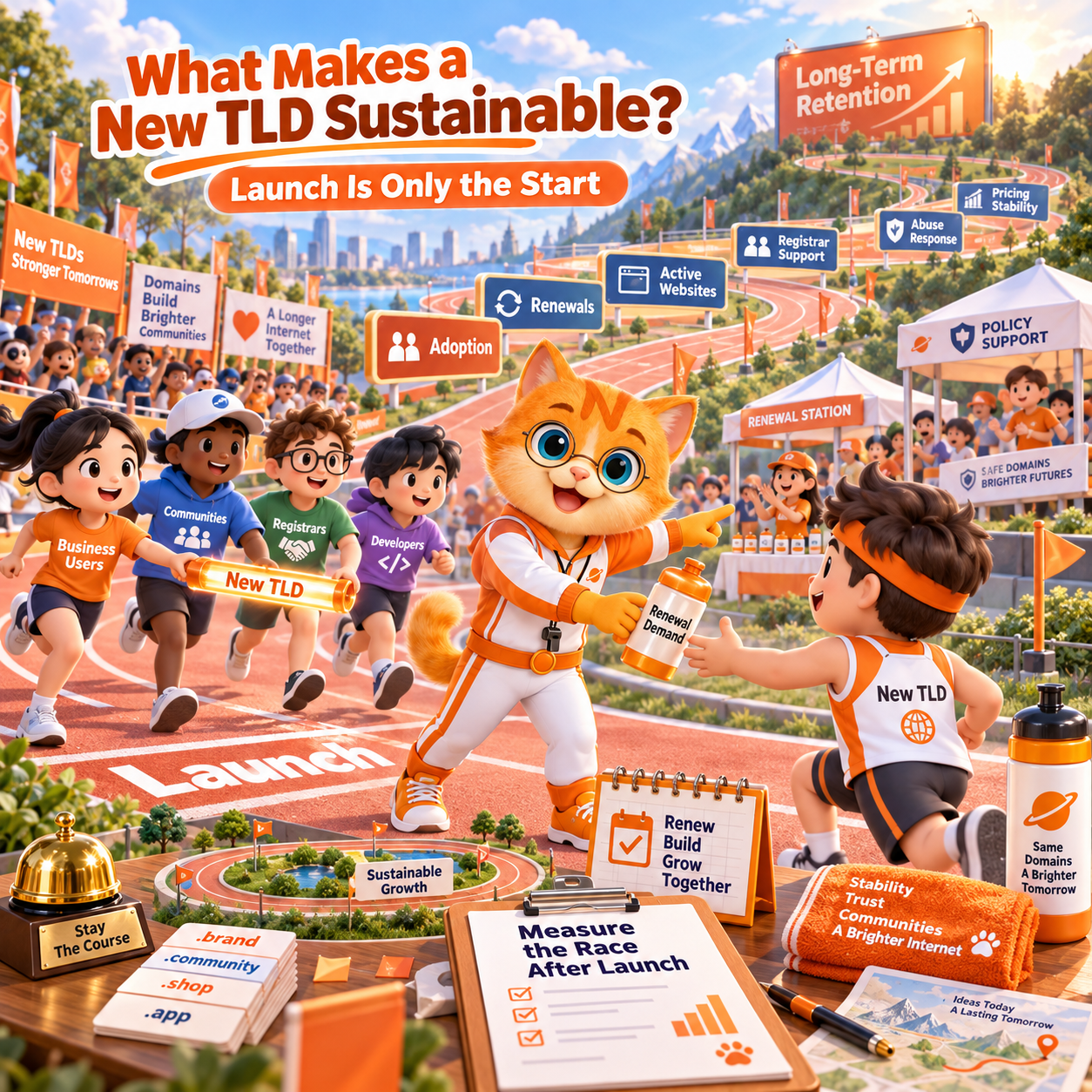
Lessons from .xihuan, .helsinki, and the 2026 New gTLD Round
Launching a new top-level domain is only the beginning. A TLD becomes sustainable when it has a clear long-term purpose, reliable distribution, healthy renewal demand, real-world usage, and an operating model that still makes sense years after delegation.
That question is especially relevant in 2026.
ICANN's Registry Agreement Termination Information Page currently lists .xihuan, operated by Beijing Qihu Keji Co., Ltd., in a public comment period following the Registry Operator's request to terminate its agreement. ICANN opened the comment period on September 7, 2026, and it runs through October 7.
.helsinki, operated by the City of Helsinki, is going through a similar process, with its current comment period ending September 18.
At the same time, a new generation of TLDs is moving forward. ICANN reported more than 1,600 primary applications when the 2026 New gTLD Round application window closed in August.
For open TLDs in particular, long-term success also depends on how effectively they reach registrants through registrars, hosting companies, resellers, and automation platforms. NiceNIC's Domain Reseller Program and Domain API are examples of the distribution infrastructure businesses use to offer and manage TLDs at scale.
So the important question is no longer simply:
Can a new TLD be launched?
It is:
What will make that TLD worth operating ten years later?
Registry Agreement Termination Does Not Automatically Mean Failure
It would be misleading to describe every terminated Registry Agreement as evidence of a “failed TLD.”
Registry operators may leave for different reasons, including changes in corporate strategy, branding priorities, organizational structure, expected demand, operating costs, or other considerations.
The current ICANN termination information for .xihuan and .helsinki does not establish a simple commercial explanation for either decision.
That distinction matters.
A brand TLD, geographic TLD, community-oriented extension, and open generic TLD may have completely different objectives. Registration volume that looks small for an open commercial extension may be perfectly reasonable for a restricted corporate namespace.
A better definition is:
A sustainable TLD is one whose long-term value continues to justify the resources, responsibilities, and cost required to operate it.
Several factors determine whether that happens.
1. The TLD Needs a Long-Term Reason to Exist
A strong launch campaign can create attention. It cannot guarantee lasting relevance.
Every TLD needs a clear answer to a basic question:
Who will still need this namespace five or ten years from now, and why?
For an open generic extension, the answer may be businesses, developers, domain investors, or communities looking for meaningful alternatives to established extensions.
For a geographic TLD, value may come from local identity.
For a brand TLD, the goal may be security, controlled digital identity, marketing, or internal infrastructure rather than large registration numbers.
This is why comparing every new TLD purely by domain count is misleading.
The business model has to match the purpose of the namespace.
2. Distribution Can Determine Whether Demand Becomes Registrations
A good TLD cannot grow if potential customers rarely encounter it.
For open TLDs, distribution through registrars and resellers is therefore a major part of sustainability.
That includes more than simply signing registrar agreements. Registrants increasingly expect extensions to work across:
- registrar search systems;
- reseller platforms;
- Domain APIs;
- hosting and billing systems;
- bulk domain management tools;
- local payment methods; and
- different geographic markets.
Every extra layer of friction reduces the number of people who move from seeing a TLD to actually registering one.
A registry may have a strong string and a reasonable price, but limited distribution can still restrict adoption.
The opposite is also true. Broad registrar and reseller availability can give an extension repeated opportunities to reach completely different groups of customers.
For open TLDs, sustainable growth is therefore partly a distribution problem.
3. First-Year Registrations Are Not the Same as Long-Term Demand
Launch numbers receive attention because they are easy to measure.
Renewals tell a different story.
Aggressive first-year promotions can introduce a new extension to the market and help registrants experiment with it. That can be a legitimate customer acquisition strategy.
But eventually a TLD has to answer a harder question:
Do registrants see enough value to keep the domain?
That makes several signals more important over time:
- renewal rates;
- renewal pricing;
- active website usage;
- email and business use;
- repeat registrations;
- reseller demand; and
- the gap between promotional registrations and retained registrations.
A large first-year registration spike may be useful, but it does not by itself prove that an extension has established durable demand.
Long-term sustainability comes when registrations turn into continued use.
4. Real Usage Makes a Namespace Harder to Replace
Registration volume measures how many domains exist.
Usage tells us how important those domains have become.
A domain used for a company’s website, customer portal, email address, application, redirect infrastructure, or public identity carries a very different renewal incentive from a domain registered only because it was inexpensive.
This matters because genuine usage creates dependence on the namespace.
A business that actively uses a domain has invested time, links, branding, customer awareness, technical configuration, and sometimes years of search visibility into that address.
That does not mean every successful TLD needs millions of active websites.
It means sustainable extensions benefit from giving registrants a reason to stay.
Registrations create scale. Usage creates durability.
5. Registry Operations Have to Work for the Long Term
Operating a TLD involves continuing technical, contractual, security, compliance, and commercial responsibilities.
The 2012 New gTLD Program’s Base Registry Agreements were established with initial 10-year terms and an expectation of successive renewal when applicable. ICANN’s 2026 Base Registry Agreement also uses a 10-year initial term.
That time horizon is important.
A TLD cannot be planned as a one-year product launch.
Registry operators have to consider years of technical operations, DNS availability, security requirements, abuse handling, policy changes, registrar relationships, support, compliance, and financial commitments.
The question at launch should therefore include the question at year ten:
Will the strategic or commercial value of this TLD still justify operating it?
Applying for a TLD is a project.
Operating one is a long-term commitment.
What the 2026 New gTLD Round Can Learn
ICANN announced that the 2026 Round closed with more than 1,600 primary applications, although the final number depends on completion of the required evaluation fee process.
Over the next several years, attention will naturally focus on evaluation, objections, contention, contracting, delegation, and launch.
Those milestones matter.
But delegation will not be the final measure of success.
For each new namespace, the more important questions begin afterward:
Will people understand what the TLD is for?
Will registrars and resellers make it accessible?
Will first-year registrations become renewals?
Will registrants actually use the domains?
And will the operating model still make sense ten years later?
The experiences of existing new gTLDs should therefore be viewed as useful evidence for the next generation, not simply as a scoreboard of winners and losers.
Launch Is Only Day One
The expansion of the domain name system creates room for new brands, communities, geographic identities, technologies, and business models.
But obtaining a TLD and sustaining one are different achievements.
A strong extension needs more than a successful application and launch campaign. It needs lasting purpose, effective distribution, real registrant demand, meaningful usage, and an operating model capable of surviving changing markets.
As the 2026 Round moves forward, those may ultimately be more important than the size of the launch.
The real test of a new TLD is not how much attention it receives on day one. It is whether people still have a reason to use it in year ten.


