


A domain registrar API lets software connect directly with registrar-side domain services so supported operations can be performed without manually opening a control panel for every task.
But before integrating one, developers usually have more practical questions.
Is API access free? Do you need a reseller account? How do you authenticate requests? How is domain pricing handled? What does a 201 Pending response mean? Can the API manage DNS and domain portfolios? And should a hosting company use a direct API or WHMCS?
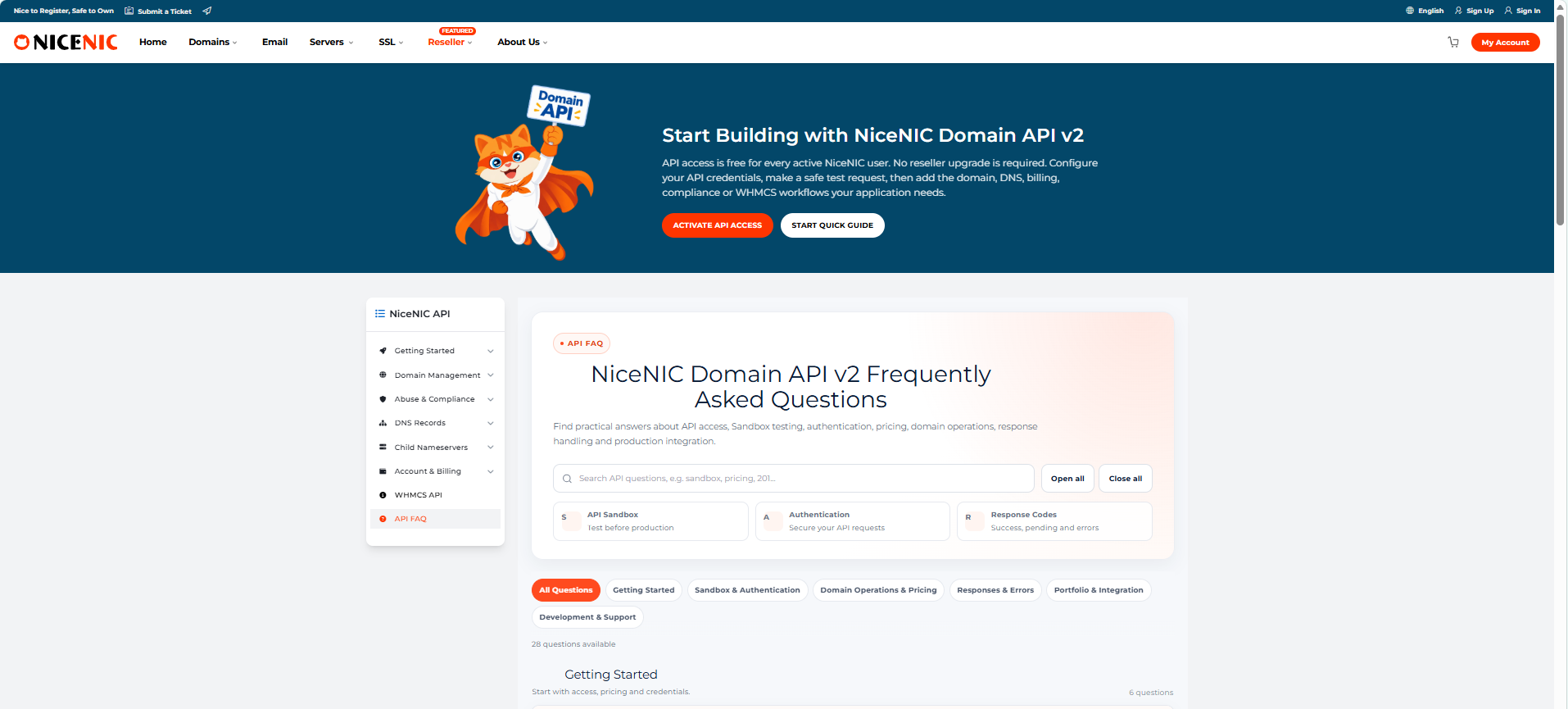
The updated NiceNIC Domain API v2 FAQ brings 28 of these questions together, covering API access, Sandbox testing, authentication, domain pricing, responses, portfolio management and production integration.
For implementation details, developers can use the full NiceNIC Domain API v2 documentation. Those who want to test first can use the NiceNIC API Sandbox before enabling live domain operations.
New to NiceNIC? You can create a NiceNIC account before setting up API access.
What Questions Should You Ask Before Choosing a Domain Registrar API?
Before choosing a domain registrar API, check who can access it, how authentication works, what domain operations it supports, how pricing and errors are handled, whether a test environment is available, and how easily it connects with your existing systems.
NiceNIC organizes its Domain API v2 FAQ into six areas:
- Getting Started
- Sandbox & Authentication
- Domain Operations & Pricing
- Responses & Errors
- Portfolio & Integration
- Development & Support
A search box also lets developers search terms such as Sandbox, pricing, transfer or 201 instead of opening every question individually.
The FAQ currently contains 28 questions, while individual API documentation pages provide the exact request parameters and examples required for implementation.
Is NiceNIC Domain API v2 Free, and Do You Need a Reseller Account?
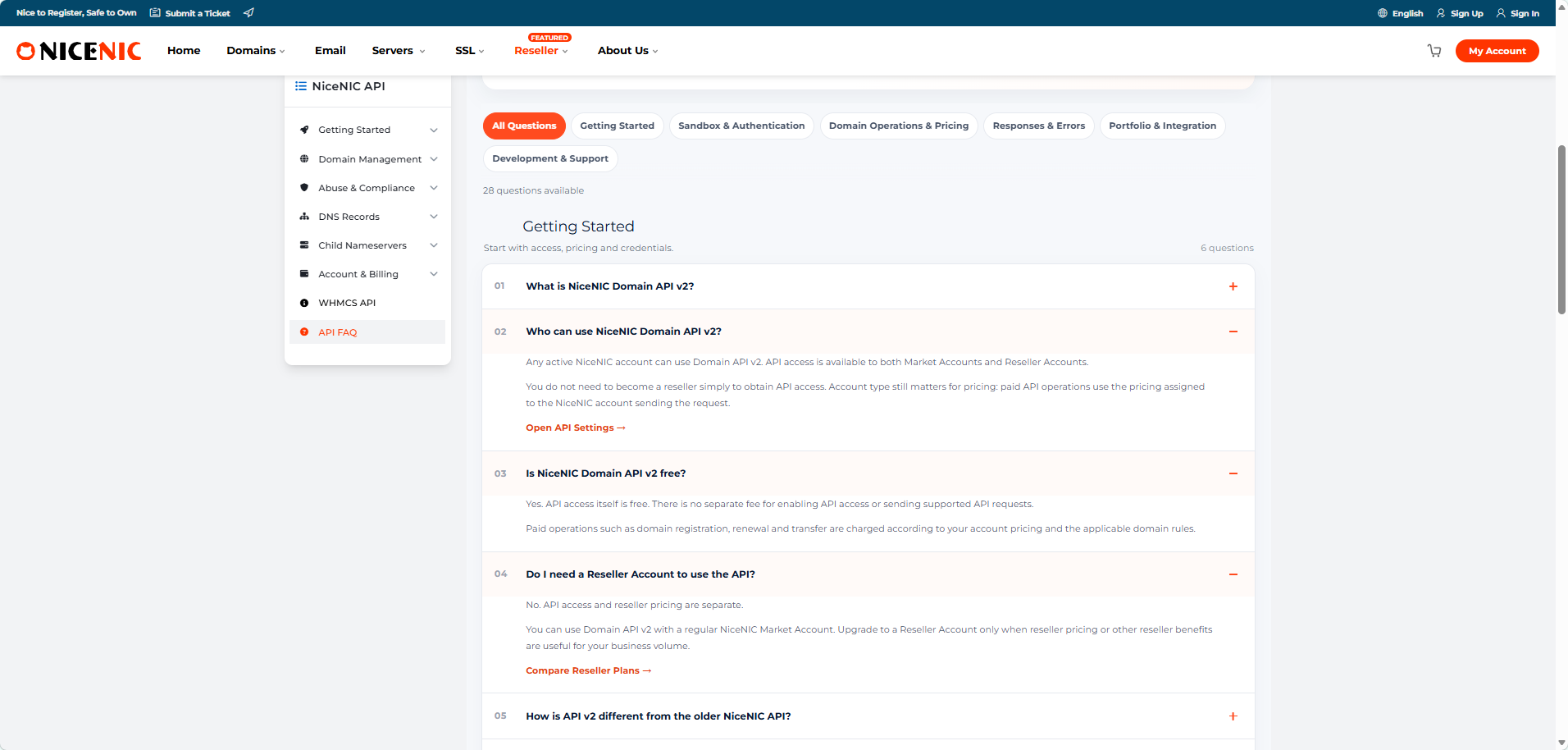
NiceNIC Domain API v2 access itself is free, and you do not need a Reseller Account simply to use the API.
API access is available to both active NiceNIC Market Accounts and Reseller Accounts.
There is no separate charge for enabling API access or sending supported API requests.
Paid domain operations are different.
Registrations, renewals, transfers and other paid services are charged according to the pricing assigned to the NiceNIC account submitting the request and the applicable rules for the domain extension.
The distinction is:
Domain API access = technical capability
Reseller status = reseller pricing and commercial reseller benefits
A developer can therefore create a standard account, evaluate the API and test an integration first.
If domain volume later makes reseller pricing more useful, the business can separately compare the NiceNIC Domain Reseller Program.
How Do You Get Domain API Credentials and Authenticate Requests?
NiceNIC Domain API v2 uses your NiceNIC username and API Secret to authenticate requests.
After signing in, open API Settings to view or manage the credentials required for your integration.
Production requests are sent over HTTPS and include the username and API Secret in the Authorization header.
For example:
Authorization: username:api_secret
If IP restrictions are enabled for the account, requests must also come from an authorized server IP.
API credentials should remain on trusted server-side systems.
Do not expose an API Secret in browser-side JavaScript, public repositories, downloadable applications or other publicly accessible locations.
For the current authentication format and examples, use the NiceNIC API Authentication documentation.
What Should You Test Before Using a Domain API in Production?
Before enabling live registrations, renewals or transfers, test authentication, request handling, responses, errors and non-final operation states.
NiceNIC provides a separate API Sandbox for development and integration testing.
A practical starting point is to test lower-risk read operations first:
Domain Availability → Domain Pricing → Account Balance → Domain Listing
Then confirm:
- authentication is working consistently;
- parameters are formatted correctly;
- responses are parsed correctly;
- errors are handled safely;
- and pending operations are not treated as completed transactions.
NiceNIC recommends the following general sequence:
Authentication → Availability → Pricing → Balance → Response Handling → Live Operations
The purpose is not simply to prove that the API connection works.
The complete application workflow should behave correctly before real customer domain operations are enabled.
How Does Domain API Pricing Work?
Domain API orders use the pricing assigned to the NiceNIC account sending the request.
For supported pricing queries, the Get Domain Pricing API can return applicable registration, renewal and transfer pricing.
This is important because those three prices are not necessarily the same.
Applications handling paid customer orders should query current account-level pricing when appropriate rather than relying indefinitely on an old cached price list.
Pricing responses can also identify premium registration cases where supported.
Individual TLDs may have different registration periods, renewal periods, transfer rules, eligibility requirements or verification requirements, so an application should not assume that the same rules apply to every extension.
What Does a 201 Pending API Response Mean for a Domain Registration or Transfer?
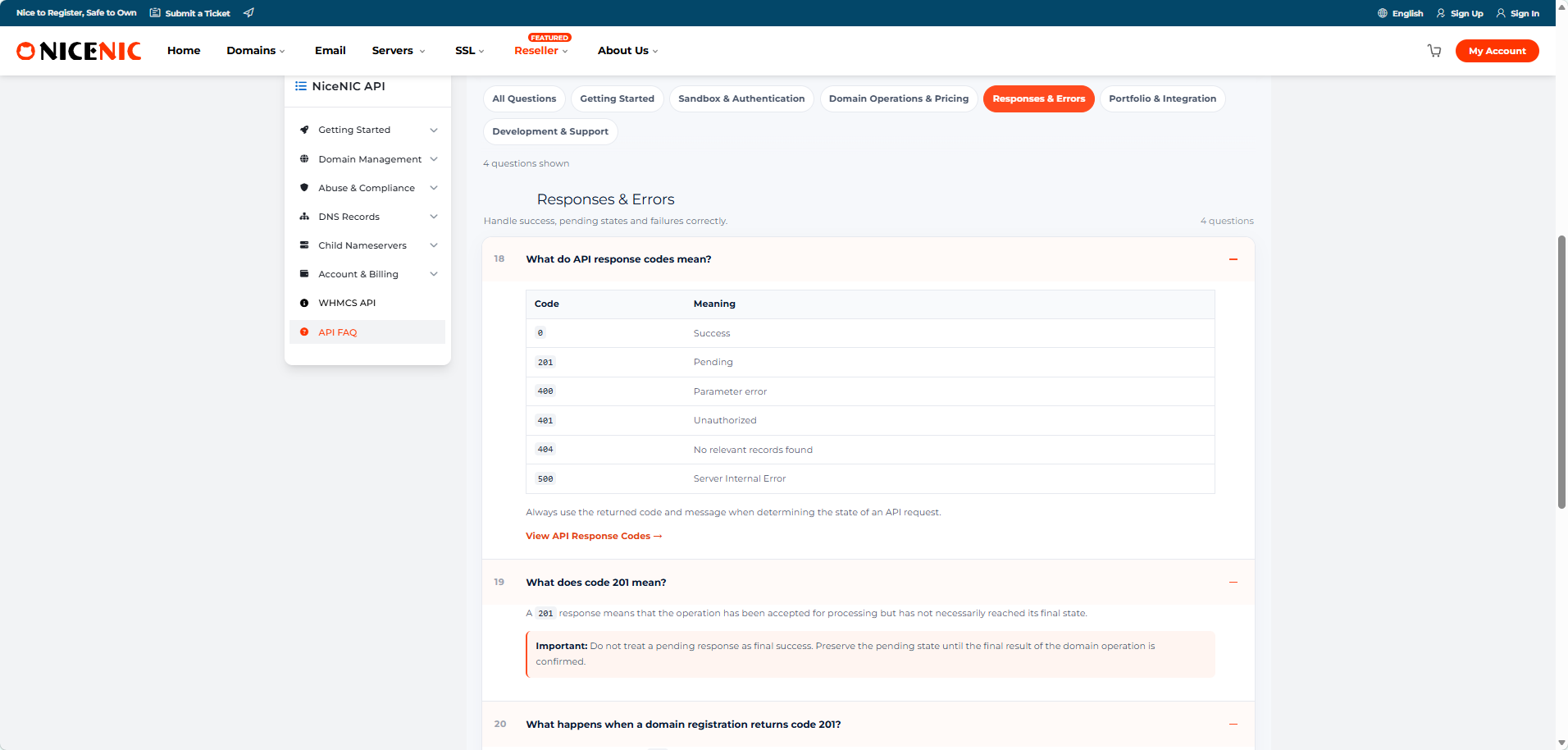
A 201 Pending response means the operation has been accepted for processing but has not necessarily reached its final result.
This distinction is critical for registrar integrations.
NiceNIC API v2 currently distinguishes several response states, including:
0
201
400
401
404
500
Applications should use the returned API code and message to determine the state of an operation.
What Does 201 Pending Mean for a Domain Registration?
For a domain registration, 201 indicates that the order has been submitted and is waiting for final registry processing.
It should not be presented to the customer as a completed registration until the final result has been confirmed.
What Does Pending Mean for a Domain Transfer?
A pending transfer means the transfer request has been accepted for processing.
It does not mean that the domain has already completed its transfer to NiceNIC.
Transfer completion may still depend on registrar and registry processing and the current transfer status of the domain.
Production systems should preserve the Pending state until the final outcome is confirmed.
Developers can use the NiceNIC API Response Codes documentation when implementing response logic.
Can a Domain Registrar API Manage DNS, Nameservers and Domain Portfolios?
Yes. A registrar API can support more than domain registration when the relevant operations are available.
NiceNIC Domain API v2 currently documents workflows covering:
- domain availability;
- registration;
- renewal;
- inbound transfer;
- domain lists and individual domain details;
- registration, renewal and transfer pricing;
- nameserver updates;
- domain contact updates;
- DNS records;
- child nameservers;
- account information;
- and other supported portfolio operations.
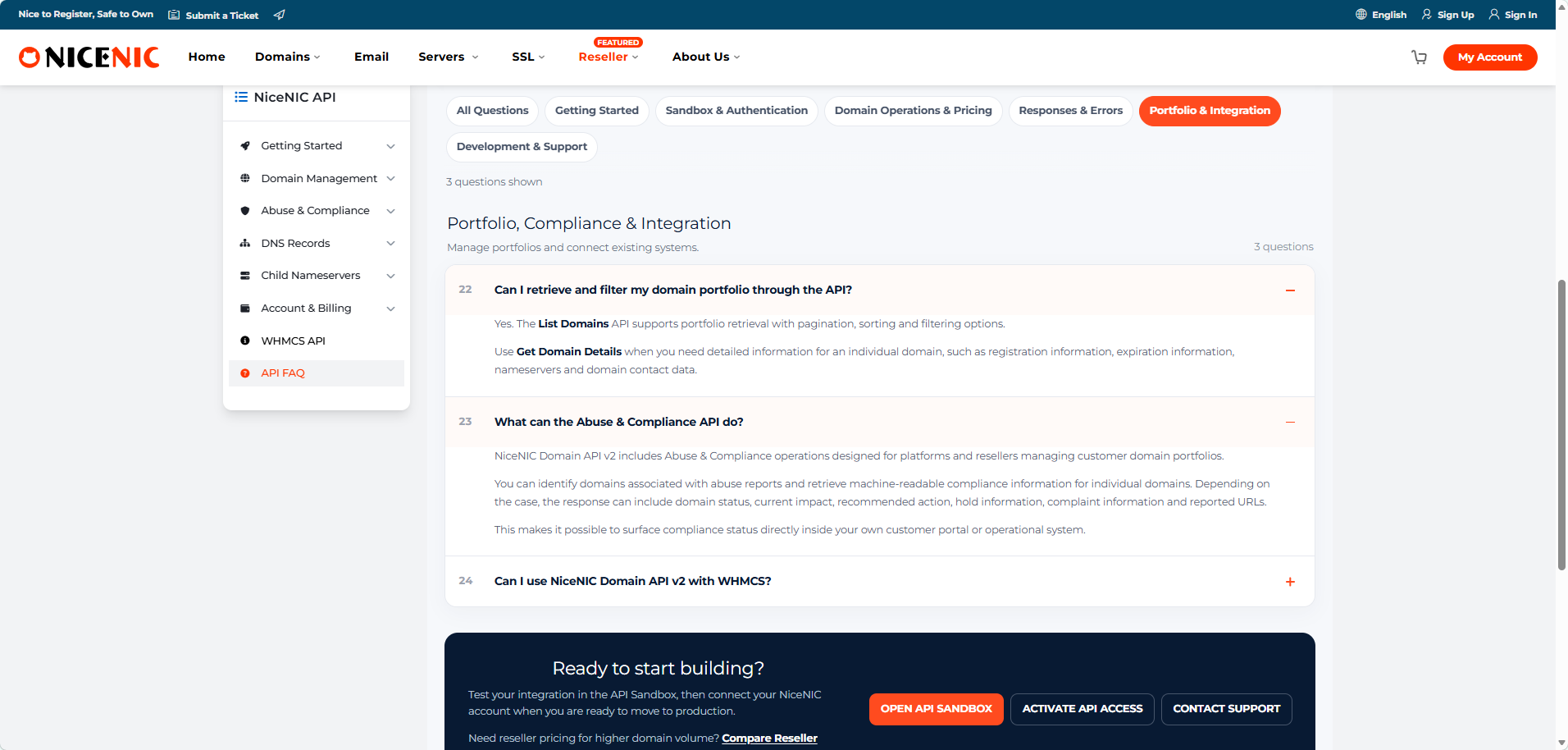
For portfolio management, the List Domains API supports pagination, sorting and filtering.
Developers can use Get Domain Details when they need information for one specific domain, including applicable registration information, expiration information, nameservers and domain contact data.
What Is the Difference Between Nameservers, DNS Records and Child Nameservers?
These are three separate domain-management functions.
Nameservers determine where the domain’s authoritative DNS is delegated.
DNS Records manage records such as A, MX, CNAME or TXT inside a DNS zone when the applicable NiceNIC DNS service is being used.
Child Nameservers create host or glue records such as ns1.example.com.
An application should not treat these operations as interchangeable.
Can a Domain API Show Abuse or Compliance Status?
Yes, where supported by the registrar API.
NiceNIC Domain API v2 includes Abuse & Compliance operations designed for platforms and resellers managing customer domain portfolios.
Depending on the case, machine-readable information may include:
- domain status;
- current impact;
- recommended action;
- hold information;
- complaint information;
- and reported URLs.
This allows a reseller, hosting company or platform to surface relevant operational information inside its own customer portal or internal system instead of relying entirely on manual communication.
For businesses managing a larger domain portfolio, that visibility can become an important part of day-to-day operations.
Should You Use a Domain API or WHMCS for Domain Automation?
Use a direct Domain API when you are building your own application or custom workflow. Use WHMCS when your hosting or domain business already relies on WHMCS for billing and provisioning.
Neither option is automatically better for every business.
When Should You Use Domain API v2?
A direct API is usually a better fit when you are building:
- a custom customer portal;
- a SaaS platform;
- an internal domain-management system;
- a website builder;
- an automation workflow;
- or another application that requires direct control over domain operations.
When Should You Use WHMCS?
WHMCS can be more practical when your hosting business already uses it for customer accounts, billing and provisioning.
NiceNIC provides a WHMCS integration for businesses using that environment.
The decision therefore depends on your existing technology stack and the amount of customization required.
Which Programming Languages Can You Use With a Domain Registrar API?
Any server-side programming language or runtime capable of sending HTTPS requests and processing JSON can integrate with NiceNIC Domain API v2.
Common options include:
- PHP
- Python
- Node.js
- Java
The important requirement is not the programming language itself.
The application must be able to make authenticated server-side HTTPS requests, handle API responses correctly and keep credentials secure.
Are There Domain API Rate Limits?
Rate limiting may be used to protect API security and platform stability.
Businesses planning sustained high-volume production traffic should review the current NiceNIC API requirements and discuss expected request patterns before launch when appropriate.
High-volume availability checking deserves particular attention because availability endpoints at domain providers may apply stricter controls than normal account-management operations.
Applications should therefore be designed to avoid unnecessary duplicate requests and should handle rate-related responses safely.
Where Do You Find the Exact API Parameters and Code Examples?
Use the individual operation pages in the NiceNIC Domain API v2 documentation.
The FAQ explains general behavior, but it should not replace endpoint-specific documentation.
For example, when implementing domain registration, use the dedicated Register Domain documentation for:
- required parameters;
- optional parameters;
- request examples;
- response examples;
- and operation-specific behavior.
The same principle applies to renewal, transfers, DNS, pricing and other API functions.
The individual endpoint documentation should be treated as the source of truth for the exact request format.
What Information Should You Send When Asking for API Support?
Provide enough technical context to reproduce or understand the issue without exposing sensitive credentials.
Useful information includes:
- request timestamp;
- API category and action;
- affected domain where relevant;
- non-sensitive request parameters;
- returned response code;
- returned message;
- and whether the request came from Sandbox or Production.
Never include your full API Secret in a normal support ticket.
This makes troubleshooting more useful while keeping credentials protected.
Why Does API Documentation Matter When Choosing a Domain Registrar?
A domain registrar API is useful only when developers can understand how the platform behaves before and after a request.
Registration endpoints are important, but so are authentication, pricing, errors, pending states, portfolio information and operational exceptions.
NiceNIC is an ICANN-accredited registrar with IANA ID 3765 and continues to expand the infrastructure around its domain services through Domain API v2, Sandbox testing, reseller tools, WHMCS integration and clearer API documentation.
For businesses comparing registrar APIs, technical capability and documentation quality should therefore be evaluated together.
How Do You Start Using NiceNIC Domain API v2?
Start with the NiceNIC Domain API v2 FAQ if you have a question about API access, pricing, authentication, responses or integration.
Ready to implement an endpoint? Open the Domain API v2 documentation.
Still testing? Use the API Sandbox before enabling live customer operations.
Need reseller pricing as your domain volume grows? Review the NiceNIC Domain Reseller Program.
New to NiceNIC? Create a NiceNIC account, activate API access and begin with the domain workflow your application actually needs.


