


Reporting a suspicious domain to a registrar is only the beginning of the abuse-handling process.
A domain abuse report does not automatically prove that a domain is malicious, and it does not automatically mean the domain should be placed on ClientHold. A registrar first needs to understand what was reported, whether the activity is still occurring, what evidence is available, which part of the infrastructure is involved and what action is appropriate.
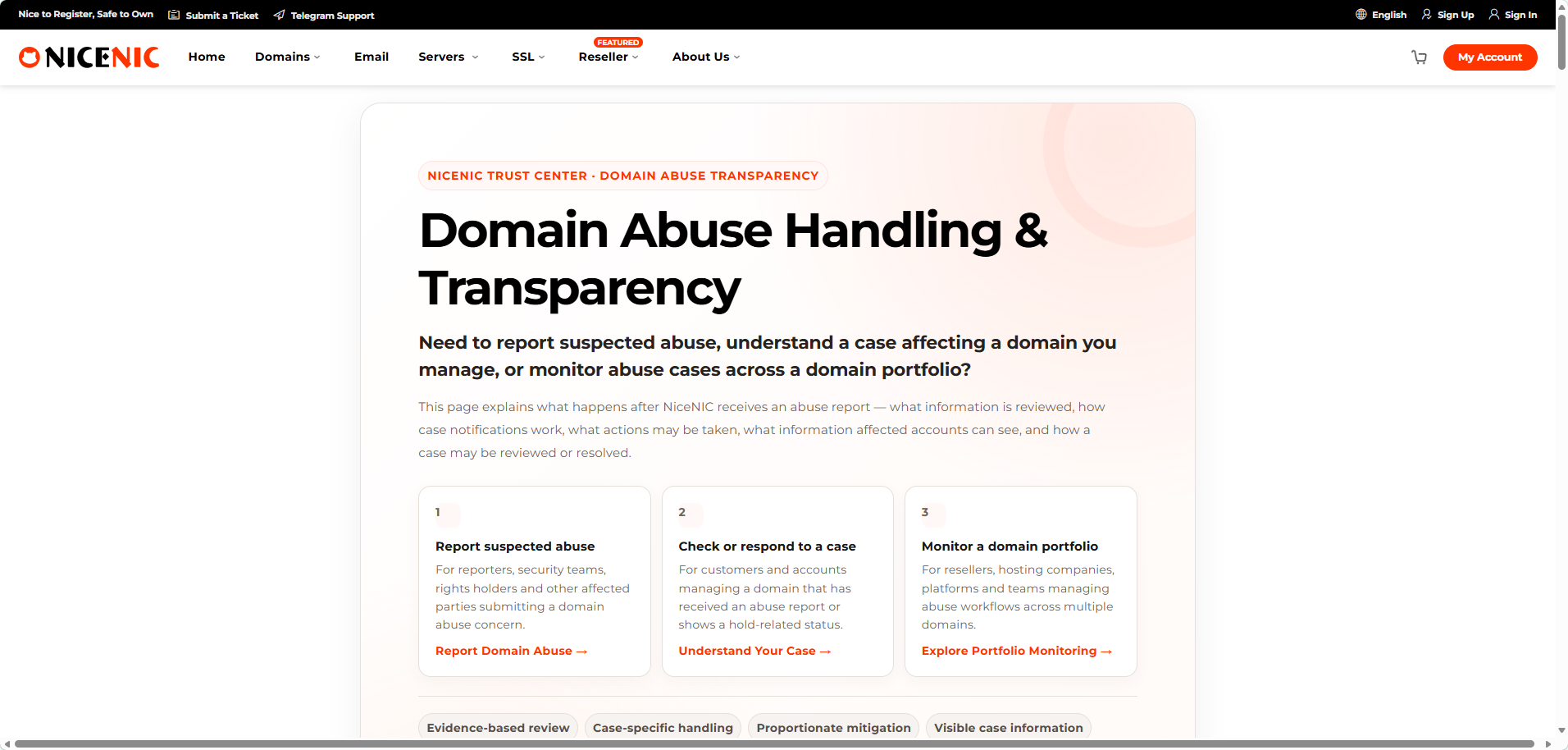
NiceNIC explains this process publicly through its Domain Abuse Handling & Transparency page, covering DNS Abuse definitions, evidence review, case handling, domain status, remediation and registrar-versus-registry responsibilities.
If you have found suspected phishing, malware or other abuse involving a NiceNIC-sponsored domain, you can also use the official NiceNIC Domain Abuse reporting channel. Domain owners and resellers who want to understand NiceNIC's broader registrar policies can review the NiceNIC Trust Center.
What Counts as DNS Abuse Under ICANN Rules?
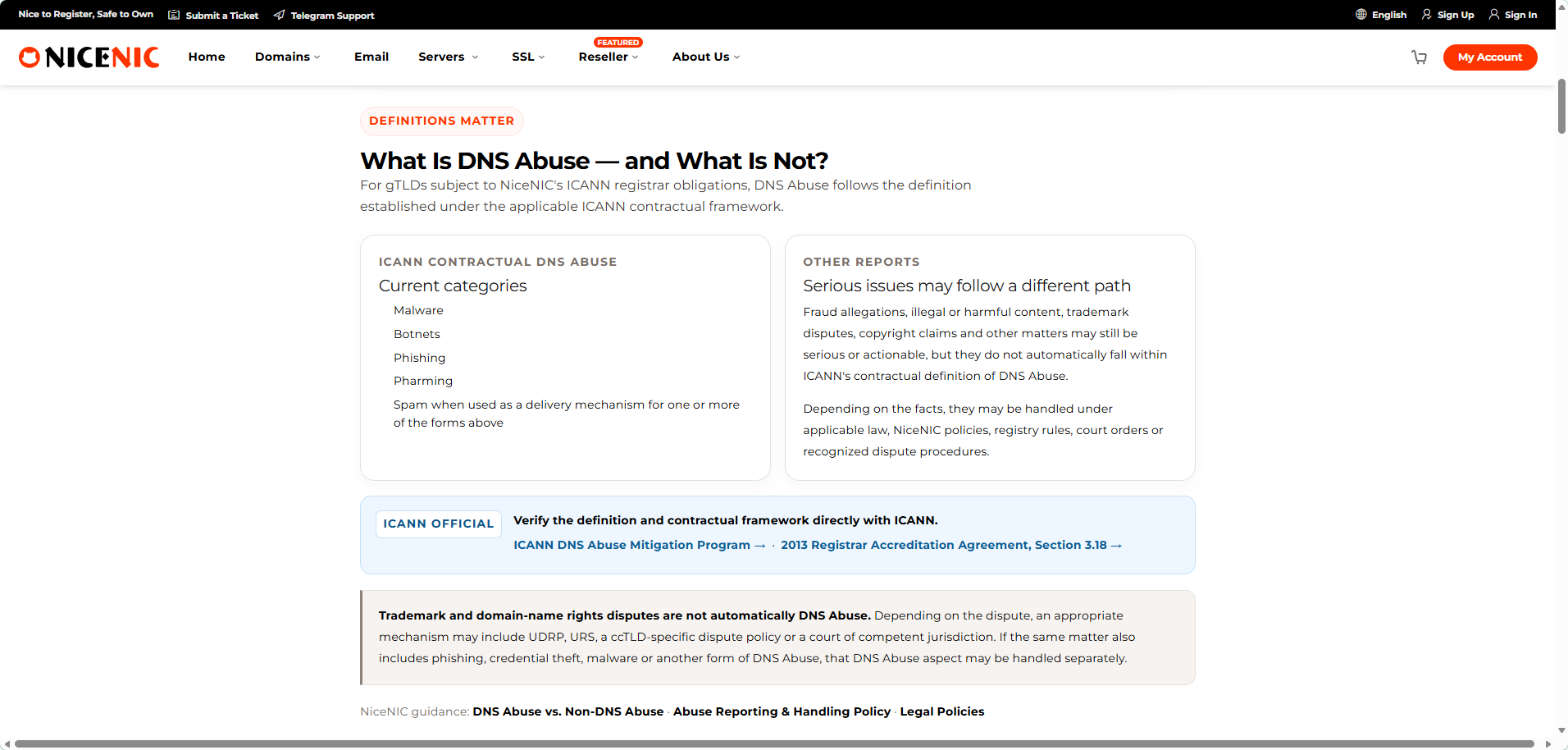
Under the current ICANN contractual framework, DNS Abuse covers five specific categories: malware, botnets, phishing, pharming, and spam when spam is used as a delivery mechanism for one or more of the other forms of DNS Abuse.
That definition matters because not every complaint involving a domain follows the same registrar process.
Fraud allegations, trademark disputes, copyright complaints, harmful content and other serious issues may still require action, but they do not automatically become contractual DNS Abuse simply because a domain name is involved.
For example, a trademark dispute may be more appropriately addressed through UDRP, URS or a court process. A website-content issue may involve the hosting provider. If the same domain is also being used for phishing or malware, however, that DNS Abuse component can be assessed separately.
NiceNIC’s public framework makes this distinction visible rather than treating every complaint category as the same type of case.
Does an Abuse Report Automatically Suspend a Domain?
No. Receiving an abuse report does not by itself automatically result in ClientHold or establish that a domain owner has violated policy.
A report starts an assessment.
NiceNIC reviews the available evidence, the nature and current status of the reported activity, the technical context and applicable ICANN, registry, legal and NiceNIC requirements before determining the appropriate response.
This distinction is important because a domain can be reported, suspicious or listed by an external source without that signal alone establishing the final outcome of a specific case. ICANN has likewise emphasized the difference between a domain being reported as malicious and having actionable evidence sufficient to support mitigation such as suspension.
Where actionable DNS Abuse is established for a gTLD, however, ICANN’s current contractual requirements call for registrars to take prompt mitigation action that is reasonably necessary to stop or otherwise disrupt the abuse.
What Happens After NiceNIC Receives an Abuse Report?
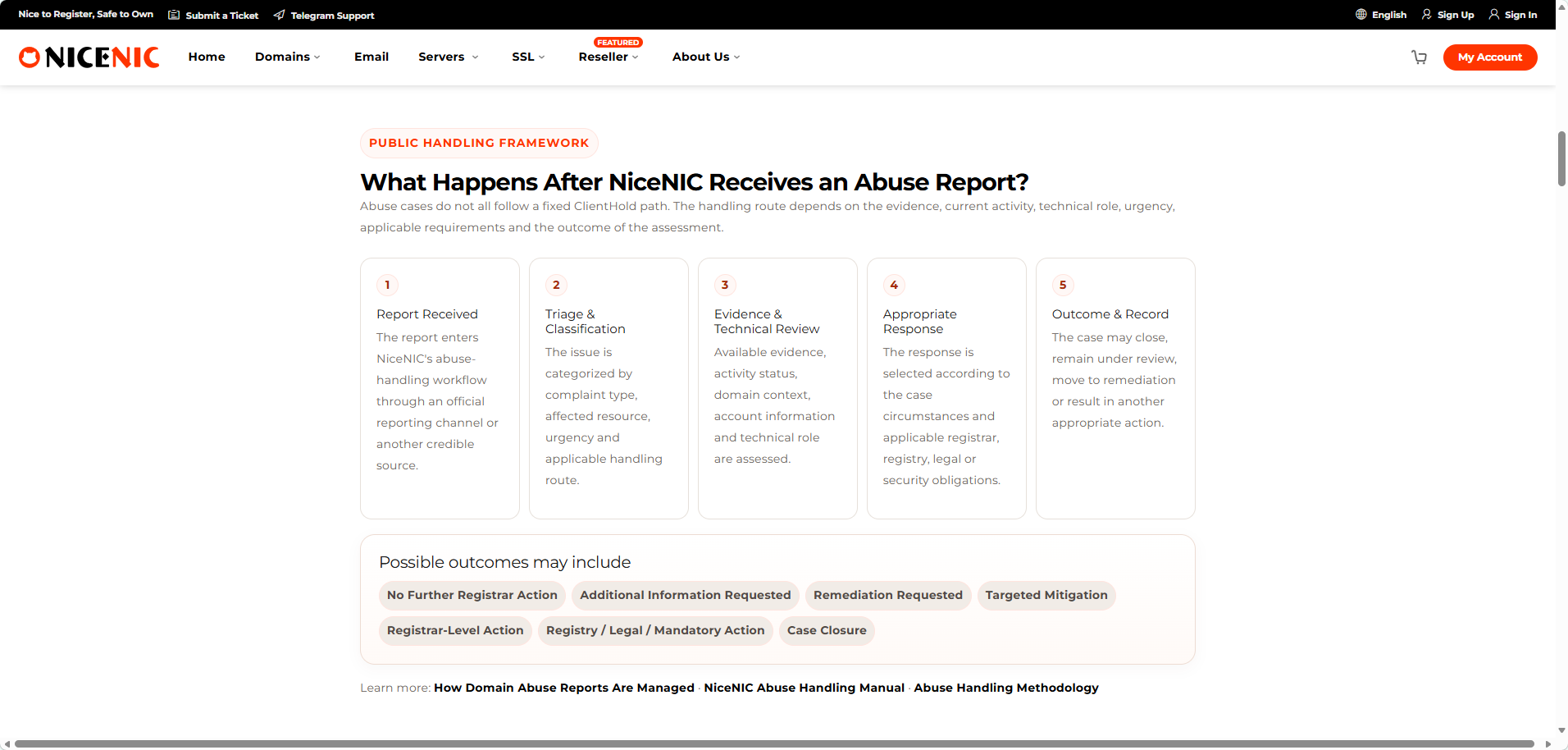
NiceNIC’s public handling framework breaks the process into five general stages.
1. Report Received — The complaint enters the abuse-handling workflow through an official reporting channel or another credible source.
2. Triage & Classification — The issue is categorized according to the complaint type, affected resource, urgency and appropriate handling route.
3. Evidence & Technical Review — Available evidence, current activity, domain context, account information and the technical role of the domain are assessed.
4. Appropriate Response — The response is selected according to the circumstances and applicable registrar, registry, legal or security requirements.
5. Outcome & Record — The case may close, remain under review, move to remediation or result in another appropriate action.
Possible outcomes can therefore range from no further registrar action or a request for more information to remediation, targeted mitigation, registrar-level restriction, registry or legally required action, or case closure.
There is no rule saying every complaint must travel through exactly the same path.
What Evidence Does a Registrar Review in a Domain Abuse Case?
A registrar needs enough information to understand both the allegation and the technical context.
Depending on the case, NiceNIC may review the reported domain and URLs, whether the activity remains active, the relevance and quality of the evidence, DNS and nameserver information, relevant registration or account information, and whether the domain appears intentionally malicious or may instead be a legitimate domain that has been compromised.
The review may also consider whether the reported material is actually controlled at the registrar layer or sits on third-party hosting, email, CDN or application infrastructure.
This is why a specific, reproducible report is usually more useful than a general claim that a domain “looks suspicious.”
Reporters who need guidance can use NiceNIC's Domain Abuse Evidence Guide before submitting supporting material.
How Does a Registrar Decide What Action to Take?
The appropriate response depends on the evidence, current activity, severity, domain context, technical responsibility and applicable requirements.
NiceNIC’s current framework specifically evaluates whether the reported activity is still active or has already been remediated, how serious the potential harm is, whether the domain appears intentionally malicious or compromised, and which provider actually controls the affected technical layer.
This is the basis for proportionate mitigation.
A response should be effective against the abuse without assuming that exactly the same measure is appropriate for every report. At the same time, well-evidenced actionable DNS Abuse must be addressed promptly where registrar action is required.
Should You Report Abuse to the Registrar or the Hosting Provider?
It depends on which technical layer is involved.
A domain registrar controls domain-registration functions and registrar-level statuses. It does not necessarily control the website files, web application, email server, VPS, CDN or hosting environment behind the domain.
A hosting provider controls infrastructure where website content or applications may actually reside.
For some cases, action at the hosting layer may therefore remove abusive content more directly. For others, particularly actionable DNS Abuse, registrar-level mitigation may also be required.
Reporting to the correct technical provider can reduce unnecessary delay, especially when the abuse exists in infrastructure the registrar itself does not host or control. NiceNIC explains this registrar-versus-hosting distinction directly in its transparency framework.
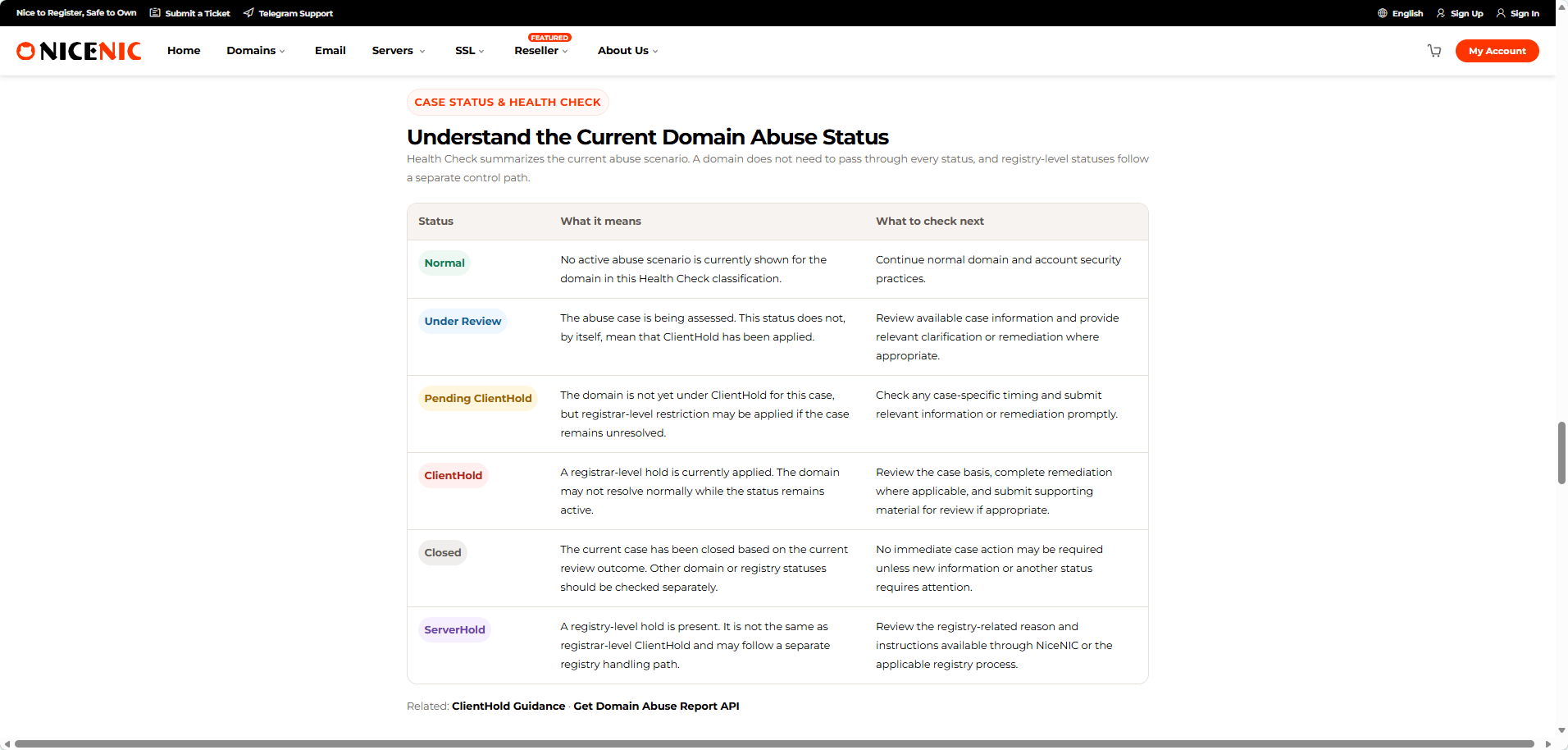
What Do Under Review, Pending ClientHold, ClientHold and ServerHold Mean?
These statuses describe different situations and should not be treated as interchangeable.
The most important distinction is control.
ClientHold is registrar-level. ServerHold is registry-level.
Both can affect DNS resolution, but a registrar cannot simply treat a registry-imposed ServerHold as if it were its own ClientHold. Current industry documentation similarly distinguishes client statuses set at registrar level from server statuses controlled by the registry.
Can a Domain Owner Respond or Submit Remediation Evidence?
Yes, where the case circumstances permit.
When clarification or remediation is appropriate, NiceNIC may give the account managing the domain an opportunity to respond before registrar-level restriction. Available case information may include the complaint category, reported URLs, timestamps, summary, current status, domain impact, relevant timing, evidence indicators and recommended next steps.
If a discretionary NiceNIC restriction has already been applied, an affected customer may also request review and submit new information, remediation evidence, or evidence that earlier information was inaccurate, outdated or misclassified.
A review does not guarantee restoration when a continuing registry, legal, ICANN, security or abuse basis requires the restriction to remain.
Affected customers can review NiceNIC's Review and Remediation guidance for more information.
What Should You Include in a Domain Abuse Report?
A useful domain abuse report should make the affected resource and the alleged activity easy to identify and reproduce.
NiceNIC recommends providing the affected domain, the exact abusive URL or hostname where relevant, a clear factual description and complaint category, the date and time observed with time zone, screenshots or captured evidence where appropriate, relevant technical indicators or logs, and reporter contact information.
The exact evidence depends on the complaint. A phishing report, for example, may benefit from the malicious URL and the legitimate organization being impersonated, while an email-abuse report may require full message headers.
The goal is not simply to send more material. It is to provide evidence that helps identify, reproduce and assess the reported activity.
How Does Abuse Transparency Help Domain Owners and Resellers?
Transparency is useful when it answers operational questions, not when it simply says that a case exists.
An affected account needs to know what was reported, what information is available, whether the domain is currently affected, whether action is expected, whether a deadline applies and what happens next.
NiceNIC’s Health Check approach is designed around those questions and may display complaint information, current status, current domain impact, timing, evidence indicators and recommended next steps where available and permitted.
That visibility is particularly important for resellers and hosting companies managing domains for customers, because a case can otherwise become a support problem before the reseller understands which domain is affected or what action is needed.
It also reflects a broader principle behind the NiceNIC Trust Center: registrar trust should be supported by public processes and verifiable information, not only by marketing claims.
How Do You Report or Review a NiceNIC Domain Abuse Case?
If you are reporting suspected phishing, malware or other domain abuse, use the official NiceNIC Domain Abuse Report page and provide specific, verifiable evidence.
If you manage a domain affected by an abuse case, start with the information available in your NiceNIC account and review the Domain Abuse Handling & Transparency page to understand the handling stage, domain impact and possible next step.
For broader information about NiceNIC's accreditation, policies, security, privacy and registrar responsibilities, visit the NiceNIC Trust Center.
NiceNIC is an ICANN-accredited registrar, and its abuse-handling framework is designed to make an important distinction visible: a report starts a review; evidence and applicable requirements determine what happens next.


