


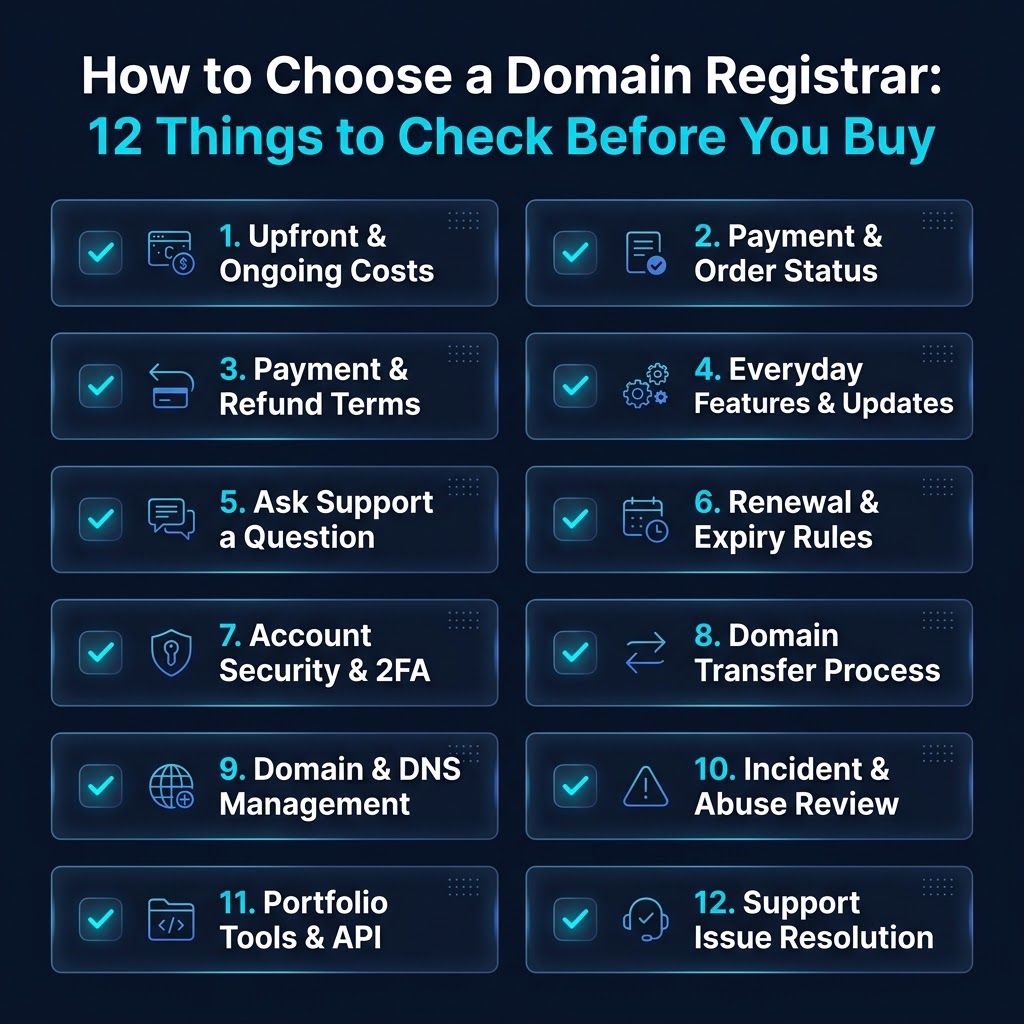
A domain name may support your website, email and brand for years. When choosing a registrar, consider the ongoing costs, day-to-day management and support process alongside the initial registration price.
Whether you are building your first website or managing several domains, these 12 checks can help you make an informed choice.
1. Compare upfront and ongoing costs
Compare registration, renewal and transfer-in fees, along with any redemption fees that may apply. Confirm whether the quoted prices include applicable additional charges.
For introductory offers, check the promotion period, any account tier requirements and the subsequent renewal price. Premium domains may have different registration and renewal pricing, so confirm those terms separately. Estimate the total cost over the years you plan to keep the domain.
2. Check how payment and order status are shown
Before placing an order, check how the registrar distinguishes between paid, processing, completed and failed orders. You should also be able to find guidance for orders that require a review or additional information.
After a registration or renewal, verify the domain details and the result in your account. If the information is inconsistent, keep your order number and payment record and contact official support. Clear status information helps you decide whether further action is needed.
3. Understand payment and refund terms
Choose a payment method you can use, and confirm the amount, currency and applicable fees before paying. If you enable automatic renewal, check which payment source it uses, when payment is taken and how to turn it off.
Review the process for incomplete payments, failed orders and refund requests, including where to check progress, the conditions that apply and the steps involved. If a transaction’s status is unclear, check the original order before paying again to reduce confusion from duplicate submissions.
4. Check everyday features and service updates
Check whether everyday tasks, such as signing in, searching for domains, making payments, renewing and managing domains, are straightforward for your needs.
If a provider publishes uptime figures or service commitments, review which services they cover and how performance is measured. Find out where planned maintenance and unexpected outages are announced, so you can plan migrations, launches and bulk operations.
5. Ask support a specific question
Before buying, ask a question relevant to your plans. You might ask what documents a particular domain extension requires, how a transfer works or how to check the results of a bulk order.
Consider whether the reply answers your question, explains the next step and provides the information or instructions you need. If further work is required, find out how to follow up on the ticket and check progress. Resolution times can vary by issue; clear communication helps you plan.
6. Review renewal and expiry arrangements
Check how to enable automatic renewal, when it runs, its payment requirements and how you will be notified if it fails. For important domains, regularly review expiry dates and renewal results, and keep your account’s contact email address current.
Post-expiry procedures depend on the domain extension and its status. For generic top-level domains covered by the relevant ICANN policy, consult the Expired Registration Recovery Policy. For other extensions, check the rules published by the relevant registry and service provider.
If a domain has already expired, confirm its current status, available options, deadlines and fees before arranging payment.
7. Check account security and identity verification
Find out which account protection features are available, such as two-factor authentication, login alerts and verification for sensitive changes, and how to enable them.
Also review identity verification for account recovery, contact email changes and domain transfers. If you need to submit documents, confirm the official submission channel and the relevant privacy information. If several people manage your domains, define their access permissions and maintain internal records of important actions.
8. Understand the transfer process in advance
Find out how to unlock a domain and obtain transfer authorization details where required, how to track progress, and what fees apply. Confirm how a transfer affects the registration term.
Transfer conditions vary by extension and domain status. The ICANN Transfer Policy applies to the generic top-level domains within its scope. Country-code domains require a separate check of the relevant registry's rules.
Before scheduling a transfer, confirm any applicable restrictions, required information and the earliest date you can proceed.
9. Know who manages your domain and DNS
Domain registration, DNS, website hosting and email may be provided by different companies. When choosing a registrar, find out where to change your domain’s nameservers and who manages the DNS records themselves.
If you plan to connect a third-party website or email service, check for relevant setup instructions. When requesting help, include the domain name, error messages, recent changes and checks you have already made. These details help support identify which part of the setup needs attention.
10. Understand incident handling and review options
Read the provider’s published procedures for security incidents, abuse reports and requests for review. Find out whom to contact after receiving a notice, what information to submit and how to follow the case.
Where the relevant ICANN contractual provisions apply, DNS abuse handling requires prompt, appropriate action based on actionable evidence, while taking potential effects on legitimate activity into account. See ICANN's advisory on DNS abuse obligations for the applicable principles.
Understanding the notice, how to provide supporting information and the available review process can help you respond promptly when needed.
11. Choose tools that fit your domain portfolio
For a few domains, a clear dashboard and expiry reminders may be sufficient. As your portfolio grows, check whether bulk actions, filters, record exports and APIs suit the way you work.
If you plan to use an API, review the documentation, test environment and methods for checking operation results. Also check the guidance for verifying and retrying requests after a timeout. Validate your workflow before gradually introducing live orders, so you can identify and address issues.
12. Find out how support issues are resolved
Understand how to report order problems, service faults and billing disputes, and where to check their progress and outcome.
After an issue is handled, verify the relevant order, domain status or refund progress. If anything remains outstanding, add the details to the original ticket to keep a complete record. A clear support process can reduce repeated explanations and help you resume normal operations.
Explore NiceNIC for your needs
If you are planning to register or transfer a domain, use the NiceNIC domain price list to check the fees for your chosen extension and account tier. You can also review the domain expiry policy.
For bulk management or integration needs, read the Domain API documentation and use the API sandbox to test your workflow. Sandbox operations do not create live domain orders or incur real charges.
You can also contact official support with your preferred extensions, the number of domains you plan to manage and your business requirements to ask about the relevant products and rules.
Clarifying costs, management tools and service processes, then considering your actual experience, can help you choose a registrar that fits your long-term website, email and domain needs.


