


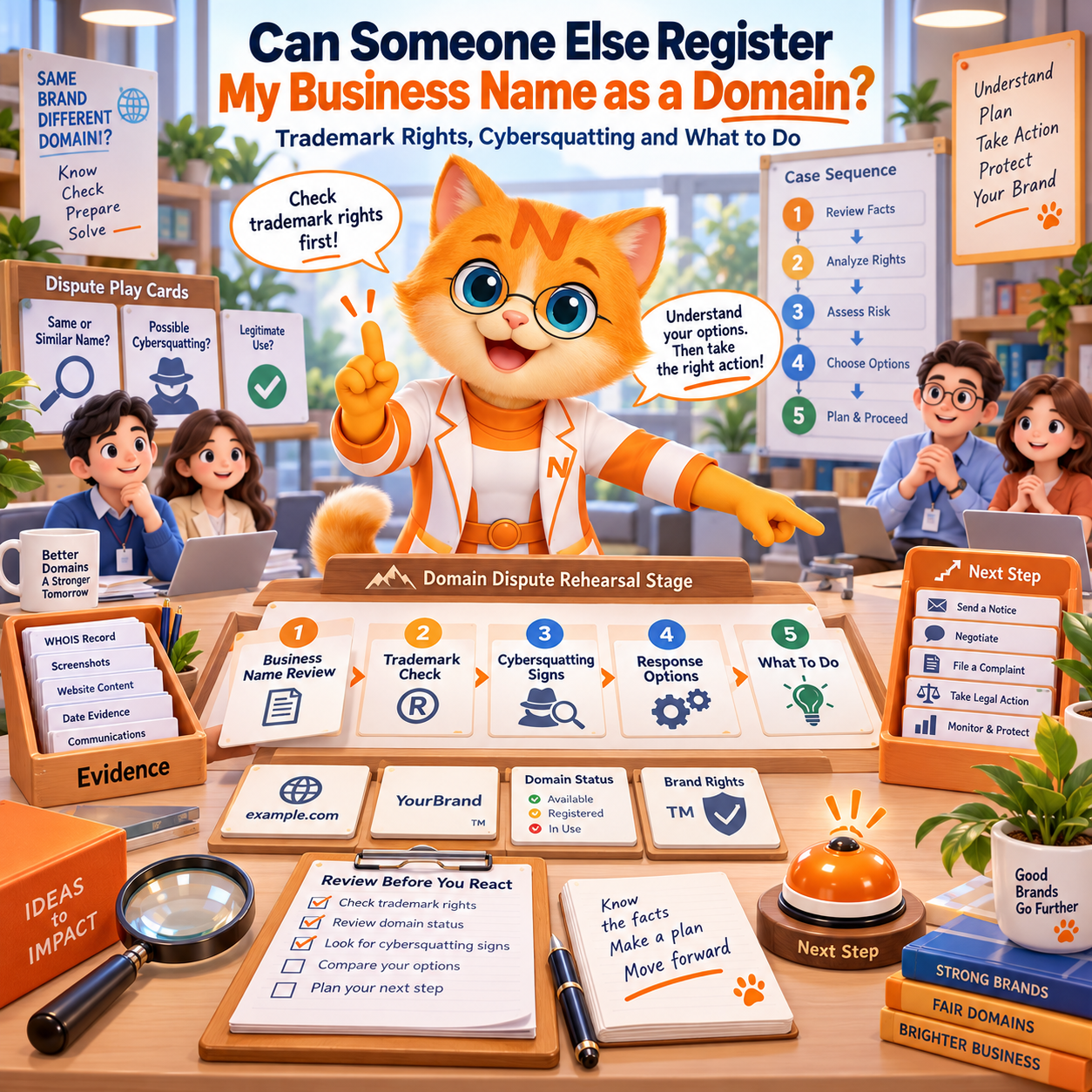
Can Someone Register a Domain That Matches My Business Name?
Yes, in many cases someone else may be able to register a domain that matches your business name if the domain is available and they meet the rules of that TLD.
Registering a company or business name does not automatically reserve the matching domain name.
But that does not mean every registration or use of your business name is lawful.
Trademark rights, the registrant’s legitimate interest in the name, how the domain is used, and whether it was registered and used in bad faith can all matter in a domain dispute.
If you are still choosing a business name, it is smart to check the domain before publicly launching the brand.
Check Multiple Domain Extensions
Important: Domain registration, business-name registration and trademark rights are separate systems. Registering one does not automatically give you rights to all the others.
Is a Business Name the Same as a Domain Name or Trademark?
No.
For example, registering:
Example Studio LLC
does not automatically reserve:
examplestudio.com
And registering examplestudio.com does not automatically give the registrant trademark rights to Example Studio.
That is why domain availability should ideally be checked at the same time as business-name and trademark research.
Does Registering a Business Name Protect the Matching Domain?
Not automatically.
A company registry, business-name registry and domain registry perform different functions.
A domain may still be available for another eligible person or organization to register even though you have already formed a company using the same words.
This is especially important before:
- announcing a new company
- launching a product
- publishing a new brand name
- printing packaging
- starting a large advertising campaign
Checking the domain after the brand becomes public creates more opportunity for someone else to register it first.
A better order is:
Check business name → Check trademark risk → Check domain availability → Secure important domains → Launch the brand
Does Owning a Trademark Mean You Automatically Get the Matching Domain?
No.
A trademark can give you important rights, but it does not automatically transfer every matching or similar domain to you.
Another registrant may have:
- an independent legitimate business using the same or similar name
- earlier rights
- a legitimate descriptive use
- a personal or organizational connection to the name
- another recognized legitimate interest
For trademark-based disputes involving gTLDs such as .COM, the Uniform Domain Name Dispute Resolution Policy, or UDRP, provides a process for certain abusive registrations.
Under the UDRP, a complainant generally needs to establish all three elements:
- The domain is identical or confusingly similar to a trademark or service mark in which the complainant has rights.
- The registrant has no rights or legitimate interests in the domain.
- The domain was registered and is being used in bad faith.
You can review the official ICANN UDRP information and the WIPO UDRP Guide.
Does Registering a Domain Give You Trademark Rights?
Not by itself.
Registering a domain proves that you obtained that particular domain registration.
It does not automatically establish trademark rights in the words contained in the domain.
Trademark rights depend on factors outside the normal domain-registration process, including the applicable jurisdiction, mark and use.
This distinction works both ways:
A domain registration does not automatically create a trademark.
And:
A trademark does not automatically transfer every matching domain.
What Is Domain Cybersquatting?
Cybersquatting generally refers to bad-faith registration or use of a domain that targets another party’s trademark rights.
Under the UDRP, examples that may support a finding of bad faith include circumstances where a domain was registered primarily to:
- sell it to the trademark owner for more than documented domain-related costs
- prevent the trademark owner from using the corresponding domain as part of a pattern of such conduct
- disrupt a competitor
- attract users for commercial gain by creating confusion with the trademark
But context matters.
Simply registering the same or a similar word does not automatically prove cybersquatting.
The registrant may have a legitimate reason for using the name.
Can Two Legitimate Businesses Use the Same or Similar Name?
Yes, this can happen.
Two businesses may operate:
- in different countries
- in unrelated industries
- in different markets
- under a common surname
- using an ordinary dictionary word
- with separate legitimate histories
For example, the fact that another company operates under a similar name does not automatically mean its domain registration is abusive.
This is why:
"They registered my business name" is not enough by itself to prove cybersquatting.
The trademark rights, timing, legitimate interests, domain use and evidence of bad faith all matter.
What Should I Do If Someone Already Registered My Business Name?
First, find out what is actually happening.
If this has already happened, read:
Someone Registered My Business Name as a Domain: What Can I Do?
For a genuine security or abuse issue involving a NiceNIC-sponsored domain, use the official Report Abuse channel.
Can a Registrar Transfer a Trademark Domain to Me After I Complain?
Usually, a registrar cannot simply decide a private trademark ownership dispute and transfer the domain to one party based only on a complaint.
ICANN explains that most trademark-based domain disputes must be resolved through:
- agreement between the parties
- the applicable dispute-resolution process
- court action where appropriate
For gTLD cybersquatting disputes, the UDRP is one available administrative process.
This protects both sides: trademark owners have a dispute mechanism, while legitimate registrants have the opportunity to respond.
What Is the Difference Between UDRP and URS?
They are different rights-protection mechanisms.
UDRP
The UDRP can apply to gTLD trademark-based abusive-registration disputes and certain ccTLDs that have adopted it.
Possible UDRP outcomes include:
- transfer of the domain
- cancellation of the domain
- denial of the complaint
URS
The Uniform Rapid Suspension System is designed as a faster process for particularly clear-cut trademark infringement cases involving applicable gTLDs.
Its main remedy is suspension, not transfer of the domain to the complainant.
URS does not apply to ccTLDs through ICANN’s URS process.
You can review the official ICANN URS information.
For ccTLDs, always check the dispute policy for that specific extension. Some use the UDRP, some use a modified version, and others have their own dispute procedures.
This article provides general domain-name information, not legal advice. Specific trademark rights and dispute options depend on the facts, jurisdiction and TLD.
How Can I Reduce the Risk of Someone Registering My Brand Domain?
The best time to think about domain protection is before the brand becomes public.
A practical approach is:
1. Search the main domain before finalizing the brand
2. Check obvious trademark conflicts
Do this before investing heavily in branding, advertising or packaging.
3. Register your primary domain early
If the domain is important to the business, do not wait until the website is finished.
You can register the domain first and connect hosting later.
4. Consider your most important alternative extensions
For example, a business may consider:
-
its main
.COM - an important country-code TLD
- a key market-specific extension
- a small number of obvious defensive variants
5. Protect the registrar account
Use a strong password, Two-Factor Authentication and accurate account information.
6. Keep important domains renewed
Defensive registration only works while the domains remain under your control.
Should You Register Multiple Domain Extensions for Your Brand?
Sometimes, but you do not need to register every TLD.
The better question is:
Could this domain realistically confuse customers or create a meaningful brand risk?
A growing business might prioritize:
- its primary domain
- the main ccTLD for a core market
- one or two obvious alternative extensions
- a particularly important product name
- an obvious typo only where the risk justifies the cost
Buying hundreds of unrelated extensions can create unnecessary renewal cost.
If you want to check several brand variations at once, use NiceNIC Bulk Domain Search.
What Should You Check Before Launching a New Business Name?
Before announcing the brand, run this quick checklist:
- Is the main domain available?
- Are important alternative extensions available?
- Have you checked obvious trademark conflicts?
- Is the business name available where required?
- Are your key social handles available?
- Who will control the registrar account?
- Have important domains been registered and secured?
- Do you know which domains need long-term renewal?
The cheapest time to solve a domain-name problem is usually before the brand becomes established.
Frequently Asked Questions
Can someone legally register my business name as a domain?
Potentially, yes. Business-name registration does not automatically reserve the matching domain. Whether another person’s registration or use infringes trademark rights depends on the specific facts and applicable rules.
Does registering a business name give me rights to the domain?
Not automatically. Business names and domain registrations are separate systems.
Does owning a trademark mean I automatically get the matching domain?
No. A trademark may support a UDRP or other legal claim, but the rights, legitimate interests and bad-faith evidence still matter.
What is cybersquatting?
Cybersquatting generally refers to bad-faith domain registration or use that targets another party’s trademark rights.
What can I do if someone registered my trademark as a domain?
Preserve the evidence, identify the applicable TLD dispute policy, assess whether the registrant has legitimate rights or interests, and consider the UDRP, another applicable dispute procedure or legal advice where appropriate.
Should I register several domains to protect my brand?
Register the domains that create a realistic brand or customer-confusion risk. You usually do not need every available TLD.
Protect the Domain Before You Launch the Brand
If you are still choosing a new business or product name, check the domain before announcing it publicly.
If the matching domain has already been registered:


