


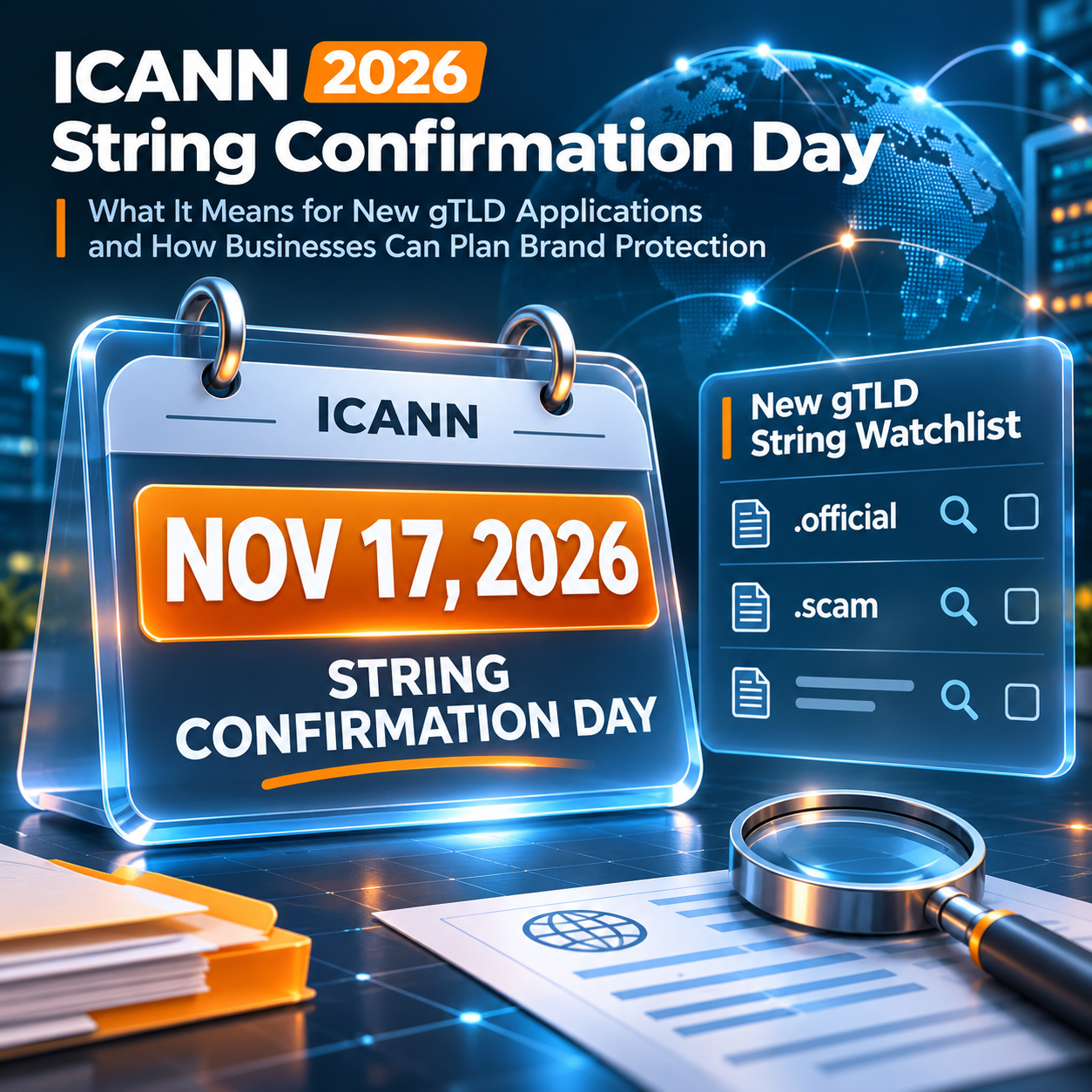
Direct answer: Use ICANN's November 17, 2026 String Confirmation Day to review the confirmed new gTLD applications, identify strings relevant to your trademarks, and assign decisions to your legal and domain teams. This milestone opens the community input and objections process; it is not a public registration launch. At the same time, secure available brand names in the markets where you already trade or have approved expansion plans. Start with NiceNIC Bulk Domain Search to check your existing-extension shortlist, then budget for registration, renewals and any required local-presence services.
What changes on November 17?
Under ICANN's announced 2026-round timetable, November 17 brings publication of the confirmed applied-for strings and updated contention sets following the replacement period. A contention set groups applications competing for identical or confusingly similar strings.
The Community Input and Objections Period runs from November 17, 2026 through March 16, 2027. For brand owners, this creates a defined opportunity to examine applications and organize a response.
The next steps toward operation include string evaluation, contention resolution where applicable, applicant and application evaluation, contracting, technical onboarding and delegation. ICANN's Applicant Journey explains these stages. Plan purchasing decisions around each extension's eventual launch schedule and registration policies.
Why .official and .scam belong on a brand watchlist
In its November 3 coverage of potentially sensitive strings, Domain Name Wire highlighted applications for .scam and .sus, alongside competing applications for .official and .brand.
These names raise different business questions. With .official, a brand team should examine who will qualify to register and how the proposed registry intends to address misleading claims of affiliation. With .scam, the review should involve communications as well as legal staff, with attention to the applicant’s stated purpose, registration policies and planned rights-protection mechanisms.
Build your watchlist from ICANN's Application Publication and Statistics database. Record the application ID, applicant, proposed purpose, status and relevant policy documents. Recheck those records on String Confirmation Day: ICANN explains that the database's initial Reveal Day information is updated at that milestone and regularly thereafter.
Use the following working structure:
Give every watchlist entry a named owner and a next review date. That turns a headline into a decision your team can track.
Prepare the right response at the right stage
During application review, distinguish public comments from formal objections. ICANN's Community Input, Objections and Appeals guidance sets out four objection grounds: string confusion, legal rights, limited public interest and community. Formal objectors must meet the standing requirements for the ground they select.
Have your legal team record the relevant application, trademark evidence, filing route, fees and deadline. Submit public comments through the Application Comment Forum and follow the designated dispute-resolution provider’s process for a formal objection.
Before a relevant public launch, prepare your trademark records. ICANN's 2026 Trademark Clearinghouse requirements describe Sunrise priority registration for eligible rights holders and Trademark Claims notices. For Sunrise, check the validated mark, matching domain labels, valid Signed Mark Data file and the registry's eligibility and allocation rules.
Trademark Claims alerts prospective registrants to matching rights and notifies eligible trademark holders of registrations. A registrant who acknowledges the notice can still proceed, so assign someone to review those notifications and decide the next action.
For each extension your team plans to buy, record the published Sunrise dates, registration price, renewal price and allocation method when launch details become available.
Close the gaps in markets you already serve
While the new round progresses, act on available domains connected to current revenue, customers and approved launches.
Start with your main brand, important product names and the countries in your commercial plan. Add spelling variants supported by customer enquiries, search data or documented confusion. NiceNIC's guide to how many domains a business should register for brand protection provides a framework for choosing the size and scope of that portfolio.
Country-domain requirements belong in the same worksheet as availability and price. Two examples show why:
- Germany: DENIC's registration guidance permits legally capable individuals and organizations outside Germany to register .de domains.
- France: Afnic's eligibility guidance requires a business registering .fr to have its registered office or main place of business in the European Union, Iceland, Liechtenstein, Norway or Switzerland.
For each target country, identify the qualifying registrant, prepare the required records and confirm any local-presence arrangement for that exact extension. Record who will hold the domain and who can authorize renewals, transfers and contact changes.
For an available name, proceed through registration and verify completion. For a name already registered, record its current use and route it to acquisition or legal review. Keep both outcomes visible in the same portfolio plan.
Build a budget you can maintain
NiceNIC (NICENIC INTERNATIONAL GROUP CO., LIMITED) is an ICANN-accredited registrar under IANA ID 3765, with operations dating back to 2006. Its catalog covers 2,500+ domain extensions and registration options, giving businesses a broad starting point for cross-market domain planning.
Use the NiceNIC Domain Price List to compare registration, renewal and transfer pricing for your selected extensions and account level. Add Premium pricing, required local-presence services and applicable taxes to the relevant domain's budget.
For names registered for one year initially, a useful planning formula is:
Five-year holding estimate = first-year registration + four annual renewals + required service charges over the five years.
Build the estimate from current quotes and update it when prices change.
For a familiar reference, NiceNIC's .COM registration page lists these prices:
These standard .COM registration offers run from November 1 through December 31, 2026 UTC, in USD per domain-year, including applicable ICANN fees. NiceNIC also includes Free Lifetime WHOIS Privacy on eligible .COM registrations.
Finance teams can fund the portfolio through NiceNIC's cryptocurrency payment options using USDT, USDC, BTC or ETH with 0% NiceNIC processing fees. Include the payment provider's and blockchain network's charges in the funding calculation, then allocate the credited balance to the approved purchases.
Give every domain an owner and an operating plan
For every completed registration, record the business owner, registrant entity, expiry date, renewal arrangement and intended destination. Configure website redirects or DNS for the agreed use, then verify the result. Keep account recovery and renewal contacts under company control.
Before consolidating a portfolio, use NiceNIC's 12-point registrar selection checklist to review pricing, account access, transfers, DNS management, evidence-based abuse handling, and support against your operating requirements.
For sponsored gTLDs, Section 3.18 of the ICANN Registrar Accreditation Agreement (RAA) requires investigation of abuse reports and prompt, appropriate mitigation when there is actionable evidence of DNS abuse. NiceNIC’s published procedures cover evidence assessment, case notifications and reconsideration supported by remediation or false-positive evidence, giving brand teams clear steps for reporting phishing and responding to complaints affecting their own domains.
Agencies managing several client portfolios can use the free NiceNIC Domain API for documented domain and DNS workflows. Active Market and Reseller accounts have API access. Validate your integration in the free API Sandbox, where testing creates no live domain orders or charges, then verify completed production orders against the approved client list.
Put the November 17 review on your team's calendar
Before String Confirmation Day, assemble your trademarks, existing domains, target markets and application watchlist. Assign legal review and registration-budget owners.
On November 17, compare the confirmed application records with your watchlist. Update changed strings, applicants and contention information, and set internal deadlines for comments or objections within the published process.
As launch details emerge, add the relevant Sunrise dates, eligibility rules and prices to your purchasing calendar. Continue registering and maintaining the existing-extension domains already approved for your business.
For an established corporate portfolio or agency client base, compare the NiceNIC Reseller Program with your expected registration and renewal volume. Send your target extensions, portfolio size and registrant countries through a NiceNIC support ticket or speak with the team on official Telegram to request an account-level review and confirm the registration requirements.
Bring a defined domain list and a funded renewal plan. Your team can then move from watching the next round to securing the names your business needs.
Primary Sources & Related Guides
- ICANN: 2026 Round Milestones and String Confirmation Day — confirmed-string publication and community input dates.
- ICANN: Application Publication and Statistics — application records, applicants and published documentation.
- ICANN: Community Input, Objections and Appeals — comments, objection grounds, standing and filing processes.
- ICANN: 2026 Trademark Clearinghouse Requirements — Sunrise and Trademark Claims requirements.
- ICANN: Registrar Accreditation Agreement, Section 3.18 — registrar obligations for investigating and mitigating abuse.
- NiceNIC: How Many Domains Should a Business Register for Brand Protection? — portfolio priorities and market coverage.
- NiceNIC: 12 Things to Check Before Choosing a Domain Registrar — operational criteria for registrar selection.
- NiceNIC Trust Center — registrar credentials, published policies, abuse-handling information and support channels.


