


दृश्य:85
समय:2026-07-31 11:55:31 लेखक: windy 
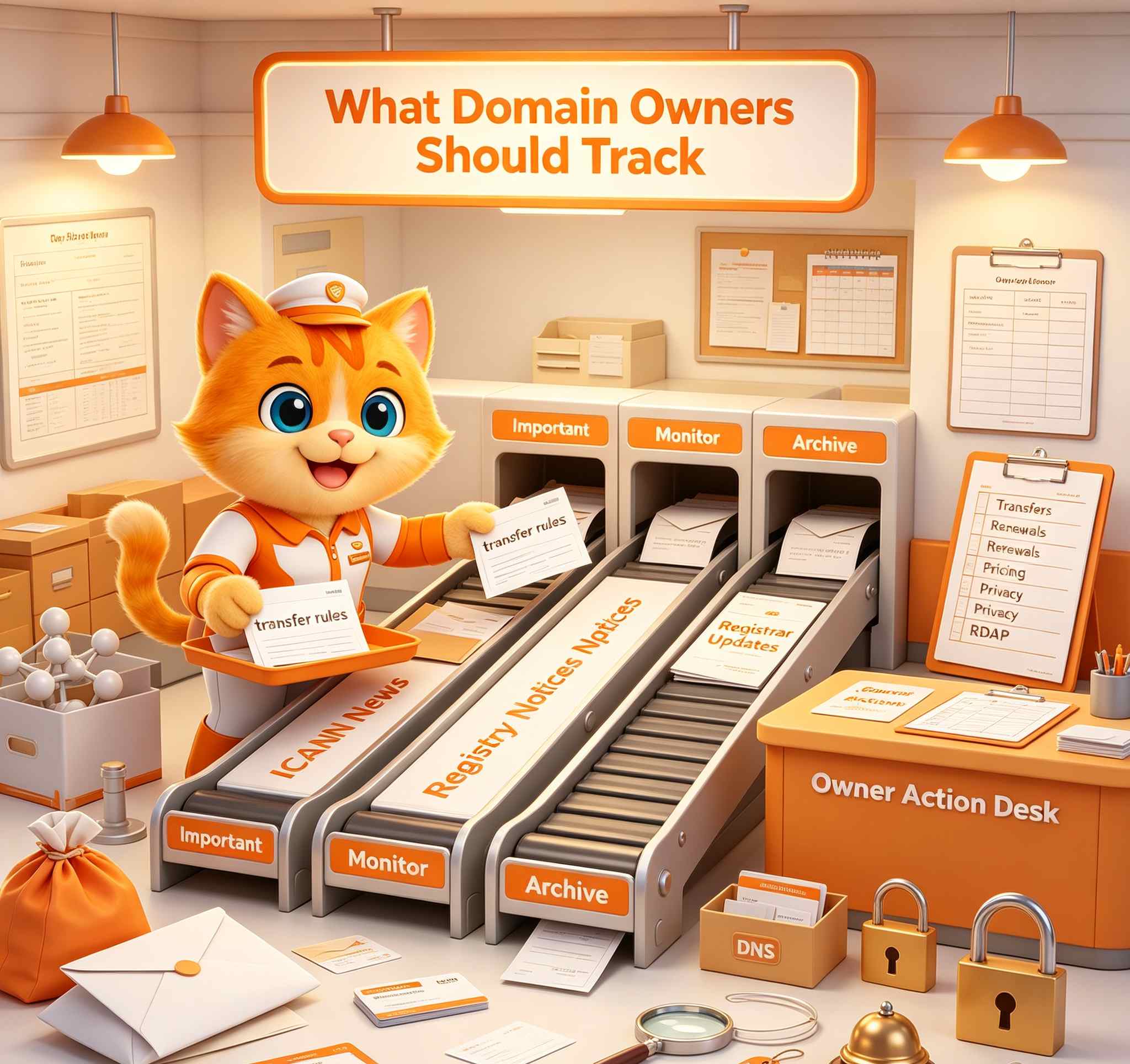
But some of these updates can affect real domain management.
A policy change may decide whether a domain can transfer, whether contact data is shown publicly, whether a TLD requires extra documents, whether renewal prices change, or whether a domain on hold can resolve normally.
Most domain owners do not need to read every industry update. But they should know which news matters and which news can be safely ignored.
A domain name is not just an address.
It can support your website, email, brand, customer access, online store, product launch, or client project.
That is why domain-related policy changes can become practical very quickly.
For example:
- A transfer rule may delay a registrar move.
- A registry price change may increase renewal cost.
- A TLD eligibility update may require documents.
- RDAP changes may affect public lookup results.
- A privacy rule may change what data is visible.
- A hold policy may affect website and email resolution.
- A lifecycle rule may affect domain recovery after expiration.
1. ICANN Transfer Policy Updates
Transfer policy updates matter when you move a domain from one registrar to another.
Watch for changes related to:
- Transfer lock rules
- AuthInfo / EPP code requirements
- Transfer approval process
- Reasons a transfer can be denied
- Domain holder notices
- Dispute handling
- Transfer timing
For domain owners, this means you should check transfer eligibility before starting a transfer.
For resellers, it means customer instructions, API logic, WHMCS workflows, and transfer failure messages may need updates when rules change.
2. Registry Rule Changes
A registry operates a domain extension.
Registry rule changes may affect:
- Who can register the domain
- What documents are required
- Whether local presence is needed
- Whether privacy is available
- Whether a transfer is allowed
- Whether certain names are reserved
- Whether a domain can be restored after expiration
Do not assume every extension works like .com.
Before registering, transferring, or renewing an important domain, check whether the TLD has special rules.
3. Registrar Notices
Registrar notices are often more practical than long policy documents.
A registrar notice may tell you:
- A price will change
- A renewal deadline is approaching
- A domain requires verification
- A transfer failed
- A domain is locked or on hold
- Contact data must be updated
- Payment or account action is required
But also be careful with phishing. If a notice looks suspicious, do not click links directly. Log in through the official registrar website and check your account.
4. RDAP and Registration Data
RDAP is the modern way to access domain registration data.
It may show the registrar, expiration date, status codes, nameservers, and public or redacted contact data.
ICANN announced that RDAP became the definitive source for delivering gTLD registration information in place of sunsetted WHOIS services on January 28, 2025.
Domain owners should track RDAP-related updates because they can affect:
- Public lookup results
- Privacy display
- Transfer checks
- Abuse contact lookup
- Registrar identification
- Domain status review
5. Renewal and Premium Pricing
Price updates matter because renewal cost is part of domain ownership.
Watch for changes in:
- Standard renewal prices
- Transfer prices
- Restore fees
- Premium registration prices
- Premium renewal fees
- Bulk or reseller pricing
- TLD-wide price increases
- Do not only check the first-year registration price.
For agencies, investors, and resellers, price changes may affect customer quotes, renewal reminders, pricing tables, API settings, and WHMCS billing.
6. TLD Eligibility and Verification Rules
Some TLDs have special registration rules.
A registry may require:
- Local address
- Company documents
- Trademark proof
- Identity verification
- Business relationship with a country or region
- Specific registrant contact details
This matters for businesses, agencies, and resellers managing domains across many countries.
Before promising a domain to a client, check whether the TLD has special eligibility requirements.
7. Domain Lifecycle and Recovery Rules
Domain lifecycle rules decide what happens after a domain expires.
Watch for updates related to:
- Expiration grace period
- Redemption period
- Restore fee
- Pending delete timing
- Transfer near expiration
- Auto-renewal behavior
8. DNS, Nameserver, and DNSSEC Rules
Some registry or registrar updates may affect DNS and nameserver management.
Watch for changes related to:
- Nameserver requirements
- Glue records
- DNSSEC support
- DNSSEC validation
- Required technical checks
- Nameserver update restrictions
If website or email stops working, check domain status before assuming the DNS records are wrong.
9. Abuse Handling and Domain Holds
Abuse policy updates can affect how registrars and registries respond to reports.
A domain may be placed on hold because of:
- Abuse report
- Phishing or malware complaint
- Spam report
- Verification issue
- Compliance review
- Registry-level restriction
- Legal or dispute issue
What Agencies, Resellers, and Investors Should Track
Agencies, resellers, and domain investors should monitor more than single-domain owners.
They should track:
- TLD pricing updates
- Transfer rule changes
- API and WHMCS workflow impact
- Bulk renewal deadlines
- Customer verification requirements
- Privacy and RDAP display changes
- Abuse and hold procedures
- Premium renewal costs
- Client ownership records
What Domain Owners Can Ignore
Not every domain news item needs action.
You can usually ignore news that:
- Does not affect your TLDs
- Does not affect your registrar
- Does not affect your renewal price
- Does not affect your transfers
- Does not affect your privacy settings
- Does not affect your DNS or email
- Does not affect domains you own or manage
How NiceNIC Helps
NiceNIC helps users search, register, transfer, renew, secure, and manage domains from one account.
NiceNIC supports domain search, bulk search, domain registration, transfer, renewal, DNS management, WHOIS privacy where available, SSL certificates, Business Email, reseller tools, API v2, WHMCS-compatible workflows, flexible payment options where available, and global support.
NiceNIC cannot override ICANN or registry rules.
But NiceNIC can help users understand domain requirements, manage supported workflows, review transfer or renewal issues, and keep domain operations organized.
Domain news only matters when it affects real domain operations.
Track updates that may affect transfers, renewals, pricing, RDAP, privacy, eligibility, DNS, abuse handling, and domain holds.
2006 से ICANN मान्यता प्राप्त रजिस्ट्रार
आज ही अपना .COM डोमेन खरीदें और रजिस्टर करें
.COM डोमेन उपलब्धता जांचें, नया .COM डोमेन रजिस्टर करें, एक साथ कई नाम खोजें, या अपने मौजूदा .COM डोमेंस को NiceNIC में ट्रांसफर करें। व्यवसायों, डोमेन निवेशकों, एजेंसियों, होस्टिंग प्रदाताओं और रिसेलरों के लिए बनाया गया।
नवीनीकरण करें: $17.99
बाजार
$22.49 $14.99
पहला वर्ष
नवीनीकरण करें: $17.99
मूल
$14.99
0% off
नवीनीकरण करें: $17.99
सुपर
$14.99
0% off
नवीनीकरण करें: $16.99
VIP
$14.99
0% off
संबंधित समाचार:
पिछली खबरें:
Bulk Domain Registration Costs: Protect Margins and Avoid Renewal Waste
अगली खबरें: WHMCS Domain Registrar Integration: What Hosting Providers Should Check Before Connecting
अगली खबरें: WHMCS Domain Registrar Integration: What Hosting Providers Should Check Before Connecting


