


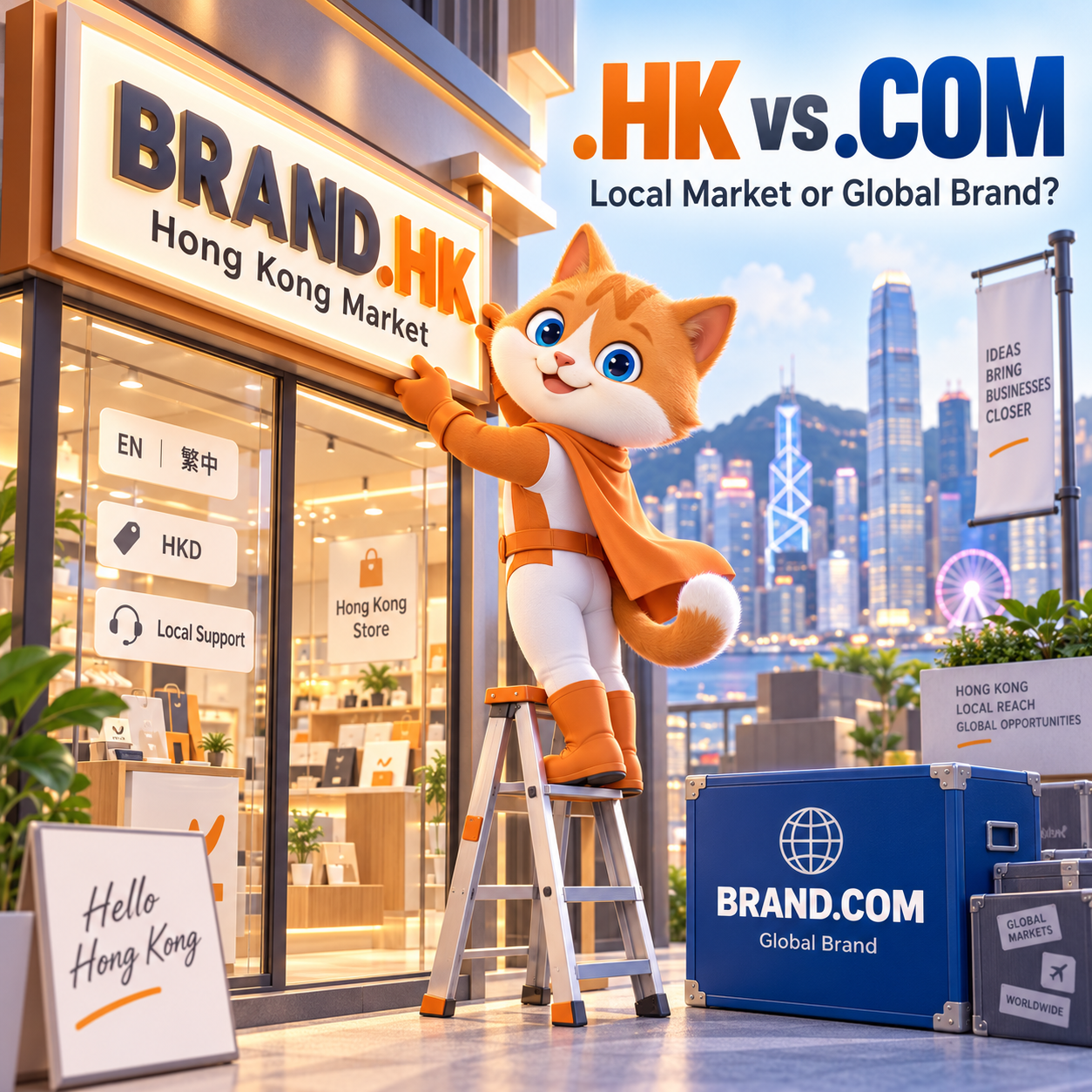
A global brand may want one permanent domain for every market.
A Hong Kong retailer, local service, fintech project, regional support site, or cross-border ecommerce business may want a domain that makes its Hong Kong focus clearer.
That makes .HK and .COM useful for different reasons.
Choose .COM when you want one broad primary domain that can represent the company across countries, products, languages, and future expansion.
Choose .HK when Hong Kong is a meaningful target market and you want the domain itself to communicate a Hong Kong-specific web presence.
For some organizations, the answer can be both:
brand.com → global company website
brand.hk → Hong Kong market website
shop.hk → Hong Kong-focused store
support.hk → Hong Kong customer resource
Before deciding, compare the actual names and long-term costs:
Check .COM Domain Availability
.HK vs .COM at a Glance
Choose .HK if: Hong Kong is a primary market and a country-specific domain supports the way you want to organize your local website.
Choose .COM if: you need one broad global domain that can represent the company across many markets.
.HK type: Country-code top-level domain, or ccTLD, for Hong Kong.
Who can register .HK: HKIRC currently allows local or overseas individuals and entities to register second-level .hk names, subject to applicable rules and availability.
Documents: HKIRC states that, except in special cases, no document is normally required to register a second-level .hk domain.
.HK is not the same as .COM.HK: .COM.HK is a separate Hong Kong domain category with different eligibility requirements.
SEO: A country-code domain can provide a strong geographic signal, but .HK does not guarantee higher Google rankings.
Pricing: Compare first-year, renewal, transfer, and any name-specific pricing before choosing a long-term domain.
What Is the Main Difference Between .HK and .COM?
The main difference is Hong Kong market positioning versus global brand flexibility.
.COM is generic.
A company using:
northstar.com
could serve customers in:
- Hong Kong
- Singapore
- the United States
- Germany
- Australia
- Japan
- multiple international markets
without the domain identifying one country or territory as the primary audience.
.HK is country-specific.
A domain such as:
northstar.hk
clearly connects the web address with Hong Kong.
That can be useful when the website itself is designed specifically for Hong Kong customers.
It may be less suitable as the only company domain when Hong Kong is just one of many equally important markets.
What Is a .HK Domain?
.HK is the country-code top-level domain for Hong Kong.
The .hk and .香港 namespaces are administered by the Hong Kong Internet Registration Corporation Limited, or HKIRC.
Unlike a generic extension such as .COM, .HK carries a geographic association.
That makes it relevant for projects such as:
- Hong Kong businesses
- Local ecommerce
- Restaurants
- Professional services
- Financial and fintech projects
- Logistics
- Trading businesses
- Agencies
- Tourism
- Hong Kong media
- Regional customer portals
- International brands entering Hong Kong
- Hong Kong support sites
For current eligibility information, see HKIRC Eligibility & Required Documents.
Who Can Register a .HK Domain?
This is an important distinction between .HK and some more restricted country-code domains.
HKIRC currently lists:
Local or overseas individuals or entities
as eligible applicants for second-level:
.hk
and:
.香港
HKIRC also states that, except for special cases, registration of a second-level .hk domain normally does not require documentary proof.
That means a company does not have to assume that it needs a Hong Kong-incorporated entity just to consider a standard second-level .HK domain.
However:
- The domain must be available.
- Registrant information must be accurate.
- Restricted names and registry policies still apply.
- Special circumstances may require additional information.
- Other Hong Kong domain categories can have different rules.
Always check the current registry requirements for the exact category you plan to register.
.HK Is Not the Same as .COM.HK
This is one of the most important practical points for buyers.
Compare:
example.hk
and:
example.com.hk
These are different domain names under different Hong Kong registration categories.
HKIRC currently states that:
.hk / .香港
can generally be registered by local or overseas individuals or entities.
By contrast:
.com.hk / .公司.香港
is intended for qualifying commercial entities registered in Hong Kong and normally requires appropriate documentation.
That means an international company considering:
brand.hk
should not automatically assume that the registration requirements are the same as:
brand.com.hk
For current category requirements, refer to HKIRC's official eligibility guide.
How Much Do .HK and .COM Cost?
At publication, NiceNIC currently shows:
.HK Market Account
- First year: $18.99
- Renewal: $29.99
.COM Market Account
- First year: $14.99
- Renewal: $17.99
At current Market pricing, .HK costs more than .COM both for the first registration term and renewal.
The pricing difference should therefore be considered alongside the strategic value of having a Hong Kong-specific domain.
A global business should not register .HK simply because it is available.
Ask whether the Hong Kong-specific domain has a clear role.
Account level, registry pricing, promotions, transfer pricing, and other terms can change.
Always confirm the current domain registration and renewal prices before ordering.
When Should You Choose .COM?
Choose .COM when:
- You are building the main global company website.
- Hong Kong is one market among many.
- You want one domain for all countries.
- Your company may expand internationally.
- Your brand needs to remain geographically neutral.
- You prefer managing regional content under one main website.
- You expect the domain to represent the company for many years.
-
A suitable
.COMis available.
Imagine a company operating in:
Hong Kong
Singapore
Australia
Europe
and North America.
It may choose:
brand.com
as the main corporate domain.
Hong Kong content can then live under a structure such as:
brand.com/hk/
or another carefully planned regional URL architecture.
That keeps the global identity centralized.
If this matches your strategy, check whether your preferred .COM domain is available.
When Does .HK Make More Sense?
.HK becomes more relevant when Hong Kong is genuinely central to the project.
Strong use cases can include:
- Hong Kong companies
- Local retail
- Hong Kong ecommerce
- Restaurants and hospitality
- Local professional services
- Hong Kong property-related services
- Logistics
- Trading
- Financial services
- Fintech
- Recruitment
- Local media
- Tourism
- Hong Kong events
- International companies launching a dedicated Hong Kong site
For example:
brand.hk
can work as a Hong Kong-specific destination even when:
brand.com
remains the global company website.
If a Hong Kong-specific identity has a clear role in your business, check whether your preferred .HK domain is available.
.HK vs .COM for a Hong Kong-Only Business
Consider a business whose customers, operations, and services are concentrated almost entirely in Hong Kong.
Examples might include:
- Local repair services
- Restaurants
- Tutors
- Professional practices
- Local retailers
- Property services
- Events
- Community businesses
For that type of business:
.HK
may provide a natural geographic identity.
A .COM can still work.
The question is whether a Hong Kong-specific domain improves clarity for the intended audience.
If the business plans to remain local, .HK may fit the long-term brand.
If international expansion is likely, the business should also consider how the domain strategy will scale.
.HK vs .COM for a Global Company
A global business has a different decision.
Suppose:
brand.com
already represents the company worldwide.
There is usually no need to replace that domain simply because the company enters Hong Kong.
Instead, the company could consider:
brand.com → global parent site
and:
brand.hk → Hong Kong site
This can be useful when the Hong Kong operation needs:
- Local pricing
- Hong Kong-specific products
- Local customer support
- Different promotions
- Local contact details
- Local shipping information
- Hong Kong-specific legal information
- Local-language content
The important point is that each domain should have a clear purpose.
Does .HK Help With Google Search in Hong Kong?
A .HK domain can provide a strong geographic signal because it is a country-code domain associated with Hong Kong.
Google’s international-site guidance identifies country-code top-level domains as one of the clearest signals that a site is intended for a particular country or market.
That does not mean:
.HK = automatic higher rankings
Search visibility still depends on factors such as:
- Relevant content
- Search intent
- Technical crawlability
- Website quality
- Internal linking
- Relevant external links
- Page performance
- Local relevance
- User experience
Think of .HK as a geographic signal, not an SEO shortcut.
For Google's current guidance, see Google Search Central: Managing Multi-Regional and Multilingual Sites.
Does .COM Have an SEO Disadvantage in Hong Kong?
Not automatically.
A .COM website can rank for Hong Kong searches.
Many international businesses successfully serve country-specific audiences from generic domains.
Google recommends using additional signals when a generic domain serves different markets.
Those can include:
- Locale-specific URLs
-
hreflang - Local content
- Local contact information
- Appropriate internal linking
- Clear regional navigation
For example:
brand.com/hk/
can be a valid structure for a Hong Kong version of a global site.
A company does not need a .HK domain solely for SEO.
The domain architecture should fit the business.
.HK vs .COM/hk/: Which Structure Is Better?
This is a more useful question than simply asking which extension is “better.”
Two common structures are:
brand.hk
and:
brand.com/hk/
A separate .HK domain can make sense when:
- Hong Kong operates as a distinct market.
- Local teams manage the site.
- Products or pricing differ significantly.
- Local legal information differs.
- Hong Kong branding is important.
- The regional site needs operational independence.
A .COM subdirectory can make sense when:
- One team manages the global site.
- Most content is shared.
- The company wants one central domain.
- Regional differences are limited.
- International SEO and analytics are managed centrally.
There is no universal winner.
Choose based on the organization, not only the extension.
Hong Kong Is Not the Same as "All Chinese-Language Users"
This distinction matters.
.HK communicates a Hong Kong connection.
It should not be treated as a generic domain for every Chinese-speaking market.
Chinese-speaking audiences can be found in:
- Hong Kong
- Mainland China
- Taiwan
- Singapore
- Malaysia
- other regions
Their:
- Domain expectations
- Language usage
- Regulations
- Search behavior
- payment methods
- commerce rules
can differ.
Use .HK when Hong Kong is the actual market focus.
Do not assume that a .HK website automatically represents all Chinese-language audiences.
.HK Is Not the Same as .CN
.HK and .CN are separate country-code namespaces.
.HK is associated with Hong Kong.
.CN is China’s country-code top-level domain.
They have different:
- Registries
- Registration rules
- Market positioning
- Operational requirements
A company serving both markets may decide to maintain:
brand.hk
and:
brand.cn
or use another international architecture.
The correct choice depends on where the business actually operates.
English or Traditional Chinese: What Should a .HK Site Use?
There is no rule that a .HK website must use only one language.
Hong Kong-facing websites may use:
- English
- Traditional Chinese
- Both languages
depending on the audience.
A bilingual structure could use clear language URLs such as:
brand.hk/en/
and:
brand.hk/zh-hk/
when appropriate.
For multilingual websites, consider:
- Explicit language navigation
-
Correct
hreflang - Consistent canonical tags
- Localized page titles
- Localized metadata
- User-friendly language switching
Avoid automatically redirecting every visitor solely based on IP location.
Google recommends explicit regional and language signals rather than relying only on location detection.
Can You Use .HK for Cross-Border Ecommerce?
Yes, when Hong Kong is a meaningful part of the ecommerce strategy.
A global retailer might use:
brand.com → global store
brand.hk → Hong Kong storefront
A Hong Kong-specific store may need to communicate:
- HKD pricing
- Delivery areas
- Shipping costs
- Return terms
- Local contact options
- Payment methods
- Stock availability
- Product restrictions
- Tax or customs information where relevant
The .HK extension can communicate market focus.
It does not automatically localize the store.
The actual customer experience still needs to be designed for Hong Kong buyers.
Does .HK Automatically Increase Customer Trust?
That should not be assumed.
A Hong Kong-specific domain may help users understand which market the site serves.
Actual trust depends on the business.
Useful signals can include:
- Clear company identity
- Accurate contact details
- HTTPS
- Transparent pricing
- Customer support
- Return policies
- Privacy information
- Accurate product information
- Appropriate business information where relevant
The domain provides geographic context.
The company earns trust through its operation.
Does .HK Prove the Company Is Registered in Hong Kong?
No.
This is particularly important because second-level .HK registrations are currently available to both local and overseas applicants.
A website ending in:
.hk
does not by itself prove that the registrant is:
- A Hong Kong incorporated company
- A Hong Kong resident
- Licensed by a Hong Kong authority
- Regulated in Hong Kong
- Physically located in Hong Kong
If company registration or regulatory status matters, users should verify that information separately.
The domain provides a Hong Kong association.
It is not a corporate-registration certificate.
What About .COM.HK?
.COM.HK serves a different purpose.
HKIRC currently lists .com.hk as a category for commercial entities registered in Hong Kong, with documentary requirements.
That makes:
brand.hk
and:
brand.com.hk
different both technically and in eligibility.
A company should not choose between them based only on which looks shorter.
Consider:
- Applicant eligibility
- Required documents
- Brand structure
- Existing domain portfolio
- Customer expectations
- Long-term management
If you specifically need .COM.HK, review the current HKIRC requirements before registering.
What About .香港?
HKIRC also operates the Chinese internationalized domain namespace:
.香港
This can be relevant for brands that want a Chinese-script Hong Kong domain identity.
A .香港 strategy should be evaluated separately from .HK based on:
- Brand name
- Character support
- Audience
- Language
- Availability
- Technical configuration
- Long-term use
Do not assume that registering .HK automatically guarantees ownership of every corresponding Chinese-script name.
Check current availability and applicable registration conditions separately.
Should a Global Brand Own Both .COM and .HK?
Sometimes.
A company might use:
brand.com → global website
brand.hk → Hong Kong website
Another option is:
brand.com → primary website
brand.hk → redirect to Hong Kong content
Owning both can also be useful when:
- Hong Kong is commercially important.
-
The matching
.HKis strategically relevant. - Brand confusion is a concern.
- A Hong Kong site may be launched later.
But defensive registration has a cost.
Register domains that have a clear business or brand-protection purpose rather than collecting extensions without a management plan.
Avoid Publishing Duplicate .COM and .HK Sites
If:
brand.com/hk/
and:
brand.hk
contain substantially the same content, search engines need clear signals about which version should be indexed and shown.
Depending on the site architecture, consider:
- Canonical tags
-
hreflang - Redirect strategy
- Internal linking
- Sitemap configuration
Do not simply clone a global .COM site onto .HK and forget about it.
A Hong Kong-specific site should ideally have a clear regional purpose.
Think About Email Before Choosing
A .HK domain can also become part of the customer-facing email identity.
For example:
Both structures can work.
A separate .HK email identity can be useful when Hong Kong has its own:
- Sales team
- Customer support
- Ecommerce operation
- Regional office
A global company may prefer keeping email under .COM for consistency.
Choose one structure and communicate it clearly to customers.
Does .HK Improve Email Deliverability?
The extension itself does not create an email-deliverability advantage.
Email delivery can depend on factors such as:
- SPF
- DKIM
- DMARC
- Sending reputation
- Message quality
- IP reputation
- Recipient engagement
Using .HK does not automatically improve deliverability.
Using .COM does not guarantee it either.
Configure the sending domain correctly.
.HK vs .COM for Brand Protection
For a brand with meaningful Hong Kong business, the matching .HK may be worth reviewing even if .COM remains the primary domain.
Possible reasons include:
- Future Hong Kong launch
- Customer confusion prevention
- Regional campaigns
- Local support
- Ecommerce
- Defensive registration
Before registering, also review:
- Existing trademarks
- Company names
-
Matching
.COM -
Similar
.HKnames -
Relevant
.COM.HKregistrations - Potential customer confusion
Domain availability does not automatically create trademark rights.
First-Year Price vs Long-Term Cost
At publication, NiceNIC currently shows:
.HK: $18.99 first year, $29.99 renewal
.COM: $14.99 first year, $17.99 renewal
In this case, .HK is currently more expensive at both stages.
That means the decision should be driven by market strategy rather than a low introductory price.
Before registering, compare:
- First-year registration
- Renewal price
- Transfer price
- Expected ownership period
- Number of regional domains being maintained
- Operational value of the Hong Kong site
Review the latest figures on the NiceNIC Domain Prices page before ordering.
For a Permanent Hong Kong Site, Think Beyond the Domain Price
The registration fee is only one part of a regional website.
A dedicated .HK site may also require:
- Localized content
- Translation
- Regional SEO
- Customer support
- Hong Kong pricing
- Local policies
- Ecommerce operations
- Analytics
- Ongoing technical maintenance
If the business is not prepared to maintain a meaningful Hong Kong-specific experience, creating another regional domain may add complexity without enough benefit.
A good domain strategy should reflect the operating model.
Should You Register .HK If the .COM Is Taken?
Not automatically.
Before registering:
brand.hk
when:
brand.com
is owned by someone else, check:
-
Who operates the
.COM - Whether they use the same brand
- Relevant trademarks
- Similar products or services
- Potential customer confusion
- Whether your own business genuinely targets Hong Kong
An available .HK name may still create brand problems if the matching name belongs to an established business in the same sector.
Availability is only the first check.
.HK or .COM: Which Should You Choose?
Choose .COM if:
- You are building the permanent global company website.
- Hong Kong is one of several markets.
- You want one domain across countries.
- Your business may expand internationally.
- You prefer centralized website management.
-
A suitable matching
.COMis available. - Lower current renewal cost matters.
Choose .HK if:
- Hong Kong is a primary or strategically important market.
- You need a dedicated Hong Kong website.
- Local products, pricing, support, or policies differ from the global site.
- A Hong Kong-specific domain fits the brand architecture.
- You understand the ccTLD's geographic positioning.
- You have checked current registration requirements and pricing.
- You are prepared to maintain the local site over time.
Consider both when:
.COM will represent the global company
and
.HK will represent the Hong Kong market.
Final Verdict
.COM remains the more flexible option when a company needs one domain to represent its entire global business.
.HK has a more specific purpose.
It works best when Hong Kong is a real market, not simply a branding decoration.
Its strongest value comes from geographic clarity.
A suitable .HK domain can make it clear that a website, store, service, or regional operation is intended for Hong Kong.
It does not automatically prove:
- Hong Kong incorporation
- Regulatory approval
- Local ownership
- Customer trust
- Higher Google rankings
- Better email delivery
- Greater conversion rates
Those outcomes depend on the company, content, infrastructure, market strategy, and customer experience.
Before choosing, ask five questions:
Is Hong Kong a primary market or only one of many?
Does the business need a genuinely separate Hong Kong site?
Would .HK or a .COM regional directory be easier to maintain?
Are .HK and .COM.HK requirements being correctly distinguished?
Does the long-term cost and operational workload fit the market opportunity?
Then choose the domain architecture that best matches the business, audience, international SEO strategy, and expected lifetime of the project.
How to Register a .HK or .COM Domain at NiceNIC
Step 1: Search the Exact Name
Compare your preferred company, store, service, or Hong Kong market name under .HK, .COM, or both.
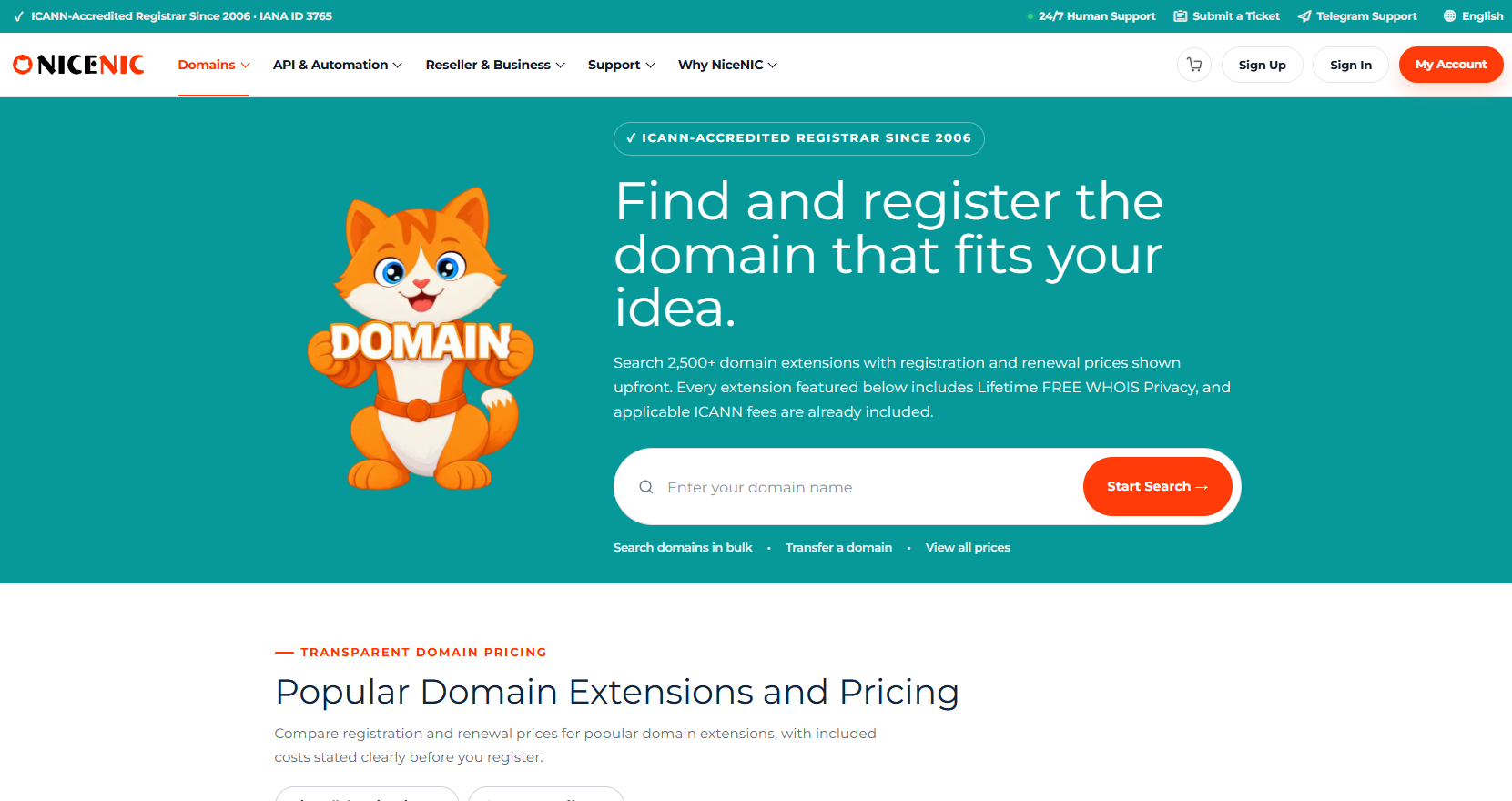
Step 2: Check Eligibility and Long-Term Costs
For .HK, review the relevant domain category and current registry requirements.
Check HKIRC .HK Eligibility Requirements
Then compare:
- Registration price
- Renewal price
- Regional website costs
- Domain portfolio needs
- Long-term market strategy
Check the latest NiceNIC Domain Prices before ordering.
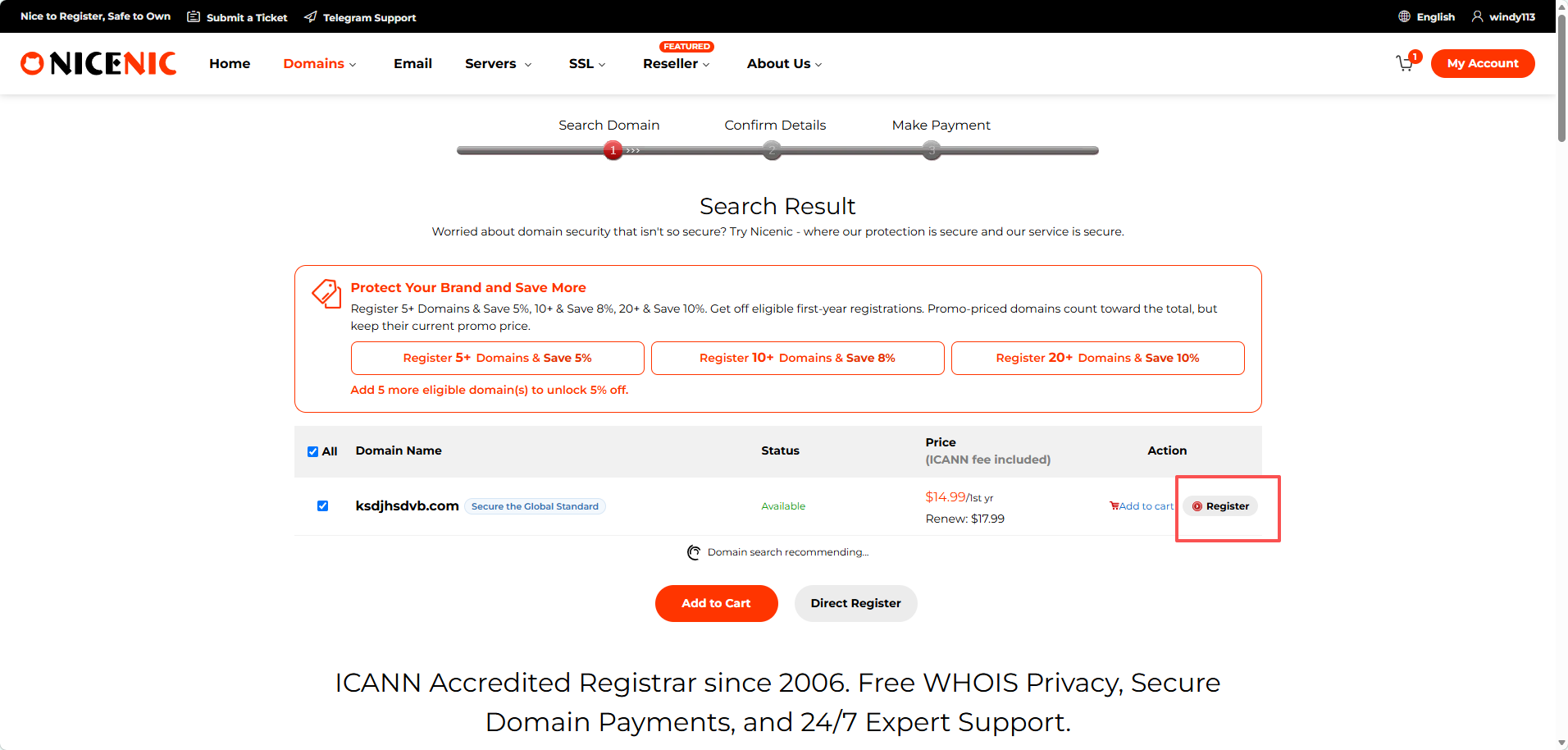
Step 3: Complete Registration
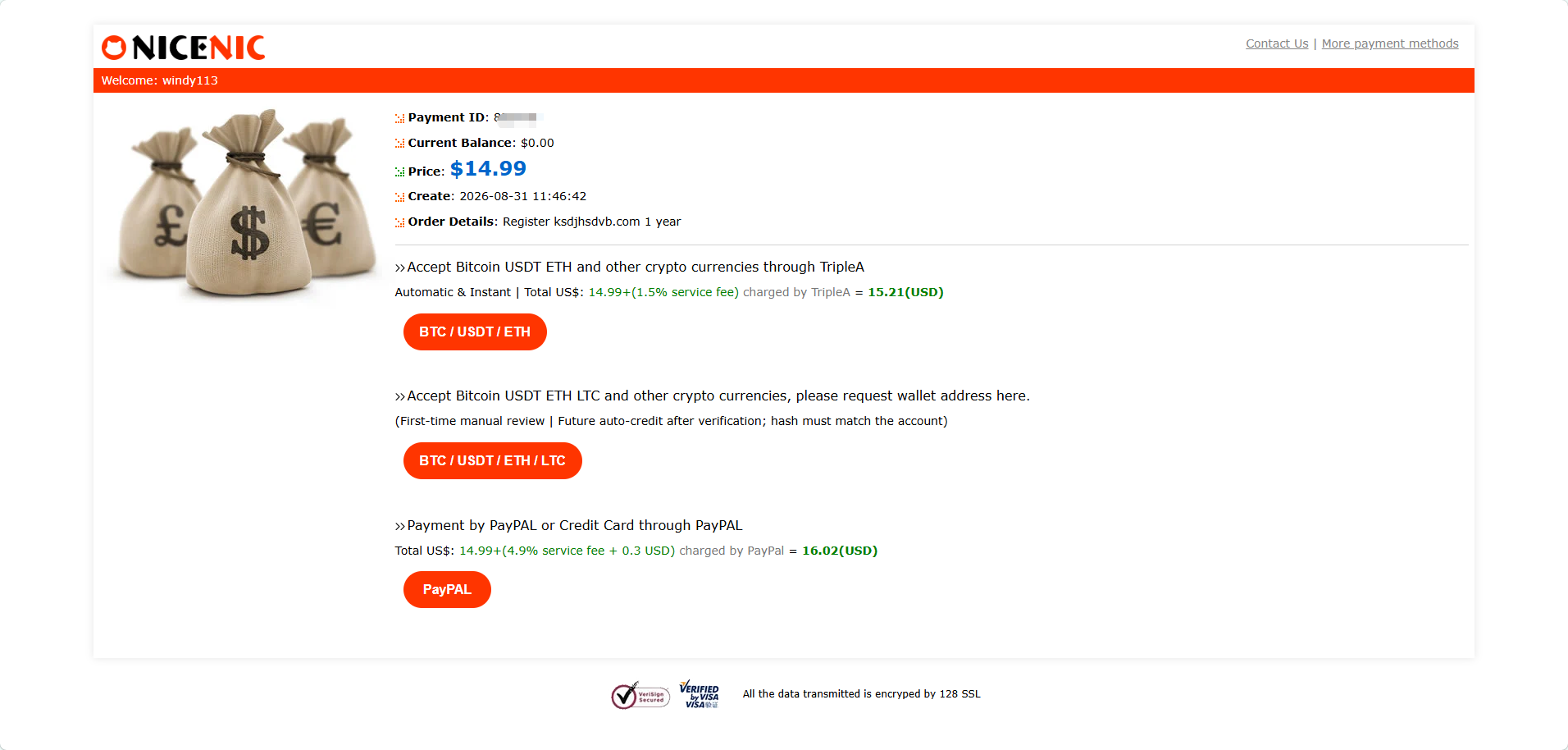
Add the selected domain to your order, confirm the registrant information, choose an available payment method, and complete payment.
After registration, the domain can be managed from your NiceNIC account.
Check Your Name in .HK and .COM
Ready to compare the actual name you want?
Checking multiple Hong Kong brand or client names? Use NiceNIC Bulk Domain Search.
Managing domains for customers or integrating domain services into your platform? Explore the NiceNIC Domain API.
Already own the domain elsewhere? Start with NiceNIC Domain Transfer.


