


It is an architecture decision.
The questions that become important in production are usually:
- Can developers test without touching live domains?
- What is required before production API access is enabled?
- Does WHMCS integrate cleanly?
- How are authentication and IP controls handled?
- Can the API manage DNS and domain lifecycle operations?
- What happens when an order is pending rather than immediately successful?
- Can compliance issues be surfaced programmatically?
- Is the integration designed only for humans, or can modern automation and AI-agent workflows use it safely?
This engineering breakdown compares Enom, ResellerClub, Namecheap, Porkbun, and NiceNIC across those practical dimensions.
The goal is not to declare one universal winner.
It is to understand which architecture fits your stack.
Quick Comparison
Authorization header; IP restrictions where configured
The table highlights an important point:
The providers are not optimizing for exactly the same customer.
Porkbun’s current developer stack, for example, is considerably more modern than the stereotype of a retail-only registrar: its current API includes a Sandbox, OpenAPI specification, signed webhooks, scoped keys, spend controls, and first-party MCP support.
Likewise, Enom and ResellerClub remain relevant because WHMCS already provides mature registrar integrations for both.
The useful comparison is therefore not “old vs. new.”
It is:
Which workflow are you actually building?
1. API Access: Can You Test Before Making a Commercial Commitment?
This is one of the first architectural differences developers notice.
Enom
Enom’s API is available to reseller accounts.
Its separate API test account provides an isolated environment where developers can test calls without modifying live domains or consuming live account balance.
Production API calls also require server IP allowlisting.
Enom’s commercial pricing uses multiple reseller tiers, while its entry-level tier does not require the same annual domain volume as its higher discount tiers.
This can work well when your business is already built around the Enom reseller model.
ResellerClub
ResellerClub currently provides both live and Sandbox REST API environments.
Its developer portal supports the normal domain lifecycle:
- Availability
- Customer and contact creation
- Registration
- Renewal
- Transfers
- Nameservers
- DNSSEC
- Privacy
- Locks
- Premium domains
WHMCS also ships with a ResellerClub registrar module supporting a broad set of domain-management functions.
This makes ResellerClub a reasonable fit when your provisioning architecture already depends on its reseller ecosystem.
Namecheap
Namecheap separates Sandbox testing from production API eligibility.
Its current production API requires an account to meet at least one of these conditions:
- 20 domains in the account
- $50 account balance
- $50 spent during the previous two years
The Sandbox can be used separately for testing.
Namecheap also provides a WHMCS registrar integration, making it a practical choice for businesses whose TLD requirements and commercial workflow already fit the Namecheap ecosystem.
Porkbun
Porkbun’s current API is more developer-focused than many engineers may remember from earlier versions.
Its current API includes:
- REST/JSON endpoints
- Domain registration and management
- DNS and DNSSEC
- OpenAPI documentation
- Signed webhooks
- Idempotency support
- Scoped API permissions
- Spend controls
- Free Sandbox keys
- First-party MCP support
For teams building a modern custom application rather than centering their infrastructure around WHMCS, those capabilities are significant.
NiceNIC
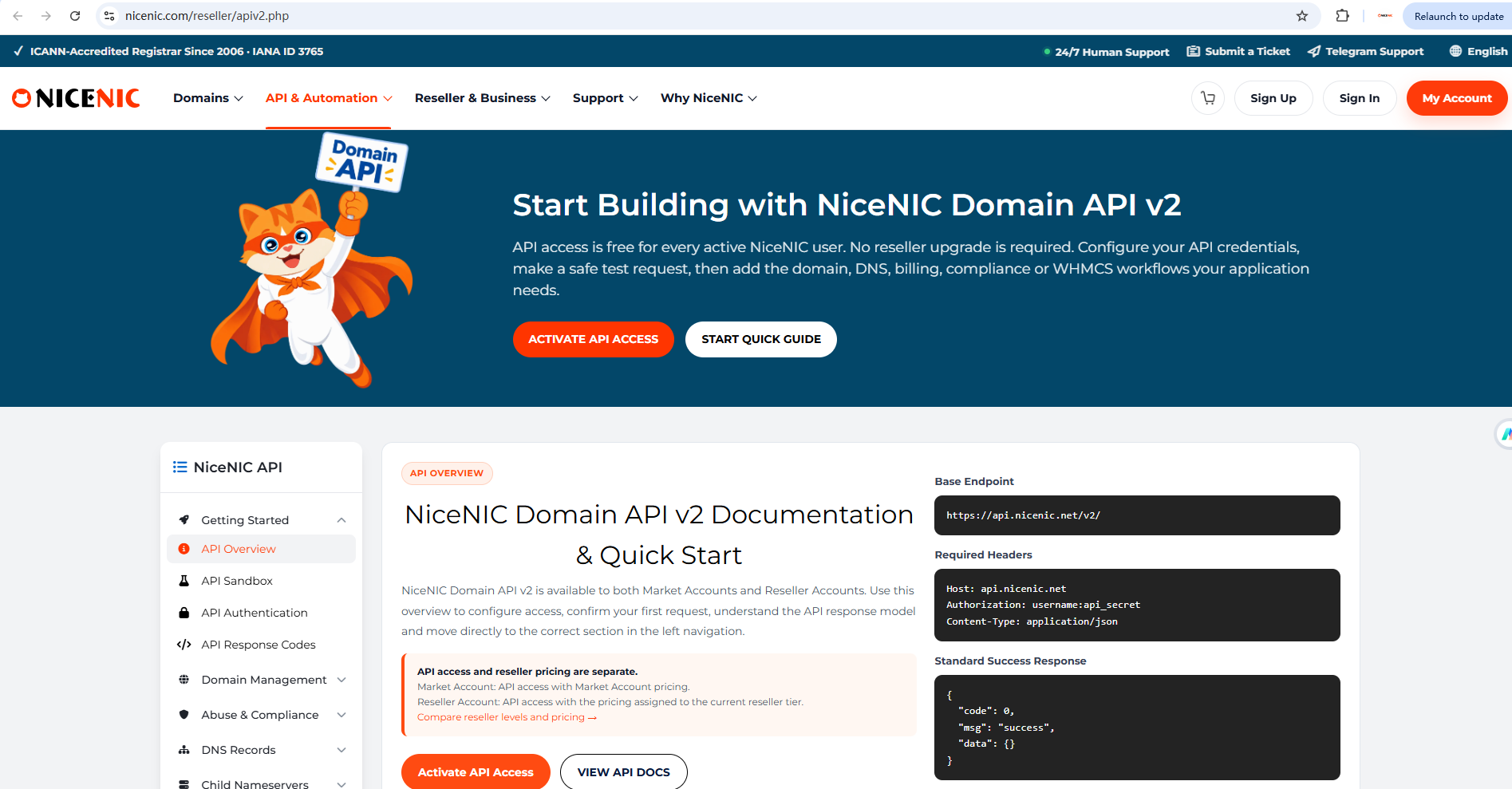
NiceNIC separates API access from reseller pricing.
Any active NiceNIC Market or Reseller Account can use the NiceNIC Domain API.
You do not need to upgrade to a paid reseller tier simply to access or test the API.
A Market Account uses Market Account pricing. A Reseller Account uses the pricing assigned to its current reseller level.
Developers can test separately in the NiceNIC API Sandbox before enabling live customer operations.
That distinction can matter for a SaaS team that wants to validate integration quality before deciding whether reseller pricing makes commercial sense.
2. Sandbox vs. WHMCS Test Mode: Do Not Treat Them as the Same Thing
This is an easy integration mistake.
A registrar’s API Sandbox is an isolated API environment.
A WHMCS Test Mode setting belongs to the registrar module and may behave differently depending on the installed package.
They are not automatically interchangeable.
For NiceNIC, the API Sandbox is designed for direct API development and allows teams to validate:
- Authentication
- Request formatting
- Response parsing
- Error handling
- Application workflows
without creating real registry orders or deducting real account balance.
NiceNIC’s current WHMCS documentation explicitly recommends confirming the module-specific test behavior rather than assuming WHMCS Test Mode points at the API Sandbox.
That distinction is worth checking with any registrar integration.
3. A Real NiceNIC API Request
A technical comparison is only useful if the examples match the actual API.
NiceNIC’s current production endpoint is:
https://api.nicenic.net/v2/
Authentication uses the HTTP Authorization header:
Authorization: username:api_secret
A read-only domain availability request looks like this:
curl “https://api.nicenic.net/v2/?category=domain&action=check&domains=example.com,example.net”
-H “Authorization: username:api_secret”
-H “Content-Type: application/json”
A standard successful response follows this structure:
{
“code”: 0,
“msg”: “success”,
“data”: {
“example.com”: “available”
}
}
NiceNIC recommends starting with read-only operations such as availability, pricing, balance, or domain listing before enabling paid production requests.
The current API also documents operations for:
- Registration
- Renewal
- Transfer in
- Nameservers
- Contacts
- Pricing
- DNS records
- Child nameservers
- Account balance
- Abuse and compliance monitoring
See the current NiceNIC Domain API documentation for operation-specific request parameters.
4. WHMCS: Built-In Modules vs. Registrar-Maintained Modules
WHMCS remains a major integration layer for hosting companies because it combines:
- Customer billing
- Domain orders
- Hosting products
- Renewal workflows
- Automation
- Support operations
Enom, ResellerClub, and Namecheap are available through established WHMCS registrar integrations.
NiceNIC takes a slightly different route by publishing and maintaining its own WHMCS Registrar Module.
NiceNIC currently advertises support for the WHMCS 9.0 release line.
The documented module functions include:
- Availability checks
- Registration
- Renewal
- Transfer
- Domain information
- Nameserver management
- Contact management
- Registrar lock / unlock
- Auth / EPP code retrieval
One important implementation detail:
A customer payment in WHMCS and a completed registrar operation are separate events.
If a registrar operation returns a pending state or times out, do not immediately repeat a paid action.
First verify the actual registrar-side result.
That rule applies beyond NiceNIC—it is a useful guardrail for any automated registrar integration.
5. TLD Breadth Is an Architectural Constraint, Not Just a Marketing Number
A five-domain personal project rarely cares about catalog breadth.
An international SaaS or hosting business often does.
If customers request:
-
.com -
.ai -
.io - country-code domains
- second-level country domains
- region-specific namespaces
then every missing TLD can become another upstream integration.
NiceNIC currently publishes support for more than 2,500 domain extensions through one account, with individual availability and eligibility still subject to registry rules.
For international hosting providers, that can reduce the need to maintain several registrar integrations solely to fill regional TLD gaps.
But catalog size alone is not enough.
Before selecting an upstream registrar, test the actual TLDs your customers buy and verify:
- Registration terms
- Renewal terms
- Contact requirements
- Transfer behavior
- Premium-domain handling
- Privacy eligibility
A smaller provider that supports your exact TLD mix cleanly can still be a better architectural choice.
6. Funding Architecture Matters More Once Automation Becomes Real
API integration eventually becomes a treasury problem.
Your automation can be perfect, but a paid registration still fails if the registrar-side account cannot fund it.
Different providers solve this differently.
NiceNIC currently supports account funding through traditional and cryptocurrency payment routes, including stablecoins and other supported digital assets.
For Online Crypto funding, NiceNIC currently adds a 0% NiceNIC processing fee, while the online provider currently charges a 1.5% service fee. Wallet, exchange, or blockchain costs may also apply.
The more important engineering question is not:
"Does the registrar accept crypto?"
It is:
"Can our production system reliably monitor available balance and avoid sending paid orders when funding is insufficient?"
NiceNIC’s Domain API includes account-balance functionality for that purpose.
For international teams, the broader payment choice can be useful—but funding flexibility should be treated as an operational feature, not a substitute for balance monitoring.
Review NiceNIC Payment Options
7. A Less Common API Feature: Compliance Telemetry
Most registrar integrations focus on the happy path:
Register → Renew → Transfer → DNS
Production systems also need to handle the unhappy path.
A compromised customer website can trigger:
- Abuse complaints
- Malware reports
- Phishing reports
- Pending registrar restrictions
- Registry holds
NiceNIC exposes domain-level abuse status through the documented get_abuse_report endpoint.
A request uses the same production API structure:
curl “https://api.nicenic.net/v2/?category=abuse&action=get_abuse_report&domain=example.com”
-H “Authorization: username:api_secret”
-H “Content-Type: application/json”
A shortened example based on the documented response model:
{
“code”: 0,
“msg”: “success”,
“data”: {
“domain”: “example.com”,
“scenario”: {
“status”: “Pending ClientHold”,
“impact”: “At risk of restriction”,
“action”: “Submit supporting materials now”
},
“hold”: {
“state”: “pending”
},
“complaint”: {
“case_count”: 3,
“categories”: [
“Phishing”,
“Malware”
],
“is_dns_abuse”: true,
“has_evidence”: true
}
}
}
The API can expose information such as:
- Current operational status
- Hold lifecycle state
- Complaint count
- Abuse categories
- DNS-abuse classification
- Evidence state
- Recommended action
It does not give an automated system authority to remove registrar or registry restrictions.
Human review and remediation still matter.
For a hosting provider managing customer domains, the value is visibility: the support team can surface compliance state inside its own dashboard rather than discovering a problem only after a customer reports that DNS has stopped resolving.
See the NiceNIC Abuse & Compliance API and Domain Abuse Transparency Center for the current model.
8. AI-Agent Access: MCP Is Becoming a Real Registrar Integration Surface
REST APIs are no longer the only automation interface worth evaluating.
Both Porkbun and NiceNIC now publish first-party MCP options for AI-agent workflows.
That matters because an engineer may want to ask an authorized assistant to:
- Check availability
- Compare pricing
- Inspect a portfolio
- Review nameservers
- Perform supported account or domain operations
without writing a new UI for every task.
NiceNIC currently exposes a remote MCP endpoint at:
https://mcp.nicenic.com/mcp
Current NiceNIC setup guidance covers authorized connections from ChatGPT and Claude.
The important security rule is the same as with any automation layer:
Start with read-only discovery and require explicit approval before write operations.
For direct application development, the Domain API still gives the engineering team the most explicit control over:
- Validation
- Scheduling
- Spending logic
- Retries
- Error handling
MCP is an additional interaction layer, not a replacement for good backend engineering.
9. So Which Registrar Architecture Fits Which Team?
There is no universal answer.
Enom may fit when:
- You already have an Enom reseller business
- Your provisioning stack is built around Enom
- WHMCS compatibility is important
- Migration cost outweighs the benefit of changing upstream providers
ResellerClub may fit when:
- You already operate in the ResellerClub / OrderBox ecosystem
- You rely heavily on its WHMCS integration
- Its 500+ TLD catalog covers your customer base
- You want an established reseller-oriented platform
Namecheap may fit when:
- Your domain mix is mainstream
- You already use the Namecheap ecosystem
- Its production API eligibility requirements are not a barrier
- WHMCS integration is more important than a highly customized registrar backend
Porkbun may fit when:
- You prioritize a modern API design
- OpenAPI and signed webhooks matter
- You are building agent-driven automation
- Scoped permissions and spend controls are important
- Your architecture is API-first rather than WHMCS-first
NiceNIC may fit when:
- Your business needs broad international TLD coverage
- You want to test the API before upgrading to reseller pricing
- WHMCS is part of your stack
- Stablecoin or multi-rail account funding matters
- You want domain lifecycle, DNS, child nameserver, account, and compliance operations in the same API ecosystem
The right decision should come from your own integration test—not from a comparison table alone.
10. A Practical Evaluation Checklist
Before moving production domain volume to any registrar, test these ten things:
- Authentication: Can your production backend authenticate without exposing credentials?
- Sandbox: Can you reproduce registration and failure cases safely?
- Availability: Can you batch the checks your storefront actually needs?
- Pricing: Can you retrieve or reliably reconcile account-level cost?
- TLD requirements: Can your app discover special registration fields before checkout?
- Pending states: Does your system handle asynchronous or pending results without duplicate orders?
- DNS: Can you automate the DNS or nameserver operations your customers expect?
- Balance: Can you detect insufficient funding before a paid order fails?
- Compliance: Can your support team detect registrar-side restrictions early?
- Migration cost: How difficult will it be to move away later if the provider no longer fits?
That test will tell you far more than a headline registration price.
Final Takeaway
A domain registrar is part of your production infrastructure.
The right choice depends on what your application needs to automate:
- WHMCS billing
- Custom API provisioning
- DNS management
- Country-code domains
- Portfolio monitoring
- Payment and balance operations
- Compliance visibility
- AI-agent workflows
Enom, ResellerClub, Namecheap, Porkbun, and NiceNIC each make different architectural trade-offs.
For NiceNIC, the most distinctive combination today is:
- API access for both Market and Reseller Accounts
- Dedicated Sandbox
- NiceNIC-maintained WHMCS integration
- More than 2,500 supported domain extensions
- Domain, DNS, child-nameserver, billing, and abuse/compliance APIs
- Multiple account-funding options
- Remote MCP access for supported AI clients
If you are evaluating NiceNIC specifically, start with a read-only API test rather than moving production volume immediately.


